
How Big Caring Group Plans Pharmacy Replenishment with AI
A Klang warehouse picks with more than 160 robots. The replenishment layer reads what each store sells, and people stay on the decision.
ButterflyCopilot
0105
Lim Sin Yin, executive director of Big Caring Group, described the shift in one sentence.
"We are no longer reacting to demand; we are predicting it and preparing for it in advance."
He was speaking at a distribution centre in Klang, unveiled on 9 April 2026 along with a new headquarters. The group behind it is a Malaysian pharmacy and healthcare retailer preparing to list on Bursa Malaysia's Main Market. For the year ended 30 June 2025 it reported revenue of RM3,412 million and profit after tax of RM143 million. Same-store sales grew 9.6%, from 7.3% the year before.
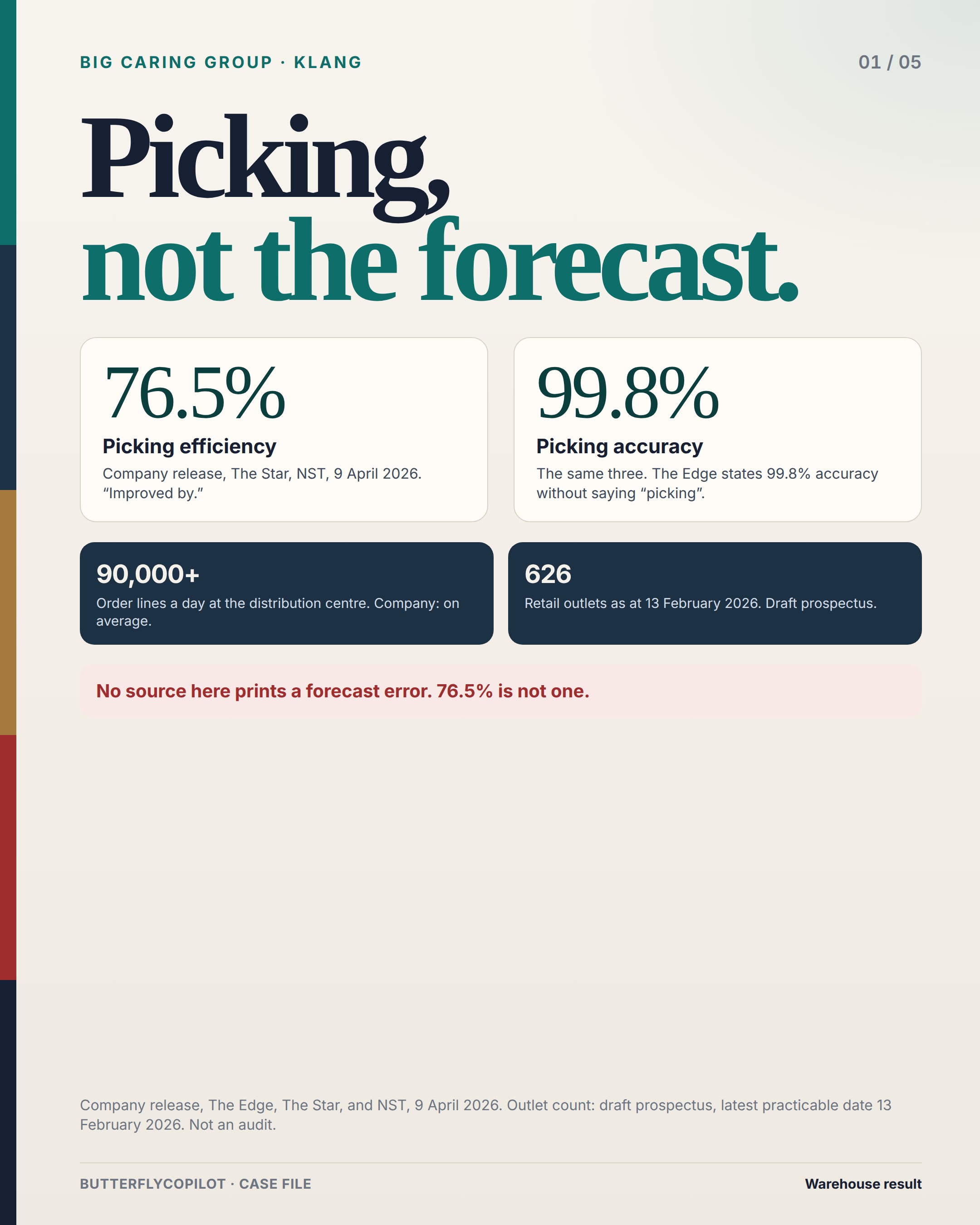
The stores trade as BIG, CARiNG, Georgetown, Ting, and Wellings. There were 626 outlets as at 13 February 2026. The company describes the estate as more than 600. On an average day the distribution centre handles over 90,000 order lines.
The problem
In a chain this size, the miss is usually local. One outlet starts selling a medicine faster than it did last month. The warehouse can still be full. The store is the one that runs short, if yesterday's pattern is what wrote today's order.
Most of the retail inventory was not even in Klang. On 31 December 2025, 32.2% of it sat at the Bukit Raja Distribution Centre. The rest was out in the network, including satellite centres in Penang, Johor, and Sarawak. A plan that only watches the warehouse will treat the shops as empty.
The centre itself, at No. 8, Jalan Astana 3/KU2, Bandar Bukit Raja, had room. Utilisation was 61% as at 13 February 2026, which the draft prospectus called enough for the present. A further centre nearby may take up to five years from the listing to develop. Its cost is not set. The retail plan beside that is about 40 to 50 new pharmacy outlets a year, for three to five years.
Beyond the pharmacies, the company counts more than 5,000 healthcare partners, hospitals, clinics, and physiotherapy centres among them. The prospectus counts a wider set of over 6,941 distribution points.
That is a lot of shelves asking, at different speeds, for the same catalogue.
What they built
The building you could walk through on 9 April was a goods-to-person warehouse.
Robotics, warehouse control, and inventory sit in one system. Slower lines use tote-to-person. Faster lines, including medicines, use shelf-to-person and a fast-moving path. The company describes more than 160 robots and 700 racks. The racks and totes come to the picker, which cuts the walking inside the warehouse. Put-to-light, autonomous mobile robots, and automated carton transfer units are part of the same centre.
Underneath, a central SAP system holds master data, sales and distribution, and financial control. It is integrated with the store tills and with the warehouse system. An in-house IT team of 36, as at 13 February 2026, sits behind that. Stock is visible in real time. Replenishment between the centre and the stores was already automated in the ordinary sense: the tills and the warehouse talk.
The newer layer is the one Lim was talking about. AI-driven replenishment reads sales as they happen, notices when one location moves differently from another, and positions inventory ahead of that shift. The company's line on the split of labour is the right one to keep: AI supports planning, automation does the execution, and people remain central to the decision.
The draft prospectus, with facts as at 13 February 2026, was more careful about that planning layer. It described smart replenishment, using real-time data and machine learning, as a pilot the group intended to launch in the second quarter of 2026. About RM3 million over two years, from the group's own funds, was set aside for the technology enhancements in that section. That sum is the plan for those enhancements. It is not the receipt for the robots.
By the April unveiling, the company was describing the replenishment system in the present tense, already reading sales. The warehouse was running. The forecasting layer is the piece the prospectus had still called a pilot in February.
How it works
A sale happens at a till. The point-of-sale system updates central inventory. Replenishment is supposed to read that stream, see which store is moving, and decide what should be on the way before the shelf is bare.
Then the building executes. The right tote or shelf travels to a person. A light shows the pick. The person takes it. Bringing the goods to the picker is what cuts the walking.
Store till records the sale
        ↓
Central inventory updates
        ↓
Replenishment reads the pattern, including a store that is suddenly busy
        ↓
Stock is positioned for that store
        ↓
Robots bring the goods to a person, who picks
        ↓
A person remains on the decision
The tills, the stock, and the pick are one chain. A person stays at the point where a quantity becomes an order.
The results
Since the system went in, picking efficiency improved by 76.5%, and picking accuracy reached 99.8%. Those are the company's figures from its 9 April announcement, and they measure the pick inside the building. The centre's volume sits beside them: over 90,000 order lines a day, on average.
The planning story is the one Lim told. Stop reacting. Prepare before the store asks.
What other SMEs can learn
Picking and planning are different jobs. Robots that bring a tote to a person change how fast and how accurately you pick. The question of what a single outlet needs on Thursday is a planning question. Copy the half you actually have. A chain without 160 robots can still copy the planning loop.
See the stores, not only the warehouse. Only 32.2% of Big Caring's retail inventory was at the Klang centre on 31 December 2025. A replenishment run that reads the warehouse alone will treat the stores as empty. Sales and on-hand have to arrive from the tills.
Keep a person on the quantity. Big Caring's own line is that people remain central to the decision. That is the part worth copying before any of the machinery. A draft the buyer agrees to is a replenishment system. A draft that posts itself is a different project.
Say what stage you are in. In February the machine-learning replenishment was a pilot aimed at the second quarter. In April the company spoke as if it was already reading live sales. The useful habit is the same at a smaller scale. Call a pilot a pilot until the buyer trusts the draft.
You do not need their stack. SAP, a robot fleet, and a national store estate are this group's tools. The pattern underneath is a daily sales file, a lead time, a pack size, and a named person.
How to start
If you replenish stores from a distribution centre, and the order still depends on who remembers what sold, start here:
Point-of-sale sales and store on-hand, plus open orders and lead times from the ERP
        ↓
A weekday-median forecast, or a simple rule for items that sell on only a few days
        ↓
A model may replace that forecast only when it beats it on a holdout
        ↓
Draft a transfer to the store, rounded down to the pack. A person accepts
        ↓
Draft the supplier order for the distribution centre. A person accepts
        ↓
The first version stops at the file
The instruction file is our design for a mid-size pharmacy chain or distributor. It does not require SAP or a robot, and it is not a reconstruction of Big Caring's stack. It writes a draft. It does not post it.
It will refuse to suggest a quantity until you name the planner, the review cycle, the lead times, and the pack sizes, and until the sales, on-hand, and supplier files are real. If any product is marked controlled, it also waits until you name a pharmacist. It reads the till and the ERP as exports. If the only login can post a document, it stops and will not use that login.
A missing sales file is a missing file. It is not a day of zero sales. The forecast is a weekday median, or an intermittent rule when most days are zero. Replenishment rounds down to the pack. It does not round up to a supplier minimum. An optional model stays silent when it cannot beat that baseline.
A store selling well above or well below its own recent pace is flagged. The flag does not move stock by itself. The store transfer is drafted first, then the purchase for the distribution centre, without counting the same demand twice. Controlled lines go to the pharmacist. A planner's accept does not clear them. A cold-chain product is blocked at a location that cannot hold it. A line that expires inside the cover window is blocked. Member files, prescriptions, and patient records stay out. The forecast is product, location, and day.
Run it in shadow. The forecast is written while the buyer still orders as they already do. Compare the two. Let the draft become the starting point when the sheets in the file exist. Leave the purchase-order button, and the pick, for later.
The file includes the tests: a stale export, a true zero, a round-down, a gap below one pack, a demand-shift flag that leaves the quantity unchanged, a controlled line the planner cannot release, and a draft that stays a draft. The worked example has to suggest 48 units and stop there. Time your own error before you talk about a result. The 76.5%, the 99.8%, the 90,000 lines, the 61% utilisation, and the RM3 million are Big Caring's.
Replace every REPLACE line. Delete every EXAMPLE row.
Sources
- Big Caring Group, "BIG CARING Group Strengthens Operations with Automation-Driven Distribution Centre and Centralised Corporate Hub," 9 April 2026.
- The Edge Malaysia, "Big Caring ramps up automation with new Klang distribution centre ahead of IPO," 9 April 2026.
- Megat Syahar, "Automation driving pharma group's next stage of growth," The Star, 9 April 2026.
- S. Birruntha, "Big Caring unveils automated Klang distribution centre and HQ," New Straits Times, 9 April 2026.
- Securities Commission Malaysia, prospectus exposure, Big Caring Group Bhd. Draft prospectus, not registered and not an offer. Latest practicable date 13 February 2026.