
How Blue Aqua Boosted Shrimp Feed Efficiency by About 30% with AI
A Singapore farm stopped waiting for the water to look wrong. The model proposes the ration. A person still throws the feed.
ButterflyCopilot
0106
A shrimp pond does not send a memo when it is about to go wrong. The oxygen sags after dark. The ammonia creeps up. By the time the animals look sick, the feed has already been wasted.
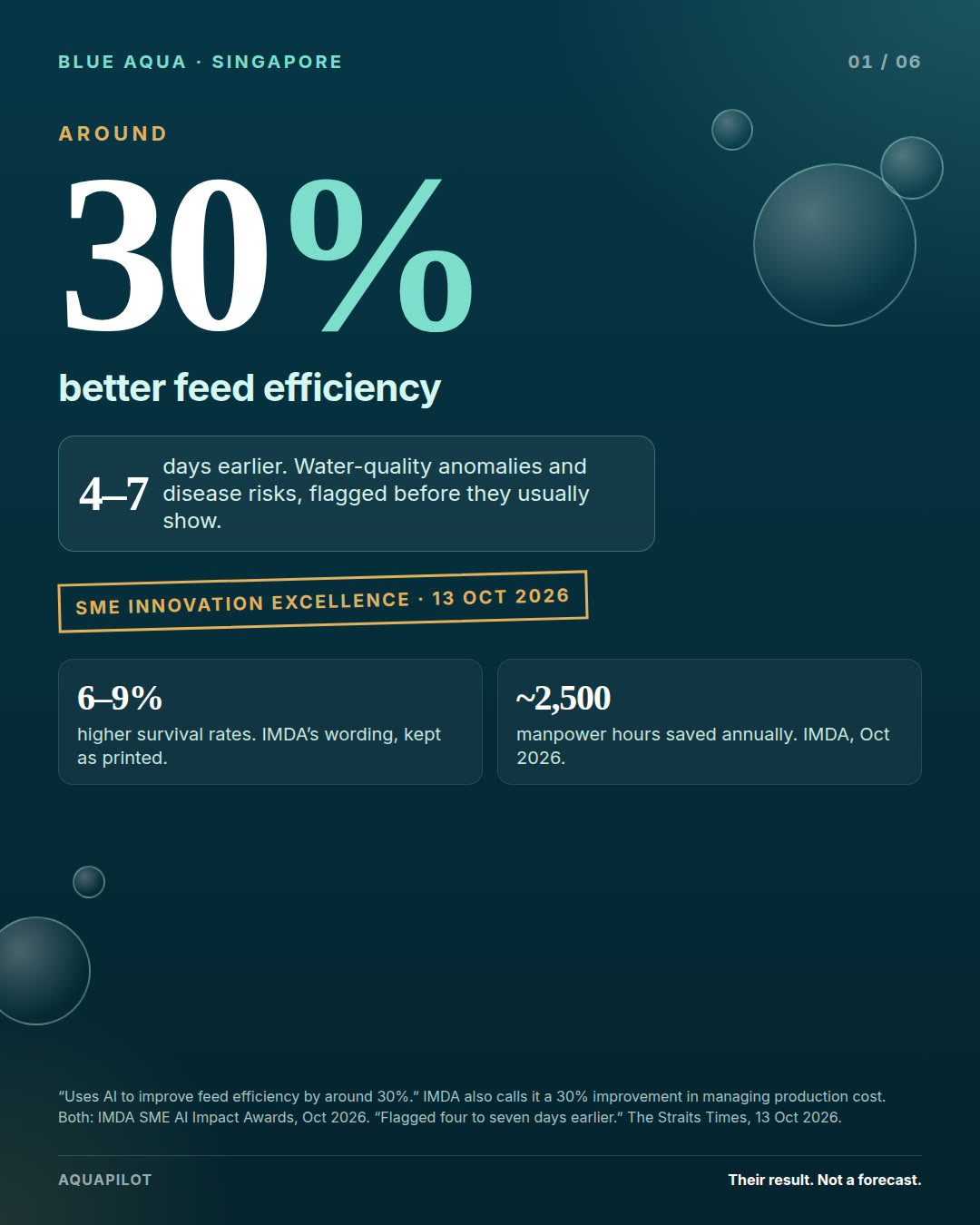
Blue Aqua International, a Singapore aquaculture group, put an AI platform on that lag. Feed efficiency improved by around 30%. Water-quality anomalies and disease risks can be flagged four to seven days earlier. On 13 October 2026 the company won an SME Innovation Excellence Award at the SME AI Impact Awards, for a proprietary system it built and runs in its own business. The product is called AquaPilot.
The awards page also records a 30% improvement in managing production cost, survival rates 6–9 % higher, and around 2,500 manpower hours saved a year. Those figures belong to this rollout. A farm with four ponds does not inherit them by switching a tool on.
The eye, and the paper
Blue Aqua started in Singapore in 2009, founded by Dr Farshad Shishehchian and Ms Amornrat Boonchuay. The group is headquartered there and operates in 14 countries. It sells farm-care and nutrition products to farmers, and it farms. In Singapore that includes an indoor shrimp farm on a recirculating system, a hatchery, a breeding centre, and the country’s first trout farm. In 2017 the breeding centre was converted into what the company calls a super-intensive, zero-waste, and water exchange indoor shrimp farm. In 2023 that farm was the first indoor RAS shrimp farm in the world to obtain ASC certification.
Shishehchian has spent decades being the person who can see the problem before the spreadsheet can. In a 2022 conversation with Singapore’s Economic Development Board he described the aim plainly: put his knowledge of the farms into the systems, so someone else can use it. One look at the water, or at the colour of the shrimp in a hatchery, and he would know something was wrong. Not every farmer can do that. Prevention, he said, is always less costly than treatment.
The awards page describes the same gap in the language of a Tuesday morning. Water was checked too rarely, so a fault could sit there between readings. Feeding was generic, which wasted feed, and disease was noticed late, which risked the stock. The decision lived with whoever was on the pond that day, written into paper logs that did not match the next farm’s paper. You cannot compare ponds you did not record the same way.
About a year and a half before the October 2026 award, Blue Aqua introduced AI into its farm operations.
What the morning became
AquaPilot reads water quality, feeding, health, and production data, and turns the company’s own farming experience into decisions a team can repeat. It predicts risks and recommends actions. The people still walk the pond.
Five jobs, in the words the award uses.
The platform forecasts oxygen, ammonia, and temperature six to twenty-four hours ahead, and tells the team when a line is about to be crossed.
It writes a risk score for each pond every day, and flags a possible health problem four to seven days before that problem would usually be visible.
It calculates that day’s feed for each pond from the biomass in the water, the condition of the water, the way the animals are growing, and the health risk.
On the recirculating system, it watches for trouble and adjusts the feeding to match.
It lines the ponds up on feed conversion, survival, growth, and production cost, and says what that farm should change if it wants more yield.
The Straits Times sat with founder and group executive chairman Farshad Shishehchian after the ceremony. The system, he said, analyses water-quality data and biological data from the fish and the shrimp. It also predicts what may happen in one or two weeks, which is a longer view than the six-to-twenty-four-hour water forecast, and it is there to help a person decide. On the feed itself, the article says the technology improved shrimp feeding efficiency by about 30%, leading to a reduction in wastage and the amount of feed required to achieve the same shrimp growth.
He was just as specific about the limit.
AI cannot do the physical work. We encourage our team to be more productive in terms of understanding the system.
The speed, in his words, is that the model connects the signals and hands back a conclusion faster than a person can. To The Business Times he put the same idea on the industry: AI matters in food and agritech because the work helps people produce better food. Blue Aqua, the paper noted, has been using the platform on problems such as overfeeding and water quality.
How a reading becomes a scoop
Readings and the day’s logs come in
        ↓
Oxygen, ammonia, and temperature are forecast 6 to 24 hours ahead
        ↓
Each pond gets a risk score, with the reasons written out
        ↓
A feed ration is proposed for that pond
        ↓
A person approves it. A person feeds.
        ↓
Once a week, ponds are compared on conversion, survival, growth, and cost
The feed line is the one worth copying in full. The ration comes from biomass, water, growth, and health risk. It is a different number for a different pond. The generic scoop, the same kilograms because that is what the whiteboard said yesterday, is the habit the award page describes as the old one.
An oxygen crash does not wait for that morning meeting. The alert has to reach someone who can walk to the machine. The model does not turn the machine on.
The hard parts
The paper is the first system. A forecast built on a notebook that only one supervisor can read is a story about that supervisor. The before-state on the awards page is infrequent checks, generic feeding, and records that were not comparable. The columns have to exist, and they have to mean the same thing on Thursday as they did on Monday. The model comes after that.
A sensor can lie politely. A probe that sticks on one number looks like a calm pond. A reading in the wrong unit looks like a crisis, or like nothing at all. Someone has to own calibration. A missing hour has to stay missing. Filling the gap with a plausible oxygen value is how a farm learns to trust a pond it never measured.
A forecast needs a rule about who may act. Six hours of warning helps when the night shift knows who is allowed to change the feed, and who must be called when oxygen is headed under the line. Inside a band the manager has already set, a proposal can stand. Outside it, a named person says yes. A team that obeys every cut will underfeed a pond on a bad input. A team that ignores every cut is back on the generic scoop.
The physical work stays with people. Shishehchian said so, in the sentence above. Sampling, feeding, and walking the bank are still jobs for staff. So is any decision to treat or to harvest. The gain he described is a team that spends more of its time understanding the system. The instruction file is stricter than a slogan. Version 1 will not dose a chemical, will not name a disease, and will not switch a pump.
What a smaller farm should steal
If you grow shrimp, tilapia, catfish, or another fish, in ponds or a recirculating system, the same morning exists in Perak, in Kedah, in Sabah, and in plenty of places that are none of those. The first fortnight can look like this.
Two to four ponds, and a person who already knows them
        ↓
A sheet for the ponds, the readings, the feed, and the samples
        ↓
Bands and a feeding table your own aquaculturist writes
        ↓
Manual readings first. A sensor only after the habit exists
        ↓
A forecast, a score with reasons, a proposed ration
        ↓
The manager approves. Someone feeds. The decision is written down
Steal the loop. Leave the scoreboard. Around 30% feed efficiency, a 30% improvement in managing production cost, survival rates 6–9 % higher, and around 2,500 hours are Blue Aqua’s published results. They are not a line for your proposal, and they are not a saving to turn into money or into kilograms of feed. Time your own conversion, your own survival, your own feed cost per kilogram, the hours you spend logging, and whether anyone acted when the alert arrived.
What the instruction file will make an agent do
The file below is the brief. It is not AquaPilot, and it is not Blue Aqua’s thresholds, probes, or feed table. None of those are public. The blanks are yours.
It will make the agent:
- Refuse to run while a
REPLACEline is empty, or while anEXAMPLErow is still in a live sheet. - Take a reading from a sensor export, or from a person on a phone form, WhatsApp, or Telegram, in the languages you turned on. A missing reading stays “no data”. The agent asks. It does not invent the oxygen.
- Reject a unit it was not taught to convert, and reject a number that cannot be a real reading. A probe stuck on the same value is a fault, not a calm pond. A manual check that disagrees with the sensor waits until a person picks one.
- Forecast oxygen, ammonia, and temperature out to 24 hours by a method you can explain: the same hour yesterday, the pattern of that hour across the week, or a short trend. Alert when the forecast crosses a band your aquaculturist set. An emergency on the current reading goes to a human immediately. The agent does not start an aerator.
- Score each pond Low, Watch, or High from points you can read: hours the water was outside the band, feed left over, deaths, growth, and the words staff actually wrote. The points are our design. A high score is a reason to look. It is not a diagnosis, and it is not a medicine.
- Propose a ration from the count, the average weight, and your feeding table, then cut it for poor water, a high score, or feed still sitting in the pond. Past the percentage you set, only the manager can accept the change.
- Once a week, compare ponds of the same species and stage on feed conversion, survival, daily gain, and feed cost per kilogram, and say plainly when a number cannot be computed.
- Keep the sheets and the photos on the host you named.
The tests are in the file. A missed check. A stuck probe. A percent-saturation reading with no conversion. A night-time oxygen sag while the afternoon still looks fine. An ammonia spike. A jump in deaths. A feed cut that waits for a person. A pond stocked this morning. A harvest already underway. A manual reading that fights the sensor. A request to turn a paddlewheel on and dose lime. If the agent names a treatment, or a pump answers, the test fails.
The instruction file
Here is the brief: the role, the sheets, the two ways a reading arrives, the forecast, the points, the ration, the weekly numbers, the messages, the weeks of shadow running, and the tests that decide when a feeder may trust a figure inside the band.
Replace every REPLACE line. Delete every EXAMPLE row. Let it sit beside the real ponds before anyone throws a ration it proposed.
Sources
The outcome figures in this article are the company’s results as the awards page and the two newspapers reported them. They are not an independent audit of a baseline, and they are not a forecast. The company history is from Blue Aqua’s own pages. The 2022 EDB piece is background on why the founder wanted the judgement written down. It is not a description of AquaPilot.
- IMDA and the Singapore Business Federation, “SME AI Impact Awards,” winners announced 13 October 2026. Blue Aqua International. SME Innovation Excellence Award, for a proprietary AI solution deployed in the business. Product: AquaPilot. “Uses AI to improve feed efficiency by around 30%.” Metric tile: “30% improvement in managing production cost”; “6–9 % higher survival rates”; “Around 2,500 manpower hours saved annually.” Key challenges: infrequent water checks, generic feeding and late disease detection, paper logs and inconsistent records. The five modules: oxygen, ammonia, and temperature forecast 6 to 24 hours ahead; daily pond risk scores flagging potential health issues 4 to 7 days before they typically become visible; daily feed per pond from biomass, water conditions, growth, and health risks; RAS monitoring that adjusts feeding; benchmarking on feed conversion, survival, growth, and production cost.
- Samuel Devaraj, “Social enterprise using sentiment analysis at call centre among 30 winners of SME AI Impact Awards,” The Straits Times, 13 October 2026. Blue Aqua introduced AI about a year and a half earlier. Water-quality and biological data from fish and shrimp. Predicts what may happen in one or two weeks. Shrimp feeding efficiency about 30%, with less wastage and less feed for the same growth. Anomalies and disease risks flagged four to seven days earlier. Farshad Shishehchian, founder and group executive chairman.
- Ranamita Chakraborty, “IMDA expands digital support for SMEs,” The Business Times, 13 October 2026. Blue Aqua provides farmcare solutions and runs Singapore’s first trout farm. AI platform for issues such as overfeeding and water quality. Dr Farshad Shishehchian, group executive chairman and founder.
- Blue Aqua International, “Our Story” and “Meet the Founders.” Started in Singapore in 2009. Headquarters in Singapore, operating in 14 countries. Indoor shrimp farm, hatchery, breeding centre. 2017 conversion of the breeding centre. 2023 ASC certification. 2022 start of rainbow-trout development.
- Economic Development Board, “Revamping aquaculture farming with innovation and technology,” 3 November 2022. Replicate farm knowledge so it can be passed on. Prevention is less costly than treatment.