
How Crestar Fan Cut Daily Manual Inquiries from 50 to Just Over 20
The IMDA mirror prints a 56% drop in routine man-hours. CNA Brand Studio prints over 50 per cent. The 80% sales line is their claim.
ButterflyCopilot
0105
What they achieved
Crestar Fan’s public record has a before, an after, and two ways of writing the percentage. They are not one sentence.
The before is on the IMDA CTO-as-a-Service highlight. Websentials republishes that highlight: once on 22 January 2025, under a vendor headline, and again on 5 March 2025, under an IMDA SMEs Go Digital heading. Both reprints carry the same story, and both point back at the IMDA page.
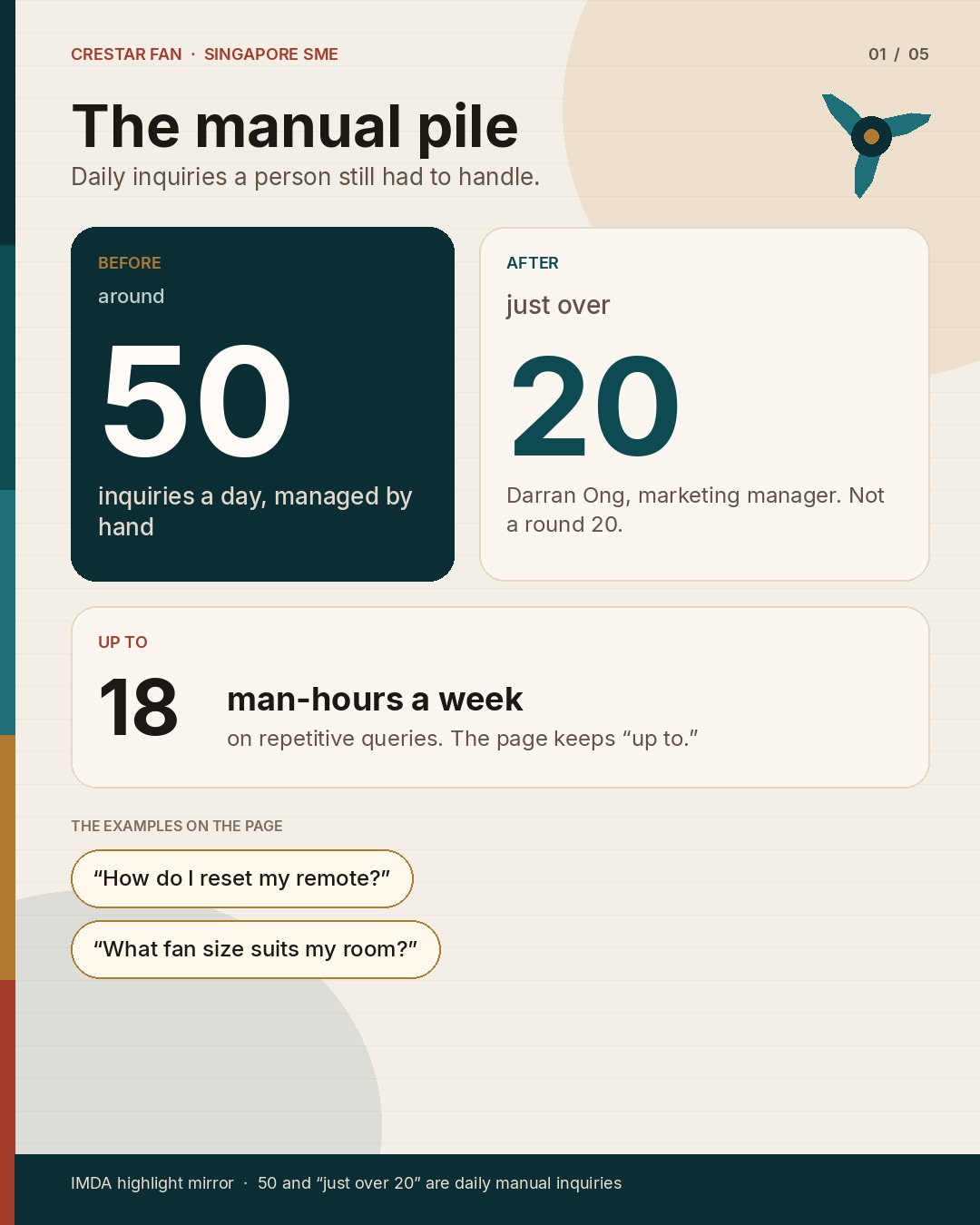
Repetitive queries were consuming up to 18 man-hours a week. The examples on the page are “How do I reset my remote?” and “What fan size suits my room?” Darran Ong, marketing manager, says that before the chatbot the team manually managed around 50 inquiries a day. He says that number has since dropped to just over 20.
The same page then says what Crestar saw. A 56% drop in man-hours spent on routine tasks. An 80% increase in overall sales, driven by faster responses to more customer queries. Improved customer satisfaction with quicker and more accurate answers. No satisfaction score is printed. Shawn Lee, the chief operating officer, says the chatbot let them respond to more customers than ever before, and that the faster response times helped drive up sales. He says Crestar recouped the investment within just a week or two.
CNA Brand Studio, published 17 March 2025 and updated 1 April 2025, uses different words for the cut. GenAI-enabled chatbots on the CTO-as-a-Service platform. “An over 50 per cent drop in the manual handling of queries and man-hours spent on routine tasks, along with an 80 per cent increase in sales.”
“56%” is the IMDA mirror. “Over 50 per cent” is CNA. Do not average them into a new figure, and do not let one page’s wording stand in for the other. Both pages state an 80% sales increase. Neither page is an independent audit. CNA’s piece is Brand Studio. The 80% has no period and no baseline attached. Treat it as Crestar’s attributed claim.
The units are neighbours, not the same count. Up to 18 man-hours a week is the repetitive-query load. Around 50, then just over 20, is Darran’s daily manual inquiries. The 56% is man-hours on routine tasks, on the IMDA mirror only.
What they do
Crestar’s own about page says the company was established in 2004, founded by Eric Tew, as a homegrown ceiling-fan brand for commercial and residential customers. The IMDA highlight calls it the family business. Shawn joined in 2019, while the founder, his father-in-law, was terminally ill. The founder died 10 months later. Shawn is named COO on that page.
The highlight is written as an SME story. Shawn’s advice on it is addressed to SMEs, and he describes CTO-as-a-Service as a way for SMEs to start. This article stays there. Crestar is a specialty fan retailer and maker. It is not described here as a mid-sized or large firm. No headcount and no revenue are printed, because the pages this piece relies on do not publish a figure worth quoting.
The bottleneck was the front of customer service. High call volumes. The same questions, asked again. Customers who wanted an instant answer on WhatsApp or in a chatbot, and a desk that could not give one. CNA adds that paper logs proved unreliable. That sentence is CNA’s. The IMDA mirror does not print it.
What they put in front of the pile is a GenAI chatbot. The IMDA mirror places the work under IMDA’s Generative AI Sandbox 1.0. CNA says the chatbots sit on the CTO-as-a-Service platform. Shawn says that with the grant, it cost less than the price of a holiday flight ticket. That is his comparison. The page does not print a dollar amount.
How they do it
The IMDA mirror is specific about the channels and about four behaviours.
The chatbot runs on the website, on WhatsApp, and on social media, and it operates 24/7. Shawn says they worked closely with the developers so it could manage the most common questions. The reprinted story says “the developers.” It does not name a product in the body. The 22 January Websentials page titles the same reprint “Websentials Omnibot.” The title is the vendor’s. The paragraph underneath still says developers. CNA names the platform category, CTO-as-a-Service, and does not name a product either. Copy the loop. Leave the logo off.
Eric Oh, a customer, asked which fan size suited his rooms. He says the chatbot broke the answer down by square feet, and recommended 36-inch or 44-inch fans. That is his account of one conversation on the IMDA page. It is not a sizing table for every shop.
Carmen, customer service executive, says fewer repetitive calls left her more time for online service bookings and for more complex queries. Her example of a return is concrete. A customer started the return in the chatbot. It guided them through the steps. It provided a direct link to schedule a service appointment. She says that without the chatbot the same job was a long exchange of calls or emails.
The hard cases stay with a person. Darran’s line is that the team can respond faster to online service bookings and spend more time on complex issues, because the chatbot is on the routine tasks. Carmen’s line is the same split, from the desk.
After the chat, the company read the queries. The repeating trouble was remote-control troubleshooting and battery concerns. Those notes were used to improve product guides and FAQs. The page describes the company doing that improvement. It does not describe the bot rewriting the guide.
Shawn also says that handling more queries online reduced the need for technicians to visit in person. That is his observation. The page does not count the visits.
Later in the same article, Crestar implemented Microsoft Co-Pilot, the spelling on the page, for reports and presentations. The article calls that a next step after the chatbot. It is not the customer assistant, and it is not the instruction file below.
The hard parts
56% and “over 50 per cent” are two pages. The IMDA mirror prints a 56% drop in man-hours spent on routine tasks. CNA Brand Studio prints an over 50 per cent drop in the manual handling of queries and man-hours spent on routine tasks. Use the sentence from the page in your hand. A blended line sounds more precise than either source.
80% sales is their claim. The IMDA mirror says an 80% increase in overall sales, driven by faster responses to more customer queries. CNA says an 80 per cent increase in sales. Shawn ties the movement to faster responses. No page shows the period, the baseline, or an audit. Do not put 80% in a forecast for another shop.
“Just over 20” is not 20. Darran’s pair is around 50 inquiries a day, then just over 20. Those are manual inquiries. They are not the 18 man-hours, and they are not the 56%.
18 man-hours a week is written as “up to.” The highlight says the repetitive queries were consuming up to 18 man-hours a week. Dropping “up to” turns a ceiling into a quota.
The payback lines are Shawn’s. Recouped within a week or two. With the grant, less than a holiday flight ticket. Neither line is a published price.
The builder is not named in the story. “The developers” is the phrase in the IMDA text. A vendor headline on a reprint is not a product diagram. CTO-as-a-Service is the platform category CNA names.
36-inch and 44-inch are one customer’s example. Eric Oh, on the IMDA page. A shop that copies the pattern uses its own square-foot bands. Those two sizes are not a default catalogue.
A booking link is only a link the business published. Carmen’s example included a direct link to a service appointment. If the sheet has no URL, the assistant does not invent one, and it does not approve a refund along the way.
Electrical safety, damage, and a refund dispute are not FAQ rows. The published bot handled routine questions and a guided return. The pages do not print a rule for a burning smell, a spark, a fallen fan, or an argument about money. The instruction file sends those to a person.
Another shop does not inherit 56% or 80%. The figures are this company’s published results. They are not a target in the file below.
How a smaller business can copy it
The useful shape, if you sell fans, small appliances, or furniture, and the customer already asks the same questions:
A customer writes on the one channel you launched
        ↓
The assistant matches an approved FAQ, or asks for the room size
        ↓
A fan size comes only from your square-foot bands
        ↓
A return uses your steps and your appointment link
        ↓
Stock, price, and warranty stay on the sheet, or they stay unsaid
        ↓
Electrical safety, damage, a refund dispute, or a request for a person goes to the desk
Launch WhatsApp or the website widget first. Add the second channel after the first one passes the tests. Social is a later channel, on that network’s official interface, not a personal account.
What the instruction file will make an agent do
The file below is the brief. Hand it to the agent that builds or runs the assistant. It is written as orders, with the blanks marked REPLACE.
It will make the agent:
- Refuse to go live until you name the desk owner, the inbox, and real files for the size guide, the FAQ, and the service links.
- Stand up WhatsApp on the official Cloud API, and a website widget, then launch a single channel first.
- Run a fixed conversation: greet with a privacy line, answer one approved FAQ, or ask for the room size, or walk a return only from the steps you wrote.
- Treat a square-foot number as the only input to a size. “Master bedroom” is not a size. 36-inch and 44-inch appear only when those rows are on your sheet.
- Copy a price, a stock line, or a warranty sentence only when that exact sentence is on the sheet. Otherwise say a person will confirm it.
- Refuse card numbers. Send a burning smell, a spark, a shock, a fallen or cracked fan, and a refund dispute to a person, with no DIY electrical steps and no refund decision.
- Email a JSON handoff whose numeric
priceis null. Log the thread so a person can see which questions repeat. Do not let the bot edit the FAQ.
The acceptance tests are in the file. A remote-reset answer that must be copied whole, a 100 square-foot room against a sample band, a room with no band, a return that must carry the appointment link, a request for a person, a card number, a price the sheet does not hold, a burning smell, and a refund dispute. If the reply invents a size, a stock position, or a warranty outcome, the test fails.
That is the whole implementation. The agent does not get to promise 56%, or 80%, on the way.
The instruction file
Here is the brief for your agent: the role, the sheets, the WhatsApp and web setup, the state machine, the questions, the handoff JSON, the hard stop before money and before electrical advice, and the tests that decide when a second channel is allowed.
Replace every REPLACE line. Delete every SAMPLE row. Then let it run on old chats before it talks to a live customer.
Sources
Figures in this article come from the IMDA CTO-as-a-Service highlight, as republished by Websentials, from CNA Brand Studio, and from Crestar’s about page. They are not an independent audit. The 56% line is the IMDA mirror. The “over 50 per cent” line is CNA. The 80% sales increase is Crestar’s attributed claim on both pages.
- IMDA, CTO-as-a-Service highlight, “How Crestar Fan boosted sales and enhanced customer experience with Generative AI.” Republished by Websentials on 22 January 2025 (page title “Websentials Omnibot,” with a line that says to read the article on the IMDA website) and on 5 March 2025 (headed IMDA SMEs Go Digital). The body is the highlight: family business, Shawn Lee joining in 2019, the founder’s death 10 months later, up to 18 man-hours a week on queries such as a remote reset and a fan size, the chatbot on the website, WhatsApp, and social media, 24/7, Eric Oh on 36-inch and 44-inch recommendations by square feet, Carmen on returns, the service-appointment link, and time for complex queries, Darran Ong on around 50 daily manual inquiries falling to just over 20, the 56% drop in routine man-hours, the 80% sales claim, Shawn on faster responses, on recouping the spend within a week or two, on fewer technician visits, on query insights used to improve guides, on Microsoft Co-Pilot for reports and presentations, on the grant costing less than a holiday flight ticket, and on SMEs starting small. The body says “the developers.” It does not name a chatbot product. Original path: services2.imda.gov.sg. Mirrors: 22 January 2025, 5 March 2025.
- CNA Brand Studio, “Find out how AI chatbots have helped this Singaporean company increase its sales by 80 per cent,” 17 March 2025, updated 1 April 2025. Second-generation owner Shawn Lee, manual processes, repetitive queries, unreliable paper logs, GenAI-enabled chatbots on the CTO-as-a-Service platform, 24/7 support, an over 50 per cent drop in the manual handling of queries and man-hours spent on routine tasks, and an 80 per cent increase in sales. Brand Studio is sponsored storytelling. It is not an audit, and it does not print the 56% figure or Darran’s 50 and “just over 20.” channelnewsasia.com
- Crestar Fan, about page. Established in 2004, founded by Eric Tew, a homegrown ceiling-fan brand for commercial and residential customers, with showrooms and a parts desk. Useful as the company’s own description of the business. It does not carry the chatbot metrics. crestarfan.com.sg