
How Faber-Castell Moved the Pen Check onto a Camera
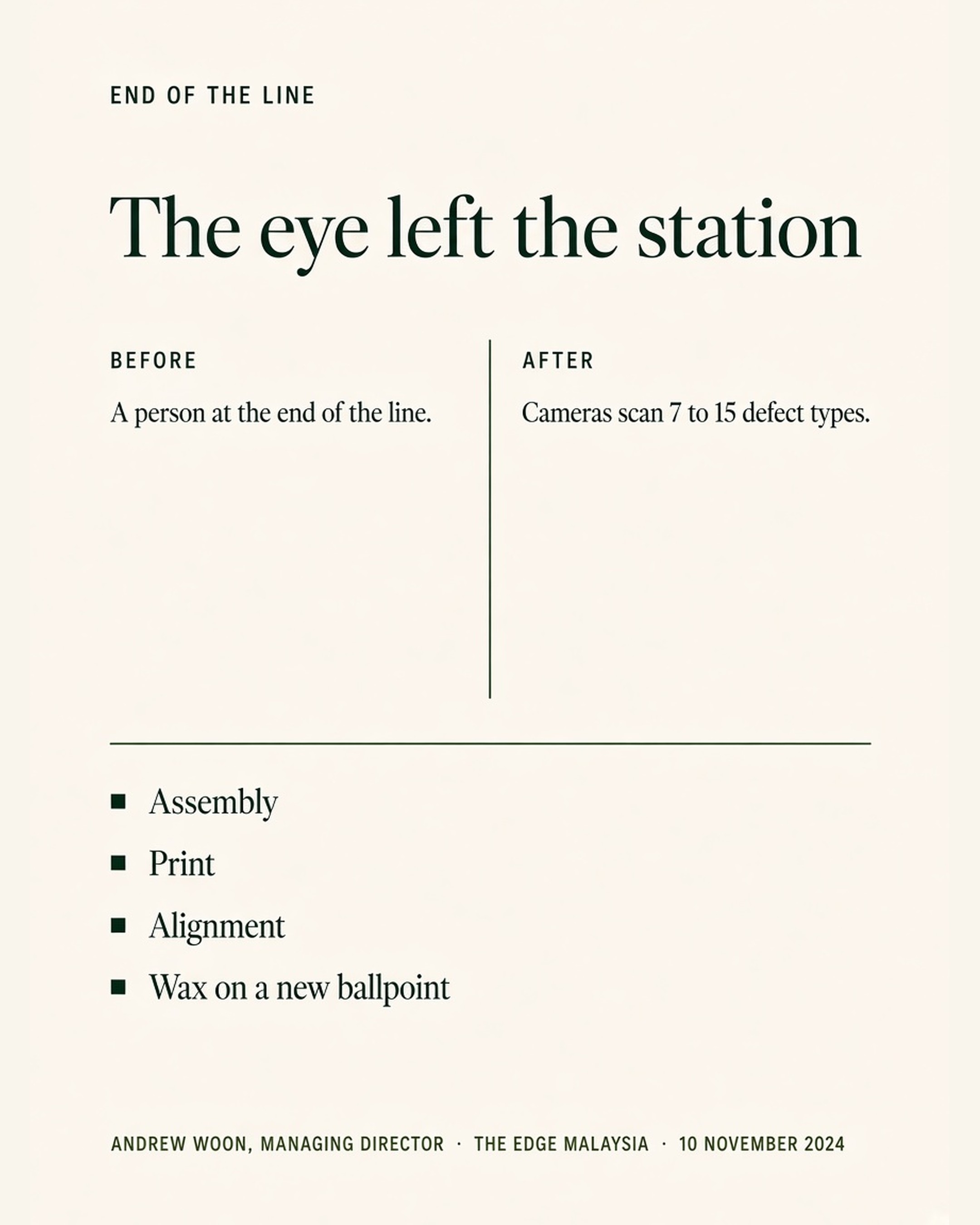
In Subang Jaya a person used to look for a bad assembly, a muddy print, a crooked part, and the wax on a new ballpoint. Cameras now scan 7 to 15 kinds of defect.
ButterflyCopilot
0105
The last job on the old ballpoint line was easy to walk past. Someone stood at the end and looked.
Was the pen actually assembled. Was the printing clear. Was anything sitting crooked. And, on a new ballpoint, was the little wax still on the tip. Those four questions were a person's job at A.W. Faber-Castell (M) Sdn Bhd in Subang Jaya. Andrew Woon, the managing director, then put cameras where that person stood.
The cameras scan for 7 to 15 kinds of defect and keep the data. Throughput on the machine improved. The public account leaves both the size of that change and any defect rate unstated. Copy the station. Measure your own line before you quote a number.
A factory that started with erasers
The Malaysian company began in 1978. The late Dr Toh Yan Peng was managing director and chief executive, with eight employees, making natural rubber and PVC erasers. The first products came off the line in 1980.
It is now one of the world's largest eraser makers. About 150 million erasers a year, and about 90 percent of them leave the country, along with a wide range of writing instruments. Woon took the managing director job in 2019. When he described the plant, it had about 177 local workers and about 83 foreign workers, many of them from Indonesia, Nepal, and Myanmar, often on two-year contracts.
The parent company is the German stationery house, with other factories in Indonesia, China, Peru, Brazil, India, Germany, and Austria. The story that matters here is the Subang Jaya line, not the global brand.
Woon's point about the line is plain. Machinery was already there in Dr Toh's time, heavy production machines. What he pushed was machines that run with AI in them, so the same plant could turn out more with less labour. The camera at the end of the line is one piece of that. It is not the whole of it.
What the eye was doing
He described the old check in the sort of detail a quality lead would recognise.
A designated person looked at whether the product was assembled properly, whether the printing was clear, and whether anything was misaligned. On a new ballpoint there is a little wax at the tip, and that was checked by hand too.
The AI vision systems sit at the end of the assembly line and look for 7 to 15 types of defect. They catch the flaws, they store the data, and he said they improve machine throughput. People still run the machines. His line on the wider automation is that the work left to a person is to operate and control, rather than to assemble each part by hand. Stations that once needed a team of at least ten, one assembling, one on the next component, one packing, one checking, have been pulled into that.
For a shop trying to copy the check, the useful grain is the list, not the headcount. Name the flaws your best inspector already looks for. Put one camera at that station. Keep every other kind of flaw off the sheet until someone on your line has actually seen it.
Three other results that are not the camera
The same conversation covers a factory in the middle of a much larger rebuild. Mixing the clocks is how a smaller firm promises a result it did not buy.
The line speed is the automated line. Before automation, volumes were modest. The plant can now turn out 2,000 to 4,000 ballpoint pens an hour. That sentence is about machines doing the assembly, not about a camera's hit rate.
The order clock is the office. Sales orders used to be taken by hand. Woon moved that work onto mobile sales apps and robotic process automation for invoicing. Processing that used to take hours for an order now takes minutes, and the sales and customer-service people spend the time in stores instead. A camera on a pen does not do that job. The bots he describes also clean up awkward data so a dashboard can be trusted, and they can raise a hand when stock falls through a threshold. Useful, and a different project.
The forecast has no percentage. A custom application uses machine learning for sales forecasting around seasons and promotions, so the plant is less likely to sit on stock for years or to run out. Finding those patterns by hand, across thousands of rows, could take weeks or months. The forecast improved their accuracy. The word he reached for was "quite good." That is the whole of the published result.
The capital plan sits in the same interview and is easy to misuse. About US$7 million for new machinery, about US$40 million more for warehousing and manufacturing, close to US$50 million over three years, against a double-digit growth hope and a lot of export. That is a factory roadmap. It is not a quote for an end-of-line camera. The interview does not price the vision system.
What it cost the people on the line
Woon does not pretend the machines were free of consequences. As the line automated, some manual workers were let go and others were moved. Foreign workers finish a two-year contract and some do not renew. With the machines in place, the plant does not need as many people as it used to.
The ones who stay are trained to program and to run the equipment. The company has also started hiring machine-learning specialists. That is a different bill from a single camera and a quality lead, and it belongs in the decision before anyone mounts a bracket.
He tied the push to wages. The minimum wage had moved from RM1,000 to RM1,500 and then to RM1,700. Labour goes up, prices follow, and he looked to automation, particularly AI, to offset that. A smaller shop can read that as a warning rather than a slogan. If the camera's real job is to avoid hiring, say so to the people on the shift. If its job is to catch a wax tip a tired inspector misses at the end of a long run, say that instead. They are not the same project.
What a smaller line should steal
Steal the station. Leave the rest of the interview on the table.
The unit finishes assembly
        ↓
One camera, where the inspector stood, frames one unit
        ↓
The frame is sharp, or it is taken again
        ↓
The model may only name defects on your sheet
        ↓
A clean frame is a pass candidate
        ↓
Anything else is a hold
        ↓
A named person releases, reworks, or scraps it
The four checks he named are a starting vocabulary, not a form to photocopy. Assembly, print, alignment, wax tip. Your eraser line does not have a wax tip. Your marker line may care about a cap that will not seat. Write the flaws your people already argue about, in their words. Stop at 15 in the first version, because that is the top of the band he described. Do not invent types to make the sheet look as full as a multinational's.
For the first stretch, leave the person in place. The agent judges, and the inspector still judges. Read the disagreements before you let a pass go through on the model's word alone. Faber-Castell's interview does not publish an accuracy rate you could trust with an automatic scrap chute. The file below refuses a reject arm until a later version, on purpose.
What the instruction file will make an agent do
The file is the brief. It is not Faber-Castell's camera software, and it is not a quote for their capital plan.
It will make the agent:
- Refuse to arm a camera until you name the quality lead, the station, the model, and a real defect sheet of 1 to 15 types.
- Sit one camera at the end of the line and accept one JPEG per unit, named so a second unit cannot hide in the same file.
- Set the blur limit from 20 sharp frames and 20 bad ones that your own lead shoots. If those two piles overlap, it will not invent a compromise number.
- Send one frame to a vision model with only the checks on the sheet, plus the artwork when the check is the print.
- Treat a missing wax bead as a hold on a ballpoint, and refuse to fail an eraser for the same wax.
- Hold, and leave the sheet unchanged, when the model invents a flaw you did not write down.
- Hold when the print artwork file is missing, when the frame is blurry, when two products share a photo, or when a face or a badge is in shot. A face is deleted after the log line, not stored as a pass.
- Mail the quality lead and wait.
Release,rework, andscrapare words only that person may write. Silence does not close a hold. - Stay in shadow for at least ten production days, with a human verdict beside every agent verdict, until the lead writes that they have read the diff.
- Refuse to report a defect rate, a pens-per-hour target, or an "hours to minutes" saving. Those clocks are either unpublished or they belong to a different project.
The tests are in the file. A clean ballpoint, a missing wax bead, an eraser accused of a wax fault, a blurry frame, an invented smudge, a print with no artwork, two units in one photo, a face, a stranger trying to scrap the unit, a sheet with sixteen types, a model that will not admit how sure it is. If a verdict contains a percentage the agent calculated, the test fails.
That is the whole implementation. The agent does not get to design a smarter line on the way.
The instruction file
Here is the brief: the role, the sheets, the blur calibration, the one-frame state machine, the vision JSON, the hold mail, the shadow log, and the clocks it must not borrow.
Replace every REPLACE line. Delete every SAMPLE row. Then let it sit beside your inspector before a pass is allowed to leave the station alone.
Sources
The figures in this article come from Andrew Woon's interview in The Edge Malaysia. They are not an independent audit of the Subang Jaya line. No defect rate is printed there, so none is used here.
- The Edge Malaysia, DigitalEdge, "Cover Story: Blending past and future," November 2024. The end-of-line cameras, the 7 to 15 defect types, the checks a person used to do (assembly, print, alignment, wax on a new ballpoint), data collection and improved throughput with no percentage, the move from hours to minutes on orders after mobile sales apps and RPA, the forecast described as quite good, 2,000 to 4,000 ballpoint pens an hour, about 177 local and about 83 foreign workers, the 1978 start with eight employees, about 150 million erasers a year with about 90 percent exported, and the capital plan of about US$7 million for machinery plus about US$40 million for facilities.