
How Footprint Automated 5,800 Supplier Follow-Ups with AI
The material plan already knew what to buy. Half the buyers' day was still the purchase order. A person steps in when the reply does not match.
ButterflyCopilot
0106
The purchase order was half the job.
Footprint makes the tray, the cup, the lid that stands in for plastic. Plant-based fiber, meant to leave the freezer, the microwave, and the oven without a single-use shell. The company was founded in 2014 by Troy Swope and Yoke Chung, both out of Intel, and it is based in Gilbert, Arizona, with more than 2,000 people and a plant in Mexicali as well as the headquarters. The buying desk still had to feed all of that.
The material plan already knew the next run. Someone still typed the purchase order into Sage X3. The supplier’s yes lived in a thread, and the next chase lived in a different thread, and a missed reply sat there until the line noticed the box had not come. MRO and spare parts travelled in the same muddle as the fiber.
Stephen Sharr runs procurement, logistics, and contract manufacturing. He put the week in one sentence. They were spending half their time creating purchase orders. They took that off the team’s plate.
What they stood up
Didero put agents on the ERP Footprint already ran. The loop is short, which is why it is worth copying.
The agent reads the MRP output and creates the purchase order in Sage X3. It sends that order to the supplier and watches for the acknowledgement. When the reply agrees, it writes the confirmed status back and keeps every open order in one place. When the reply does not agree on price, on quantity, or on payment terms, it opens a task for the buyer who owns that supplier, with the order and the reply attached. Nobody goes digging through the mailbox to reconstruct the argument. The buyer steps in there, and that is the point of the step.
Routine administration moves without a person at every keystroke. Judgment stays with the person. That split is the whole design.
The material plan names a firm buy
        ↓
The agent creates the purchase order in the ERP
        ↓
The supplier is asked to confirm quantity, price, and terms
        ↓
A match writes the confirmed status back
        ↓
A mismatch opens one task, with the difference on it
        ↓
A person decides. The price on the order does not move by itself.
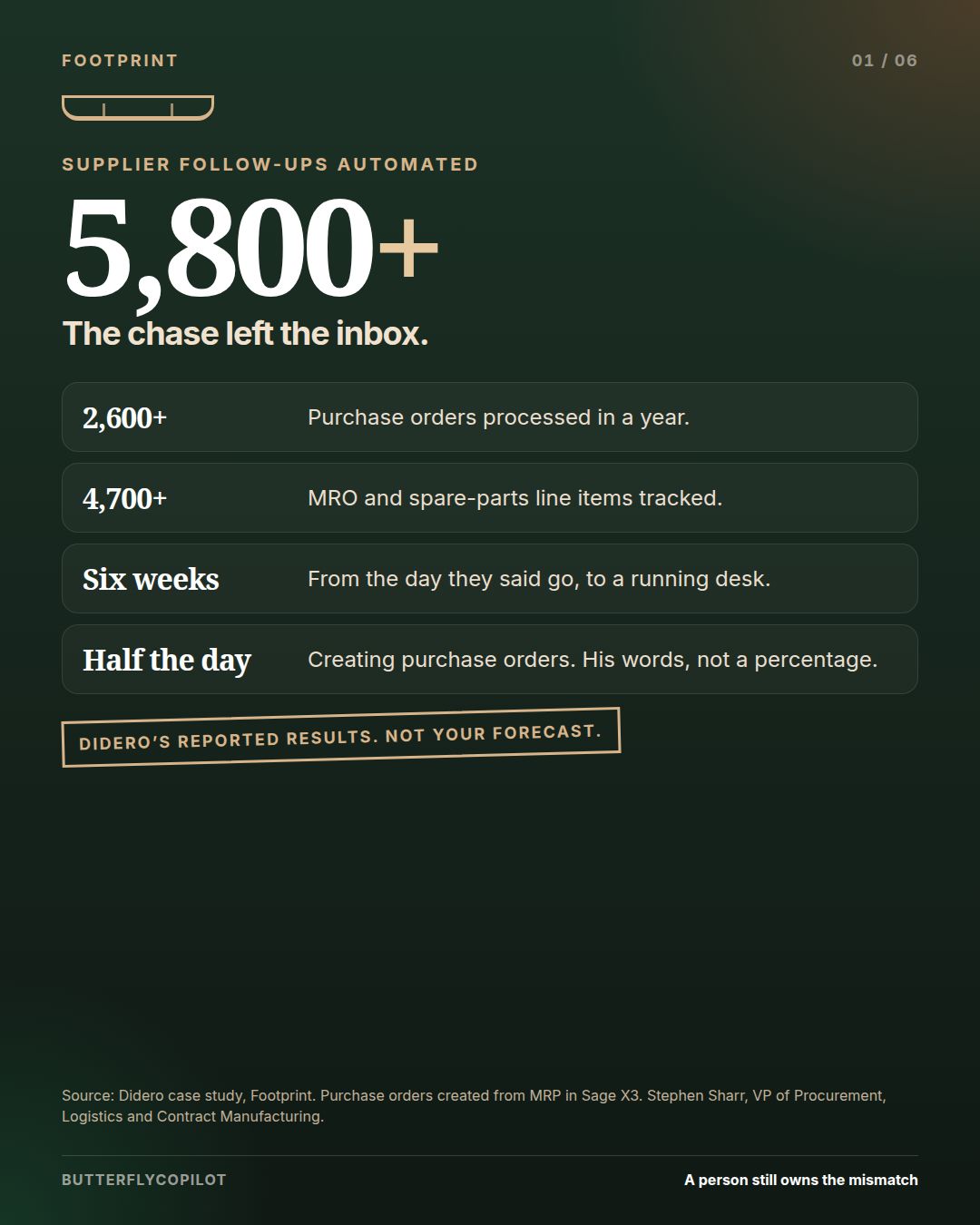
In a year of that desk, Didero reports 2,600+ purchase orders processed, 5,800+ supplier follow-ups automated, and 4,700+ MRO and spare-parts line items tracked. From the day Footprint said go, Sharr’s clock to a running desk was about six weeks. He has also said they may need two or three more buyers later, and that he no longer thinks so. When the funding round was announced in February 2026, he said the agents were already executing the buying work within weeks, and that he had not seen a deployment land with that speed.
Those sentences belong to this company and this rollout. A plant with a shorter supplier list does not inherit them by switching a tool on. Half a day is his description of their week. It is not a percentage sitting in a spreadsheet, and it is not a number of people you can subtract from a hiring plan.
The same shape shows up at FABco, a rebar maker in Houston. There the published result is half of procurement and accounts-payable capacity freed, the work of about six people, on a wider set of jobs that includes the invoice match and the receiving entry. Different plant. Different work. The pattern travels. The scoreboard does not.
The reply that does not match
Speed is how a tidy agent accepts a bad price.
The purchase order says 1,000 at the price on the item master. The reply says 1,000 at a higher price, or 900 at the right price, or net 45 where the order said net 30. If the agent “fixes” the order so the reply will match, the plant has automated a concession nobody agreed to. If it confirms the line that matched and quietly drops the line that did not, the receiving dock inherits the argument. If it sends a purchase order over a limit nobody typed, the guardrail was a sentence in a kickoff, not a rule.
The case is plain about who decides. Price, quantity, payment terms: a task, with the context, and a buyer. It does not print the tolerance, and it does not print the amount above which a person must see the order before it leaves. Those blanks are the part a smaller plant has to type for itself. Zero is a legal tolerance. It means exact. A blank is not zero, and it is not a reason to guess.
The other trap is the spare part. Four thousand seven hundred MRO and spare-parts lines is a tracking result, not proof that a bearing should ride along on a pulp order. A bearing has a different supplier habit, a different price, and a talent for looking urgent. Track it. Do not let it skip the limit because the class says spare.
Six weeks was their time from “go” to running, on a path they had already walked with the buyers: how the plan was reviewed, how the order was created, who still had to see an exception. It is not the time from a blank folder to an ERP login that can edit prices. The instruction file below is slower on purpose. The first month does not send. The write into the ERP waits until the tests pass. A purchase order over the limit never sends on the model’s say-so.
A supplier email that says to ignore the price and confirm it anyway is not an instruction. It is a reply, and the match still runs.
What a smaller plant should steal
If the material plan already lists what to buy, and a person still retypes it and then chases the yes by hand, the first ninety days are one buyer and one commodity.
One buyer, one commodity, direct materials only
        ↓
Thirty days of exports, and a stopwatch on the orders they already raise
        ↓
Thirty days of sends under a limit they typed, while they still key the ERP
        ↓
Thirty days where a confirmed status may write back, and only a status
        ↓
Over the limit, a named person. The price still does not move on its own.
Time the week you already have. Minutes to raise a purchase order from the plan. Follow-ups a person still sends. Hours from the send to a confirmation or to a task. How the tasks split across price, quantity, and terms. How many drafts sat because they were over the limit. How often a confirmation had to be undone. After the commodity is live, time the same things. Those pairs are your result.
The 5,800 follow-ups, the 4,700 spare-parts lines, the 2,600 purchase orders, the six weeks, and the remark about two or three buyers are Footprint’s published story. They are not a line for a proposal, and they are not a saving to turn into a currency. FABco’s half of a team is not yours either.
What the instruction file will make an agent do
The file below is the brief. It is not Didero. It is not Footprint’s Sage X3 tenant, tolerances, or send limit. None of that wiring is public. The blanks are yours.
It will make the agent:
- Refuse to run while a
REPLACEline is empty, or while anEXAMPLErow is still in a live sheet. - Read four exports: the material plan, open purchase orders, the item master, and the supplier master. If one of them is missing or older than the plant allows, the run stops. A stale file is not a quiet day with nothing to buy.
- Draft a purchase order only from firm buy-lines inside the horizon, at the price on the item master and the terms on the supplier. It does not take a price off the planning file, and it does not round a short quantity up to a minimum.
- Park MRO and spare-parts lines until the plant turns that class on. When it is on, those lines use the same limit as everything else.
- Send a fixed note that asks for quantity, unit price, and payment terms. No discount, no free-form negotiation, and no send at all while the first thirty days are still running.
- Refuse to send a total over the limit unless a named buyer approves on a form. A model that types the buyer’s name has not approved anything.
- Match the reply in code. Price, quantity, and terms each have a tolerance the plant typed, and both the percent and the absolute test have to pass. One bad line holds the whole order.
- Open one task with the order, the reply, and the difference. It does not change the price to force a match. A buyer who accepts the supplier’s price does that in the ERP, and the next export is what the next match sees.
- Write a confirmed status back only after the gates, and only as a status. A payload that smuggles a new price does not get called.
- Write a daily file from this plant’s own baseline. No comparison with the case study’s counts.
The tests are in the file. A clean draft under the limit. A draft over the limit that does not send. A new supplier. A spare part that stays parked. A reply inside the tolerance. A reply that misses on price, quantity, and terms at once. A missing line that must not become quantity zero. A model that tries to approve. A note that says to ignore the tolerance. A status write that tries to carry a price. If the agent clears any of those by changing the purchase order or by sending mail it was told not to send, the test fails.
The instruction file
The brief has the role, the connector for Sage X3 or any other ERP, the trigger rules, the send, the match, the task, the tools, the limit, the ninety days, and the tests that decide when a buyer may let a status write back.
Replace every REPLACE line. Delete every EXAMPLE row. Let it sit beside the purchase orders a person still keys, before anyone treats a draft as an order the supplier has already accepted.
Sources
The counts and the three quotes about the buying desk are from Didero’s Footprint case study. They are not an independent audit of a baseline, and they are not a forecast for another plant. The company description is from Footprint’s own site. The February 2026 remark is from the funding announcement. FABco’s figures are from that case study alone.
- Didero, “Footprint.” Plant-based fiber packaging, purchase-order management on Sage X3. Agents create purchase orders from MRP outputs, send them, monitor acknowledgements, record confirmed status in the ERP, and open a buyer task when price, quantity, or payment terms do not match. 5,800+ supplier follow-ups automated. 4,700+ MRO and spare-parts line items tracked. 2,600+ purchase orders processed a year. Stephen Sharr, VP of Procurement, Logistics & Contract Manufacturing: half the team’s time had gone to creating purchase orders; about six weeks from “go” to running; two or three more buyers might have been needed later, and he no longer thinks so.
- Footprint, “About” and “History.” Founded in 2014, headquarters in Gilbert, Arizona, more than 2,000 people, co-founders Troy Swope and Yoke Chung. Plant-based fiber packaging aimed at eliminating single-use plastics. A Mexicali manufacturing plant opened in 2014.
- PR Newswire, “Didero Raises $30M Series A to Bring AI Agents to Global Supply Chains,” 12 February 2026. Stephen Sharr, VP of Procurement, Logistics and Contract Manufacturing at Footprint, on agents executing procurement work within weeks. This page does not publish the 5,800, the 4,700, or the 2,600.
- TechCrunch, “Didero lands $30M to put manufacturing procurement on ‘agentic’ autopilot,” Marina Temkin, 12 February 2026. Footprint named as the customer, a provider of sustainable plant-based packaging. Didero described as a layer on the ERP the customer already runs. No Footprint counts on this page.
- Didero, “FABco.” A separate case. Houston rebar manufacturer. 50% of procurement and accounts-payable capacity freed, stated as 6 FTE. Not used as a Footprint result.