
How iHub Cut Route Planning From 15 Minutes to Three with AI
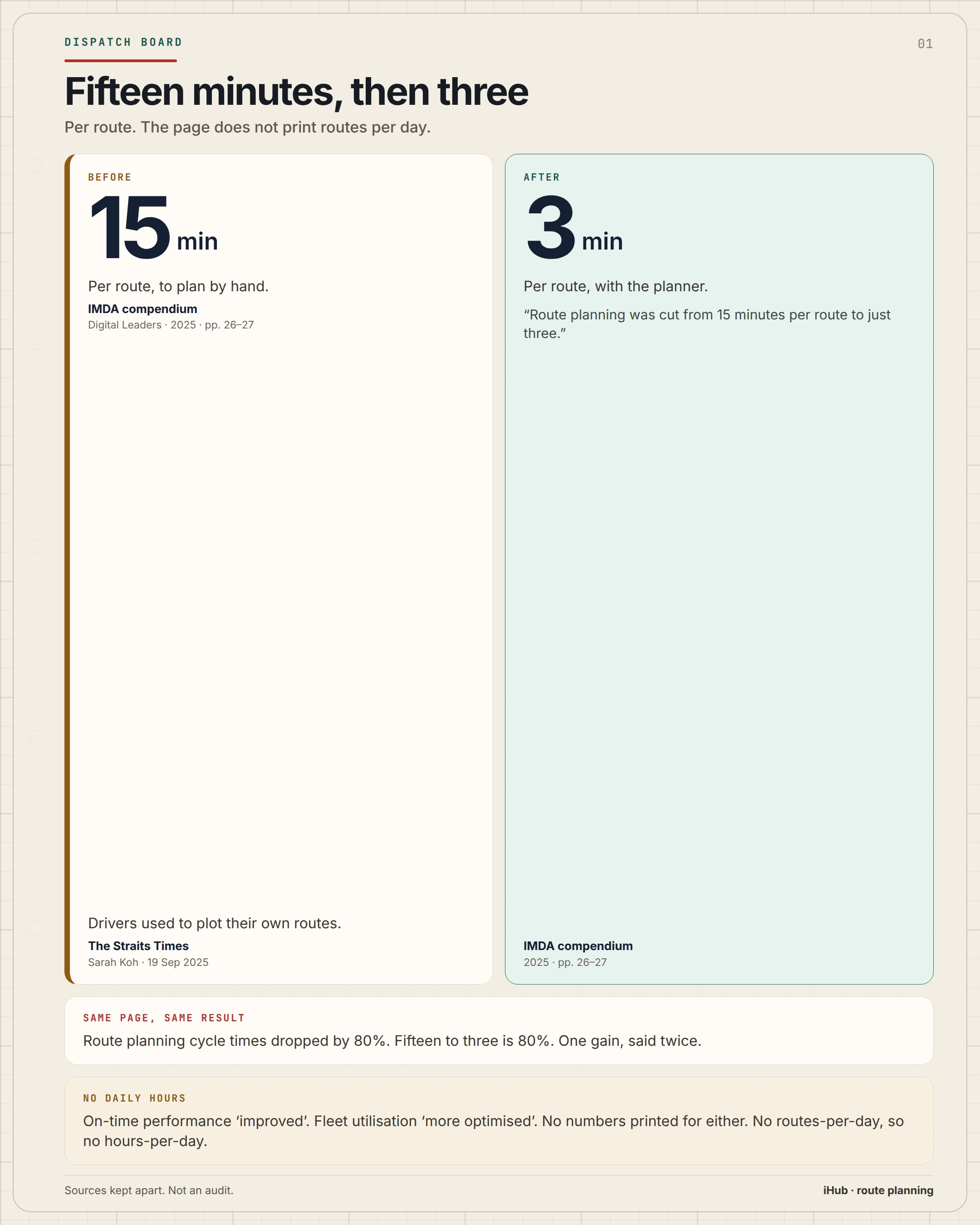
IMDA prints 15 minutes per route before and three after. The Straits Times prints drivers who used to plot routes by hand. The revenue, profit and productivity lines belong to the whole business, not to the planner alone.
ButterflyCopilot
0105
What they achieved
iHub Solutions’ public record on route planning has a per-route clock, a cycle-time percentage, and a set of company-wide lines. Each one has its own sentence.
The clock is in IMDA’s “Digital Leaders: Transforming Vision into Value” compendium (2025), pages 26–27. Route planning was cut from 15 minutes per route to just three. The page adds that on-time performance was improved and fleet utilisation became more optimised. It does not print a number for either.
The percentage is on the same spread, in the section headed The Road Ahead. Route planning cycle times dropped by 80%. Fifteen minutes to three is an 80% cut, so the two lines agree. The page does not say how many routes iHub plans a day. A daily saving in hours is not on the page.
The before is in The Straits Times, Sarah Koh, 19 September 2025. The company’s delivery drivers used to manually plot delivery routes. That task can now be done automatically at the press of a button.
The business lines are wider than routing, and they are said that way.
The compendium says that since the launch of its VLS Virtual Assistant platform in 2024, iHub has achieved a 20% revenue increase and a 30% lift in profits through smarter asset use. “Since the launch” is the timing. “Through smarter asset use” is the reason the page gives. The sentence does not say the route planner earned it alone.
The Straits Times quotes Koh San Joo, founder and chief executive, after describing the route optimisation, the AI virtual assistant, the digital warehouse tracking, and robotic arms that pick, stack and fold boxes: “As a result, the company is at least 50 per cent more productive.” That is his line about the whole set of tools. It is not a routing figure.
The same compendium paragraph says real-time warehouse tracking reduced loss incidents and improved order accuracy. No number is attached. Leave it in words.
What they do
The compendium describes iHub as a leading provider of third-party logistics, headquartered in Singapore, with operations in Malaysia, Hong Kong, the Philippines and Thailand. Its services span e-commerce fulfilment, complex warehousing, last-mile delivery, and software integration through its own platforms.
The Straits Times profile republished by Enterprise Singapore, first printed on 19 March 2020, dates the business to 2000, when Koh San Joo started it. The company’s own site says it began providing physical logistics services in 2003. The same profile says iHub opened its first overseas office in Malaysia in 2003, had about 200 clients across its five markets, and invested nearly half a million dollars a year in its in-house research team. Each date stays with its own source.
The company’s site says its transport fleet is more than 50 vehicles, deployed by geographical location so that each vehicle’s mileage is minimised and delivery is more intensive within a zone. Its last-mile page lists next-day, same-day, window-timed and timed delivery, and vans, an electric van, 14-footers and 24-footers.
The pages this piece relies on do not print a headcount or a revenue figure. The record supports an established regional logistics SME, not a multinational. The people named in public are Koh San Joo, managing director; Catherine Tan, director; Yang Jieshen, AI and machine learning engineer; and Aminah Abdullah, logistics executive.
The squeeze the compendium describes is the one most logistics owners will recognise. Customers wanted speed and visibility. The industry was traditionally manual and margin-sensitive. Koh San Joo’s line on that page: “The goal is not just about catching up with the market, but setting new benchmarks for efficiency and customer experience while bridging the gap between traditional logistics and the digital possibilities ahead.”
The compendium lists three realities the leadership named. A capability shortfall, because logistics was manual. ROI pressure, because with tight margins every innovation had to deliver measurable business impact. Resource constraints, because new solutions had to be phased in without disrupting daily operations.
The answer was to build inside. iHub built an internal GenAI/ML and robotics team, guided the work through workshops and readiness assessments, and ranked ideas by desirability, feasibility and viability. The Straits Times says the tools were developed under IMDA’s Digital Leaders Programme. Josephine Teo’s LinkedIn post after her 19 September 2025 visit says iHub is one of 600 companies supported by that programme.
iHub was not starting from paper. The 2020 profile says the company rolled out a Cloud Transport System in 2013, with help from Enterprise Singapore, to automate delivery route assignments, telematics and driver apps, and to reassign deliveries when needed. The AI planner sits on top of that.
How they do it
The compendium’s description of the routing work is short and specific.
The platform analysed live orders, customer locations and historical data to recommend the most efficient routes. Machine-learning-powered parsing processed customer remarks to extract delivery windows. Algorithmic optimisation using Google OR-Tools dynamically assigned routes to drivers.
Three parts. Read the remarks. Know where everyone is and how long it takes. Let a solver build the routes.
The remark step is the one most small fleets skip. “Before 12.” “Office close 12–2.” “Call before you reach.” In a manual office, a dispatcher reads those lines and keeps them in their head. iHub turned them into windows a solver can respect.
OR-Tools is Google’s open-source optimisation library. It is free. Yang Jieshen’s LinkedIn profile says he developed the route optimisation algorithm with Google OR-Tools and deployed the machine-learning functions as a FastAPI app. The compendium does not name a vendor for the routing. It names the library.
The second tool on the same spread is a virtual assistant for business intelligence. It translates questions in plain language into SQL, so non-technical staff can get answers without waiting for a data specialist. It runs in a hybrid environment with Vertex AI for core processing, handles multi-turn conversations, and draws charts. Yang Jieshen’s profile calls the work a GenAI-powered dynamic SQL generator.
The warehouse side is described by Josephine Teo. Kwan Hon Kee, a 74-year-old warehouse assistant who has been with the company for more than a decade, used to match delivery printouts with products by hand. Errors were sometimes found only after delivery. Now a digital scanner flags a wrong item at once. Digital tracking also lets management spot when a group of workers is overloaded and move staff. The Straits Times adds that the data helps the company plan more efficient picking routes inside the warehouse, in Yang Jieshen’s words.
Koh San Joo’s summary on the compendium: “Sophisticated algorithms are only half the story. Lasting success comes from robust digital foundations — reliable data, intuitive interfaces, and systems that talk to each other.”
And in The Straits Times: “Being part of IMDA’s initiatives gave us the confidence and capabilities to integrate AI into the heart of our business – transforming our warehouses into intelligent hubs and our fleets into data-driven networks.”
The hard parts
Fifteen-to-three is per route. The compendium prints minutes per route. It does not print routes per day, so it does not print hours saved per day. Multiply only your own numbers.
80% is the same result, said again. Route planning cycle times dropped by 80%. Fifteen to three is 80%. It is not a second, separate gain.
20% and 30% are company lines. A 20% revenue increase and a 30% lift in profits since the VLS Virtual Assistant platform launched in 2024, through smarter asset use. They sit next to routing on the page. The page does not split them by tool.
“At least 50 per cent more productive” is Koh San Joo’s sentence about everything. Routing, the assistant, warehouse tracking and robotic arms come before it in The Straits Times. It is the founder’s summary. It is not a measured routing result.
On-time performance and fleet utilisation have no numbers. “Improved” and “more optimised” are the words. Do not write a percentage for them.
Remarks are free text. Customers write what they want, how they want. A parser that guesses a window when the remark says “afternoon” moves the problem from the office to the doorstep. The file below sends vague remarks to a person.
Drivers were used to doing it themselves. The 2020 profile quotes Aminah Abdullah on the earlier Cloud Transport System: some drivers were resistant at first, until they saw the business grow and their work increase. The compendium’s 2025 lesson is the same idea: intuitive dashboards and redesigned workflows are what earn trust and uptake from front-line staff.
Data matters most. That is the compendium’s first lesson, in so many words: algorithms deliver value only when built on robust, reliable data. A wrong pin or a missing weight breaks a route faster than a weak solver does.
The trucks still had to leave every morning. New solutions had to be phased in without disrupting daily operations. The compendium’s third lesson is to break complex logistics problems into smaller pilots that build credibility and momentum.
iHub had a head start. A transport system since 2013, an address history, an in-house team, and IMDA support that, per The Straits Times, can fund up to 50% of AI recruitment and implementation for programme firms. A smaller distributor does not inherit any of that. It starts with clean sheets and a dispatcher who checks every plan.
Another fleet does not inherit 15-to-3, 20% or 30%. Those are iHub’s published lines. Neither the file nor this post treats them as a target.
How a smaller business can copy it
The useful shape, if you run your own vans out of one depot and someone in the office still builds tomorrow’s runs by hand from a spreadsheet and WhatsApp:
Orders freeze at your cut-off time
        ↓
A parser turns each remark into a window, a blackout, or "needs a person"
        ↓
Addresses become checked pins; travel times come from OSRM or Google
        ↓
OR-Tools builds routes inside windows, capacities and driver shifts
        ↓
Every order lands on a route or on the exception list, with a reason
        ↓
The dispatcher edits and approves on a simple board
        ↓
Only then do the routes go to the drivers' phones
Shadow mode first. The planner runs every evening while the dispatcher still plans by hand. Compare the two each morning. Switch only when the planner’s draft is the better starting point.
What the instruction file will make an agent do
The file below is the brief. Hand it to the agent that builds or runs your planner. It is written as orders, with the blanks marked REPLACE.
It will make the agent:
- Refuse to plan until you name the dispatcher, the inbox, and real files for depots, vehicles, drivers, service levels and the order source.
- Freeze orders at your cut-off, check every required field, and list any order with a missing weight, volume or postcode instead of guessing.
- Send only the remark text and the order id to the language model, never a name, a phone number or a full address.
- Return windows and blackouts as strict JSON with the exact words that justify each one. “Afternoon”, “ASAP” and “after lunch” become a flag for a person unless you have written a rule for them. A request to change the date is never applied by the agent.
- Read English, Malay, Chinese and local shorthand in the same remark.
- Reuse pins your dispatcher has verified, and stop on a Malaysian address that only matches a postcode area.
- Model the day in OR-Tools as a capacitated routing problem with time windows: weight, volume and pallets as hard limits, height, tail-lift, cold-chain and basement rules as vehicle restrictions, driver shifts and breaks as hard, soft windows with a per-minute penalty, and EV range as a cap.
- Allow the solver to leave an order out only with a named reason, and refuse to send a plan where orders in does not equal orders routed plus orders unassigned.
- Put every plan on a board with the exception list first, log every manual change, and publish to the driver app only after the dispatcher approves.
- Re-plan during the day only on named triggers, with served stops locked, and show the dispatcher a diff before any driver’s list changes.
- Later, and only if you want it, answer staff questions with read-only SQL on approved views, showing the SQL with every answer.
The acceptance tests are in the file. A clear “before 12”. A lunch blackout. A vague “afternoon pls”. An AM/PM that could go either way. A Malay remark about the basement. A truck too tall for the car park. More kilos than the fleet can carry. A timed order after every shift ends. A pin that is only a postcode. Fifty orders in and fifty accounted for. A publish call on an unapproved plan. A mid-day breakdown. If any order disappears, or any route reaches a driver before a person approves it, the test fails.
That is the whole implementation. The agent does not get to promise three minutes a route, or 20% revenue, on the way.
The instruction file
Here is the brief for your agent: the role, the sheets, the remark parser and its schema, the address and travel-time step, the OR-Tools model with its constraints and search settings, the dispatcher board, publishing and re-planning, the plan output and its checks, the optional question assistant, the prompts, and the tests that decide when a route may reach a driver.
Replace every REPLACE line. Delete every SAMPLE row. Then let it run in shadow mode for two weeks before it plans a live day. Stopwatch your own minutes per route first. Fifteen and three belong to iHub.
Sources
Figures in this article come from IMDA’s 2025 Digital Leaders compendium, from The Straits Times, from a Straits Times profile republished by Enterprise Singapore, from iHub’s own website, and from public LinkedIn posts. They are not an independent audit. Fifteen minutes to three per route and the 80% cycle-time cut are the compendium. The 20% revenue and 30% profit lines are the compendium’s company-wide statement since the 2024 platform launch. “At least 50 per cent more productive” is Koh San Joo in The Straits Times.
- IMDA, “Digital Leaders: Transforming Vision into Value” (2025), iHub Solutions, pages 26–27. Headquartered in Singapore with operations in Malaysia, Hong Kong, the Philippines and Thailand; e-commerce fulfilment, complex warehousing, last-mile delivery and software integration. Koh San Joo on new benchmarks. Capability shortfall, ROI pressure and resource constraints. An internal GenAI/ML and robotics team; workshops, readiness assessments, and desirability, feasibility and viability. The business-intelligence virtual assistant translating natural language into SQL, on Vertex AI in a hybrid environment, multi-turn, with auto-generated charts. Route optimisation using live orders, customer locations and historical data; machine-learning parsing of customer remarks for delivery windows; Google OR-Tools assigning routes to drivers. Route planning from 15 minutes per route to three; on-time performance improved; fleet utilisation more optimised. Since the VLS Virtual Assistant launch in 2024, a 20% revenue increase and a 30% lift in profits through smarter asset use; route-planning cycle times down 80%; warehouse tracking reducing loss incidents and improving order accuracy. Lessons on data, user adoption and phased pilots. Next steps in warehouse robotics. Koh San Joo on digital foundations. imda.gov.sg
- The Straits Times, “2,000 Singapore firms to receive expertise, funding for AI adoption under enhanced IMDA programme,” Sarah Koh, 19 September 2025. Josephine Teo at iHub’s West Coast warehouse. Digital warehouse tracking, delivery route optimisation and an AI virtual assistant built under the Digital Leaders Programme. Yang Jieshen on picking routes. Drivers who used to plot routes by hand, now at the press of a button. Robotic arms for picking, stacking and folding boxes. Koh San Joo: at least 50 per cent more productive. IMDA funding of up to 50% for AI recruitment and implementation. straitstimes.com
- Enterprise Singapore, “iHub Solutions: For local logistics SME, going digital is logical,” first published in The Straits Times on 19 March 2020. Founded in 2000; first overseas office in Malaysia in 2003; the Cloud Transport System in 2013 for route assignments, telematics and driver apps; about 200 clients across Singapore, Malaysia, Hong Kong, Thailand and the Philippines; nearly half a million dollars a year in in-house research; Aminah Abdullah on driver resistance. enterprisesg.gov.sg
- Josephine Teo on LinkedIn, September 2025. Kwan Hon Kee and the digital scanner; digital tracking to rebalance workload; iHub as one of 600 companies in the Digital Leaders Programme; Koh San Joo on the programme accelerating the journey. linkedin.com
- iHub Solutions website. A transport fleet of more than 50 vehicles deployed by zone; next-day, same-day, window-timed and timed delivery; vans, EV vans, 14-footers and 24-footers; physical logistics services from 2003. ihubsolutions.com · last-mile delivery · our story
- Yang Jieshen on LinkedIn. Route optimisation algorithm with Google OR-Tools; machine-learning functions deployed as a FastAPI app; co-created a GenAI-powered dynamic SQL generator. linkedin.com