
How Little Farms Cut Invoice Processing from 5 Days to 3 Minutes with AI
Hundreds of suppliers, thousands of SKUs, and a bill that used to sit for days. A person still approves it. Nobody gets paid by the model.
ButterflyCopilot
0106
Five days is a long time to leave a crate of tomatoes unpaid.
Little Farms opened its first market at Valley Point in February 2016. Produce, meat, seafood, dairy, and the rest of a grocery basket, the way a neighbourhood shop still has to buy them: often, and from a lot of people. A cafe followed in 2017. The Tanglin Mall flagship includes a partnership with the Starterlab bakery. The invoices arrived faster than the shops did.
Hundreds of suppliers. Thousands of SKUs. Someone in accounts still collected each bill, checked it, and typed it. fileAI’s customer story, published in November 2025, puts that wait at up to five days, with the backlogs and the late payments that come with it. Cash-flow forecasting and spend tracking suffered in the same pile. A late payment is also how you sour a supplier who has other doors to knock on.
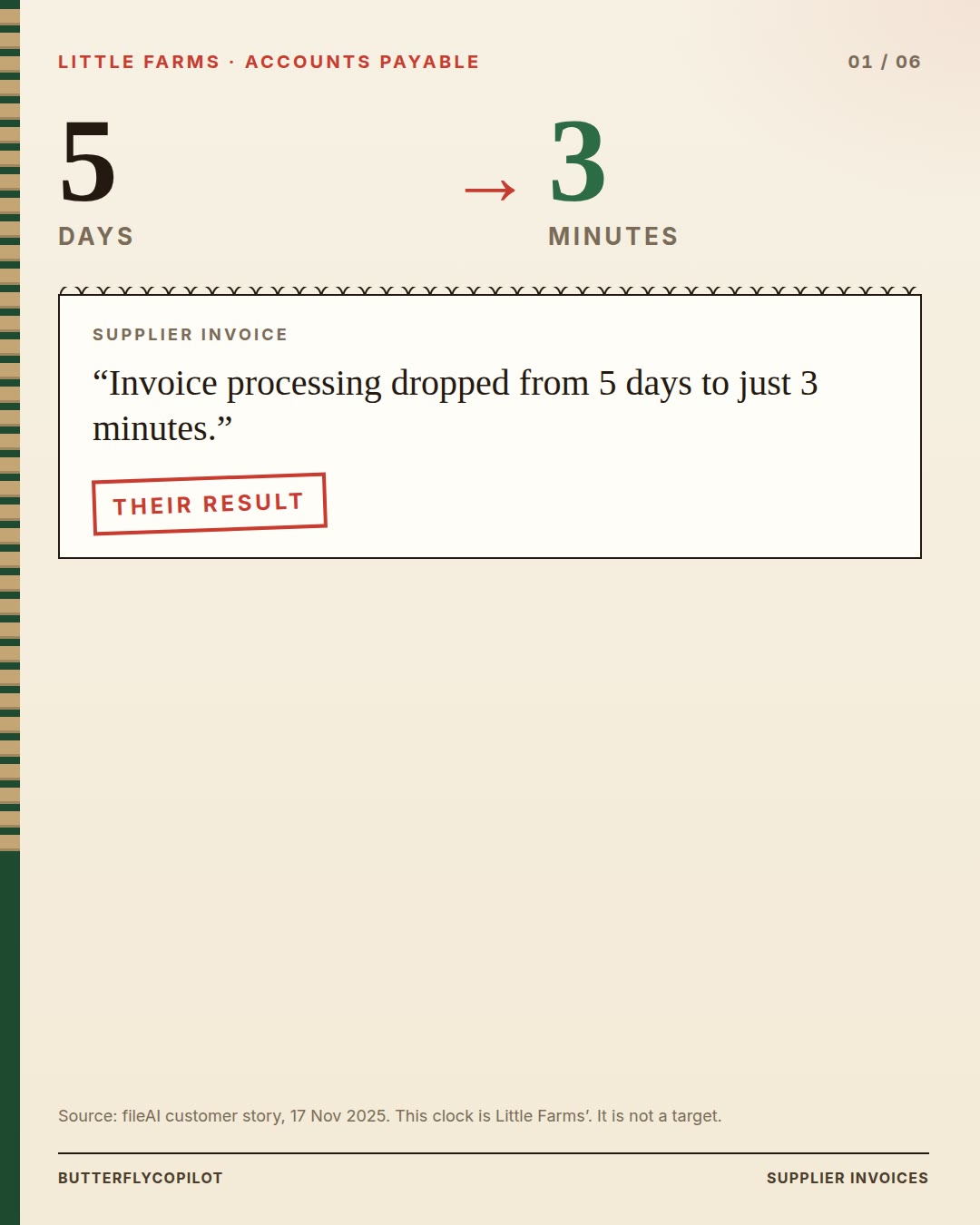
Then the clock moved. Invoice processing dropped from five days to three minutes. 100+ staff now use the mobile app every day to process and review invoices, and the finance team was freed to focus on strategy. Those figures are from fileAI’s own customer story. They belong to this rollout. A grocer with a shorter list of suppliers does not inherit them by switching a tool on.
Joe Stevens, co-founder and CEO, put the change in the company’s words:
fileAI transformed our accounts payable process, significantly reducing turnaround time and enabling our finance team to contribute more strategically to our business growth. It’s become an essential part of our daily operations.
The pile on the accounts desk
The interesting part of a premium grocer’s accounts payable is not the software. It is Tuesday.
Tuesday’s invoice is not a stationery bill. A carton of tomatoes is a weight, a price that moved since the last order, a delivery that came in short, and a credit note on Thursday because a tray spoiled. The same herb wears a different code on the next farm’s PDF. Do that across a growing chain of markets and cafes, and a manual desk stops being a desk. It becomes the bottleneck the company grows into.
Generic tools that would have left the work in inconsistent, siloed workflows were turned down. The invoices had to land in Microsoft Dynamics, and the reading of an invoice had to cope with a perishable line and a price that had changed.
What actually changed
The job is a straight line, and it is narrower than “AI in the back office” sounds.
The invoice is read. The data is extracted, classified, and validated. Each line is mapped to the internal SKU. When a price moves, finance and procurement hear about it at the time, not at month-end. The entry flows into Dynamics. A person reviews it on the phone. The same workflows were extended to acquired brands, Starter Lab among them.
The step they refused to delete is the one worth copying. A person still reviews. 100+ staff use the mobile app every day to process and review invoices, and finance was freed for strategy. The model prepares the entry. A human still owns it.
What they have said they want next is spend analytics and forecasting, and automation across procurement and contract management. That is a plan. It is not a result.
How a line gets through
A supplier invoice arrives
        ↓
It is extracted, classified, and checked
        ↓
The line is mapped to the SKU you already stock
        ↓
A price that moved goes to finance and procurement
        ↓
A person reviews the entry
        ↓
It flows into Microsoft Dynamics
Ready for a person is the product they kept. The entry can flow into Dynamics, and a member of staff still reviews it. Paying the supplier is a different job from reading the invoice. The instruction file below refuses that second job.
The hard parts
Perishable SKUs are the business, not a corner case. One kitchen has one herb. The inbox has several codes, several units, and a carton that is really five kilograms. A mapping that guesses has moved the error from the clerk’s spreadsheet into the stock account. The useful map is the one a person confirmed. A suggestion can sit on the screen. It should not become a SKU because the model was eager.
Price creep is a morning problem. A few cents on a kilogram, across a week of deliveries, is the margin on the thing you sold today. An alert that waits for the month-end file is a story about the past. The alert that helps names the supplier, the item, the price you agreed, and the price on this bill, and it reaches finance and procurement while someone can still ask what changed. Quietly accepting the higher number, because the rest of the invoice looked tidy, is how the list stops being the list.
A new brand is a new pile of paper, not a new project. Starter Lab went onto the same workflow. A smaller group copying that does not need a second product. It needs the new outlet’s approver, its cost centre, and a week of shadow running before anyone trusts the queue. The first shop’s price list is not automatically the bakery’s.
Keep the human on the approval. Lights-out accounts payable is how a wrong bank account gets paid, and how a spoiled tray becomes a number nobody looked at. Little Farms kept the review, at a scale of 100+ people a day, and gave finance the strategic work back. The instruction file below is stricter than a slogan: version 1 will not post a bill a named person has not approved, and it will not pay anyone at all.
What a smaller group should steal
If you run markets, cafes, restaurants, or a food distributor, and the invoices still land in an inbox for someone to type, the week can look like this:
One outlet, and the ten suppliers who invoice you most
        ↓
Your supplier list, your SKU map, your price list, your approvers
        ↓
Email, a photo from the outlet, or a PDF the portal already sends
        ↓
Arithmetic, tax, duplicate, price, and what was actually delivered
        ↓
A person on a phone approves, fixes, or rejects
        ↓
A bill is ready for the accounts system. Nobody has been paid.
Steal the loop, not the clock. Five days to three minutes is what fileAI reported for Little Farms. It is not a line for your proposal, and it is not a saving to turn into wages. Time your own desk. How long from the invoice arriving to a person approving it. How often a line is an exception. How many price changes you catch. How many duplicates you stop.
What the instruction file will make an agent do
The file below is the brief. It is not Little Farms’ fileAI tenant, and it is not their price list. The public story does not include a tolerance, a match rule, or a GST rate. Those are blanks you fill. They are not settings you borrow.
It will make the agent:
- Refuse to run until you name the business, the currency, the GST rate your accountant uses, the approvers, the inboxes, and the outlets, and refuse again while a sample row is still in the file.
- Read an invoice from email, from a photo an outlet employee takes, or from a PDF a portal has already dropped. It will not store a supplier-portal password.
- Extract the header, the lines, and the tax, with a confidence on each field. A blurry photo becomes an empty form. It does not become a guess.
- Match the supplier and the SKU from files you wrote. An unknown line waits. A near match is labelled a suggestion. The map learns only after a person confirms it.
- Compare the price with your price list. Above the tolerance you typed, finance and procurement get an alert, and a person without permission cannot approve it. The invoice price is not rewritten down to the list.
- Use a purchase order and a goods receipt when you have them, and the price list when you do not. Catch weight, a short delivery, and a credit note for spoilage each have a rule. A carton does not become a kilogram without a factor a person confirmed.
- Stop on a duplicate invoice number. Stop harder when the bank details on the bill do not match the hash you already verified. It will not update those bank details, and it will not email the supplier about them.
- Show the bill on a phone: the original, the lines, the variance, and approve, fix, or reject. Version 1 does not post to the accounting system without that approval. There is no button that pays.
- Export a neutral bill for Microsoft Dynamics, Xero, QuickBooks, SQL Account, or AutoCount, after you check the version you actually run.
The tests are in the file. A duplicate. A changed bank account. A price above the list. An unknown SKU. A carton with no conversion. A spoilage credit. A blurry photo. A tax figure that does not match. A short delivery. An outlet that is not yours. If a payment is created, the test fails.
That is the whole implementation. The agent prepares a bill a person can defend. It does not send the money.
The instruction file
Here is the brief: the role, the sheets, the three ways an invoice arrives, the extraction schema, the match rules you type yourself, the price alert, the phone review, the export, the checklist for a new outlet, and the tests that decide when a bill may be approved.
Replace every REPLACE line. Delete every EXAMPLE row. Then let it run on last month’s invoices before it watches a live inbox.
Sources
The outcome figures in this article come from fileAI’s customer story on Little Farms. They are the vendor’s account, not an independent audit, and they are not a forecast. The company description and the early history come from Little Farms.
- fileAI, Charmaine Liew, “Little Farms case study,” 17 November 2025. Heavily manual accounts payable across hundreds of suppliers and thousands of SKUs. Invoices took up to 5 days to process, creating backlogs and delaying payments. Invoice processing dropped from 5 days to just 3 minutes. 100+ staff use the mobile app daily to process and review invoices. Extract, classify, and validate. SKU mapping. Real-time price-change alerts to finance and procurement. Microsoft Dynamics. The same workflows extended to acquired brands, including Starter Lab. Generic tools that would create inconsistent, siloed workflows were not the fit. Next intent: spend analytics and forecasting, and procurement and contract management. Joe Stevens, co-founder and CEO.
- Little Farms, “About us.” Singapore’s friendly neighbourhood market and cafe: all-natural and organic produce, meats, seafood, dairy, and grocery. First store at Valley Point Shopping Centre, February 2016. Online orders later that year. First cafe in 2017. Tanglin Mall flagship with the Starterlab bakery.