
How Lumens Cut Car-Check Time by 75% with AI
IMDA prints a 75% cut in vehicle processing time. The Business Times prints a 10-minute paper check, and Sun Zhibo’s estimate of more than S$300,000 a year. The job-matching percentages are still expected.
ButterflyCopilot
0105
What they achieved
Lumens’ public record on the car check has a before, a processing-time cut, and a separate estimate. Each one has its own sentence.
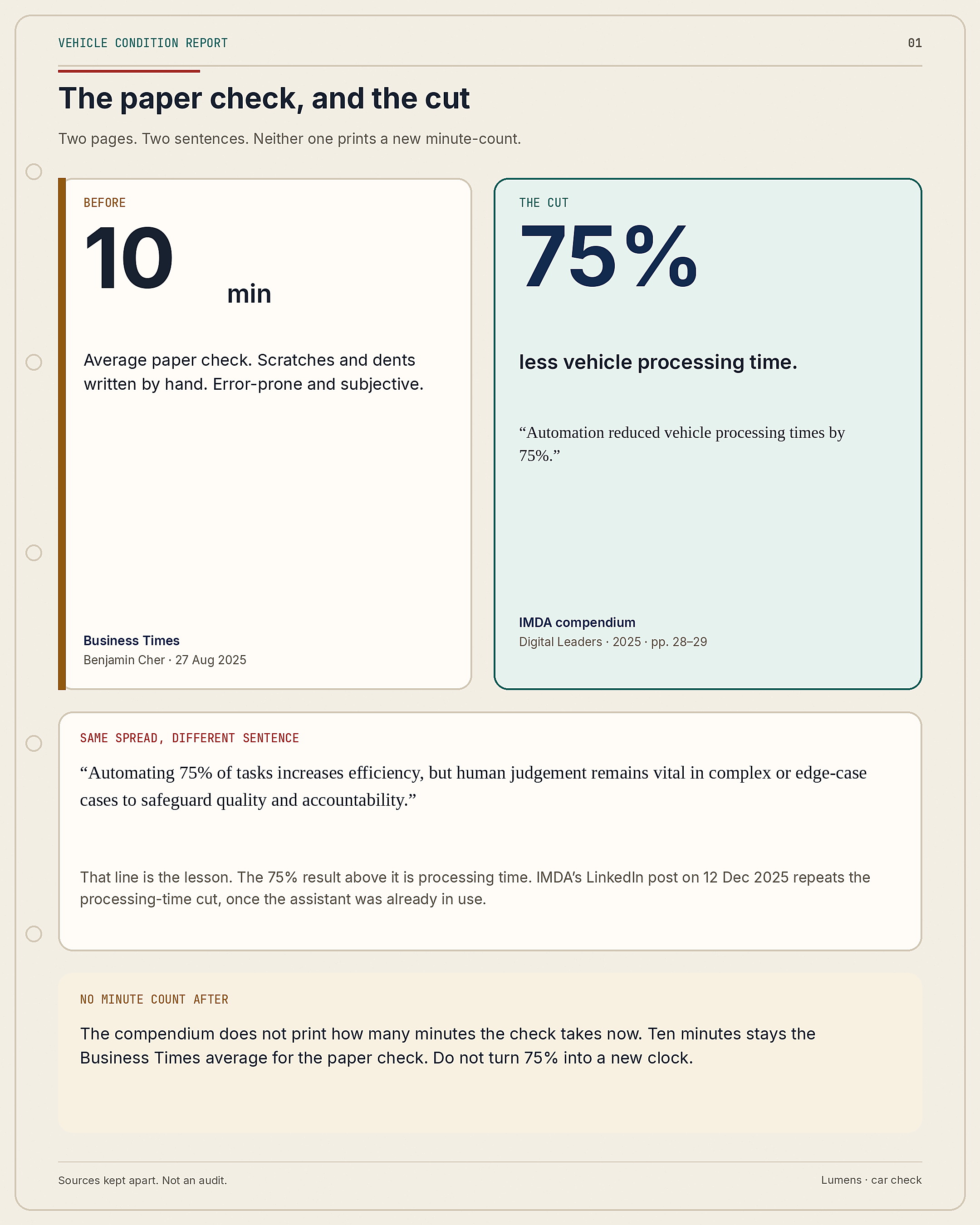
The before is in The Business Times, Benjamin Cher, 27 August 2025. A car check took an average of 10 minutes. Scratches and dents went onto paper forms. The check was error-prone and subjective.
The cut is in IMDA’s “Digital Leaders: Transforming Vision into Value” compendium (2025), pages 28–29. The gains are described as immediate. Automation reduced vehicle processing times by 75%. Standardising inspection quality let Lumens handle higher vehicle volumes without increasing manpower. The page does not print the new duration in minutes. A quarter of ten minutes is arithmetic a reader can do. It is not a figure on that page.
A lesson on the same spread uses 75% in a different sentence: “Automating 75% of tasks increases efficiency, but human judgement remains vital in complex or edge-case cases to safeguard quality and accountability.” “Vehicle processing times by 75%” is the result. “75% of tasks” is the lesson. They sit next to each other. They are two sentences.
IMDA’s LinkedIn post on 12 December 2025 says the assistant now guides staff and customers through structured photo taking. It says the assistant has already helped cut 75% in processing times and raised inspection quality across the board. That is the processing-time cut, said once the assistant was being described as already in use. The Business Times piece, on 27 August 2025, said the tool was slated for release toward the end of 2025. Quote the date you are standing on.
The money line is an estimate, and it is Sun Zhibo’s. He is chief product officer. The Business Times quotes him: “We estimate we will save more than S$300,000 annually, and this is just on the operational efficiency front.” “We estimate” and “will save” are in the sentence. The saving is not presented as a counted result, and the sentence limits it to operational efficiency.
The same article says customers doing their own checks can quadruple operations-staff productivity, so staff can serve up to four customers at once. “Can” and “up to four” are the words. The compendium does not print the four-customer line. The newspaper does not print the 75%.
The job-matching figures are a different system, and they are still ahead of the result.
The compendium says Lumens will be introducing a rules-based Job Matching Service, separate from the car-rental assistant. It will match jobs from parameters such as traffic, driver location, and pricing. A dynamic pricing module is described as in development. The system is expected to increase job acceptance rates by 20% and boost job-matching productivity by 300%. “Will be introducing” and “is expected to” are on the page. Those percentages belong to that matcher. They are not a result of the photo check, and they are not a result the page says has already been counted.
A later block on the same spread lists what the transformation delivered: standardised and accurate vehicle condition reporting, faster and more reliable customer service, and higher driver earnings through smarter job allocation. The earnings line sits in that list. The only numbers attached to job matching are the expected 20% and the expected 300%. Leave them in the expected column.
What they do
The compendium dates Lumens Group to 2014, a pioneer in Singapore’s private-hire vehicle leasing, grown into what that page calls one of the largest and most diversified mobility solution providers. It manages a fleet of over 5,000 vehicles across three lines: private hire, corporate, and personal vehicle leasing; vehicle trading and financing; and mobility-as-a-service. The company’s LinkedIn page says it started with four cars.
The Business Times, on 27 August 2025, says about 6,000 cars, and calls Lumens one of the largest fleet operators in Singapore. The short-term rental brand is Lylo, set up in 2020. “Over 5,000” is the compendium. “About 6,000” is the newspaper. Each fleet number stays with its own source.
The pages this piece relies on do not print a headcount or a revenue. The record supports an established mid-size mobility operator. The people named in public are Tan Tze Loong, director; Chiam Soon Chian, chief operating officer; and Sun Zhibo, chief product officer.
The bottleneck the compendium describes is scale against a manual desk. Tan Tze Loong’s line: “Manual processes were holding us back from scaling effectively. We needed intelligent solutions that could support our fleet’s growth and still deliver reliable service.” Manual checks and paperwork created inefficiencies, inconsistencies, and delays. Inspectors relied on personal judgement. Claims and data processing were still on paper.
A second pile sits beside the car check. Assignments for business-to-business mobility services went out as WhatsApp broadcasts, with basic location awareness. The compendium’s result for that pile is slow responses, mismatched jobs, and high cancellation rates. That pile is what the planned job matcher is for. The inspection assistant is for the car check.
Sun Zhibo’s reason for starting with the check, in the Business Times: “A good example at the intersection of operational efficiency and customer experience is car checks – it is critical because it carries financial implications for both Lumens and our customers.”
What they put in front of the check is a Car Rental GenAI Assistant. The compendium says it was built on Microsoft Azure. The Business Times says the work sat under IMDA’s GenAI x Digital Leaders initiative. Lumens has an in-house technology team. The same article says the team lacked the expertise to build this alone. The pages name Microsoft Azure, Azure Document Intelligence, and AI Vision. They do not name a further product vendor.
How they do it
The compendium’s description of the assistant is specific.
The system guides people through a structured photo-taking protocol, so the vehicle condition is documented the same way each time. Photos are processed through Azure Document Intelligence. AI Vision detects and catalogues damage. Cloud-native APIs sync in real time with the backend fleet management system.
The Business Times describes the same loop from the counter. The app guides customers to photograph the car from different angles. The model compares those frames with the photos taken at collection. Where it finds damage, it checks the rental insurance the customer bought and calculates additional repair costs. It also reads the odometer and the fuel gauge, including whether the tank was brought back to the level at collection. The check is integrated with billing, and it is synced with the fleet management system.
Two pages, one inspection. The compendium names the Azure services and the fleet sync. The newspaper names the angles, the comparison, the insurance calculation, the two gauges, and the billing link.
The control is printed on the compendium, in the lesson already quoted. Efficiency goes up when tasks are automated, and a person stays on the complex case and the edge case, so quality and accountability survive. A second lesson on that page is the order of work: start with vehicle inspections, then expand to job matching. The inspection assistant is the phase tied to the processing-time cut. The job matcher is the phase still written as upcoming.
Chiam Soon Chian’s line, on the compendium: “These intelligent solutions have transformed our operations. We’re poised to scale our mobility ecosystem while delivering trusted experiences for drivers and customers.”
The Business Times also names a later interface. A chat box to guide people through collection and return. In August 2025 that was a next step, and the assistant itself was still slated for release toward the end of the year. On 12 December 2025, IMDA’s LinkedIn post describes the assistant as already guiding staff and customers through structured photo taking. The chat box, the photo assistant, and the job matcher stay in the sentences that name them.
The training material the newspaper describes is specific to this operator: more than ten years of paper car-check records, and the damage photos that came with them. That pile is Lumens’. A smaller desk that copies the shape does not inherit it.
The hard parts
75% of processing time and 75% of tasks are neighbours. The result line is vehicle processing times, reduced by 75%, on the compendium, and a 75% cut in processing times on IMDA’s December LinkedIn post. The lesson line is automating 75% of tasks. Use the sentence from the page in your hand.
The after-clock in minutes is not on the page. Ten minutes is the Business Times average for the paper check. The compendium prints the percentage. It does not print a new minute count.
More than S$300,000 a year is Sun Zhibo’s estimate. “We estimate we will save.” He limits the sentence to operational efficiency. It is his forward figure. It is not an audited saving, and it is not a forecast for another fleet.
“Up to four customers” is the newspaper’s productivity line. Self-checks can quadruple operations-staff productivity, so one person can serve up to four customers at the same time. The compendium’s manpower line is a different sentence: higher vehicle volumes without increasing manpower. Keep both wordings where they were printed.
The fleet size depends on the page. Over 5,000 vehicles is the compendium. About 6,000 cars is the Business Times. Leave both numbers on the pages that printed them.
20% and 300% are expected, and they belong to job matching. A rules-based service Lumens will be introducing. Expected job-acceptance rates up 20%. Expected job-matching productivity up 300%. The photo assistant has the 75%. The matcher has the expectation.
The body is not one shape. The Business Times says a hard part was identifying the car model and the manufacturing year, because the body changes. A mark on one year’s panel is not the same outline as the next year’s.
The dashboard is not one layout. Different instrument layouts. Analogue gauges and digital gauges. A needle the model is unsure of is a reason to stop. It is not a litre, and it is not a kilometre, until a person has read it.
Light, weather, and angle change the photo. The newspaper names all three as part of the training problem. A dark frame, a wet panel, or the wrong corner is a retake. It is not yet a damage finding.
Spoofing means the photos have to be this vehicle. The check has to know the frames are the car on the booking, not a cleaner car in the next bay. The Business Times calls that spoofing detection.
The model was trained on their own decade of paper. More than ten years of car-check records and damage photos. That is the newspaper’s account of why the loop could be trained. A smaller shop starts with an off-the-shelf multimodal model and a person on every draft.
A figure that reaches the customer before a person has read it is a different product. The newspaper says the model checks the insurance the customer bought, calculates repair costs, and sits on the billing path. The compendium’s lesson keeps a person on the edge case, because the check moves money for the company and for the customer. The instruction file below drafts the amount. A named person approves it. The file does not charge a card, and it does not speak a final figure first.
Another fleet does not inherit 75% or S$300,000. The percentage is Lumens’ published processing-time cut. The money is Sun Zhibo’s estimate. Neither number is a target in the file.
How a smaller business can copy it
The useful shape, if you rent cars, lease vans, hire equipment, or run a small fleet, and someone already walks around the vehicle with a phone:
Collection or return starts on the checklist for that vehicle class
        ↓
Each shot is refused if it is dark, blurred, or the wrong angle
        ↓
A vision step reads damage, the odometer, and the fuel gauge
        ↓
On return, only damage missing from the collection set is listed
        ↓
A draft maps that list, plus fuel and mileage, to your rates and their cover
        ↓
A named person approves, edits, or stops the draft
        ↓
The customer hears an amount only after that approval
Staff-assisted first, on a form. A customer self-check is the same checklist on a phone, with the same stops. WhatsApp can carry the photos later, on the official business platform, after the form has passed the tests.
What the instruction file will make an agent do
The file below is the brief. Hand it to the agent that builds or runs the inspection. It is written as orders, with the blanks marked REPLACE.
It will make the agent:
- Refuse to open a counter until you name the staff owner, the inbox, and real files for the vehicles, the photo checklist, the repair rates, the cover plans, and the rentals.
- Run one inspection at a time, collection or return, on a staff form first. Add WhatsApp only after that form passes the tests.
- Walk the checklist for that class: front, rear, sides, corners, wheels, the roof when the sheet requires it, the dashboard, the interior, the plate, and the VIN when you store one. Reject a dark, blurred, or wrong-angle shot with a retake line. After three failures on the same shot, hand the case to a person.
- Match the plate photo to the plate on the booking. Match the VIN when the vehicle row has one. A mismatch is a spoof suspicion. It goes to a person. It does not become a charge.
- Send each accepted photo to the multimodal model you named. Store panel, damage type, severity, where it sits, and a confidence. Azure AI Vision, a GPT-4o-class model, or Gemini can fill that step. The file does not require Lumens’ stack.
- Read the odometer and the fuel gauge from the dashboard photo. Under the confidence you set, the reading is empty. An analogue needle under your analogue threshold goes to a person. The agent does not guess the kilometre.
- On a return, list only damage that was not on the locked collection set. A dent that was already there is not a new line. If the collection set is missing, the agent does not invent a clean car.
- Build an internal draft from one matching repair-rate row per new line, the cover plan on the booking, the fuel shortfall, and any mileage over the allowance. Two matching rows, or none, means that line has no figure. The total stays blank until the lines that need numbers actually have them.
- Keep the draft off the customer’s screen, and off any card charge, until a named person sets the approved amount. The customer message before that point carries a reference and no currency.
- Send an accident, an injury, or the police, a dispute, a spoof suspicion, and a low-confidence read to a person at once. Copy a coverage sentence only when that sentence is written on the plan sheet.
The acceptance tests are in the file. A dark photo that must be retaken. A plate that does not match. A new scratch that may be drafted. A dent that was already on the collection set and must not be charged. Fuel at half, against a full tank at collection. An analogue gauge with low confidence. A customer who says “I didn’t do that.” An accident mentioned in the thread. If a customer-facing reply contains an amount before a person has approved one, the test fails.
That is the whole implementation. The agent does not get to promise 75%, or S$300,000, on the way.
The instruction file
Here is the brief for your agent: the role, the sheets, the staff form and the later WhatsApp path, the state machine, the quality gate, the vision JSON, the return-versus-collection compare, the draft arithmetic, the report, the hard stop before money, and the tests that decide when a customer may see an amount.
Replace every REPLACE line. Delete every SAMPLE row. Then let it run on old handovers before it stands at a live counter. Baseline your own minutes per check. The Business Times figure of 10 minutes belongs to Lumens.
Sources
Figures in this article come from IMDA’s 2025 digital-leaders compendium, from The Business Times, and from IMDA’s and Lumens’ LinkedIn posts. They are not an independent audit. The 75% processing-time cut is the inspection assistant, on the compendium and on IMDA’s December 2025 post. “75% of tasks” is the compendium’s lesson. The 10-minute paper check, the four-customer line, and the training on a decade of paper records are the Business Times. More than S$300,000 a year is Sun Zhibo’s estimate in that article. The 20% and 300% figures are the expected results of a separate rules-based job matcher.
- IMDA, “Digital Leaders: Transforming Vision into Value” (2025), Lumens Group, pages 28–29. Since 2014, a fleet of over 5,000 vehicles across private hire, corporate and personal leasing, vehicle trading and financing, and mobility-as-a-service. Tan Tze Loong on manual processes. Paper checks, personal judgement, paper claims, and WhatsApp job broadcasts with slow responses, mismatched jobs, and high cancellations. The Car Rental GenAI Assistant on Microsoft Azure: structured photo-taking, Azure Document Intelligence, AI Vision for damage, real-time sync to fleet management. Vehicle processing times reduced by 75%. Higher volumes without increasing manpower. The lesson that automating 75% of tasks still leaves human judgement on complex and edge cases. The phased path from inspections to job matching. The rules-based Job Matching Service Lumens will introduce, expected to raise job acceptance by 20% and job-matching productivity by 300%, with a dynamic pricing module in development. The results list: standardised condition reporting, faster customer service, and higher driver earnings through smarter job allocation. Chiam Soon Chian on the change in operations. imda.gov.sg
- The Business Times, “Singapore car rental business Lumens taps AI to boost productivity and lower costs,” Benjamin Cher, 27 August 2025. About 6,000 cars, one of the largest fleet operators in Singapore, short-term brand Lylo set up in 2020. A paper check of about 10 minutes. Built under IMDA’s GenAI x Digital Leaders initiative. An in-house technology team that lacked the expertise to build this alone. Guided angles, comparison with collection photos, rental insurance used to calculate repair costs, odometer and fuel-gauge reads, billing integration, fleet sync. Self-checks that can quadruple operations-staff productivity, up to four customers at once. Sun Zhibo’s estimate of more than S$300,000 a year, on operational efficiency. Model year and body shape, dashboard layouts, analogue versus digital gauges, lighting, weather, photo angles, spoofing, and the training load. More than ten years of paper checks and damage photos. Slated, as of that article, for release toward the end of 2025. A later chat box for collection and return. Sun Zhibo on why the car check carries financial implications for Lumens and for the customer. businesstimes.com.sg
- IMDA on LinkedIn, 12 December 2025. The assistant now guides staff and customers through structured photo taking. It has already helped cut 75% in processing times and raised inspection quality across the board. linkedin.com
- Lumens Group on LinkedIn. The company page says the business started with four cars. The linked post is the company’s repost of IMDA’s December 2025 note. linkedin.com