
How Masteel Cut Rebar Counting Time by About 80% with AI
A bundle of rebar used to be counted with a finger and a sheet of paper. A phone counts the cut face. A person still lets it leave.
ButterflyCopilot
0106
A lorry should not have to wait on a tally sheet.
Malaysia Steel Works (KL) Bhd, Masteel, makes the steel that goes into Malaysian concrete. High-tensile deformed bars, mild steel round bars, and the billets those bars are rolled from. It is listed on the Main Market of Bursa Malaysia, and it is one of the country’s top five steel producers. The mills are in Selangor: Bukit Raja in Klang, and Petaling Jaya.
Before a bundle left the yard, someone at QC counted it. Every bar. By eye. A mark on a sheet, then the number written out again by hand. It was slow. It was easy to get wrong. And the pile of work grew whenever the mill did, because the counting grew with the tonnes. A wrong number became a customer complaint, a stock figure that did not match the yard, or an argument about what had actually gone on the lorry. If the customer rang back, there was nothing digital to open. There was a sheet, if the sheet was still there.
That station is where the counting changed. PixeVision, an AI-vision firm in Petaling Jaya and a spin-off of ASPL (Malaysia) Sdn Bhd, put See.AI on the phones the workers already carried. A web app in the browser. Nothing to install. No camera bolted over the line. The case study places the work at Bukit Raja.
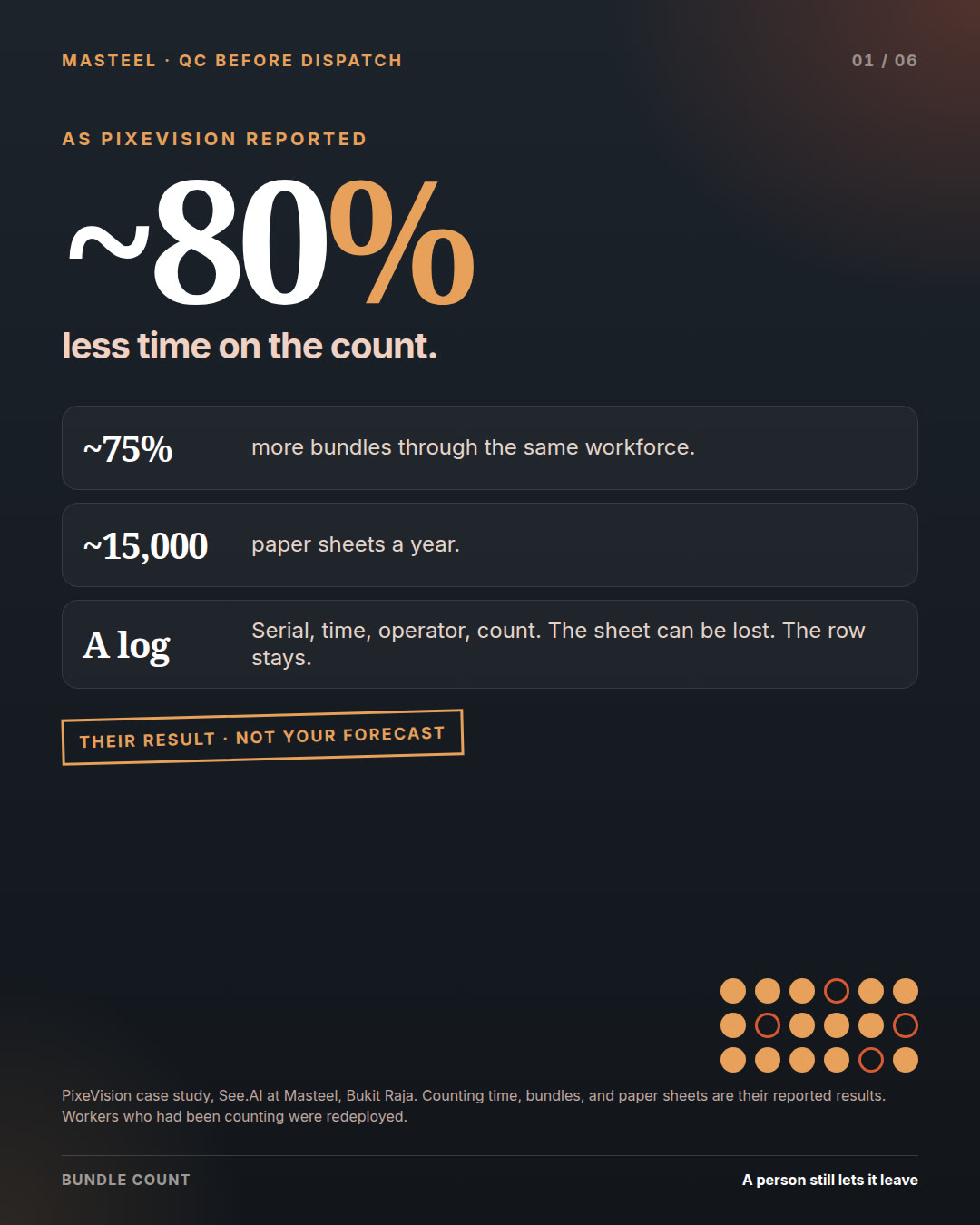
PixeVision reports the results, and they belong to this deployment. Counting time down by about 80%. About 75% more bundles through the same workforce. Around 15,000 paper sheets out of the year. The people who had been counting, redeployed. And a record on the bundle: a serial number, a time, an operator, a count.
A yard with one bay does not inherit those figures by pointing a phone at a stack. The habit underneath them is what travels.
What they put in a worker’s hand
The old count had three moves, and all three were a person. Find the next bar with your eye. Mark it. Write the total down before you forget where you were. A dense bundle makes that last move worse. You lose your place, you start again, the lorry idles, and the next bundle is already on the table.
See.AI takes the same spot at the end of the line and drops the paper. The worker opens the web app. They hold the phone over the cut face, the cross-section where every bar shows as an end. The model picks out each end and returns a count in seconds. The number lands on a cloud dashboard while the worker is still standing there: serial, timestamp, operator id, count. Management can open the same record without asking someone to find a sheet.
No new hardware is the part owners usually skip past, and it is the part that made the station possible. The phones were already in the yard. The browser was already on them. A fixed camera, a gantry, and an installation crew were not the project.
How a face becomes a number
Open the web app on the phone already in the pocket
        ↓
Point it at one bundle’s cut face
        ↓
The model marks each bar and returns a count, in seconds
        ↓
Serial, time, operator, and count land on the dashboard
        ↓
A confident match is the record
        ↓
A doubtful photo does not pretend to be finished
The log is the piece worth copying in full. A disputed load used to be a memory and a missing sheet. It is now a row a second person can open: who counted, when, which bundle, what number. Traceability here is not a slogan on a sustainability page. It is the answer to the phone call from the site.
The same shape works off a steel mill. A pipe stockist counting ends in a hex bundle. A timber yard counting rounds on a face. A line of cans. A stack of cartons where the flaps make a grid. If a person can see the units on one face, a detector can be asked to see them too. The SKU and the size still come from the order and the tag. The photo is a count of ends. It is not a caliper, and it is not a mill certificate.
When the model is wrong
A count that is fast and silent is how you automate the old mistake. Dense bars, an end hidden under a strap, a photo with a shadow across the face, a stack that is not the stack you usually see. The number comes back a little off, and if the screen treats it as finished, the bundle leaves.
The count is not treated as finished when the photo is doubtful. When confidence is low, the result is flagged, and the operator looks before anyone approves it. It does not hand the whole bundle back as a fresh tally. It makes a masked image: the bars it has already counted are hidden, and the uncertain ends stay visible. The operator checks those, approves, and the log keeps a recount flag. The doubt is part of the record, not a smudge that gets rewritten.
That is the lesson to take into a smaller yard. Buy the doubt, not only the speed. A recount that covers the bars already settled is a few seconds. A recount that starts from zero, on paper, under a waiting driver, is how the station became a bottleneck. And a confident number that does not match the order is not a prompt to type the order over the top of it. The bundle waits. Someone named on the sheet decides whether the order was wrong, whether the customer has accepted the difference, or whether a person has counted the face again with a witness. Then the dispatch note can say the load is clear. Until that happens, the note says held, and the print button stays quiet.
Masteel’s own FY2025 reporting describes a wider paper habit, separate from this station: digital documentation in place of printing, and a target to cut paper consumption a further 3% from the FY2025 baseline. That reporting does not mention this tool. The 15,000 sheets are PixeVision’s figure for the QC tally. They are not the company’s paper target, and they are not a number to lift onto another yard’s slide.
What a smaller yard should steal
If you ship rebar, pipe, timber, cans, cartons, or any other bundle a person currently counts by eye, the first month is one station. Not the yard.
One line, one product family, a supervisor who already stands there
        ↓
The order’s expected count, written down before the photo
        ↓
Ten days to label ends, or to build a small set the supplier did not train on
        ↓
Two weeks of shadow: phone count beside the hand count
        ↓
Dispatch still follows the hand
        ↓
The supervisor reads every disagreement, then decides go-live for that line only
Time your own station before you change it. Seconds per bundle, with a stopwatch, thirty of them. Bundles cleared in a shift, with the same crew. How often the count disagrees with the order. How often the photo has to be taken again. How many tally sheets you actually used that week. Quantity complaints, if you have been writing them down. After the line is live, time the same things. Those pairs are your result. About 80% less time, about 75% more bundles, and around 15,000 sheets are Masteel’s published story, as PixeVision tells it. They are not a line for your proposal, and they are not a saving to turn into ringgit.
What the instruction file will make an agent do
The file below is the brief. It is not See.AI. It is not Masteel’s dashboard, model, or thresholds. None of that wiring is public. The blanks are yours.
It will make the agent:
- Refuse to run while a
REPLACEline is empty, or while anEXAMPLErow is still in a live sheet. - Offer one phone page, nothing to install, and a checklist for the photo: one bundle, face filling the frame, phone square to the cut, light on the ends, no person’s face.
- Count with one approach the yard picks: a YOLO-family detector it trains on its own ends, a hosted vision API on a host it has named, or a vendor export. A vendor number with no boxes cannot clear itself.
- Keep a count record with the bundle serial, the SKU and size, the expected count from the order, the AI count, the confidence, the recount flag, the operator, the time, and the photo.
- Mask the ends it is sure about, ask the operator for the ones still showing, and leave the recount flag on that row.
- Hold the bundle when the final count misses the order. The operator cannot type the order over the model. A named supervisor releases, with a reason.
- Leave dispatch on the hand count until shadow is over. The agent cannot type the supervisor’s name, and it cannot ship.
- Write a daily file: holds, recounts, retakes, median seconds. No comparison with another company’s figures.
- Start on one line, sit beside the manual count, and go live on that line only after the tests and the acceptance set pass.
The tests are in the file. A dark photo. Two bundles in one frame. A bar cut off by the edge. A phone held at an angle. An unknown serial. An operator trying to edit the model’s count. A low-confidence image approved with the remainder left blank. A match that is still in shadow. A vendor that sends a number and no boxes. A note that says to ignore the rules and ship. A release with no reason. A training run that pastes two bundles into one picture. If the agent clears any of those by inventing a count, the test fails.
The instruction file
The brief has the role, the sheets, the photo rules, the labelling plan, the mask, the hold, the dispatch note, the thirty days, and the tests that decide when a dispatcher may trust the row.
Replace every REPLACE line. Delete every EXAMPLE row. Let it sit beside the real station, next to the hand count, before anyone treats a phone number as the quantity on the lorry.
Sources
The outcome figures are PixeVision’s reported results for this Masteel deployment. They are not an independent audit of a baseline, and they are not a forecast for another yard. The company description is from Masteel’s own reporting. The FY2025 paper target is a separate sustainability note. It does not describe this tool.
- PixeVision, “AI rebar counting for Malaysia Steel Works (Masteel).” QC before dispatch. Manual count by eye, paper tally, handwritten record. See.AI as a cloud web app on existing smartphones, no installation, no fixed cameras. Phone at the bundle cross-section, count in seconds, dashboard with serial number, timestamp, operator id, and count. Low-confidence flags for dense bundles, occlusion, and poor images. Masked recount, operator approval, recount flag. Reported results: counting time reduced by 80%, production output up 75% as more bundles with the same workforce, 15,000 paper sheets a year, workers redeployed, traceability. Location: Bukit Raja, Selangor.
- PixeVision, “See.AI vision inspection.” The product page groups the same counting results under steel rebar for publicly listed steel companies. This article uses the Masteel case study for the figures, not the other industries on that page.
- PixeVision, “About.” Petaling Jaya AI-vision firm, spin-off of ASPL (Malaysia) Sdn Bhd.
- Masteel, “Annual Report 2025” and the annual reports index. Main Market listed integrated steel maker. High-tensile bars, mild steel bars, billets. Plants at Bukit Raja, Klang and Petaling Jaya. The report points to the stand-alone Sustainability Report 2025.
- Masteel, “Waste management.” FY2025 paper use cut through digital documentation, with a further paper-consumption reduction target of 3% from the FY2025 baseline. This page does not mention the counting tool.