
How Minsawi Industries Lifted Oil Extraction with AI
A 41-year-old mill in Kuala Kangsar kept its presses and added sensors, cameras, and a system that recommends the next move. Extraction went from about 17.85% to 19.02%.
ButterflyCopilot
0105
In Kuala Kangsar, Perak, a palm oil mill that had already been running for 41 years was fitted with sensors, cameras, and a layer of software that watches the process and recommends the next move.
Nobody retired the plant. From August 2024, Minsawi Industries Kuala Kangsar turned the mill it had into a smart mill. On 19 November 2024, Plantation and Commodities Minister Datuk Seri Johari Abdul Ghani launched it, and called it the first mill in the world to use this technology for palm oil.
The partner is Artificial Intelligence Robotics Engineering Industries, AIREI. K. Surendran, its founder and chief executive, was there. The minister said the mill had invested between RM4 million and RM5 million, and had been on the system for more than a month.
The problem
A palm oil mill is a chain of hot, wet, timed steps. Fresh fruit arrives at the ramp. It is sterilised. It is digested and pressed. The oil is clarified. Kernels are recovered. A boiler keeps the steam up. Crude palm oil sits in tanks until it leaves.
Each station already had instruments and people. What the mill did not have was one picture: fruit quality on the ramp, the steriliser recipe, oil still stuck in the fibre, oil leaving in the underflow, and the boiler's fuel, seen together while the shift was running.
Ordinary control systems watch a set point and react when a number crosses it. They do not notice a pattern building across a shift, and they do not tell you a fault is coming.
The fruit still sets a ceiling. Software cannot invent oil that was never in the bunch. The gain, if there is one, is losing less of the oil that arrived, and stopping the line less often while you do it.
What they built
The mill was instrumented, not replaced. Sensors cover temperature, pressure, amperage, and how the machines are performing, in real time. Cameras look at bunch volume, quality, and anything on the ramp that looks wrong.
The system AIREI presented covers the fresh-fruit ramp and weighbridge, the steriliser, the digester and press, clarification, the kernel plant, the boiler, the crude palm oil tanks, and a data room.
On that line it does a specific set of jobs. It analyses fresh fruit as it arrives. It selects a steriliser recipe from fruit quality. It predicts, in real time, how much oil is being left in the mesocarp fibre. It monitors oil loss in the clarification underflow. Boiler fuel control can run automatically. Flowmeters calculate the extraction rate as the shift is happening. Operations, maintenance, the store, procurement finance, human resources, and the weighbridge feed the same picture.
The company developed the technology, and the minister said it also uses some technology from Brazil.
AIREI is pursuing MyPalmGPT features for the production and maintenance teams. That work is still a pursuit.
How it works
Fruit hits the ramp. The cameras and the online analysis describe the load. The steriliser recipe follows that fruit. Through the digester and the press, the system predicts fibre oil loss while the presses are running. At clarification it watches the underflow. Flowmeters calculate the extraction rate during the shift.
This is the difference from a normal control panel. The panel sees preset limits and responds. The AI layer analyses patterns, detects anomalies, predicts faults, and recommends adjustments. In some cases it carries a response out itself. Accountability stays with the management team. They validate, adjust, or override.
Fruit at the ramp
        ↓
Steriliser recipe from fruit quality
        ↓
Press and clarification watched for oil still being lost
        ↓
Boiler and extraction rate read from live data
        ↓
Anomalies and faults surfaced as recommendations
        ↓
Management validates, adjusts, or overrides
The engineering still has to be real. Software will not rescue poor steam, a tired boiler, or instruments nobody trusts. It will report the chaos faster. Kuala Kangsar was launched as a working platform, and it still needed fine-tuning after the day of the speeches.
The results
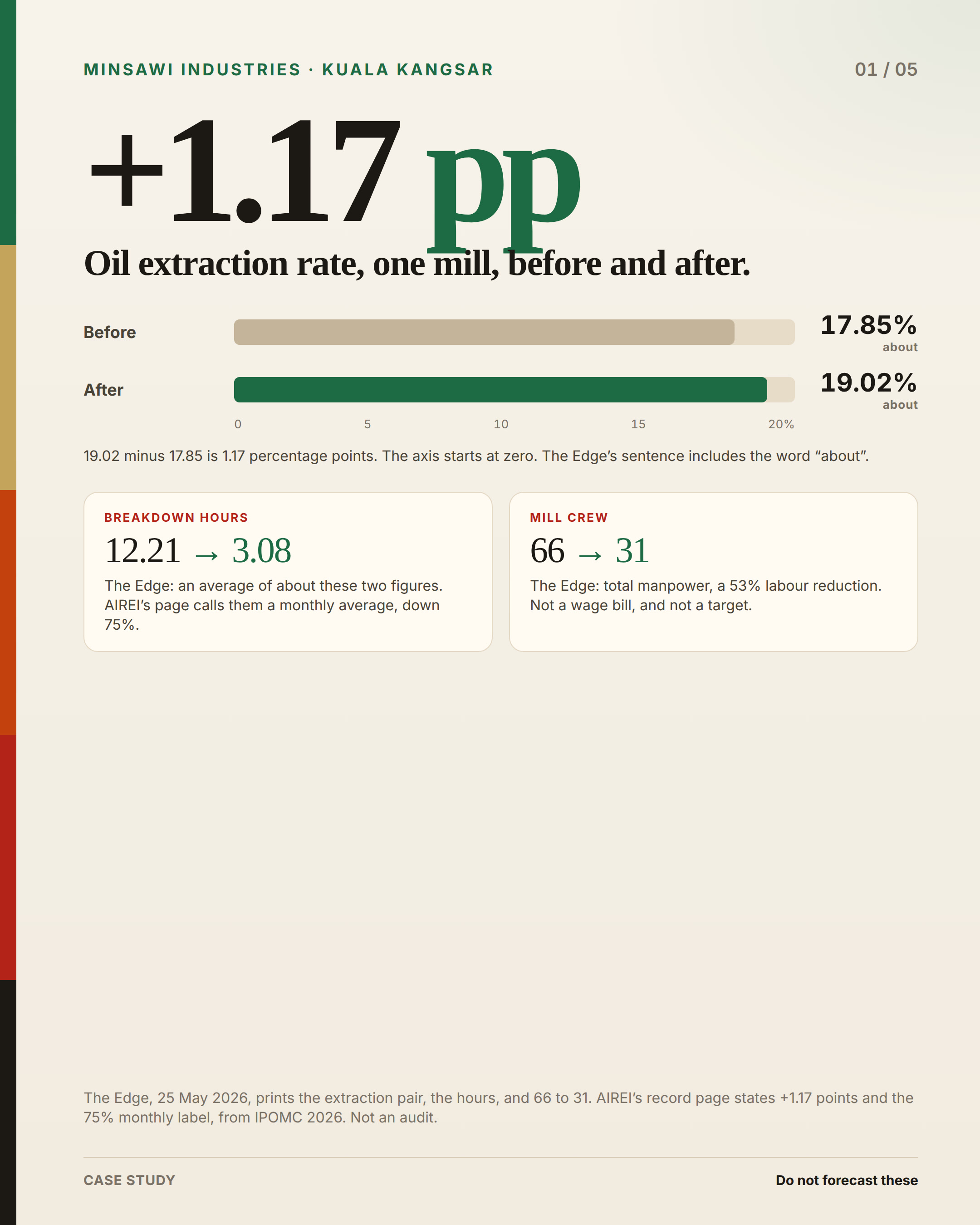
As reported by The Edge, oil extraction moved from about 17.85% to 19.02%. AIREI states the difference as 1.17 percentage points, from the figures it presented at the International Palm Oil Millers Conference in 2026. Oil losses were heading down.
Breakdown time fell from an average of about 12.21 hours to 3.08 hours. AIREI describes that pair as a monthly average, down 75%.
The crew went from 66 people to 31, a 53% reduction. A smarter mill still needs people. It needs fewer of them, and it needs them better trained, on a line that now offers recommendations as well as steam.
The technology provider has claimed a payback within two years. That line is the provider's forecast against the capital spent. It is not a set of published accounts.
A second smart mill came later. In August 2026 AIREI and the Malaysia Digital Economy Corporation launched one at Perak Motor Co's PMC Oil Mill in Teluk Intan, a 60-tonne-an-hour plant. Early results there were a 13% drop in mesocarp oil loss at the press, extraction higher by 0.1% to 0.2%, and foreign-operator dependency down 20% in the first month. Those figures belong to Teluk Intan.
What other SMEs can learn
Retrofit the plant you have. Minsawi did not wait for a new mill. Sensors, cameras, and a prediction layer went onto a line that had been running for decades. Most factories are in that position.
Engineering comes before the model. Calibrate the instruments you already trust. Get the steam right. Keep the boiler healthy. Train the operators. A model on a badly run plant just produces faster bad news.
Separate "watch and recommend" from "move the valve". Their system can execute some responses automatically, with management still able to override. A smaller plant should earn that right. Start with recommendations a shift lead accepts. Automatic fuel control is a later decision, made when you have seen the failure modes.
Score oil, stops, and people separately. Extraction, oil loss, breakdown hours, and headcount move for different reasons. A shorter stoppage chart is not, by itself, a better extraction rate. Publish them side by side, from your own sheets.
The fruit still matters. A mill does not fully control what arrives on the ramp. Claim the oil you stopped losing. Leave the rest of the bunch alone.
How to start
If you run a continuous plant and the result still depends on whose shift it is, start smaller than a full smart mill:
Calibrate the instruments you already trust
        ↓
Read steriliser, press, clarification, and boiler tags into one store
        ↓
Keep the lab extraction rate, the oil-loss samples, and the breakdown log as sheets a person fills
        ↓
The watches recommend, the crew still runs the plant, and you compare
        ↓
A named shift lead accepts or rejects each line
        ↓
Time your own extraction, oil loss, breakdown hours, and crew
The instruction file is a first version for a mid-size mill. It is our design: four stations, tags read and never written back, three watches, and a person on every line. It is not a reconstruction of AIREI's product. Their boiler fuel control and their steriliser selection, as presented, can act on the plant. This file does not move a steam valve, a press, or a fuel feeder.
It will refuse to score a shift until you name the engineer, the shift lead, and the tag source, and until the tag list, the bands, and the lab results are real files. If the only login can write to the plant, it stops. A stale tag stays stale. It does not draw yesterday's value as if it were live, and it does not train on it.
A steriliser recipe is recommended only when one row on the mill's own table matches a fruit grade a person has confirmed. The press oil-loss watch stays silent until the mill has enough of its own labelled shifts, and it stays silent if it cannot beat a simple median. A tag outside a band the engineer wrote becomes a deviation a person can accept. Accepting it records that someone saw it. It does not move the equipment.
The file will count extraction, oil loss, breakdown hours, and headcount from your sheets. Kuala Kangsar's 19.02%, 3.08 hours, and 31 people are that mill's results. Put yours in the blanks.
Run it in shadow. The watches write recommendations. The crew runs the mill the way they already do. Compare. Let the screen become the starting point when the sheets exist, and leave the boiler alone.
The file includes the tests: a login that can write, a stale gap, two recipes that both match, a press watch with too few lab rows, a boiler tag over its band, and a headcount that must not turn into a redundancy list. Time your own mill before you talk about a result.
Replace every REPLACE line. Delete every EXAMPLE row.
Sources
- Manjit Kaur, "Perak facility is world's first palm oil mill to adopt AI," The Star, 19 November 2024.
- Joseph Tek Choon Yee, "Opinion: When palm oil learns to think: The AI estate-mill frontier (Part 1)," The Edge Malaysia, 25 May 2026.
- AIREI, "Minsawi Smart Mill" record page, from figures presented at IPOMC 2026.
- Bernama, "AIREI Launches Its Second AI-Based Smart Palm Oil Mill," 28 August 2026, on the Teluk Intan mill.