
How Nanyang Inc Cut Order Processing Time by 67% with AI
A Singapore tentage company started with a website chatbot, then built one record for every hire. Order-processing time fell 67%, and 850 man-hours a month came back.
ButterflyCopilot
0105
A marquee promised twice is not a paperwork problem. It is a Saturday with two weddings and one tent.
Nanyang Inc has been living with that risk since 1965. It started as a tentage provider. It is a full-service logistics company for events now, from weddings to large exhibitions, at 29 Tampines Industrial Avenue 5. The yard holds marquees and tents, stages and platforms, tables and chairs, flooring, cooling, lighting, and AV. The office runs weekdays, 9am to 6pm. The warehouse runs 10am to 6pm every day. Safety is part of how the company describes the work, from design through to setup.
For a long time the order itself was the slow part. Manual processes, paper trails, disconnected platforms, and staff spending their days coordinating between them.
Founder Don Ho put the standard the clients already expect:
"Speed, accuracy, and creativity; these are table stakes for today's clients. To win tomorrow, we needed to combine digitalisation and AI with our signature service DNA."
The problem
The work was scattered. An enquiry lived in email. Availability lived in an inventory list. The customer history lived with customer service. The crew and the subcontractors lived in vendor relations. A quote had to visit all four before anyone could promise a date.
Jimmy Jigmo of tridorian sat with the operations team and named the job that made people want to quit: order coordination across multiple systems.
Handoffs between departments took days. And in a hire yard, stock is a date, not a pile. A tent in the warehouse, a tent out on a job, and a tent on the way home are three different answers.
What they built
They did it in two steps, on purpose.
The first experiment was a chatbot for enquiries coming in from the website, with support from IMDA's GenAI Sandbox. It saved the team 82% of the time previously spent writing manual replies. One job: answer the website faster.
Then they partnered with the consultancy tridorian to build AutomateAI, a single platform on Google's Vertex AI and BigQuery, through IMDA's GenAI x Digital Leaders initiative.
AutomateAI pulled the scattered pieces into one place: emails, inventory, customer service, and vendor relations. Multi-agent modules took on real-time inventory allocation, scheduling, quoting, invoicing, and coordination across departments.
Quotations and invoices went out immediately. Inventory allocation and vendor scheduling stayed in step as the job changed. The handoffs that used to take days between departments were largely gone.
How it works
Five jobs sit together.
An order comes in. The platform checks what is free and allocates it. It schedules the job. It writes the quotation and the invoice. It keeps sales, operations, and vendors on the same record, so the work does not leave one department's inbox and wait in another's.
Enquiry
   ↓
Stock allocated for the dates of the job
   ↓
Schedule, quotation, and invoice
   ↓
Vendors and crews updated on the same record
   ↓
The job moves without a multi-day handoff
A chatbot that answers the website does not do this. A tool that types one message into a system does not do this either. The useful object is the single job, visible to every desk that has to touch it.
Ho's line after the build:
"AutomateAI has turned what used to be bottlenecks into business advantages. We're faster, more accurate, and better aligned across every team."
The company is now piloting generative AI for 3D impressions and drawn-to-scale mock-ups, so a client can approve a layout sooner.
The results
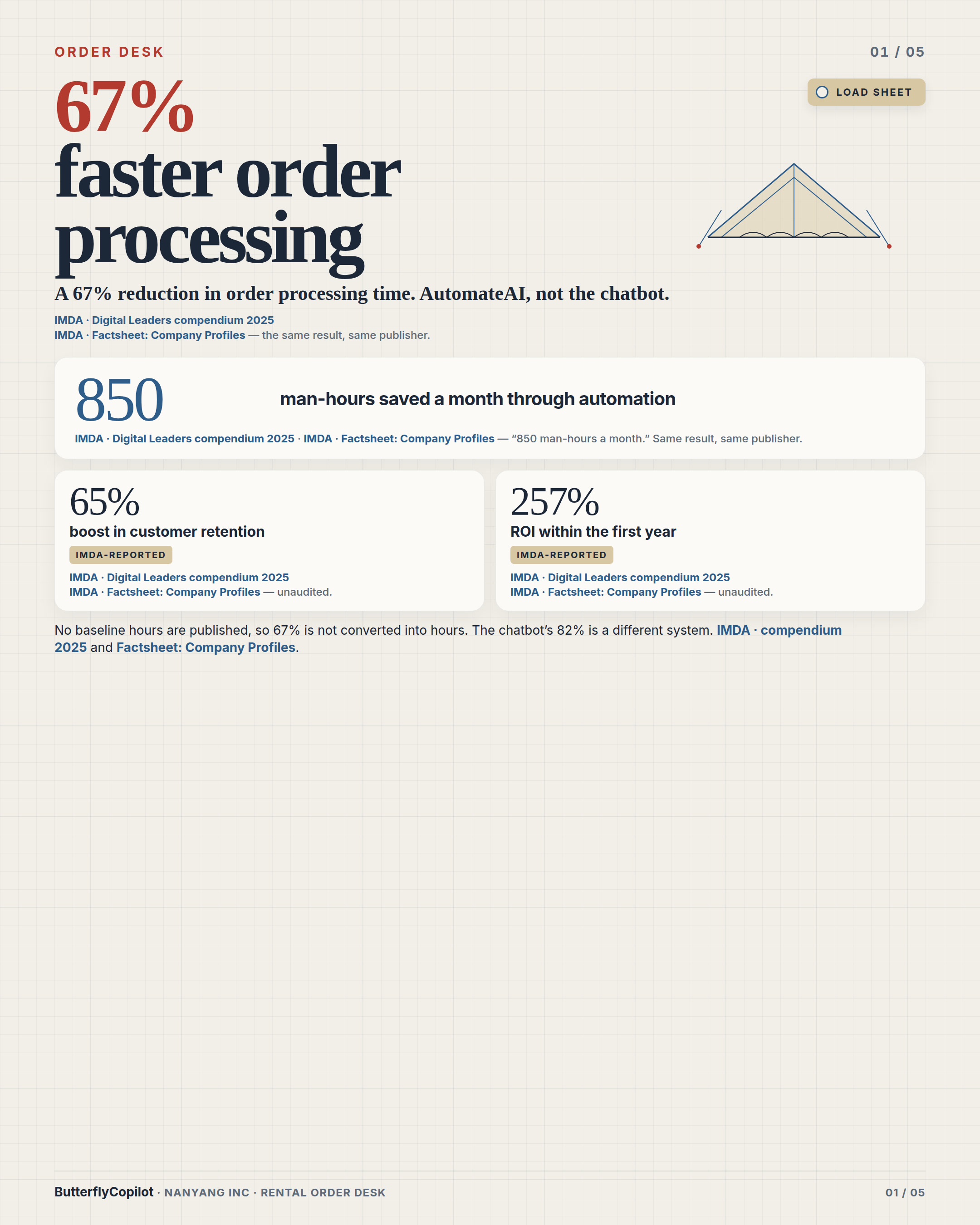
IMDA's 2025 Digital Leaders profile is the public account of AutomateAI. Order-processing time fell by 67%. Automation saved 850 man-hours a month. Customer retention got a 65% boost. The first year showed a 257% return.
The chatbot's 82% was the earlier step. The retention boost and the first-year return are the company's figures, as IMDA published them.
What other SMEs can learn
Put the diaries in one place first. A model sat on top of four lists will book the wrong one. Email, stock, customers, and vendors had to become one platform before the agents had anything reliable to read.
Start with a small, finished job. The chatbot came first. It had one measure, the time spent on website replies, and it earned the right to a larger build. Copy the sequence. A custom platform is the second project, once you know what "good" looks like on a narrow one.
Give the system one job record, not a tour of the building. Sales, operations, the warehouse, and finance should read and write the same hire. The pick list should not live in someone else's inbox.
Treat access as part of the design. Nanyang's programme included encryption, tighter permissions, and privacy safeguards from the start. On a smaller desk that means each role sees its own work, and a customer's phone number never needs to sit inside a prompt.
Hire stock is a diary. The quantity you can promise is the quantity free on the dates of the job, including the days to set up, tear down, and clean. A unit that comes home dirty on Sunday is not free for a Monday wedding.
How to start
If you hire out tents, chairs, stages, AV, scaffolding, or furniture, and the quote still depends on someone remembering what is out this weekend, the day can look like this:
Enquiry arrives by email, web form, or a WhatsApp export
        ↓
Dates, venue, setup, teardown, items, and quantities come out as fields
        ↓
Each item is checked on every date it would be away, including cleaning
        ↓
A quotation is drafted from the rate card
        ↓
A person approves it and sends it
        ↓
On acceptance, the same record reserves the stock, drafts the invoice,
proposes the crew and the vendors, and writes the pick list
        ↓
A change of dates runs the check again
The instruction file is our design for a smaller hire desk. Nanyang's screens stay theirs. The sheets, the columns, and the prompts are the brief you hand to an agent.
It will refuse to quote until you name the approver, the currency, the enquiry inbox, and real files for items, bookings, the rate card, and the buffers. A vague "next Saturday" stays blank. A missing date is not guessed. Setup days, teardown days, and the cleaning buffer all block the item. An overlap on a single day is a clash.
A short quantity is a partial, quoted at the lower number only after a person accepts it. A substitute stays a suggestion until someone says yes. A price has to match one row on the rate card. The agent will not declare a tent, a stage, or a platform safe or certified. In the first version it will not send the quote, the reply, or the invoice. A person approves. A person sends.
When a person records an acceptance, the diary is checked again. Then the same job id reserves the stock, drafts the invoice and the deposit request, proposes crew and vendors, and writes the pick list. A cancellation stays reserved until a person confirms it. The agent takes no payment and stores no card number.
Run the drafts in shadow while the desk still prices by hand. Let the draft become the starting point when it is the better one. Leave reservations alone until then.
The file includes the tests: a vague date, two rates that both match, a buffer day that blocks a free weekend, a send button on a draft, two people accepting the last unit, and a date change after a reservation. Time your own order desk before you talk about a result. The 67%, the 850 man-hours, the retention lift, the first-year return, and the chatbot's 82% belong to Nanyang.
Replace every REPLACE line. Delete every EXAMPLE row.
Sources
- IMDA, "Digital Leaders: Transforming Vision into Value" (2025), Nanyang Inc, pages 33–35.
- IMDA, "Factsheet: Company Profiles," released with the Singapore Digital Economy Report 2025.
- Jimmy Jigmo, tridorian, on LinkedIn.
- Nanyang Inc, about page.