
How ONG&ONG Cut Workflow Time by Up to 95% with Its Own AI Platform
Twelve thousand past projects, and the answer used to sit with whoever had been in the room. Their own AI now cites the file. A registered professional still signs.
ButterflyCopilot
0106
A senior architect should not have to be the filing system.
ONG&ONG is a regional consultancy for the built environment. It designs, engineers, and manages, across infrastructure, education, commercial work, and high-density living, from a Singapore headquarters, with offices and markets that include Malaysia and the rest of the region it lists: Indonesia, Mongolia, Myanmar, Thailand, and Vietnam. On 13 October 2026 the group won an SME Innovation Excellence Award at the SME AI Impact Awards, one of 30 winners that day. The category is for a firm that built a proprietary AI system and put it to work inside its own business. The system is called 360i.
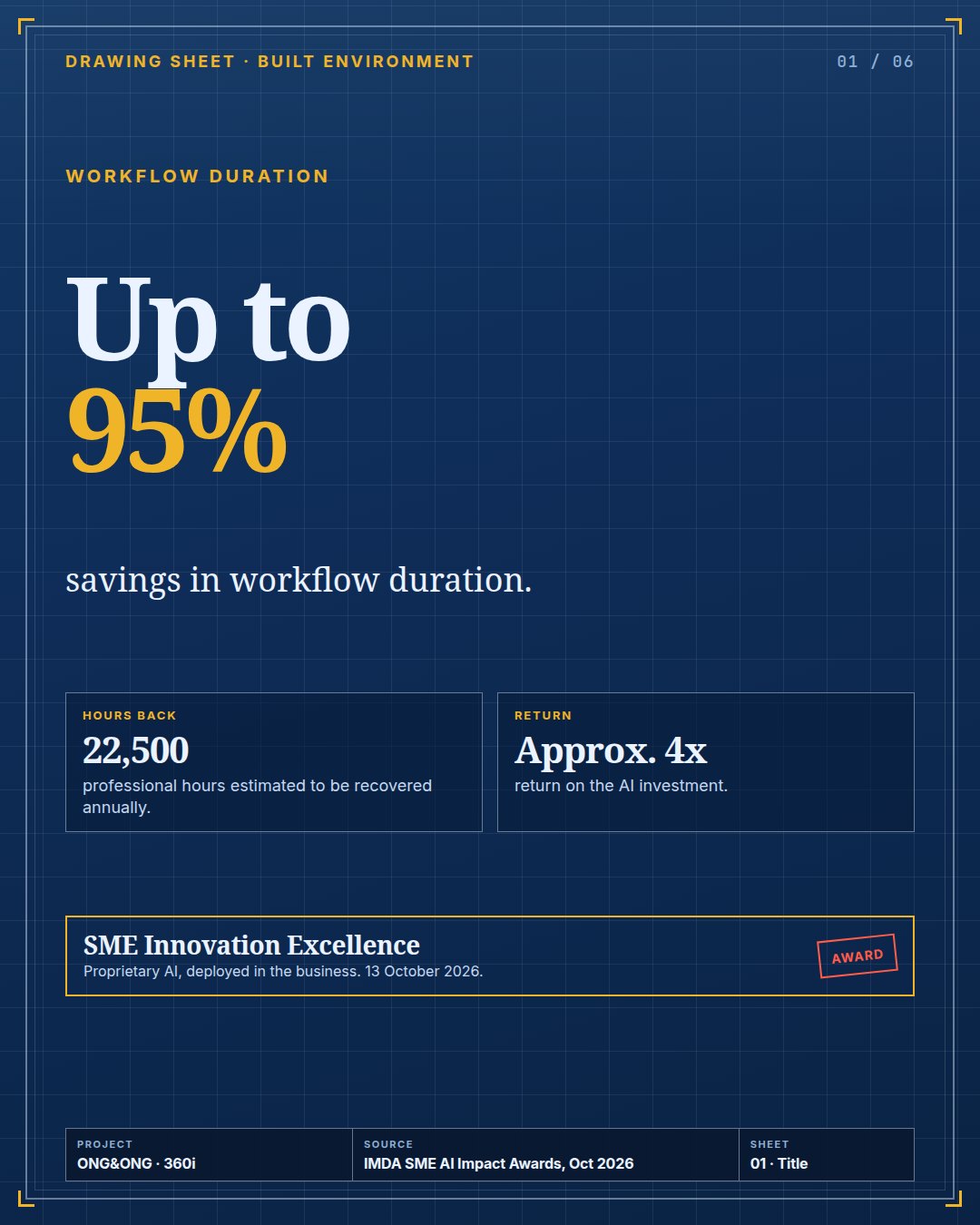
The award card’s headline is the kind of sentence an owner remembers: the firm uses AI to cut workflow durations by up to 95%. The same card records up to 95% savings in workflow duration, an estimated 22,500 professional hours recovered in a year, and an approximate four-times return on the AI investment. Keep the small words. Up to. Estimated. Approximate. They belong to this rollout. A studio that copies the habit does not collect the percentage.
The library that lived in one head
ONG&ONG’s own line for the practice is a holistic 360 consultancy. The work runs from architecture and masterplanning through landscape, lighting, interiors, and project management. The Singapore office on the site is at 510 Thomson Road. The public portfolio is the sort of pile a regional firm actually accumulates: schools, housing, hotels, rail, workplaces, across more than one country.
That pile has a cost, and the award card prices the searching. Up to 2,750 manhours a week, spent looking for project precedents, building regulations, policies, and project information scattered across multiple systems.
The second line is the one partners recognise even when the first number is not theirs. Technical expertise sat with experienced staff. Getting anything out of a past job meant you already knew the exact reference to search for. The drawing set was not lost. It was behind a memory. If you did not have the project code, you waited for the person who had drawn it.
The third line is the rest of the week. Manual regulatory work, design work, presentation, and financial reporting slowed both the project and the management pack.
The firm had already spent years on the digital model of the building. A digital technology department looks after BIM across disciplines and stages. The about page records a BCA BIM Platinum Award in 2016, ISO 19650 accreditation in 2020, a TechBlazers award for best adoption in the SME category in 2021, BCA IDD Platinum Awards in 2022, and Autodesk ASEAN Innovator of the Year in 2021 and 2022. 360i is a different room in that same building. The model describes the structure. The question is how a person finds the decision that was made three jobs ago.
It still qualified as an SME for this award. The rule is group annual sales turnover below S$100 million, or group employment size below 200. A regional practice can be large in the work it touches and still meet that test. Which branch of the test applied is not published, and the lesson does not need a headcount.
What they turned on
360i connects the company’s project knowledge, its regulatory information, and its business workflows, in a secure and governed environment. Staff search what the firm already knows, check regulations, generate project materials, and automate selected processes, with the system grounded in the firm’s own data and standards.
Five jobs are on the card.
Staff search more than 12,000 historical projects, and the internal information around them, by asking in ordinary language. The answer comes back linked to the source records. You do not have to remember the code before you are allowed to ask.
Dedicated assistants answer questions on Singapore building regulations and on CORENET X, and they cite the source clauses. The clause is the product. A smooth paragraph with no clause is a different product, and it is the wrong one.
Designers generate and edit concept images for architecture, interiors, urban design, and landscape, and try more than one direction inside a few hours.
Finance consolidates and checks numbers across 10 entities to produce the group’s profit and loss. Analyst modules raise alerts, forecasts, and scenarios.
The same platform reaches into PowerPoint, Excel, Outlook, and ordinary documents. Separate tools handle branded presentations, exact calculations, and landscape research.
The June 2026 issue of the firm’s own 360 News describes 360i as the group’s AI platform for company knowledge: the project database, the industry codes, and large language models used inside one environment rather than on a personal account. The same issue introduced 360CloudPC alongside it, to support teams across the regional offices. Later pages of the same issue add a floating widget, so a person can ask without leaving the window they are already in; a wider set of models, with the reasoning made easier to see; an upgraded Singapore Compliance Tool integrated with Builtsearch; and a modular agent builder, so a team can shape an assistant around one repeated professional task. In June 2026 the firm also put 360i on stage at the BuildSG LEAD Summit, for design, compliance, and workflow.
Which models, which cloud, what it cost, and how the hours were counted are not in those pages. They stay out of this one.
How a question leaves the archive
A question in ordinary language
        ↓
The project archive, or the regulation shelf
        ↓
A short answer, then the record, the clause, the project code, the date
        ↓
A person opens the file
        ↓
A registered professional decides
The search is the part worth copying in full. Someone asks for the school with the covered drop-off, and for how the setback was handled. The reply is a project the firm actually did, with a path. The regulation question has the same shape on a different shelf. What is the minimum staircase width under the edition the library holds? The assistant quotes that edition, or it says the library does not have it.
“Compliant” is a sentence this kind of system should leave unfinished. Finding the clause and signing the drawing are different jobs. In Singapore the published shelf includes building regulations and CORENET X. In a Malaysian studio the shelf might be the Uniform Building By-Laws 1984 and the state amendments, a local-authority note, a fire-safety document, a CIDB or JKR specification. The documents change. The refusal to guess does not.
Reporting sits in a different room. Ten entities, one profit and loss, a flag when a number does not tie. That room is not the studio channel. A person who can ask about a staircase is not, on that fact alone, a person who should see the group’s accounts.
The hard parts
The archive is a mess on the day you point a model at it. Twelve thousand projects is a count of history, not a count of answers. A file named final, a scan with no text, two jobs sharing a code, a folder the new hire cannot open. The award card’s before-state is information scattered across systems, and a search that worked only if you already knew the reference. The first build is an index. Project code, path, who may open it, whether the scan was actually read. A model on an unnamed drive will quote the wrong revision in a confident voice.
A regulation goes out of date on a Tuesday. The clause that was right in the edition on the shelf is a problem in the edition that replaced it. The assistant has to know which document is current, and it has to say so when it is holding the old one. The firm’s own later note, that the Singapore compliance tool was upgraded and tied to Builtsearch so retrieval would be more accurate, is the maintenance job made visible. Currency is a person checking the cover sheet. It is not a prompt.
Trust is the link. An answer that sounds like a senior architect and does not name the drawing is how a junior sends the wrong setback to a client. Reasoning a person can follow, and a source a person can open, are the whole product. A widget that answers inside the window you already have open helps on a busy afternoon only if the citation survives the shortcut.
A registered professional still signs. The award is for workflow duration. It is not a claim that the architect or the engineer has left the building. Life safety, structure, and fire are interpretations. The assistant can find the clause. Someone with the letters after their name still decides, on this project, this week.
What a smaller firm should steal
If you practice architecture, engineering, quantity surveying, interiors, design-and-build, or contracting, you already have a smaller version of that 2,750-hour week. It might be fifty jobs, not twelve thousand. The first month can look like this.
One studio, and a person who already knows its jobs
        ↓
A register of 30 to 50 recent projects, and who may open each one
        ↓
Five to ten regulation documents, with the edition and the date written on the row
        ↓
Questions in ordinary language. Every answer cites, or it says it is not in the library
        ↓
Anything structural, fire, or life-safety goes to a named Ar. or Ir.
        ↓
You time your own lookups
Steal the citation. Leave the scoreboard where you found it. Up to 95% savings in workflow duration, an estimated 22,500 professional hours, and an approximate four-times return are ONG&ONG’s published results. They are not a line for your proposal, and they are not a saving to turn into ringgit or into posts. Time the minutes a lookup takes now, how many lookups a week, how often the citation is real, how often the honest answer is that the library does not have it, whether staff trust it, and whether a precedent actually got reused.
What the instruction file will make an agent do
The file below is the brief. It is not 360i. It is not ONG&ONG’s archive, models, or screens. None of that wiring is public. The blanks are yours.
It will make the agent:
- Refuse to run while a
REPLACEline is empty, or while anEXAMPLErow is still in a live sheet. - Answer only from the project archive and the regulation library the firm loaded, in the languages they turned on. English, Bahasa Malaysia, and Chinese are the three scripts in the file. Another language waits until a person writes it.
- Put a citation on every factual sentence: document, page or clause, project code, date, and a path the person can open.
- Say it could not find this in the library when the source is missing. It does not guess a clause number, and it does not quietly correct a number the user mistyped.
- Mark a superseded edition as superseded, and keep it off the “current” line.
- Hide projects the asker is not allowed to see. A finance question from someone outside finance gets nothing from the finance files.
- Send life-safety, structural, and fire questions to a named professional, with the clauses attached, and with no sentence that signs the design off.
- Keep the files and the chat on the host the firm named. A personal chatbot account is a failed launch.
- Start with a few dozen projects and a short shelf of regulations. A draft brief from precedents, and a monthly pack from finance exports, stay off until a person switches them on.
The tests are in the file. No source. A superseded edition. Two documents that disagree. A user without access to a confidential job. A scan the OCR could not read. A Malay term and an English term for the same thing. A question that needs a professional judgement. A clause number that is not in the book. Two projects with one code. An old procedure still in the folder. A prompt that says to just call it compliant. A finance question from the studio. If the agent answers any of those by inventing a clause, the test fails.
The instruction file
The brief has the role, the sheets, the index, the way a question is retrieved, the citation, the weeks of a single-studio pilot, and the tests that decide when that studio may trust a link.
Replace every REPLACE line. Delete every EXAMPLE row. Let it sit beside the real archive before anyone treats a citation as the firm’s advice.
Sources
The outcome figures are ONG&ONG’s results as the awards page published them. They are not an independent audit of a baseline, and they are not a forecast for another firm. The practice description is from ONG&ONG’s own site. The June 2026 newsletter is the firm’s account of 360i. Nobody is quoted here about the platform, because those sources do not quote anyone on it.
- IMDA and the Singapore Business Federation, “SME AI Impact Awards,” winners announced 13 October 2026. ONG&ONG Group, built environment. SME Innovation Excellence, for a proprietary AI solution deployed in the business. Headline: “Uses AI to cut workflow durations by up to 95%.” “Up to 95% savings in workflow duration.” “22,500 professional hours estimated to be recovered annually.” “Approx. 4x return on AI investment.” Key challenges, including up to 2,750 manhours a week spent searching. 360i, including search over 12,000 historical projects with answers linked to source records, and assistants for Singapore building regulations and CORENET X with citations to source clauses.
- The Straits Times and The Business Times, 13 October 2026, on the same awards day. Thirty winners. The day, not a profile of this firm.
- ONG&ONG, “home” and “about.” The 360 consultancy, the markets, the disciplines, the Singapore office, the digital technology department, and the BIM and IDD record.
- ONG&ONG, 360 News, June 2026, “issue PDF.” 360i and 360CloudPC. The widget, the model library, reasoning transparency, the Singapore Compliance Tool with Builtsearch, the Agent Builder.
- ONG&ONG on LinkedIn, 15 June 2026. 360i at BuildSG LEAD Summit 2026.