
How Pastry Pro Cut Inventory Reporting Time with AI
More than 8,000 line items, and a stock report that used to take about ten minutes, then came around again. They automated the copy. The buy stayed with a person.
ButterflyCopilot
0105
There is a kind of growth that looks like success in the warehouse and like a bad morning in the office. Pastry Pro has been in that morning for a long time.
The company has supplied bakeries and confectioners in Malaysia since 1984. From Kepong it sells the long list a pastry kitchen actually orders: flour, yeast, colour, honey, the utensil beside the butter, the machine when the kitchen is ready for one. The about page puts the list at over 8,000 line items, bought from more than 40 suppliers around the world, and sold on to hotels, restaurants, cafés, and manufacturers. The catalogue is the business. It is also the reason nobody can hold the stock position in their head.
By 2006 the company’s own account had the built-up area at 35,000 square feet. The square footage is not the point. The point is what happens after the building gets bigger and the spreadsheet does not. Someone still has to say, before the morning’s orders go out, what is on the floor, what a supplier says it can still ship, and which of those two numbers is allowed to become a purchase.
What the morning looked like
That sentence used to be a job.
Staff collected inventory reports by hand from supplier portals, from email, and from the company’s own systems, then tried to make them agree. FPT, which later automated the work, describes the pile as slow, easy to get inconsistent, and awkward when stock moved and purchasing needed an answer the same day.
AkaBot’s account, published 3 April 2026, times one of those reports at about ten minutes. The same job came back through the day. Ten minutes is nothing. Ten minutes, on the next portal, while a kitchen is already waiting, is how a distributor starts answering from memory.
The miss, in a job like that, is ordinary. A code in the wrong row. Tuesday’s file treated as this morning. A carton read as a kilogram. It does not look like a crisis until a batch is short the one ingredient that stops it.
What they built
They did not start by automating the company. They started with inventory reporting, and they asked FPT to put akaBot on that one job.
Software bots collect the reports from the supplier portals, from email, and from the internal systems. They consolidate the rows, put them into one format, and send the inventory report out on a schedule. On that path the output updates without someone retyping it. People watch what the rules did not settle.
That is a narrower system than the phrase “AI in the warehouse” suggests, and the narrowness is why it is worth copying. Nobody published a forecast, a robot, or a new ERP. The change is that the morning report is assembled by a bot instead of by a person hopping between logins.
How the loop works
A file exists somewhere the company already looks: a portal, an inbox, a system they run themselves. The bot picks it up. Rows that mean the same ingredient are lined up. The report goes to the people who buy and the people who sell, on a clock, without a fresh copy-and-paste.
Supplier portal, email, internal system
        ↓
Bots collect the inventory reports
        ↓
One standardised report
        ↓
It goes out on a schedule
        ↓
People use the time on the decision, not the copy
The published reporting path does not say a bot raises the purchase order. Purchasing got a faster picture. The picture is not itself an order. That distinction is the whole lesson, and it is the line the instruction file below refuses to cross.
What changed
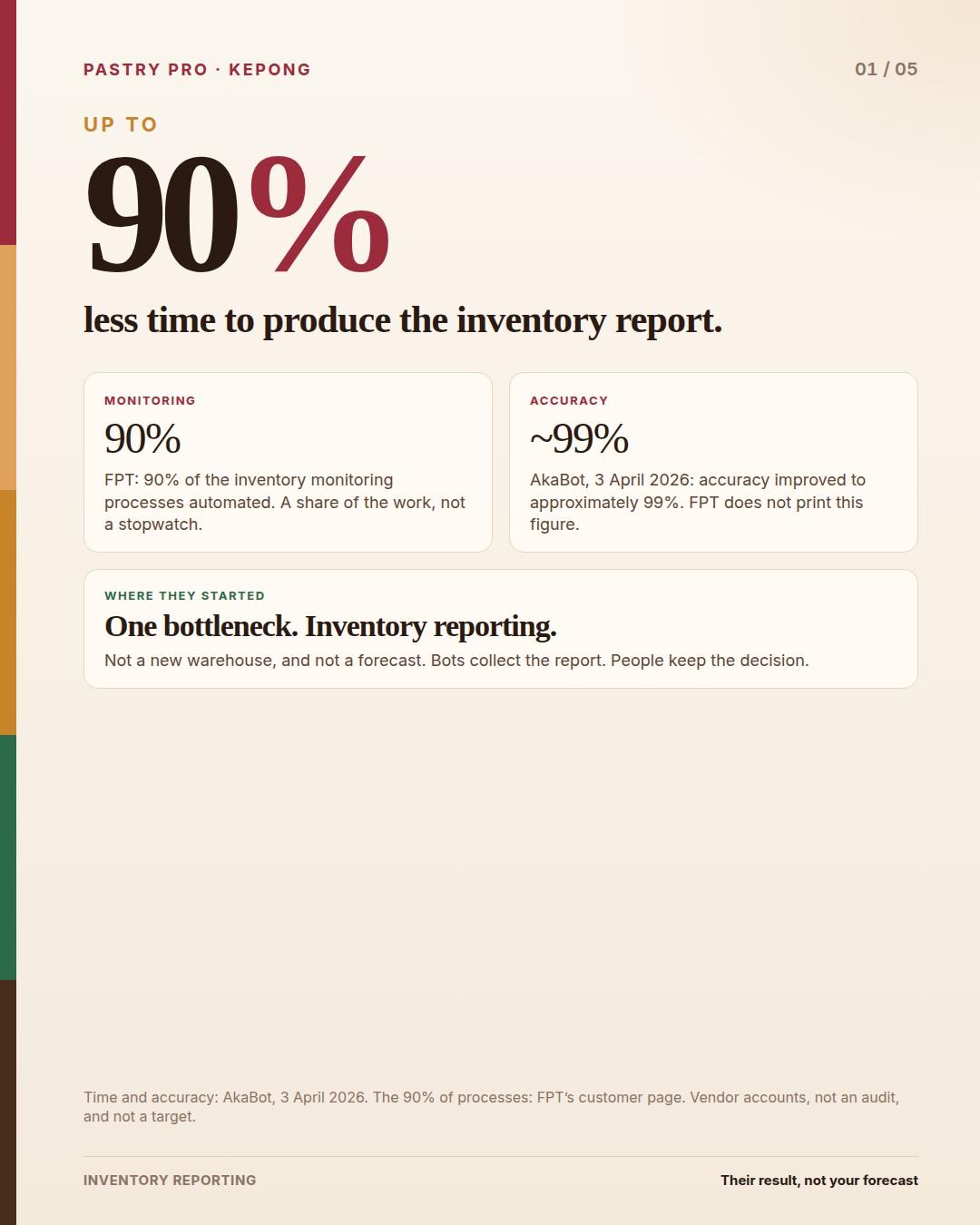
FPT says the work automated 90% of Pastry Pro’s inventory monitoring. The stock figures became more accurate, more current, and easier to find in one place. The people who had been pasting them moved onto work that needed a judgment.
AkaBot, writing the same story later, put the time saving at up to 90% and the accuracy at about 99%. The desk could take more volume without a matching increase in people spent on the copying.
Those are Pastry Pro’s results, as the two companies that did the work have published them. A distributor with a smaller catalogue does not inherit them by installing a bot. What it can inherit is the shape: one report, three kinds of source, a person still responsible for what gets bought.
What other distributors can learn
Start with the report that already hurts. Pastry Pro did not open with a transformation programme. The painful, repeated job was inventory reporting. If your version of that job is a price list, or a customer order, do that one. Do not borrow theirs because the percentages are round.
A second file is not a second pile of stock. The portal says what the supplier can ship. The ERP says what is on your floor. Adding them produces a number nobody holds. Showing them on separate rows produces a number someone can argue with.
A blank export is not an empty warehouse. The file that failed to arrive, and the file that arrived with only a header, are both failures. Yesterday’s balance is not a substitute. Treating either as zero is how a distributor orders the entire catalogue in a panic.
Agree the unit before you agree the quantity. Kilograms and cartons can both be “10” and still be a different ingredient story. A map the business wrote is a conversion. A guess is a wrong purchase.
Keep the planner on the accept button. The scheduled report can go out without someone building it. The suggestion to buy should not. A named person looks at the exceptions first. Flagged lines do not become orders underneath them.
How to start
If you distribute food, or anything else with a long catalogue and more than one stock file, start smaller than a portal robot:
Name the planner, the timezone, and the currency
        ↓
Point at the CSV you already get from the ERP, the inbox, and the portal
        ↓
Map the codes and the units you actually use
        ↓
Write one report. Keep blanks blank. Keep disagreements visible
        ↓
A named planner accepts it
        ↓
Only then, a draft of what you might reorder. Still not a purchase order
The instruction file is our design for a mid-size distributor. It is not akaBot, and it is not a reconstruction of Pastry Pro’s project. Their collectors can open a supplier’s website. This file will not. It reads an export the portal or the ERP already drops, and it refuses to store a portal password.
It will not run until you have written the company name, the planner, Asia/Kuala_Lumpur if that is where you operate, MYR, the list of sources, and the folder the report should land in. A blank source list is a stop, not a demo.
A missing SKU stays missing. A duplicate row, even when both quantities match, waits. A stale timestamp stays stale. A negative quantity is not rounded up to zero. Two sources that disagree are not averaged. A blank portal file does not zero the catalogue. A reorder draft is written only after the planner accepts the report, and only for warehouse lines that cleared the checks. The ERP stub refuses a stock change and a purchase order, with or without that acceptance. Version 1 ends at the draft.
Their 90%, their 99%, and their ten minutes are not fields in the file. You time your own morning.
The tests are in the file. A stale supplier file, a duplicated flour row, a portal export with no data, a carton beside a kilogram, a negative balance, a write attempted before anyone accepts. If yesterday’s quantity reappears when today’s file is missing, the test fails.
Replace every REPLACE line. Delete every EXAMPLE row. Then let it run on last week’s files before it sits on a schedule.
Sources
Outcome figures are from FPT and AkaBot, the companies that did the work. They are not an independent audit. The catalogue and the founding year are from Pastry Pro.
- Pastry Pro, “About Us.” Established 1984, over 8,000 line items, more than 40 global partners, HORECA and manufacturers, ingredients through machinery.
- Pastry Pro, “Store Location.” Office at 8, Jalan 3/37A, Taman Bukit Maluri, Kepong.
- Pastry Pro, LinkedIn. Built-up area increased to 35,000 square feet in 2006.
- FPT IS, “Pastry Pro optimizes inventory tracking with akaBot automation.” Portals, email, and internal systems. 90% of inventory monitoring processes automated. Staff moved off the repetitive copy.
- AkaBot, “From Adoption to Impact,” 3 April 2026. About 10 minutes a report. Up to 90% less processing time. Accuracy about 99%. One process first.
- AkaBot, “case study” and “back-office automation,” 19 June 2025. The same reporting loop, and 90% of inventory tracking automated.