
How Printcious Cut the Quote Wait with AI
A standard item can come back from the rate sheet while the buyer is still in the chat. A person still owns the design, the sample, and the mockup.
ButterflyCopilot
0106
The work at a merchandise shop is still the print. Someone has to put ink on a shirt, fire a mug, or pack a gift set that will not embarrass the logo. The leak, for Printcious, was the message that came before any of that.
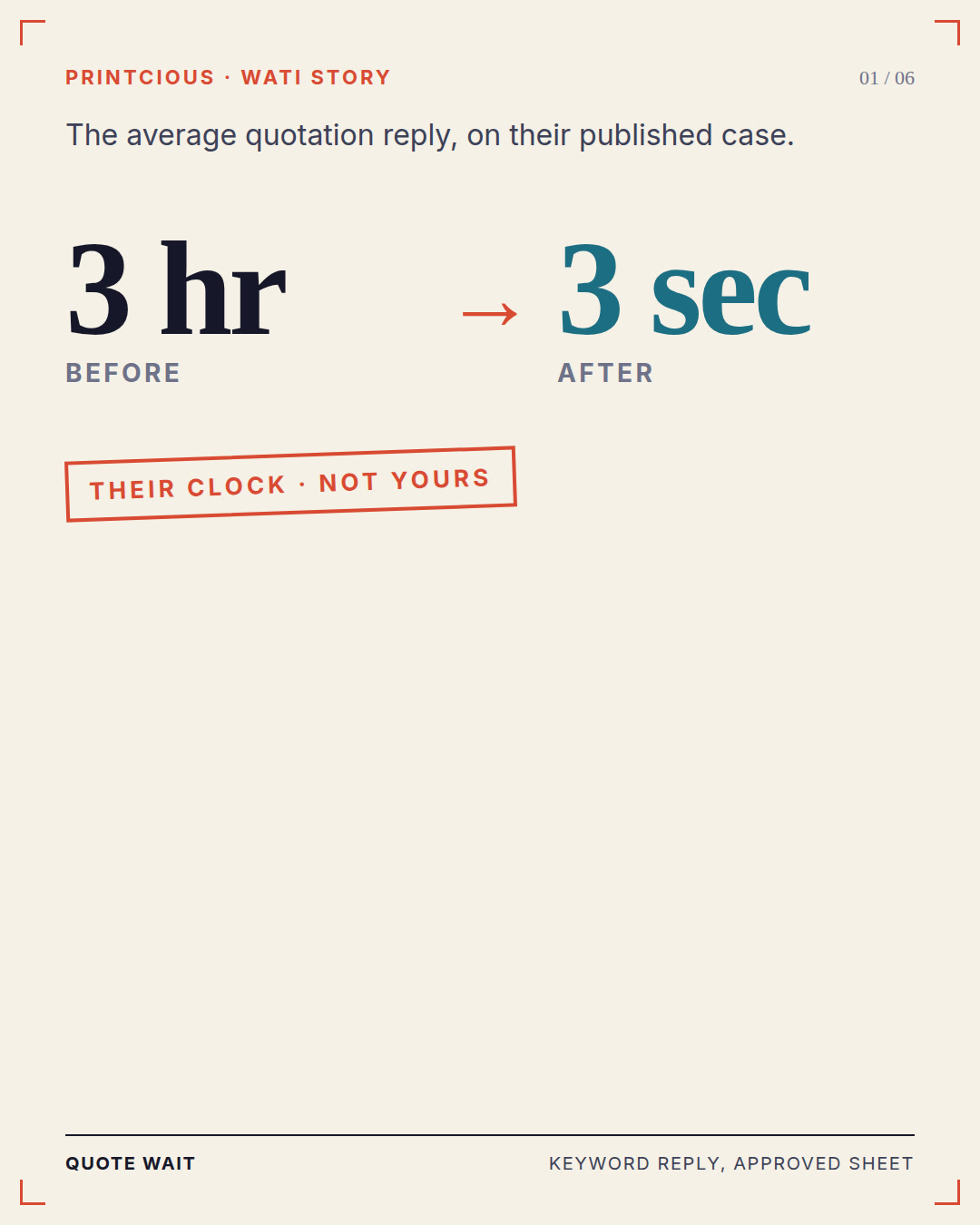
A buyer who already knew they wanted tees, or lanyards, or a run of corporate gifts, asked on WhatsApp what it would cost. The answer waited on a person who had to look up the price and type it. Wati’s case study says that wait averaged about three hours. After keyword actions and a chatbot on the same channel, the quotation came back in about three seconds.
The same page says revenue rose 300%, and the closing rate moved from 10% to 25–30%, with some products to 40%. Those figures belong to this company and this write-up. A shop with a different rate card does not inherit them by switching on a bot. What it can inherit is the split.
Vincent Tong, CEO and co-founder, put that split in one place. They print t-shirts and merchandise for business owners. When the buyer is ready to purchase, a person on the sales team takes over for designs, sample printing, and specifications. The hard part was getting to that moment without losing the chat.
A printer with a sheet, not a guess
Printcious was established in 2015. The company prints corporate gifts, apparel, and merchandise, with production in-house, for customers in Malaysia and beyond. The about page talks about a low minimum order, and it gives the range in the plainest way: 20 pieces or 20,000. That range is theirs. It is not a default you should type into someone else’s file.
Vincent and his co-founder Henry Tong, the CTO, are the two voices on the Wati story. In 2023 Vincent was appointed vice president of the Malaysian Gifts and Premium Association. The early timeline on the company site includes MaGIC’s first accelerator cohort and a Cradle CIP 500 grant. In February 2026 the same timeline says they launched a new AI-powered customer service system. That line is the company’s own. It is not a second set of percentages, and this article does not fold it into the three-second clock.
The useful fact is older than any of those awards. A standard item can have a sentence the business has already approved. A custom item cannot. The bot’s only honest trick is to tell those two apart and to refuse the second.
Three hours, and a chat nobody could pick up
WhatsApp is how a lot of Malaysian buyers already talk. Printcious was on the WhatsApp Business app. The replies did not follow one SOP, so two people could answer the same question two ways. Quotations sat while someone checked a price. If that person was out, the conversation could not be handed to anyone else. There was no picture of how many chats were open, how long they sat, or whether the desk was keeping up.
They looked at more than ten tools. Henry’s reasons are the unglamorous ones: it could automate the problems they actually had, the tutorials were there when the team got stuck, and the product looked as if it would still be around. He has also said they run 50 to 100 chatbots, because they use them for a lot of paths, and that a form which never becomes a WhatsApp message gets a first message from their side, through an API, so the chat at least starts.
Vincent’s line on speed is the one to keep. When a buyer is asking several suppliers, the one who answers first has the better chance. That is an argument for a fast true answer. It is not an argument for a fast invented one.
The bot’s questions, on that story, are quantity, timeline, and shipping. Those three are how the desk tells a serious buyer from a browse. A keyword can then return a price the business has already decided for a standard specification. Follow-up campaigns go out at three, six, and twelve months. The dashboard is how they decide who to hire. None of that replaces the person who has to look at a logo.
What they said they want next is a multilingual agent that can also answer with a product photo, because the goods have to be seen. A photo the shop stored is a catalog. A photo the buyer sent, of a sketch or a mockup, is still a file a person has to open.
What the agent is allowed to say
The sentence is the whole price.
If the buyer wants a standard shirt, in a size and a colour the catalog names, in a quantity that lands on one row of the rate sheet, the reply is the sentence the business wrote for that break. Not a blend of the break below and the break above. Not “about” the number. Not a shipping fee the sentence forgot to mention. The lead time, if it is said at all, is the other sentence they wrote, and it does not become Friday because the buyer asked for Friday.
If two rows match, there is no price. Averaging them feels helpful and it is how a shop wins a job at a number nobody approved. If the quantity sits in a gap, the neighbouring row does not stretch. If they want fewer pieces than the sheet’s minimum, the bot does not invent a small-run price and hope production agrees.
Design is the other door. A logo file, a request to “check if this is okay”, a sample before they commit, a mockup waiting for a yes: those go to the named person with whatever the chat already collected. The bot may already have sent the standard sentence. It may not say the artwork looks fine. Approving a mockup in the chat is how a wrong spelling gets printed onto five hundred shirts.
A discount is the same door. So is a complaint, a card number, and an NRIC. The quote does not need any of those, and the chat is a bad place to store them.
The jobs a chat should not close
A three-second reply is only a gift if the sentence was already true. Keyword automation that hears “tee” and blurts a price before anyone has said fifty or five hundred is a different product from the one in the case study, and a worse one. Their keywords sat on specifications. Yours have to sit on a row.
Do not put 300%, or 25–30%, or three seconds, or 40%, into a proposal for another factory. Do not borrow the 50 to 100 chatbots as a target. One flow, on the channel buyers already use, is the start. A second channel comes after the first one can survive a missing quantity, an ambiguous shirt, a discount, and a card number.
Do not claim their MaGIC place, their Cradle grant, or a vice-presidency of the association. The February 2026 line on their timeline is not your launch date. The follow-up campaigns are a retention programme they chose to run. A smaller shop can copy the quote desk and leave the promotional blast for a later month, and a first WhatsApp message after a web form is only decent if the form asked for that message.
There is a family of questions the rate sheet cannot answer even when the price cell is full. Rush printing for an event tomorrow. A colour that is not on the list. A gift set that was never a standard sku. A buyer who wants the whole job for a number you did not write down. Those are the reason the handoff exists. The agent that returns the approved sentence and the agent that negotiates are not the same project, and only one of them should be switched on.
What a similar shop should steal
If you print shirts, mugs, lanyards, or corporate gifts, and the simple jobs are a rate card while the serious jobs are a design, the shape is this:
The enquiry lands on the WhatsApp they already use
        ↓
Quantity, timeline, shipping
        ↓
One rate row, one sentence you already approved
        ↓
Or a named person, with the partial brief
        ↓
Design, sample, mockup, rush, discount stay with that person
Steal the split, not the scoreboard. Standard merchandise can move toward an instant sentence. Artwork and samples stay human. One official WhatsApp channel first, on the Cloud API, not a personal phone someone automated. A web form only after the everyday chat already behaves, and only when the buyer agreed to be messaged.
What the instruction file will make an agent do
The file below is the brief. It is not Printcious’s Wati tenant, and it is not a copy of their prices. Their public pages do not hand you a rate card, and you should not invent one.
It will make the agent:
- Refuse to go live until you name the owner, the inbox, and a real product catalog, rate sheet, and qualification file, and refuse again if a sample row is still in the file.
- Treat WhatsApp, on the official Cloud API, as the first channel. It will not automate the consumer app. A web chat is a later channel, on the same rules.
- Open with a short notice that the details are for this enquiry, then ask one missing field at a time: product, size and colour when the catalog has them, quantity, timeline, destination.
- Send a price only when one rate row matches and the sentence on that row is marked safe to send. The buyer hears that sentence, copied. They do not hear a unit price the sheet kept for the human, and they do not hear an average of two breaks.
- On a quantity below the minimum, a gap between breaks, two matching rows, or a custom item, hand the thread over with no price in the reply.
- On a design file, a mockup, or a sample, hand it to the named person. A standard sentence may already have been sent. An approval may not.
- Treat rush, a discount, a dispute, a card number, and an NRIC as a handoff. It will not confirm a date the lead-time sentence does not contain.
- Stay quiet on a thread a person has taken over. Keep card numbers and identity numbers out of the transcript.
- Refuse to promise three seconds, 300%, or a close rate. A form-to-WhatsApp message stays off until the tests pass, and it sends no price. The three-month, six-month, and twelve-month campaigns are not in this version.
The tests are in the file. A price asked with the quantity missing, a fifty-piece sentence that must not leak the twenty-piece number, a Malay reply, two rows that must not be averaged, a quantity that falls in a gap, an order below the minimum, a discount, a design with no product, a card number, a sample, a mug the sheet refuses to price, a request for a person, a language you do not support, a tomorrow deadline, a demand for their revenue figures, an NRIC, and a buyer who wants one price for a whole range of quantities. If the reply contains a total the sheet did not write, the test fails.
That is the whole implementation. The agent does not get to design a friendlier price on the way.
The instruction file
Here is the brief: the role, the sheets, the WhatsApp setup, the state machine, the scripts in English and Malay, the rule that Chinese is added only when you have written it, the handoff, and the tests that decide when a sentence may be sent.
Replace every REPLACE line. Delete every SAMPLE row. Then let it run on old enquiries before it talks to a live customer.
Sources
The outcome figures in this article come from Wati’s case study on Printcious. They are not an independent audit, and they are not a forecast. Company facts and the timeline come from the Printcious about page. A shorter CaseStudies.com page repeats the clock, the 300% line, and the 10% to 25–30% band. It is corroboration of that story, not a second measurement. A LinkedIn reshare by Vincent Tong is the same kind of corroboration and is not quoted here.
- Wati, “How Printcious Uses Wati To Reduce Response Time From 3 Hours To 3 Seconds And Boost Revenue By 300%.” B2B t-shirt and merchandise printing, Vincent Tong (CEO, co-founder) and Henry Tong (CTO, co-founder), WhatsApp Business before, quotations from about 3 hours to about 3 seconds, keyword actions and chatbots, SOPs, analytics, 300% revenue, closing rate from 10% to 25–30% with some products to 40%, more than 10 tools evaluated, 50 to 100 chatbots, form-to-WhatsApp first message, follow-ups at 3, 6, and 12 months, qualification on quantity, timeline, and shipping, human handoff for designs, sample printing, and specifications, and the plan for multilingual replies and product photos. wati.io/case-studies/printcious
- Printcious, about page. Established 2015, corporate gifts, apparel, and merchandise, in-house production, Malaysia and beyond, low minimum orders including 20 pieces or 20,000, MaGIC accelerator, Cradle CIP 500, Vincent Tong appointed vice president of the Malaysian Gifts and Premium Association in 2023, and the February 2026 line “Launched our new AI-powered customer service system.” printcious.com/my/about-us
- CaseStudies.com, “Printcious cuts response time from 3 hours to 3 seconds with WATI.” A shorter restatement of the Wati story: the clock, the 300% revenue line, and the closing-rate band. casestudies.com