
How SACES Turned the Aircon Inbox into Bookings
Two brothers put an agent on the chats a small desk could not finish. A person still owns the discount, the dispute, and the install.
ButterflyCopilot
0106
The work at a Singapore aircon shop is still the visit. Someone has to clean the filter, clear the drain, or stand in a condo and look at the trunking before a new system gets a real price. The leak, for Solar Air-Conditioning & Electrical Services, was the chat that came before any of that.
WhatsApp, Facebook, and Instagram each had their own pile. A small admin team typed the same answers, and on a busy day they answered the people closest to a booking first. The earlier questions waited. Some of those people were already talking to the next contractor. Roadshows made the same hole in a different room: a busy booth, a clipboard, and a list that had gone cold by the time anyone sat down to type it up.
Two brothers had taken over the family business and set out to modernise that desk. With support from IMDA’s Productivity Solutions Grant for GenAI customer-engagement chatbots, they put SleekFlow AgentFlow agents on the three channels. The published story is specific about what happened next.
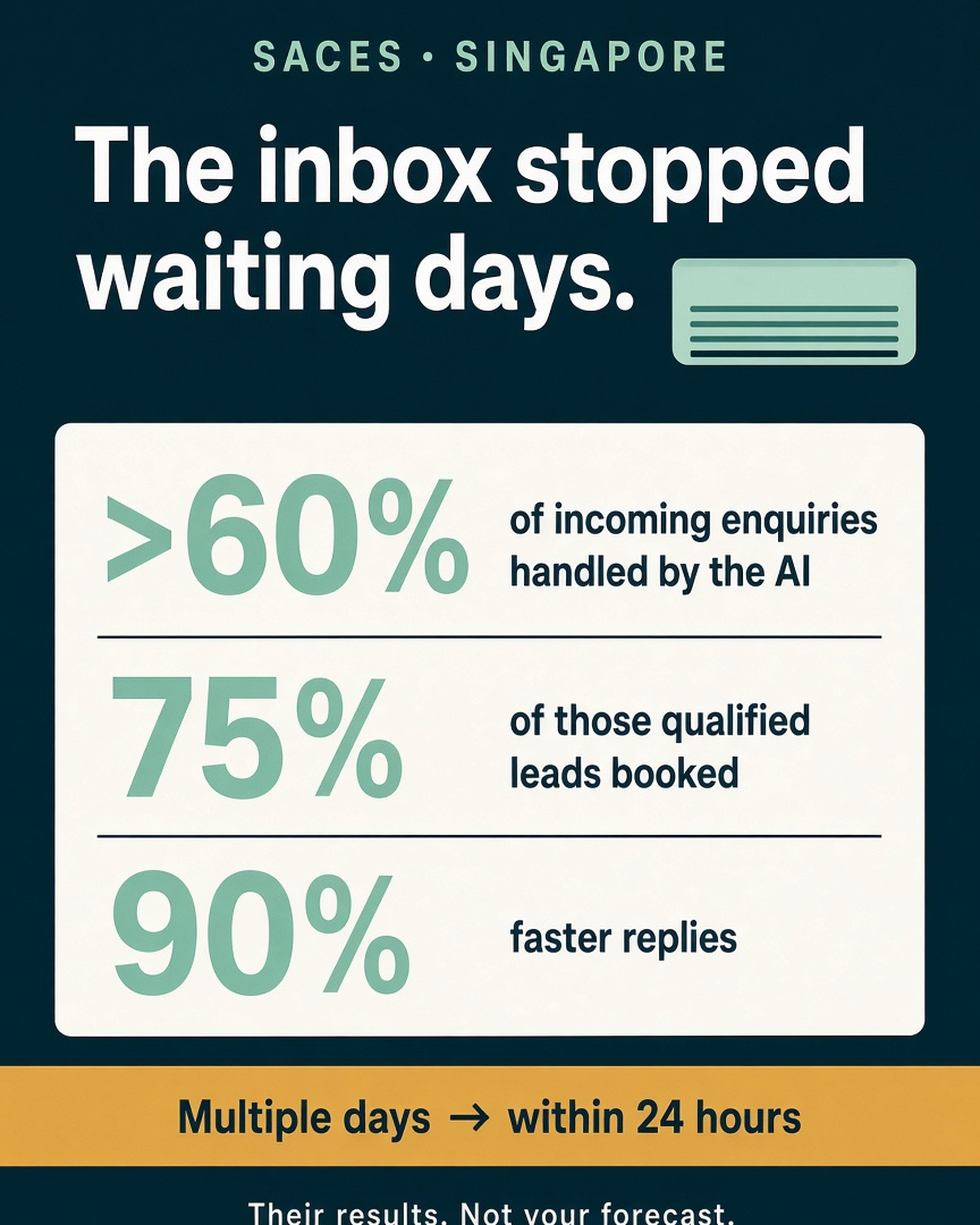
More than 60 percent of incoming enquiries are now handled by the AI agents. Of the leads those agents qualify, 75 percent go on to book. Replies that used to take multiple days come back within 24 hours, which the same story headlines as 90 percent faster. Roadshows, once the clipboard was replaced by a WhatsApp QR, contributed to a 15 percent increase in conversions.
Those figures belong to this shop and this rollout. A two-technician firm does not inherit them by switching on a chatbot. What it can inherit is the shape of the desk.
A contractor with a rate card
SACES has been installing and servicing air-conditioning, and doing electrical work, for more than 30 years. The company site still reads like a working contractor. General servicing starts from $90 a unit. A chemical wash starts from $160. A system installation is listed from $3,000 a unit. Electrical troubleshooting starts from $70. A few jobs are a single figure rather than a floor: a system-4 pressure test at $300, a ceiling-cassette chemical clean at $370. The workshop is at Block 3024 Ubi Road 3. The credentials on the page are bizSAFE STAR, ISO 45001, and registration with SCAL. Homes and offices, a phone on weekdays and Saturday morning.
That mix is the whole lesson of the rate card. “From $90” is not a sum. Three units are not automatically $270 unless the shop has agreed the multiply rule, and a cassette is not a wall unit. The agent story is stricter than a webpage. Pricing replies are built from the service type and the number of units, off a rate sheet the team trained in, together with FAQs and manufacturer brochures. Anything the sheet does not cover is not a moment for the model to be helpful.
Jerome Koh put the daily feeling of it in one line. A lot of the time he sees customers asking a lot of questions, and he thinks: thank God he does not have to type all of that out himself.
One thread instead of three apps
The operational mess was not a shortage of answers. It was that nobody could see the conversation.
Each channel was handled on its own. In a rush the team switched apps to work out who already had the customer, what had been promised, and who still needed a follow-up. Promising leads fell through that gap. Pricing questions, comparisons, and “when can you come” were the interested ones, and they were also the ones waiting behind whoever was about to confirm.
The agents run all day. They tell a new customer from a returning one. A new customer is asked for the address, the service, and how many air-conditioning units. A returning customer is not walked through the same form again. Parts a homeowner cannot name can be shown with an image the team has stored, shared as a Google Drive link, so the chat stops guessing at a drain plug.
Underneath, the inbox is shared. Servicing jobs and installation projects are not the same queue. An install needs a site survey and a formal quotation. Notes stay on the thread for a technical question or a discount a person has actually approved. If one admin is out, another picks up the same conversation without asking the customer to start again. Supervisors can see it. Labels and lifecycle stages mark who is new, who is back, who is waiting on a quote, who has booked, and who has already been serviced.
The roadshow version is the same pipe with a shorter front door. A QR code opens WhatsApp with a prefilled message. The flow asks property type, how many units, and what they are interested in. The lead is in the inbox before the booth is packed up.
What the agent is allowed to say
One published conversation is the pattern worth stealing, more than any dashboard.
A customer had a lower price from another company and pushed back. The agent did not invent a discount and did not repeat the number in a louder voice. It explained what the service included, and the extra the shop was actually selling. The customer booked.
That only works if the inclusions are written down. A model that “knows aircon” will happily describe a chemical wash it has never been authorised to describe, and it will happily meet the other contractor halfway on price. Both of those are how a small shop ends up doing a job it did not quote.
The handoffs are just as plain. Discount requests go to a person. Disputes go to a person. Complex installation scopes go to a person, who can answer with the thread in front of them or arrange the site visit. The agent’s job is the repetitive middle: qualify, answer from the sheets, and keep the low-intent servicing chat warm until that customer is ready to book.
Lead scoring is how the team decides who is no longer low-intent. The factors in the story are service type, number of units, urgency, and how wide the enquiry is. A full installation that needs a survey or a formal quote scores higher, so a person follows up faster. The story does not publish the points. It should not. Those weights are the shop’s, and another shop’s mix of HDB servicing and landed installs will not share them.
The jobs a chat should not close
A 24-hour reply is not a 24-hour technician. The useful change on the clock is the one they published: the first response moved from multiple days to within a day, so a homeowner comparing three contractors did not wander off. The visit is still a slot a person can honour. The company site talks about same-week bookings, subject to availability. An agent that offers “tomorrow morning” because the customer sounds hot is inventing a van.
The grant is easy to misuse in the other direction. SACES qualified for up to 50 percent support under the PSG scheme for this kind of chatbot. That is how this project was funded for them. It is not a sentence your own homepage has earned.
There is a family of questions the rate sheet cannot answer even when the price cell is full. A baby coughing next to a mouldy unit. A room that smells of gas. A ceiling a technician is accused of cracking. A request to match a $60 flyer. Those are not FAQ rows. They are the reason the handoff exists. The agent that books the quarterly service and the agent that argues a refund are not the same project, and only one of them should be switched on.
What a similar shop should steal
If you service air-conditioners, do electrical call-outs, or run any trade where the simple jobs are a rate card and the serious jobs are a visit, the shape is this:
The enquiry lands in the app they already use
        ↓
New or returning
        ↓
Address, service, unit count
        ↓
Answer from your rate sheet, your FAQ, your brochure
        ↓
Score with weights you wrote
        ↓
Book a window you listed, or hand it to a named person
Steal the split, not the scoreboard. Servicing can move toward a booking. Installation, a survey, a discount, and a complaint stay with a named person. One inbox, so Facebook does not hold a different memory from WhatsApp. A roadshow QR only after the everyday channel already behaves.
What the instruction file will make an agent do
The file below is the brief. It is not SACES’s SleekFlow tenant, and it is not a copy of their rate card.
It will make the agent:
- Refuse to go live until you name the owner, the inbox, and a real services sheet and rate sheet, and refuse again if a sample row is still in the file.
- Treat WhatsApp, Messenger, and Instagram as one enquiry, launch a single channel first, and stay quiet on a thread a person has taken over.
- Tell a returning phone number from a new one, and skip the address you already hold.
- Quote only when one rate row matches and the rule is the multiplication you wrote, or a sentence you marked safe to send. Two matching rows become a handoff. A “from” price never becomes mental arithmetic.
- On a cheaper quote elsewhere, read the inclusions cell aloud and leave the total where it was. A discount, a dispute, a complex install, a medical question, or a gas smell goes to the named person with a reference number.
- Send a parts picture only when the Drive link is on your parts sheet. Store the customer’s photo and do not diagnose it.
- Score with your weights on service type, units, urgency, and scope. An empty weights file does not borrow anyone else’s points. Installs and surveys hand off even then.
- Book only a window on the slot sheet, and only after the tests pass. Until then it can take the details and must not say the job is booked.
- Keep card numbers and NRIC out of the thread, and open with a short notice that the details are for this enquiry.
The tests are in the file. A three-unit service price with the address still missing, a chemical wash the sheet refuses to price, a Malay booking on a real slot, a customer who wants the whole job for a number you did not approve, a condo install, a 10 percent discount, a cracked ceiling, a coughing child and a gas top-up, a drain-plug picture, a card number, a returning customer, a person who asks for a person, a language you do not support. If the reply contains a total the sheet did not produce, the test fails.
That is the whole implementation. The agent does not get to design a friendlier price on the way.
The instruction file
Here is the brief: the role, the sheets, the channels, the state machine, the scripts in English, Chinese, and Malay, the score rules you have to fill in yourself, the booking lock, the privacy checklist, and the tests that decide when a slot may be offered.
Replace every REPLACE line. Delete every SAMPLE row. Then let it run on old enquiries before it talks to a live customer.
Sources
The outcome figures in this article come from SleekFlow’s customer story on SACES. They are not an independent audit, and they are not a forecast. Company facts and the public rate card come from the SACES website.
- SleekFlow, “How SACES converts 75% of qualified leads with SleekFlow AI Agents, supported by the Productivity Solutions Grant.” More than 60 percent of incoming enquiries handled by the AI agents, 75 percent enquiry-to-booking conversion among leads the AI qualified, 90 percent faster response, replies from multiple days to within 24 hours, roadshows contributing to a 15 percent increase in conversions, the WhatsApp QR flow, lead scoring factors, the rate-sheet and brochure training, Drive images, human handoff for discounts, disputes, and complex installs, Jerome Koh’s remark, the two brothers, PSG support of up to 50 percent, and the shared inbox. sleekflow.io/customer-stories/saces
- SACES, company site. Services, the public rate card (general servicing from $90 a unit, chemical wash from $160, system installation from $3,000 a unit, electrical troubleshooting from $70, system-4 pressure test at $300, ceiling-cassette chemical clean at $370), Block 3024 Ubi Road 3, and bizSAFE STAR, ISO 45001, and SCAL. saces.sg