
How Suzhou Universal Cut Scheduling Errors by 70% with AI
Four systems had the answer. The planner still had to walk between them. The change now waits in a draft.
ButterflyCopilot
0106
The order was already late enough to argue about.
Suzhou Universal makes chains. Drive chains, conveyor chains, leaf chains, the chain inside an escalator, the chain on a farm machine. The automotive conveyor chain carries parts down a vehicle line. The company started in 1970. It is a national “little giant”, with a national enterprise technology centre, a site in Wuzhong, Suzhou, and a plant in Jiangyan, Taizhou. One of the companies in the group is X-POWER, the software firm, founded in 2018, building manufacturing systems for other plants.
IBM’s case calls the chain maker Suzhou Universal. The English page says X-POWER is backed by Suzhou Global Technology. The Chinese page says 艾科斯幂 is backed by 苏州环球科技, and it uses 苏州环球 for the manufacturer. Same deployment.
The plant already had the systems a factory of that size collects. A manufacturing execution system. An ERP. An advanced planning and scheduling tool. A quality system. Each one held a piece of the day. A question that needed all four could take up to 30 minutes. Working out a quality problem was manual, and it took the same half hour. Changing the plan was slow, and it was easy to get wrong. By the time a planner had walked the four screens, the line had moved, and the edit went into the plan that was already running.
What they put in front of the plan
X-POWER put an agent platform on IBM watsonx Orchestrate in front of those four systems. The aim was one conversation over the data, the workflow, and the systems, not a chatbot parked beside them.
Two agents do the work the case describes.
The quality agent takes a sentence. It reads quality and production together. A person can ask what the line is doing, which defect codes are on top, and where the count is concentrated. IBM’s account of the shift is from a report someone had to build, to a question the team can ask while the job is still open. Monitoring, defect analysis, and the trend sit in the same place.
The scheduling agent takes a different sentence. What is on the line. What happens if this order moves. What a better sequence would look like. The change does not land on the live plan. It lands in a draft. The planner sees the old times and the new times side by side. Risk checks run before anyone executes the change.
That draft is the part worth stealing. A sentence is cheap. A sentence that edits the plan everyone else is already following is how a small mistake becomes a missed truck.
How a sentence becomes a decision
A person asks, in the language they already use on the line
        ↓
The quality agent reads quality and production together
        ↓
Top defects, a trend, and the places the count concentrates
        ↓
A person still names the cause
        ↓
A scheduling sentence opens a draft, not the live plan
        ↓
Old times beside new times, then the risk checks
        ↓
A named planner accepts or rejects
        ↓
Only then does the published workflow execute
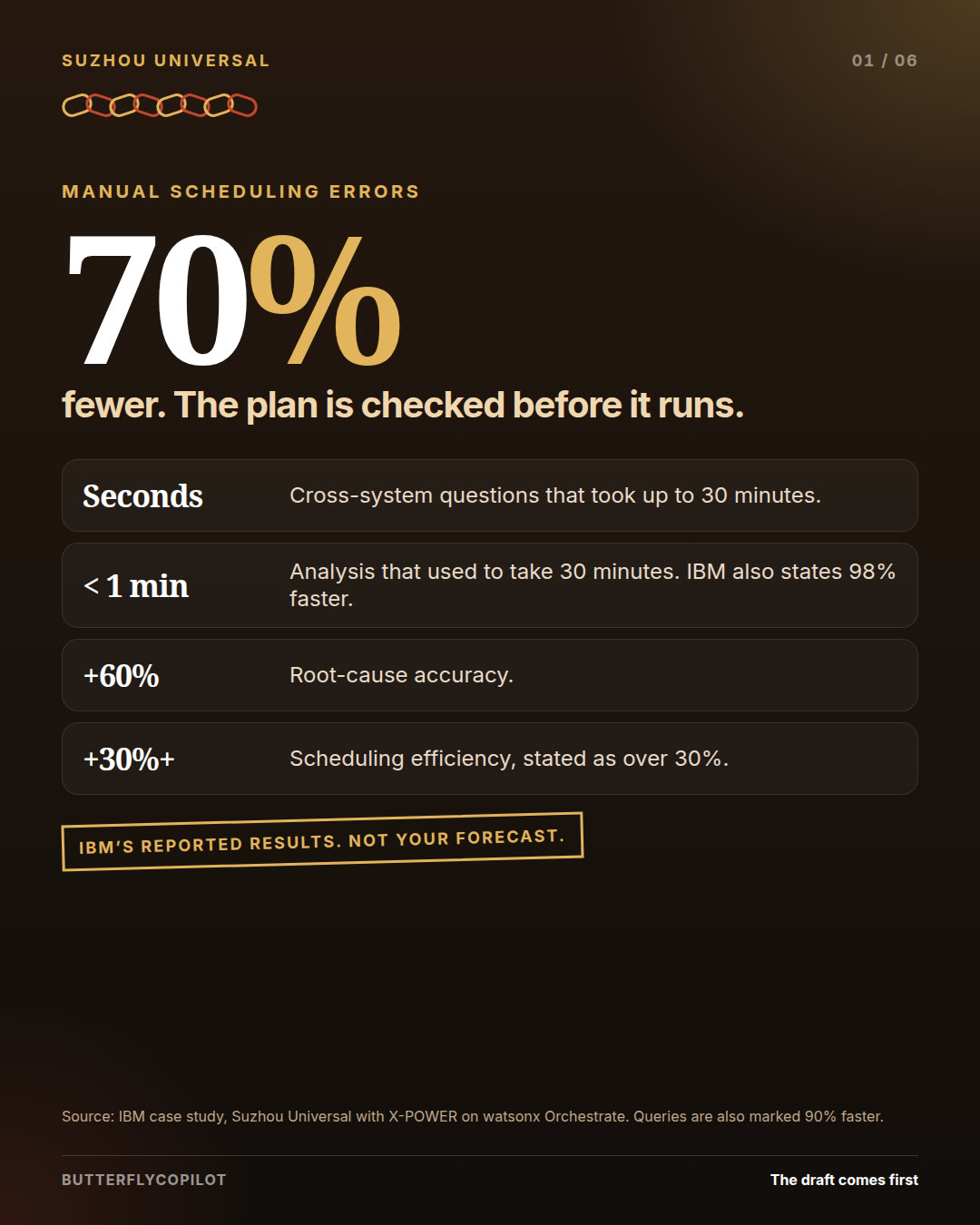
IBM reports what this deployment did. A cross-system question that could take up to 30 minutes now comes back in seconds. The case marks that as 90% faster. Analysis that took 30 minutes finishes in under a minute. The case marks that as 98% faster. Root-cause accuracy improved by 60%. Scheduling efficiency improved by over 30%. Manual scheduling errors fell by 70%, which IBM credits to the validation workflow. The stat line on the same page calls it a 70% reduction in scheduling errors.
A plant with one line does not collect those figures by dropping a chat box on the planner’s desk. The habit under them is the part that travels: one read across the systems, and a write that has to survive a comparison.
The same shape fits a job shop, a components maker, a packaging line. Anywhere a person already exports orders, a plan, and defects. The customer date still comes from the order. The agent does not invent it, and it does not weigh the chain.
The hold the sentence forgot
Speed is how a confident sentence ships a bad plan.
The machine looks free. The order looks free. Quality opened a hold that morning, on that lot, and the sentence never mentioned it. A component is short. Two jobs now want the same hour. The finish just slid past the customer date. If the draft cannot see those, the planner will approve a job the line should not run.
The case says the checks happen before execution, and that those checks are why the manual errors fell. It does not print the rule list. The instruction file supplies a list a smaller plant can actually run, and labels it as ours. An open hold that matches the order blocks the change. A start inside the freeze window blocks it. An overlap blocks it. A finish after the customer date blocks it. A short component blocks a pull-forward, and only warns when the job is moving later. The planner can reject. The planner cannot accept a blocked draft. The model cannot accept at all, and it cannot post.
IBM’s account executes the change after the checks. That is their platform. The file below stops one step earlier, on purpose. The approved sheet is a file a person types into the scheduler. A smaller plant should earn the post button.
The root-cause step has the same shape. A cause that arrives as a fluent sentence is a guess with good manners. A candidate that arrives as a count, on a machine or a lot or a shift, is something a quality lead can sign or throw out. The 60% is Suzhou Universal’s published accuracy gain. The case does not publish the denominator. The file treats that gap as a rule. The agent does not write the cause.
What a smaller plant should steal
If the order, the plan, and the defects already live in three exports, and a person still rebuilds the answer by walking between them, the first ninety days are one line.
One line, one product family, the planner who already owns the board
        ↓
Thirty days of exports, and a stopwatch on the old questions
        ↓
Thirty days of drafts beside the real board, which the planner still types
        ↓
Thirty days where the approved file may become the sheet they type from
        ↓
The post button stays off
Time the week you already have. Minutes for a question that needs more than one system. Minutes for a defect review. How often the cause a person confirms was sitting in the top three candidates. Minutes from the sentence to an approved comparison. How many accepted changes you had to reverse. After the line is live, time the same things. Those pairs are your result.
Seventy percent fewer manual scheduling errors, scheduling efficiency up by over 30%, root-cause accuracy up 60%, and the two speed figures are Suzhou Universal’s published story, as IBM tells it. They are not a line for a proposal, and they are not a saving to turn into a currency.
What the instruction file will make an agent do
The file below is the brief. It is not watsonx Orchestrate. It is not Suzhou Universal’s data model, risk rules, or thresholds. None of that wiring is public. The blanks are yours.
It will make the agent:
- Refuse to run while a
REPLACEline is empty, or while anEXAMPLErow is still in a live sheet. - Read four exports: MES, ERP, APS, and quality. If one of them is missing or older than the plant allows, the answer stops. A stale file is not a week with no defects.
- Answer a quality question with the top defect codes, a trend against the previous window, and up to three candidates. The contrast is a count. The agent does not write the cause.
- Turn a scheduling sentence into a typed change with a start time. “As soon as possible” is not a time. The draft keeps the live duration unless the person sets both ends.
- Show the old time and the new time side by side, then run the risk checks in code. A hold, a freeze, an overlap, a late customer date, or a pull-forward onto a short component blocks the draft.
- Leave the accept button on a form a named planner uses. The model cannot approve, and it cannot post the plan.
- Write a daily file from this plant’s own baseline. No comparison with the case study’s percentages.
- Start on one line, sit beside the hand-typed plan, and let the planner decide at day ninety whether the sheet is worth typing from.
The tests are in the file. A quality answer on a known pile of defects. A move that looks tidy and is blocked by a hold. An accept on that blocked draft. The same move after the hold is closed. A model that tries to approve as the planner. A start inside the freeze. Two jobs on one machine. A sentence with no time. A stale export. A second draft while the first is still open. A note that says to ignore the hold and post it. If the agent clears any of those by writing the live plan, the test fails.
The instruction file
The brief has the role, the four connectors, the tools, the draft, the comparison, the risk codes, the ninety days, and the tests that decide when a planner may trust the sheet.
Replace every REPLACE line. Delete every EXAMPLE row. Let it sit beside the real board, next to the plan a person still types, before anyone treats a sentence as a released order.
Sources
The outcome figures are IBM’s reported results for this Suzhou Universal deployment. They are not an independent audit of a baseline, and they are not a forecast for another plant. The company description is from Suzhou Universal’s own site. The July 2025 innovation-centre note, and the earlier Cloud Pak write-up, are separate pages. They are not the source of these figures.
- IBM, “Driving faster, risk-aware production decisions.” Suzhou Universal, industrial chains and precision components, headquartered in Suzhou, automotive and industrial customers. Integrator X-POWER. Agentic platform on IBM watsonx Orchestrate, over MES, ERP, APS, and quality systems. Quality Inquiry Agent: natural-language quality queries, automated defect analysis, trends, top defects, root cause. Production Scheduling Agent: natural-language changes, a draft environment, side-by-side comparison, risk checks before execution. Cross-system queries from up to 30 minutes to seconds, stated as 90% faster. Analysis from 30 minutes to under a minute, stated as 98% faster. Root-cause accuracy +60%. Scheduling efficiency over 30%. Manual errors −70%, and a stat line of 70% fewer scheduling errors. X-POWER founded in 2018, based in Suzhou, backed by Suzhou Global Technology, serving small and mid-sized manufacturers.
- IBM, “助力企业制定更高效、具备风险意识的生产决策.” The same case in Chinese. Names 苏州环球 and 艾科斯幂. Same workflow. Same figures.
- Suzhou Universal, “环球链条.” Founded in 1970. Drive, conveyor, leaf, engineering, escalator, special, and agricultural chains. Specialized “little giant”, national enterprise technology centre. Address at 188 Shizhong Road (石中路), Xukou, Wuzhong, Suzhou. Production base at 18 Jiangqin Road (姜溱路), Jiangyan, Taizhou. Names 艾科斯幂 among the group’s subsidiaries. Automotive conveyor chains are described on the product page.
- X-POWER, “艾科斯幂(苏州)信息科技有限公司.” Software company site. It describes production and quality systems for other manufacturers. The IBM case does not name those product brands, and this article does not treat them as the systems in the deployment.
- IBM China newsroom, “X-Power IBM赋能创新中心今日在苏州启动运营,” 31 July 2025. An innovation centre in Suzhou Industrial Park. Parent 苏州环球科技股份有限公司, founded in 1970. This page does not publish the query times or the scheduling figures.
- IBM, “Suzhou Universal Chain Technology’s digital reshaping with IBM hybrid cloud and AI software.” A separate, earlier project: Cloud Pak integration of order-to-delivery, including MES, ERP, a warehouse system, quality inspection, and supplier management. No figures from that page are used here.