
How Toh Thye San Cut WhatsApp Order Mistakes with AI
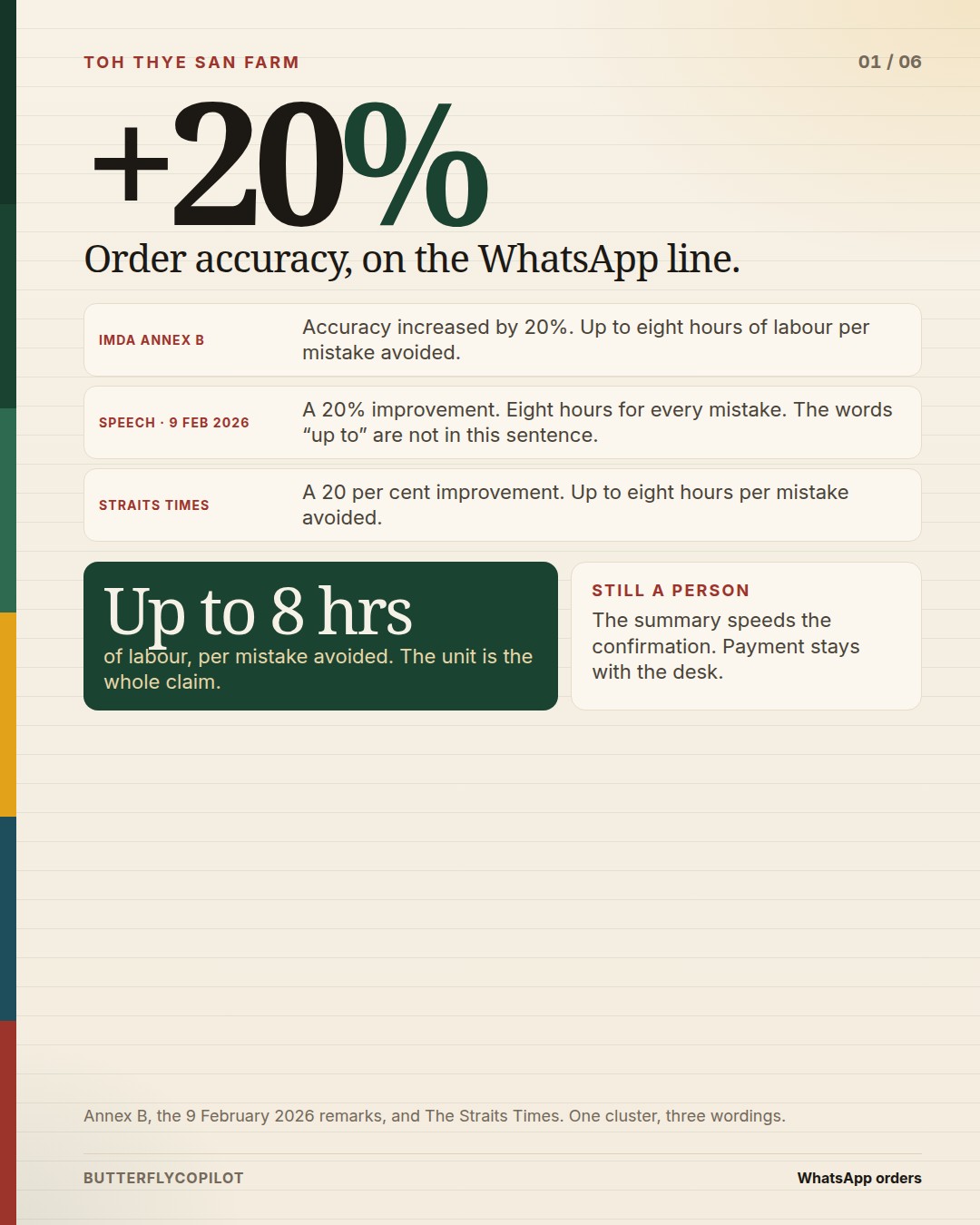
Order accuracy improved by 20%. The annex says up to eight hours of labour per mistake avoided. The accounting system’s doubled sales sit in a different paragraph.
ButterflyCopilot
0106
What they achieved
Toh Thye San Farm’s public record has three clusters. Each one has its own sentence.
The ordering tool is the first.
IMDA’s Annex B says the farm implemented an AI-enabled automated ordering system. It captures customer orders directly from WhatsApp and syncs them into the accounting, inventory, and sales platform. Order accuracy increased by 20%, saving up to eight hours of labour per mistake avoided. One staff member’s role expanded from account payables to account payables and receivables. The same sentence says there are plans to expand that role further, so it would oversee company collections in general. Auto-generated summaries enabled faster customer confirmations and communication.
On 9 February 2026, Senior Minister of State Low Yen Ling opened Kwong Cheong Thye’s new factory and launched the refreshed Food Manufacturing Industry Digital Plan. She used Toh Thye San Farm as the example of an automated ordering tool. She said the farm piloted the solution and saw a 20% improvement in order accuracy. She said this translates to eight hours of labour saved for every mistake avoided. She said staff could focus on higher-value and more meaningful work. In her wording, the solution captures orders from messaging platforms like WhatsApp and syncs them into existing systems.
The Straits Times, in the account Enterprise Singapore published that day and updated on 10 February, says Toh Thye San Farm, a poultry distributor, implemented the solution. It achieved a 20 per cent improvement in order accuracy, saving up to eight hours of labour per mistake avoided, while freeing staff for higher-value tasks.
The pages agree on a 20% move in accuracy, and that a mistake avoided is worth hours of labour. They do not agree on the small words. “Increased by 20%” is the annex. “A 20% improvement” is the speech and the newspaper. “Up to eight hours” is the annex and the newspaper. “Eight hours … for every mistake”, without “up to”, is the speech. “Piloted” is the speech. “Implemented” is the annex and the newspaper. The payables-and-receivables sentence, and the line about summaries, are in the annex. The speech and the newspaper say higher-value work and leave the job title out. Collections, in the annex, is still a plan.
The problem the annex describes, before either system, is the second cluster.
The farm was making up to 10 customer order mistakes a day, and spending more time fixing those errors than serving customers. Up to eight hours a month went to reconciling payments, which the annex ties to poor financial visibility. Stock and price were calculated by hand. Overstocking and duplicate orders came from intuition or approximation.
“Up to eight hours a month” on payments, and “up to eight hours of labour per mistake avoided”, share a number. The unit is different. A month of reconciliation is one sentence. A mistake avoided is the other.
The accounting, inventory, and sales system is the third cluster. The annex tells it before the ordering tool, as the platform the WhatsApp orders sync into.
Month-end reporting went from 10 days to four days, despite processing 2,000 daily invoices, with faster and more accurate results. Sales doubled while the staff workload stayed the same. Real-time visibility of outstanding payments improved cashflow, with 20% faster time-to-payment. Better inventory tracking minimised losses from expiry and overstocking.
That 20% is time-to-payment. The other 20% is order accuracy. The annex gives them separate paragraphs. The doubled sales have no period attached. The page does not say “in four years”, or any other span, for this farm’s sales line.
What they do
Incorporated in 1979, Toh Thye San Farm is a fourth-generation farming business focusing on poultry. That is the annex’s opening. The same profile says the farm provides antibiotics- and hormone-free chickens, is known for the GG French Poulet, and holds the brands Mr Farmer and FarmFresh. It then describes the change in the business: from a traditional poultry business to a protein distributor serving restaurants, hotels, and distributors.
The speech calls the farm one of Singapore’s leading poultry manufacturers. The Straits Times calls it a poultry distributor. The annex uses both a farming business and a protein distributor, in that order. Quote the page you are standing on.
Mr Farmer’s about page is the family’s consumer voice. It says Toh Thye San Farm has been raising poultry since 1979, four generations of one family, and that Mr Farmer started in 2017 so the chicken sold to kitchens could also reach people cooking at home. It says the GG French Poulet is free-range, with no antibiotics and no growth hormones. It says that in 2018 the farm became the first in Asia to be Certified Humane by Humane Farm Animal Care. A later block on the same page says the GG French Poulet was Certified Humane by Humane Farm Animal Corporation (HFAC) in 2018. The birds, on that page, are reared in Simpang Renggam, in Johor Bahru. The annex does not print the certification, the year 2018, or the town.
The consumer page also publishes a household ordering note. Delivery is island-wide, free above S$50, and next morning if you order before 11am. Morning slots run Tuesday to Saturday, 7am to 1pm. Evening slots run Tuesday to Thursday, 5pm to 9pm. The shop is closed Sunday and Monday, so a weekend message is answered on Tuesday. The page says: message us on WhatsApp.
That note is the consumer brand talking to a home kitchen. The annex’s ordering paragraph says “customer orders” on WhatsApp, for a company whose trade customers include restaurants, hotels, and distributors. It does not say which of those buyers the tool was pointed at. A wholesale desk that copies the pattern keeps a cutoff sheet of its own. The consumer hours are not that sheet, and the S$50 line is a price.
How they do it
The published behaviour is three moves.
A customer writes an order on WhatsApp. The tool captures it and syncs it into the accounting, inventory, and sales platform. An auto-generated summary comes back, and the confirmation is faster.
The annex adds what that sync was for: seamless data flow, accurate allocation, and faster fulfilment. It does not publish the stock file, the unit list, the alias list, or the rule for a Sunday. “Accurate allocation” is the outcome the annex names. A carton count still has to come from a sheet a person maintains. An empty cell is not a promise.
The speech describes the solution in the plan: AI captures orders from messaging platforms like WhatsApp and syncs them into existing systems. “Like WhatsApp” is the example in that sentence. The annex and the newspaper, writing about this farm, name WhatsApp. None of the three names a second channel for Toh Thye San Farm. None of them names the company that built the tool.
The accounting system is the platform in that sentence. The annex introduces the ordering tool after it, with the words “to further reduce errors”. The month-end clock, the 2,000 invoices, and the doubled sales stay with the system that produces them.
There is no vendor diagram to copy, and no extra step hiding in a footnote. Capture, sync, summary. The state machine in the instruction file is a build of those three moves for a distributor that wants the same shape. The sources do not print those state names.
The hard parts
The accuracy cluster has small words that matter. Increased by 20%, or a 20% improvement. Up to eight hours, or eight hours for every mistake. Piloted, or implemented. Use the sentence from the page in your hand. A blended sentence sounds more precise than any of the three sources.
The job-title sentence is the annex’s. One person, from payables, to payables and receivables. The speech and the newspaper say the time went to higher-value work. The further expansion, company collections, is written as a plan.
Eight hours a month is the payments sentence. Eight hours per mistake avoided is the ordering sentence. Say which one you mean. A slide with a bare “8 hours” has dropped the unit.
The accounting results belong to the accounting system. Ten days to four days at month-end, 2,000 invoices a day, sales doubled on the same workload, 20% faster time-to-payment, less loss from expiry and overstock. The annex gives that system its own heading. The ordering tool has the next one.
Ten mistakes a day is the problem, told before the cure. The annex does not publish a later “mistakes per day” to subtract from 10. The published change on the tool is the accuracy percentage.
The two 20% figures are neighbours, not twins. Faster time-to-payment sits with outstanding payments and cashflow. Order accuracy sits with WhatsApp. Adding them, or treating them as one result measured twice, changes the annex.
No vendor is on the page. A proposal that puts a product logo on this deployment is ahead of the sources. So is a diagram with a fourth step the pages do not contain.
The consumer offer is a shop window. Free above S$50, the 11am cutoff, Tuesday-to-Saturday mornings, closed Sunday and Monday: Mr Farmer’s about page. The instruction file leaves cutoff, unit, and account blanks for the business to fill. Version 1 does not speak a price, including that S$50.
A certification is a sentence someone is willing to send. The about page uses Humane Farm Animal Care, and also Humane Farm Animal Corporation (HFAC). The annex says “antibiotics and hormone free” and does not mention the certificate. The agent may repeat a line that is written on the claims sheet. It does not choose between the two organisation names, and it does not answer a blood-pressure question with a farming claim.
Another distributor does not inherit the 20%. The figure is this farm’s published result. It is not a target in the instruction file.
How a smaller business can copy it
The useful shape, if you distribute poultry, protein, or any other food wholesale, and the buyer already sends the order on WhatsApp:
A buyer writes the order on WhatsApp
        ↓
The assistant reads product, quantity, unit, date, and account from your sheets
        ↓
It asks the one gap
        ↓
It drafts a summary
        ↓
A low-confidence, unusual, or expensive line waits for a person
        ↓
The summary is handed to the desk, or synced to the platform
        ↓
The chat does not price, take payment, or confirm stock the sheet does not show
Version 1 can show that summary and email it. Marking it as an order inside the platform stays off until you switch it on.
What the instruction file will make an agent do
The file below is the brief. Hand it to the agent that builds or runs the assistant. It is written as orders, with the blanks marked REPLACE.
It will make the agent:
- Refuse to open WhatsApp until you name the order-desk owner, the inbox, and real files for the catalogue, the product aliases, the customer aliases, the units, and the cutoff.
- Stand up the official WhatsApp Business Platform on a number you control. Store a voice note or a photo. Do not turn either into an order line.
- Run one conversation: new, clarifying, draft summary, confirmed handoff, closed. Ask one missing field at a time. Stop when someone asks for a person, or eight turns add nothing.
- Take the product phrase as the buyer typed it. An exact alias is that product. A misspelling within two edits asks whether they meant the catalogue name. Two matches ask which name. The inner word “thigh” does not silently win over “bnless thigh”.
- Load “the usual”, “照旧”, and “macam biasa” only from the standing-order sheet for that account. An empty sheet is a question, not a remembered week.
- Keep a Sunday, or a same-day order after the cutoff, on the date they named. The next open morning is a date they have to say themselves.
- Lock the stock file before taking the last carton. While allocation is switched off, the buyer hears “stock is not confirmed in this chat”, even when a number is sitting in the cell.
- Send a food claim only when that product, that topic, and that language have a sentence on the claims sheet. A health question goes to the named person, and the claim stays off that reply.
- Email a JSON handoff whose price is null and whose payment flag is false. Call the platform stub only after you set sync on. The stub rejects a price, a payment, a missing unit, or a stock promise the allocation did not earn.
- Leave “the platform has accepted this as an order” off until the tests pass and a person writes yes. Until then the buyer is told the summary was sent, and that it is not a payment and not a delivery promise.
The acceptance tests are in the file. A misspelled thigh, a voice note, “the usual”, a quantity with no unit, a Sunday delivery, two buyers for the last carton of wings, a PayNow request with a card number, a stock answer the sheet cannot support, a blood-pressure question, an approved claim sentence that has to be copied whole, a Chinese Tuesday order for chicken thigh, a price the model tried to insert, and an alias that matches two products. If the reply contains a price, the test fails.
That is the whole implementation. The agent does not get to promise 20% on the way.
The instruction file
Here is the brief for your agent: the role, the sheets, the WhatsApp setup, the state machine, the questions in three languages, the summary, the handoff JSON, the platform stub, the hard stop before money, and the tests that decide when a sync is allowed.
Replace every REPLACE line. Delete every SAMPLE row. Then let it run on old WhatsApp orders before it talks to a live buyer.
Sources
Figures in this article come from IMDA’s Annex B company profile, from Senior Minister of State Low Yen Ling’s opening remarks on 9 February 2026, from The Straits Times as reproduced by Enterprise Singapore, and from Mr Farmer’s about page. They are not an independent audit. The accuracy percentage and the hours-per-mistake line are the ordering tool. The month-end clock, the doubled sales, and the faster time-to-payment are the accounting system. The mistake pile and the monthly payment reconciliation are the problem the annex describes first.
- IMDA, Annex B, company profile of Toh Thye San Farm. Incorporated in 1979, a fourth-generation poultry farming business, antibiotics- and hormone-free chickens, the GG French Poulet, brands Mr Farmer and FarmFresh, and a protein distributor serving restaurants, hotels, and distributors. The problem statement: up to 10 daily customer order mistakes, more time fixing errors than serving customers, up to eight hours a month reconciling payments, manual stock and pricing, overstocking and duplicate orders from intuition. The accounting, inventory, and sales system: month-end reporting from 10 days to four days despite 2,000 daily invoices, sales doubled at the same staff workload, 20% faster time-to-payment, inventory tracking that minimised expiry and overstock losses. The AI ordering system: WhatsApp capture synced into that platform, order accuracy increased by 20%, up to eight hours of labour per mistake avoided, one role expanded from account payables to account payables and receivables, with plans to oversee collections in general, and auto-generated summaries for faster confirmations. imda.gov.sg
- Opening remarks by Senior Minister of State Low Yen Ling, 9 February 2026, at the opening of Kwong Cheong Thye’s new factory, where the refreshed Food Manufacturing Industry Digital Plan was launched. Toh Thye San Farm, described there as one of Singapore’s leading poultry manufacturers, piloted an automated ordering solution that captures orders from messaging platforms like WhatsApp. A 20% improvement in order accuracy, eight hours of labour saved for every mistake avoided, and staff time moving to higher-value work. The speech does not name a vendor, a payables role, or the accounting-system figures. mti.gov.sg
- Enterprise Singapore, media centre, “S’pore food manufacturers to get boost in digital solutions under refreshed plan amid AI advances,” first published 9 February 2026, updated 10 February 2026, reproduced from The Straits Times. Toh Thye San Farm, a poultry distributor, implemented the WhatsApp ordering solution and achieved a 20 per cent improvement in order accuracy, saving up to eight hours of labour per mistake avoided, while freeing staff for higher-value tasks. enterprisesg.gov.sg
- Mr Farmer, about page. The consumer brand of the same family: poultry since 1979, Mr Farmer started in 2017, the GG French Poulet free-range with no antibiotics and no growth hormones, Certified Humane in 2018 and described as the first in Asia by Humane Farm Animal Care, with a later block naming Humane Farm Animal Corporation (HFAC). Farmed in Simpang Renggam, in Johor Bahru. Household ordering: island-wide, free above S$50, next morning before 11am, morning slots Tuesday to Saturday 7am to 1pm, evening slots Tuesday to Thursday 5pm to 9pm, closed Sunday and Monday. Useful as the company’s own voice. The wholesale instruction file does not inherit these hours or this price. mrfarmer.sg