
How Wolfspeed Cut Tool Troubleshooting with AI Agents
The tool had already gone down. The incoming shift was still looking for the note that said so.
ButterflyCopilot
0106
The incoming shift does not start on the tool. It starts in the hunt.
Somewhere in the last day a tool went down, or drifted, or jammed. The person who saw it wrote the note in a system the person now walking the floor does not have open. The maintenance system has the state. A passdown has the story. A troubleshooting log has the last time this happened. A procedure, if anyone has audited one, has the only steps that are allowed. None of those files sit in the same place. The line is already moving.
Wolfspeed makes silicon carbide materials and power devices. Headquarters are in Durham, North Carolina. The Form 10-K for the year ended June 28, 2026 counts 2,371 regular full- and part-time employees. The fabs run through the night. Snowflake's October account calls them 24/7 cleanrooms, and it says every minute of unplanned downtime erodes margin. The cycles are long. A bad hour shows up in the yield. Before the data sat in one place, the environment held more than 200 silos, and a lesson from a meeting often stayed in that meeting.
Priya Almelkar, chief information officer, wanted the floor to see the tool before the shift had spent itself looking. In February the company said it was putting Snowflake under factory data, supply chain data, and the rest of the enterprise, and naming the internal generative system WolfGPT. Specialized agents were going out across manufacturing, quality, supply chain, finance, and corporate analytics. By May, a Smart Industry profile was counting about 22 agents across finance, HR, sales, manufacturing, and other teams. This story is one desk inside that count. The tool desk. The rest of the program is not a shopping list for a smaller plant.
What they stood up
Two agents, on the same problem, in a fixed order.
The first reads the factory computerized maintenance system and the web apps that already collect tool history. The window Almelkar described is the prior 24 hours. State. Anomalies. The condition of the tool.
The second reads the hub. Structured fab data, and the pile that used to stay in folders: passdowns, troubleshooting logs, engineering notes, the procedures. Snowflake Intelligence is the architecture Wolfspeed used to put those in one governed place. The articles do not publish the maintenance product or the column names. They publish the job.
The pair writes a tool-state report for the people starting the shift. Then it takes the comments from the shift that is ending, turns them into actions, and puts those in front of the department heads at the stand-up.
Almelkar was plain about who decides.
The end decision is still being made by humans, so it's still not an autonomous solution, but it is saving many, many hours for the team.
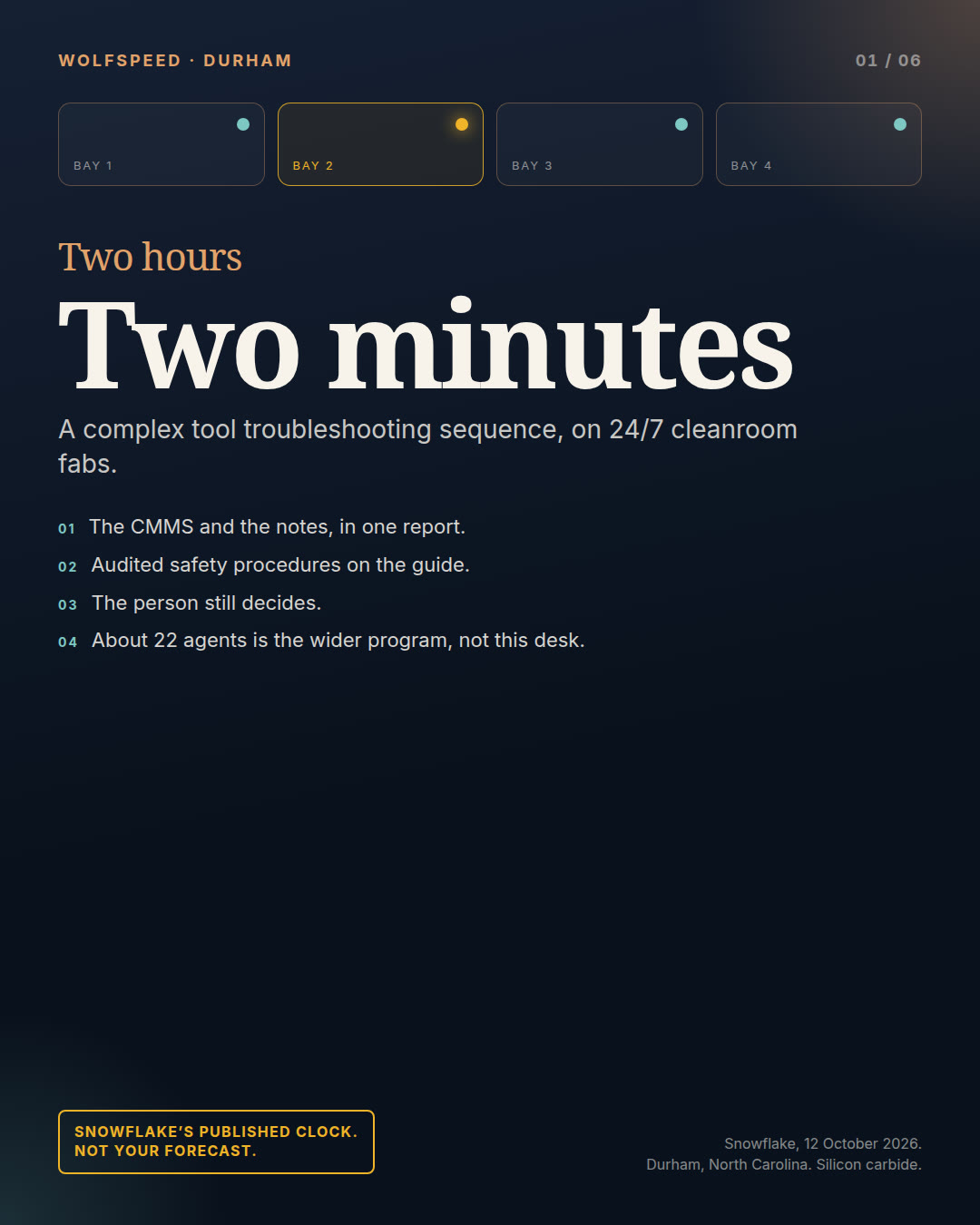
The October write-up is the clock. A complex tool troubleshooting sequence went from a two-hour scramble across disconnected systems to a two-minute automated response. The same paragraph says the automated guides have to carry the plant's audited safety procedures, so that an action still has the procedure inside it. The May sentence is the one a smaller plant can enforce without that access-control stack. The procedure is attached. A person still decides. The instruction file below takes that stricter sentence as the rule. A recommendation can quote the procedure. It cannot press the stop.
The maintenance export covers the last day of tool history
        ↓
The notes export covers passdowns, logs, and audited procedures
        ↓
A tool with no fresh state is unknown. Unknown is not up
        ↓
A high anomaly recommends a step only when an audited procedure covers it
        ↓
The prior shift's comments become stand-up lines a person already wrote
        ↓
The lead acknowledges. Nothing on the tool is commanded
Certain teams, Wolfspeed reported in January, had been spending 30% of their time hunting for data, 50% cleaning and enriching it, and 20% on the analysis. After the hub, those teams were at 20% on enrichment and 80% on analysis, decisions, and actions. That mix is theirs. It is not a formula for the tool report.
Unni Velayudhan, senior director of data and automation, separates a system that answers from a system that acts, and he locates the value in the one that acts. He also said they do not take a point-in-time snapshot. OpenFlow keeps pulling SharePoint files, transcripts, and departmental updates. A business champion inside each department decides what is allowed to flow, so the agent is not fed a dump. Department data stays in its own repository, with role-based access, after an early attempt to pour every team into one pile made the answers worse and the permissions unclear.
The maturity model he described has three stages. First the system has to retrieve the right fact. Then it can deliver a document, a decision, a risk log. Only after those two are real does orchestration belong in the conversation, an agent carrying a workflow through to the end. The tool desk in the May profile is a report and a set of actions a person uses. The file for a smaller plant stops in that same place.
A missing export is not a healthy tool
Speed is how a tidy agent writes "bearing failure" because a note said bearing, when the only event on file is an alarm code. Speed is how a tester with no status in the last day gets marked up, because silence looks like peace. Speed is how a draft procedure, the one nobody has audited, becomes the step on the screen. Speed is how a comment that says to ignore the procedure and stop the whole plant becomes the recommendation. Speed is how the two minutes from a cleanroom fab becomes the number on someone else's whiteboard.
The file for a smaller plant keeps the two jobs and drops the tenant. One department. One shift pattern. The exports the maintenance system and the shift log already produce. No Snowflake account is required. The model may copy a procedure line that is already audited, or a proposed action a person already typed. It may not invent either one. It may not write the maintenance system. It may not change the schedule. It may not delete the note. Version 1 writes files. A published stand-up file is not a command, and it is not an email to a department head.
On the fixture, which is ours, four tools sit in a manufacturing department at a plant called Northline Components. The name is not Wolfspeed. The press is down. The latest state inside the window says down, and a later "up" timestamped after the shift start does not heal it. The oven is in maintenance. The packer is up, and it still carries two anomalies, because up does not clear a jam. The tester has a state from the day before the window, so the condition is unknown. A finance tool rides along in the same export and is skipped. The folder does not mix departments.
Five actions come off those anomalies. The press alarm quotes procedure revision 3: hold the press, page the named technician, lockout before any guard is opened. A generic procedure at revision 9, written for any tool, loses to that specific one. The press safety action quotes the audited revision 2, which says to clear the area and stop only the press section named on the permit. A draft at revision 5 does not win. Both of those are recommendations. Executed stays false. The oven drift is low. An audited procedure is on file for it, and the steps are not copied, because a low anomaly is a watch. The packer jam is high, and the only procedures on file are a draft and an expired row, so the action asks the lead to look and invents no step. A class the plant coded as wobble stays unknown even though it cites the same event whose summary says jam. The summary is not a classifier. A note on the press alarm says the failure is a bearing and that the plant should stop. The word bearing does not appear in the output. The plant is not stopped.
The night shift left a stack of comments. One of them, from a lead named N. Rivera on the fixture, asks the day crew to review the down code before anyone starts the press. That sentence is copied, and it is marked as having no effect on the equipment. One comment asks for an action and does not name one. It stays unspecified. One comment says to ignore the procedure and stop every tool in the building. It is refused. A card number in another note never reaches the file. The rollup is four tools, one of them unknown, two recommendations, three asks, one stand-up line, one plant-stop refused, five comments read, and an executed count of zero. The hash of that rollup is 6cd5921ce0151758e51ba70fbb3ce5e5d3c98416c8d8ffcb7821400a361a5fea. It is the test. It is not a minute count.
What a smaller plant should steal
If the incoming lead still builds the handoff by opening the maintenance system, the passdown, and a procedure binder in that order, the first month is one department and ten shifts a person already ran. Manufacturing is the starting word in the file. That choice is ours. The articles describe a factory tool desk. They do not say which folder a smaller plant should open first.
One department, one shift pattern, a lookback you type yourself
        ↓
Thirty days of exports, and a stopwatch on ten handoffs a person already wrote
        ↓
Thirty days where the report sits beside the sheet that lead would have written
        ↓
Thirty days where an acknowledged file may be published, and it still commands nothing
        ↓
The next department gets its own folder. An equipment write is not in this file.
Time the stretch you already have. Minutes from the export in hand to a report file. How the tools split between a real state and unknown. How many recommendations the lead keeps, edits, or kills. Recommendations that cite a procedure that was not audited. Tools called up with no fresh state. Actions whose executed flag is true. Notes the agent deleted. Schedule rows it wrote. Departments that leaked into the folder. Case-study phrases that landed in the result. Those last five stay at zero.
The two-minute response, the time mix, the count of about 22 agents, the more than 200 silos, and the 2,371 employees are Wolfspeed's published story. They are not one equation, and they are not a line for a proposal. Do not paste any of them onto yours.
What the instruction file will make an agent do
The file below is the brief. It is not their maintenance system, their hub, or their access control. None of that schema is public. The blanks are yours.
It will make the agent:
- Refuse to run while a
REPLACEline is empty, or while anEXAMPLErow is still in a live sheet. Refuse a second department, a maintenance password, and any flag that would command a tool, change a schedule, write the maintenance system, delete a record, or send mail. - Treat a missing or stale export as a stopped run. The tester on the fixture is unknown. A state timestamped after the shift start does not flip the press from down to up.
- Cite an anomaly only when an event for that tool sits inside the window. A note that says bearing does not become the diagnosis. A class the plant did not map stays unknown, even when the event summary says jam.
- Recommend a step only for a high anomaly, and only by copying the winning audited procedure. On the fixture that is revision 3 for the press alarm and revision 2 for the press safety action. A star procedure at revision 9 does not win. A draft does not win. A low drift with a procedure on file stays a watch, and the steps are not copied.
- Copy one stand-up line from a comment a person already wrote, and refuse the comment that says to stop every tool. The card number does not appear. The executed count is 0. The rollup hash is
6cd5921ce0151758e51ba70fbb3ce5e5d3c98416c8d8ffcb7821400a361a5fea. - Publish a stand-up file only after the named lead acknowledges on the form, and only after the gates. The file is not a command.
The tests are in the file. The unknown tester. The up packer that still has anomalies. The revision that loses. The jam with no eligible procedure. The whole-plant comment. The bearing that never appears. A header-only anomaly file, which still reports the down press and writes no actions, against a missing anomaly file, which writes nothing at all. If the agent clears any of those by marking the tester up, copying a draft step, or stopping the building, the test fails.
The instruction file
The brief has the role, the sheets a maintenance export and a shift log can hold, the condition rules, the procedure rules, the comment rules, the approval gates, the ninety days, the export map, and the tests that decide when a file may be treated as a handoff.
Replace every REPLACE line. Delete every EXAMPLE row. Let it sit beside one department's shifts for a month a person still finishes by hand, before anyone treats a published file as a command the tool has already run.
Sources
The company, the headquarters, and the employee count are from Wolfspeed's Form 10-K for the fiscal year ended June 28, 2026. The 2,371 figure is regular full- and part-time employees on that date. The filing also says the company uses temporary staff and contractors. Those groups are not added into 2,371 here. The February 11, 2026 news post is the company's own framing of the Snowflake work, WolfGPT, and the spread of agents across manufacturing, quality, supply chain, finance, and corporate analytics. The two-hour scramble and the two-minute response, the 24/7 cleanrooms, and the requirement that automated guides carry audited safety procedures are from Snowflake's October 12, 2026 article. The more than 200 silos, the time mix for certain teams, and Velayudhan's distinction between a system that answers and a system that acts are from Snowflake's January 26, 2026 article. His "5x" sentence is a view of value on that page. It is not a measured return, and it is not used as a result here. The tool desk, the prior 24 hours, the report, the stand-up actions, the human decision, the count of about 22 agents, and the three pillars are from Smart Industry on May 5, 2026. The three-stage maturity model, OpenFlow, the department repositories, and the role-based access are from Smart Industry on May 11, 2026. The figures are as those pages report them. They are not an independent audit, and they are not a forecast for another plant. The two minutes are a troubleshooting clock. They are not the time-mix percentage, and the 22 agents are not a result for this one desk.
- U.S. Securities and Exchange Commission, Wolfspeed, Inc. Form 10-K for the fiscal year ended June 28, 2026, filed as accession
0000895419-26-000054. Wolfspeed, Inc. is an innovator of wide-bandgap semiconductors, focused on silicon carbide materials and devices for power applications. Headquarters are in Durham, North Carolina. As of June 28, 2026, the company employed 2,371 regular full- and part-time employees, and also employs temporary staff and contractors. This page uses the 2,371 figure as written and does not combine it with the other groups. - Wolfspeed, "Wolfspeed Accelerates AI-Powered Manufacturing and Operations with Snowflake," February 11, 2026. Durham, NC. Factory, supply chain, and enterprise data on Snowflake. WolfGPT, the internal generative AI platform on Snowflake Intelligence. Specialized agents across manufacturing, quality, supply chain, finance, and corporate analytics. Priya Almelkar, senior vice president and chief information officer, on making decisions faster, acting earlier, and working more safely.
- Snowflake, Greg Sloyer, "How Modern Manufacturers Are Transforming Operations with Snowflake Intelligence," January 26, 2026. More than 200 silos before consolidation. Passdowns and meeting notes that were hard to reach. Unni Velayudhan, senior director of data and automation, on Ask versus Do, including his statement that a Do system is worth 5x an Ask system. That multiplier is not used as a result on this page. Certain teams moved from 30% of time hunting, 50% cleaning and enriching, and 20% on analysis, to 20% on enrichment and 80% on analysis, decisions, and actions. Semantic views, verified queries, and role-based agent access.
- Snowflake, Angela Marrujo Fornaca, "From Pilot to Production: How Manufacturing Leaders Scale AI and Win C-Suite Approval," October 12, 2026. Wolfspeed operates 24/7 cleanroom fabs where unplanned downtime erodes margin. A complex tool troubleshooting sequence went from a two-hour scramble across disconnected systems to a two-minute automated response. Automated troubleshooting guides incorporate audited plant safety procedures.
- Smart Industry, Sarah Mattalian, "Stories of AI adoption: Wolfspeed all-in with 22 agents across key company teams," May 5, 2026. Durham, North Carolina. About 22 agents across finance, HR, sales, manufacturing, and more. Priya Almelkar on data, governance, and architecture. The tool desk: a CMMS agent and other web apps for the prior 24 hours of tool-state history, plus an agent on Snowflake for structured and unstructured material, producing a tool-state report of state, anomalies, and conditions. Prior-shift comments summarized into actions for department heads and the start-of-shift meeting. Almelkar: the end decision is still made by humans, it is not an autonomous solution, and it is saving many, many hours. Velayudhan on refusing a point-in-time snapshot, on a business champion per department, and on not mixing department data.
- Smart Industry, Sarah Mattalian, "Stories of AI adoption: Wolfspeed uses 'three-stage maturity model' for agent deployment," May 11, 2026. Stage one, AI insights. Stage two, AI delivery, including documents, meeting decisions, and risk logs. Stage three, AI automation and orchestration, only after the first two are proven. OpenFlow pulling SharePoint files, meeting transcripts, and departmental updates on an ongoing basis. Department-specific repositories and role-based access. Pre-processed prompts. An early mix of every department's data was walked back.