
How Yat Guan Cut the Quote from Three Days to One
A Singapore pallet maker let a chatbot finish the spec in the customer’s language. A salesperson still owns the price.
ButterflyCopilot
0105
What they achieved
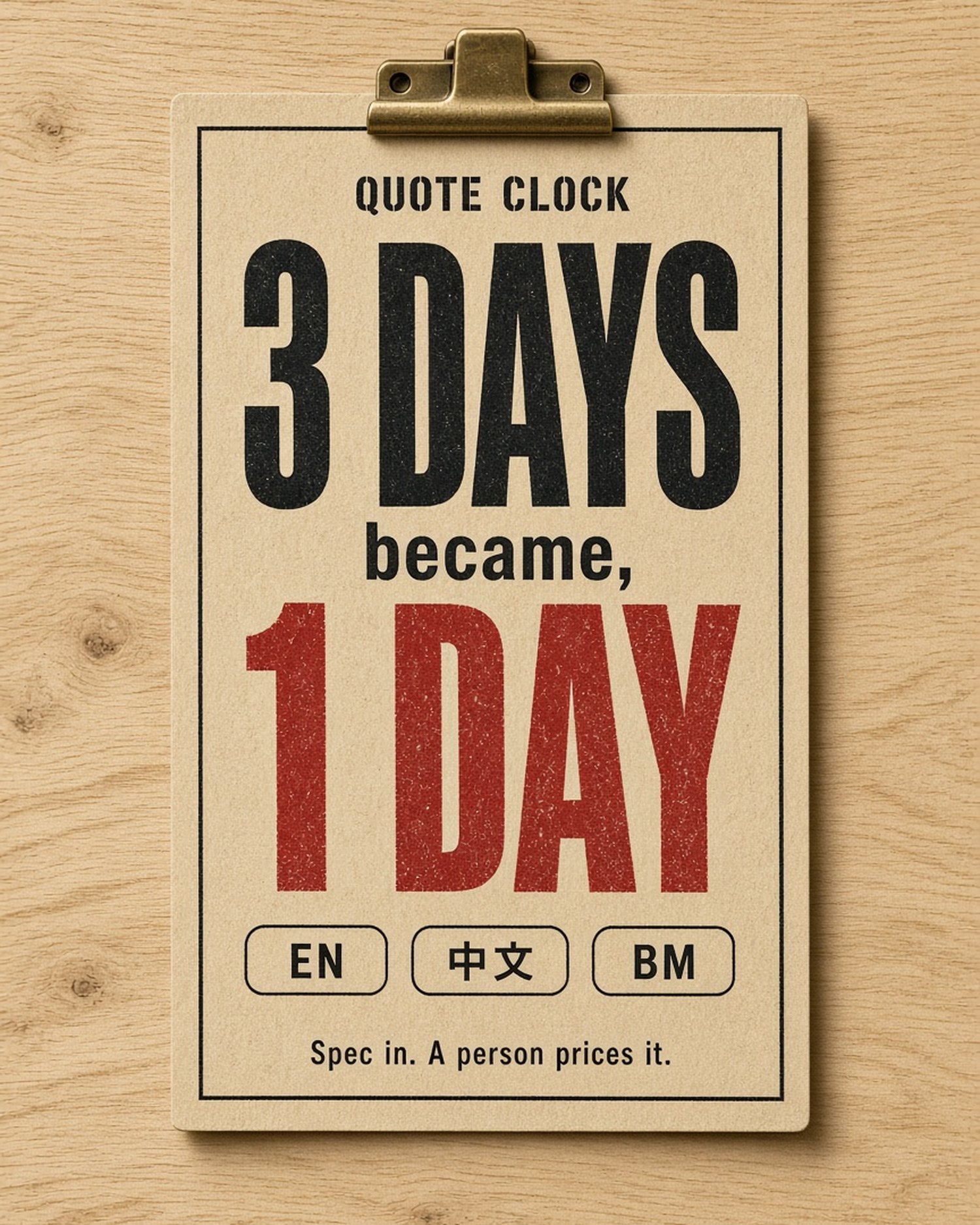
Yat Guan’s quote used to take two or three working days. IMDA’s SMEs Go Digital highlight, published 4 September 2025, says the path from inquiry to quotation now takes one working day, which they describe as a 60% improvement in response time.
The same page says the company receives 50 to 60 inquiries a week, each one custom, and that Managing Director Ryan Lim estimates the bot now operates at about 95% accuracy after continual backroom training. Voltade’s case study reports the same 95% on Yat Guan’s packaging specifications, in English, Mandarin, and Malay. That figure is Ryan’s estimate and the vendor write-up. It is not an independent audit.
Lianhe Zaobao, in an IMDA-presented feature on 3 November 2025, adds two further results: follow-up rounds down by nearly half, because the customer’s details arrive more complete, and a clear drop in people who abandoned the enquiry. The IMDA page itself says the team no longer has to answer the same questions over and over. It does not publish the “nearly 50%” line. Treat that percentage as Zaobao’s.
The sales team in the public record is five people, across Singapore and Malaysia. IMDA quotes Ryan on the point of the system: when the bot carries the repetitive engagement, and later the costing draft, the same lean team can spend time on relationships and new business. Zaobao says those five people can handle more enquiries and orders. The published picture is a five-person desk in front of 50 to 60 custom enquiries a week.
Yat Guan’s own LinkedIn post on 4 November 2025 says the same thing in the company’s voice: in a few months, response speed was up, back-and-forth was down, quoting moved from three days to one, and phase two is human-in-the-loop automated costing.
What they do
Yat Guan was founded in 1931. IMDA calls it one of the larger suppliers of wooden pallets, skids, crates, and other packaging in Singapore and Malaysia. The work is family-run, now under Ryan Lim (Lim Er Lin), and the customers sit in industries such as automotive and oil and gas. The company’s own site also lists recycled pallets, plywood, timber, and hardware, plus services that sit beside the product quote: packing, heat treatment, repair.
The bottleneck was the front of the quote.
A buyer filled in a generic form. Sales then spent two or three working days coming back. Ryan’s line, on the IMDA page and in Voltade’s case study, is that two or three days is already too slow when the job is time-sensitive. Purchasers who do not live in packaging specs either filled the form wrong or gave up halfway. Zaobao quotes the sales desk on the same pile: dimensions, design, and materials had to be checked by hand, then costed by hand. Language made it worse for customers in Malaysia and Indonesia.
The assistant they put in front of that pile is YatBot, also presented on the company site as Yat Bot Buddy. It is a GenAI chatbot. IMDA says the company adopted it in 2024 as a pre-approved GenAI Customer Engagement chatbot, with up to 50% grant support. Zaobao places that adoption under IMDA’s GenAI Sandbox and names the solution category the same way. The company’s news post says IMDA’s SMEs Go Digital programme and Lianhe Zaobao both featured it.
On the public website, the bot takes product quotes for new and recycled pallets, crates and boxes, hardware, and lumber. The customer asks, uploads details, and gets a form-ready request routed to sales. Sales sends the official quotation. Standalone jobs such as on-site packing, heat treatment, pallet repair, and events are pointed at the branch contacts. The sourcing page tells a plywood, timber, or hardware buyer to expect the team within one to two business days. That sits next to the “one working day” quote clock. The bot answers immediately. The price still comes from a person, on a clock measured in a day or two, not in a second.
How they do it
IMDA’s description of the live bot is specific.
It guides the buyer through the packaging spec. It acts as a technical explainer for people who are not in the trade. It handles English, Mandarin, and Malay. It asks questions and uses visual cues, because a static form was how the leads were leaking. Sales still generates the quotation from the spec the bot collected.
Voltade’s case study, which says Voltade built the agent branded YatBot, adds the channel list and the loop: WhatsApp Business, email, and the web form. Read the enquiry in the buyer’s language. Pull out product, quantity, delivery, and payment terms even when they are buried in a sentence. Ask for the gaps: dimensions, treatment standard, export compliance. Show a non-expert a picture or a structured prompt. Check the catalogue, the treatment options, and current capacity. Hand sales a structured spec. Final pricing stays with the salesperson. The vendor describes the deployment as PDPA-aligned and hosted in Singapore.
Zaobao describes the bot as the company’s own virtual assistant, and gives the clearest example of a single question. A buyer asks for a crate at 50 cm by 60 cm by 40 cm and does not say whether those numbers are the inside of the box, the goods, or the outside. YatBot asks that, in Chinese, before anyone opens a cost sheet. If the buyer is stuck, the bot shows an explanation or an example picture. The opening line Zaobao records is simply the assistant introducing itself and then asking for a photo or the spec: size, load, material.
The three accounts name the builder differently. IMDA says a pre-approved solution. Zaobao describes it as the company’s own assistant. Voltade says Voltade built it. The operating loop in all three is the same, and the loop is the part worth copying.
Phase two is not what produced the one-day clock.
IMDA says the company is looking at letting the bot generate quotations. Zaobao says they are training it on the cost structure of each product line, drafting a first number from the customer’s parameters, and checking that draft line by line against an Excel cost table. A mismatch gets corrected. Ryan’s reason, in that article, is trust: a faster quote still has to meet the standard a customer will believe. LinkedIn calls this phase human-in-the-loop automated costing. Voltade’s page, updated later, still marks “agent drafts the quote” as in flight.
Ryan also told IMDA that the team was shown the idea before it was built, in a workflow session with sales, and that staff asked for a bot that could simplify the product for lay buyers. After launch, the work did not stop. Zaobao says they adjust the reply logic every month from customer feedback. IMDA calls it continual backroom training. His line on that page: no solution is a magic bullet; you have to keep working at it.
The hard parts
The accuracy number is an estimate from the operator. “About 95%” is Ryan’s figure after training, published by IMDA, and repeated as spec accuracy in the Voltade case study. Use it as evidence that they measured wrong specs and kept training. Do not paste 95% into a proposal for a different factory.
The 60% is their label for “two or three working days, down to one.” Three days to one day is a larger cut than two days to one day. They still call the band 60%. Quote the band and the label together.
The follow-up cut is real in Zaobao and softer on the IMDA page. Nearly 50% fewer follow-up contacts is the newspaper line. The official highlight says repeated questions dropped away, without that percentage.
Who built it is not settled in public. Copy the loop. Leave the vendor argument in the sources.
A chatbot that prices on day one would have been a different project. The live result is a complete spec and a human price. Automatic quoting is the next phase, and even there the published control is an Excel table plus a person.
Custom work does not fit a short web form. The form was already the failure mode. The bot exists because buyers could not, or would not, finish it.
Three languages are a product decision, not a setting. English, Mandarin, and Malay are what IMDA and Voltade name. The scripts have to be ones the business has actually approved, including the question that distinguishes inner, goods, and outer.
How a smaller business can copy it
The useful shape, if you make pallets, crates, signage, machined parts, or anything else that is quoted one job at a time:
Enquiry arrives in the channel the buyer already uses
        ↓
The assistant reads it in that language
        ↓
It asks for the one gap that would make the spec unusable
        ↓
It checks your catalogue and your capacity sheet
        ↓
It hands sales a structured file
        ↓
A named person sends the price
Version 2, later, drafts a cost from your own spreadsheet. The customer still does not see that number until a person has checked the row.
What the instruction file will make an agent do
The file below is the brief. Hand it to the agent that builds or runs the assistant. It is written as orders, with the blanks marked REPLACE.
It will make the agent:
- Refuse to go live until you name the salesperson, the sales inbox, the languages, and a real catalogue file.
- Stand up one inbound pipe for WhatsApp (official Cloud API), a quotes mailbox, and a short web chat, then launch a single channel first.
- Run a fixed conversation: greet with a privacy line, detect English, Chinese, or Malay, ask one missing field at a time, and stop after eight dead turns or the moment someone asks for a person.
- Treat
50 × 60 × 40as an incomplete crate spec until the buyer says inner, the goods, or outer. Store a photo. Never measure the photo. - Look up your catalogue and capacity sheet. If nothing matches, or the yard is full, still hand the file to sales. Do not invent a decline or a delivery date.
- Email a JSON handoff whose
pricefield is null, and send the customer a reference number with no currency in it. - Keep card numbers, NRIC, and personal chatbot accounts out of the path.
- Leave the Excel draft switched off until the version 1 tests pass. When you turn it on, one matching cost row becomes an internal draft. Two matching rows become “cannot draft.” The bot still does not send the number.
The acceptance tests are in the file. A Chinese crate enquiry that asks “how much,” a complete Malay pallet spec, a packing-crew request, a photo with no dimensions, a card number, and a version 2 draft that must not leak into the customer reply. If a reply contains a price, the test fails.
That is the whole implementation. The agent does not get to design a nicer process on the way.
The instruction file
Here is the brief for your agent: the role, the sheets, the channel setup, the state machine, the questions in three languages, the handoff JSON, the privacy checklist, the hard stop before money, and the tests that decide when version 2 is allowed.
Replace every REPLACE line. Delete every SAMPLE row. Then let it run on old enquiries before it talks to a live customer.
Sources
Figures in this article come from IMDA, from Lianhe Zaobao’s IMDA-presented feature, from Yat Guan’s own site and LinkedIn post, and from Voltade’s case study. They are not an independent audit. The 95% accuracy figure is Ryan Lim’s estimate, as IMDA reports it.
- IMDA SMEs Go Digital, “Yat Guan goes from inquiry to quotation in just one day with GenAI Chatbot,” 4 September 2025. Two-to-three working days to one, the 60% label, 50 to 60 inquiries a week, English, Mandarin, and Malay, visual cues, sales still generating the quotation, five salespeople, phase two, the workflow session with sales, and Ryan Lim’s 95% estimate after continual training. smesgodigital.gov.sg
- Lianhe Zaobao, “遇到人工瓶颈 百年企业用智聊来智取,” 3 November 2025, presented by IMDA. The 50 cm crate question (inner, goods, or outer), nearly 50% fewer follow-up contacts, the five-person team handling more volume, the GenAI Sandbox in 2024, monthly tuning, and phase two as an Excel cost-table check with a person still correcting the draft. zaobao.com.sg
- Yat Guan Pte Ltd, LinkedIn, 4 November 2025. The company’s own note: three days to one, less back-and-forth, phase two as human-in-the-loop automated costing, with IMDA’s support. linkedin.com
- Yat Guan, news post by Yanqing Low, 4 November 2025, and the public bot pages. Featured by IMDA and Zaobao. Product quotes routed to sales. Other services directed to the branches. Sourcing replies expected in one to two business days. yatguangroup.com/news, Yat Bot Buddy, contact, sourcing
- Voltade, “Yat Guan” case study, updated 3 September 2026. The vendor’s account of WhatsApp, email, and web; the five-step loop including catalogue and capacity; 95% spec accuracy; PDPA-aligned hosting in Singapore; and phase two still in flight. voltade.com