
How Apollo Tyres Cut Root Cause Analysis Time with AI Agents
The press was already slow. Finding which one, and which step, took the morning. The answer comes back in under ten minutes, and a cause that is not in the rows still does not get a team.
ButterflyCopilot
0106
The press was already in the number.
Apollo Tyres, in Gurgaon, makes tyres under two brands, Apollo and Vredestein. The plants are in India and in Europe, seven of them. The tyres sell in more than 100 countries.
Curing is where a green tyre becomes a finished one. The plants run more than 250 automated curing presses, more than 140 SKUs, three curing mediums, and two machine suppliers. A dry cycle is not one number. It breaks into more than 25 timed steps, the sub-elements inside the press.
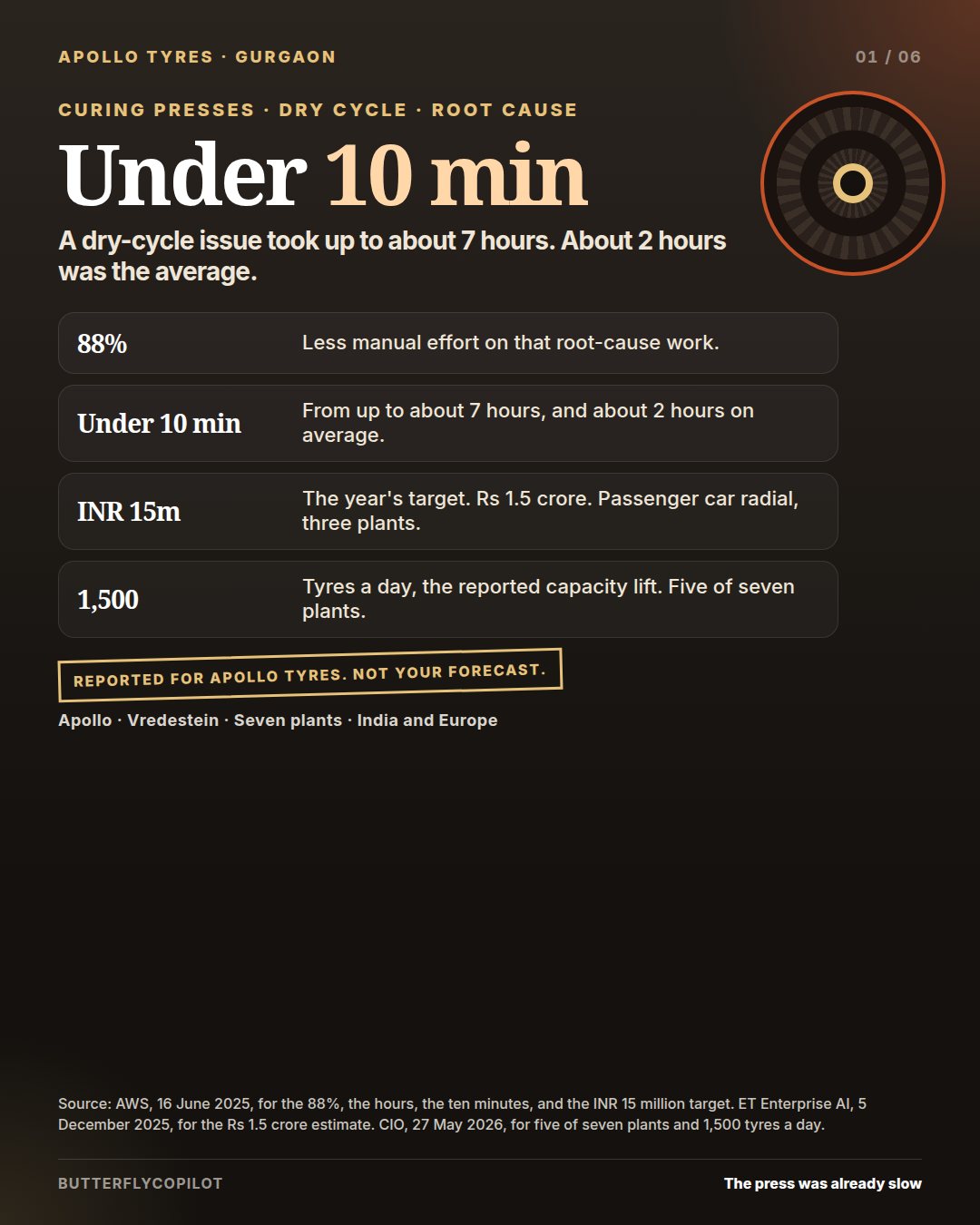
The engineers already had an IoT dashboard. It did not answer the question they brought to it. Someone still had to walk the chart, then pull manufacturing, technology, and industrial engineering into the same room. The old root-cause tools could not open a sub-element. The picture was not live, so the correction waited. An issue took up to about seven hours. On average it took about two hours of elapsed time.
What they stood up
They built it in-house. The name is Manufacturing Reasoner. The presses stream sensor, process, and condition data into a data lake on AWS. The answers are tied to rows in Amazon Redshift. The screen is a Chainlit app. Amazon Bedrock Agents sit behind the sentence.
An engineer types the question the room used to spend the morning on. Which press was the bottleneck in the morning shift, and why.
A primary agent classifies the question and routes it. A transformation agent and a root-cause agent, several steps and more than one model, pull context from Bedrock Knowledge Bases and OpenSearch, and query Redshift. An explainer, on Claude Haiku, returns two parts. Evidence is the query walked in order. The conclusion is short, and it points at the records. A chart agent, on Claude Sonnet, writes the Plotly. The pieces are combined and streamed back. Bedrock Guardrails keep the conversation on the machine data and check that the answer holds.
The knowledge base that keeps those answers stable is a set of examples. Each one is a question, the query that answers it, and the metadata around that query.
The same reasoner watches for a dry-cycle shift that should not be there, the poka-yoke on a drifting press. It can put an SPC chart on the step, set one press beside another, and send the day's alerts to the process experts.
The manual effort on that root-cause work fell by about 88 percent. The issue that had taken up to seven hours, about two hours on average, comes back in under ten minutes. The saving they set as the target was about INR 15 million a year, Rs 1.5 crore, in the passenger car radial division, across three plants. The output they took was from the plants already standing. Vardhan calls that sweating the presses they already run.
A press streams its cycle into the data lake
        ↓
An engineer asks which press was slow, and which step
        ↓
The question is classified and sent to the query that fits
        ↓
The rows come back
        ↓
Evidence, then a conclusion that points at those rows
        ↓
A chart, if the rows will bear one
        ↓
A person decides the correction
By May 2026 the reasoner was live in five of the seven plants. Unit heads asked for it after the pilot. The capacity increase they reported was 1,500 tyres a day.
A different system watches the extruder. It predicts a startup line speed, writes it toward the machine, and trims it from the tread and sidewall measurements, with the setpoint on the operator's screen. Startup rework there fell by about 26 percent. Stabilization time fell by about 40 percent. About 20 production hours came back in a month. That system moves a setting. The reasoner does not. The file on this page is the reasoner, scaled to one line.
Harsh Vardhan, who runs the digital innovation hub, put the risk in one sentence. One hallucinated insight can put plant engineering, plant technology, industrial engineering, and maintenance in a room for seven hours, and at the end of it the insight was not worth the room. The answer has to be specific. It has to show up in the forms the floor already uses, a fishbone, an SPC chart, the daily management sheet. A paragraph will not do.
The early fear on the floor was jobs. The way through it was to build the tool with the plant engineers.
The first version was slow. Several agents in a chain took more than a minute. Smaller models, and turning off the workflows the question was not using, brought that to about 30 to 40 seconds. The chart code failed when the dataset got large. They iterated until the picture was drawn from the frame in front of it. Both of those lessons are in the file below, in a stricter form. A smaller plant does not get a quarter to discover them on a live press.
A number that is not in the rows
Speed is how a tidy answer names a press the export does not contain, or a hydraulic fault no step time supports, or a temperature nobody stored.
The file for a smaller plant keeps the shape and drops the platform. One line. A handful of machines. The cycles can arrive as a CSV from the PLC, from the MES, or from the spreadsheet a supervisor already fills at the end of the shift. The query library is a list a person wrote: the question, the SQL, and the metadata. The router may only pick an id from that list. A confident sentence does not get to write a query.
The conclusion is filled from the rows. Evidence first. Every number in the answer has to be on that evidence. A machine with fewer cycles than the minimum the plant typed is named as excluded. It is not crowned the bottleneck on a short, ugly run. A chart is a bar or a line the code draws from those same rows. Past a cap, the table stands and the chart is omitted. There is no second pass that invents a shorter dataset so the picture will draw.
An alert needs a baseline the plant calculated, a gap that clears both a seconds bar and a percent bar, and that same gap on consecutive shifts. One bad cycle does not page anyone. The alert names the shifts and the medians. It does not name a failed valve.
The correction is a line from a list the plant wrote. A named engineer signs it. Nothing in this file writes a setpoint, a PLC tag, or a work order the maintenance system will treat as already approved. The extruder's closed loop is a later maturity, on a different machine. This file does not pretend to be that loop.
Suzhou Universal's planners ask a quality question across the systems they already run, and a schedule change waits in a draft. This file asks a narrower question. Which machine ran long, and which step accounts for the gap.
What a smaller plant should steal
If someone still opens a dashboard and spends the morning on one slow machine, the first month is one line and the cycles you already record.
One line
        ↓
Thirty days of exports, and a stopwatch on the root-cause notes a person already writes
        ↓
Thirty days where the answer sits beside that note, and nothing is shown as official
        ↓
Thirty days where a finished shift may return an answer, and an alert may go to one named person
        ↓
The action still waits for a signature. The machine setting still does too.
Time the stretch you already have. Minutes from the question to an answer someone will sign. How many of those answers they later mark wrong. How many contained a number the rows do not contain. How alerts split between confirmed and dismissed. How many actions were signed, edited, or killed. How many setpoints this agent wrote. That last count stays at zero.
The 88 percent, the seven hours, the two hours, the ten minutes, the INR 15 million, the 1,500 tyres, and the extruder's 26 percent are Apollo Tyres' published story. They are not a line for a proposal.
What the instruction file will make an agent do
The file below is the brief. It is not Bedrock, and it is not Apollo's data lake. None of that wiring is public. The blanks are yours.
It will make the agent:
- Refuse to run while a
REPLACEline is empty, or while anEXAMPLErow is still in a live sheet. - Read a cycle export, a step export, and a baseline the plant calculated. A blank dry cycle is not zero. A cycle whose steps do not add up is left out of the median, and the answer says so.
- Route the question in code. Bottleneck, compare, trend, and "explain this alert" are the only answers. A temperature, a setpoint, a medium, a supplier, a pump, and a personnel question stop before any query runs.
- Run only a SQL file a person stored, with parameters the code binds. A query typed into the question does not run. The medians are upper medians. A tie between machines is a tie, and no step is blamed.
- Fill the conclusion from those medians. The fixture's morning shift names the machine at 140 seconds, the load step at 40 seconds against 12 on the other machines, and the machine that had only four cycles as excluded. A model sentence that brings 200 seconds, or 88 percent, is dropped.
- Draw a chart from the included machines only. Over the cap, omit the chart. Refuse a tool that wants to write Plotly.
- Open an alert only when the last consecutive shifts each clear both a seconds bar and a percent bar against the baseline. One hot shift, or a thin baseline, writes nothing. The alert does not name a part.
- Sign an action only from the plant's list, only on a form, only by the process engineer, with a reason long enough to read. The process lead cannot sign it. The model cannot sign it. There is no tool that writes a PLC tag.
- Write a morning file from this plant's own counts. No comparison with the case study.
The tests are in the file. The morning question, with the machine at 140 seconds and the four-cycle machine left out. An empty shift that names nobody. A compare that does not say "load". A trend of one shift that does not say the line is improving. A request to set a cure temperature to 180, with 180 kept out of the answer. A medium question that does not answer "steam" or "nitrogen". A second line that is refused. A model that points at the afternoon and is ignored. A hot pair of shifts that alerts, and a single hot shift that does not. A signature of 34 characters that records the loader check, and a reason of nine characters that does not. A model that tries to sign, to run SQL, or to write the PLC. If the agent clears any of those by crowning the four-cycle machine, naming a pump, or sending a sentence it was told not to send, the test fails.
The instruction file
The brief has the role, the cycle and step sheets, the query library, the router, the evidence and the conclusion, the chart cap, the alert bars, the signature, the ninety days, and the tests that decide when an answer may be shown.
Replace every REPLACE line. Delete every EXAMPLE row. Let it sit beside one line's cycles for a month a person still explains by hand, before anyone treats a file as a cause the floor has already accepted.
Sources
The plant, the presses, the agent path, the 88 percent, the hours, and the rupee target are from the AWS machine learning post of 16 June 2025. The engineer's question, the estimated Rs 1.5 crore, the output without a new plant, and the way the floor's fear was handled are from the ET Enterprise AI interview of 5 December 2025. Five of seven plants, the 1,500 tyres a day, and Vardhan's line on a hallucinated insight are from CIO, 27 May 2026. The extruder's 26 percent, 40 percent, and about 20 hours are from the AWS industries post of 10 September 2026. The figures are as those pages report them. They are not an independent audit, and they are not a forecast for another plant. The rupee figure is a target on the AWS page and an estimate in the interview. ₹1.5 crore is the same quantity as INR 15 million. The June 2025 counts and the May 2026 counts are different sentences, and this page does not average them. The extruder is a different system.
- AWS, Harsh Vardhan, Deepak Dixit, and Gautam Kumar, “How Apollo Tyres is unlocking machine insights using agentic AI-powered Manufacturing Reasoner,” 16 June 2025. Gurgaon. Brands Apollo and Vredestein. Plants in India and Europe. Products in over 100 countries. In-house Manufacturing Reasoner on Amazon Bedrock Agents. IoT from curing presses into an AWS data lake, with answers referenced to Amazon Redshift. Chainlit on EC2. A primary agent, a transformation agent, a multi-step root-cause agent, an explainer on Claude Haiku (Evidence and Conclusion), a chart agent on Claude Sonnet (Plotly), Bedrock Guardrails. Knowledge-base entries as a question, a query, and metadata. More than 250 presses, more than 140 SKUs, three curing mediums, two suppliers, more than 25 sub-elements. Manual analysis from about 7 hours an issue to an average of 2 elapsed hours, then under 10 minutes. About 88 percent less effort on that root-cause work. Targeted about INR 15 million a year in passenger car radial across three plants. Anomalous dry-cycle triggers, SPC, press-to-press comparison, daily alerts. Latency from over 1 minute to about 30–40 seconds. Chart code iterated for large frames. Harsh Vardhan, Global Head, Digital Innovation Hub.
- ET Enterprise AI, Ramarko Sengupta, “From 2 hours to 10 minutes: Inside Apollo Tyres’ AI revolution,” 5 December 2025. The same reasoner, the same 88 percent, under 10 minutes against an average of two hours, and an estimated ₹1.5 crore a year in the passenger car radial division. The question: “Which press was the bottleneck in morning shift and why?” Additional output without a new factory. Asset sweating. Initial fear of job loss, handled by co-developing with plant engineers. Other programs on that page, including a call assistant and a supply-chain forecast across seven plants, are not this file.
- CIO, Sandhya Michu, “Apollo Tyres Rolls Out Autonomous AI Agents,” 27 May 2026. Agentic systems across five of seven plants. The reasoner live in five of seven after unit heads asked, with a reported capacity increase of 1,500 tires a day. Vardhan on one hallucinated insight costing a cross-functional team seven hours, and on answers that have to be specific. The extruder section on the same page is the closed-loop system, with rework down 26 percent. The opening caption joins that 26 percent to the 1,500 tires. The body does not. Energy procurement is named with no figure.
- AWS, Harsh Vardhan, Anindya Bhattacharya, and Gautam Kumar, “How Apollo Tyres Uses AI-Driven APC for First Time Right Tyre Extrusion,” 10 September 2026. A separate extrusion system at the Andhra Pradesh passenger-car plant. Startup line speed predicted, written toward the PLC, trimmed from tread and sidewall measurements, shown on the HMI. Startup rework down about 26 percent, stabilization time down about 40 percent, about 20 production hours back in a month. Human-in-the-loop confirmation, then human-on-the-loop oversight. Those figures are not curing-press figures. This file does not write a setpoint.