
How BASS Cut Scrap with a Shop-Floor AI Agent
The night shift already knew which carrier held the workpiece. The morning meeting did not. Then the note had somewhere to go.
ButterflyCopilot
0106
The night shift already knew which carrier held the workpiece. The morning meeting did not.
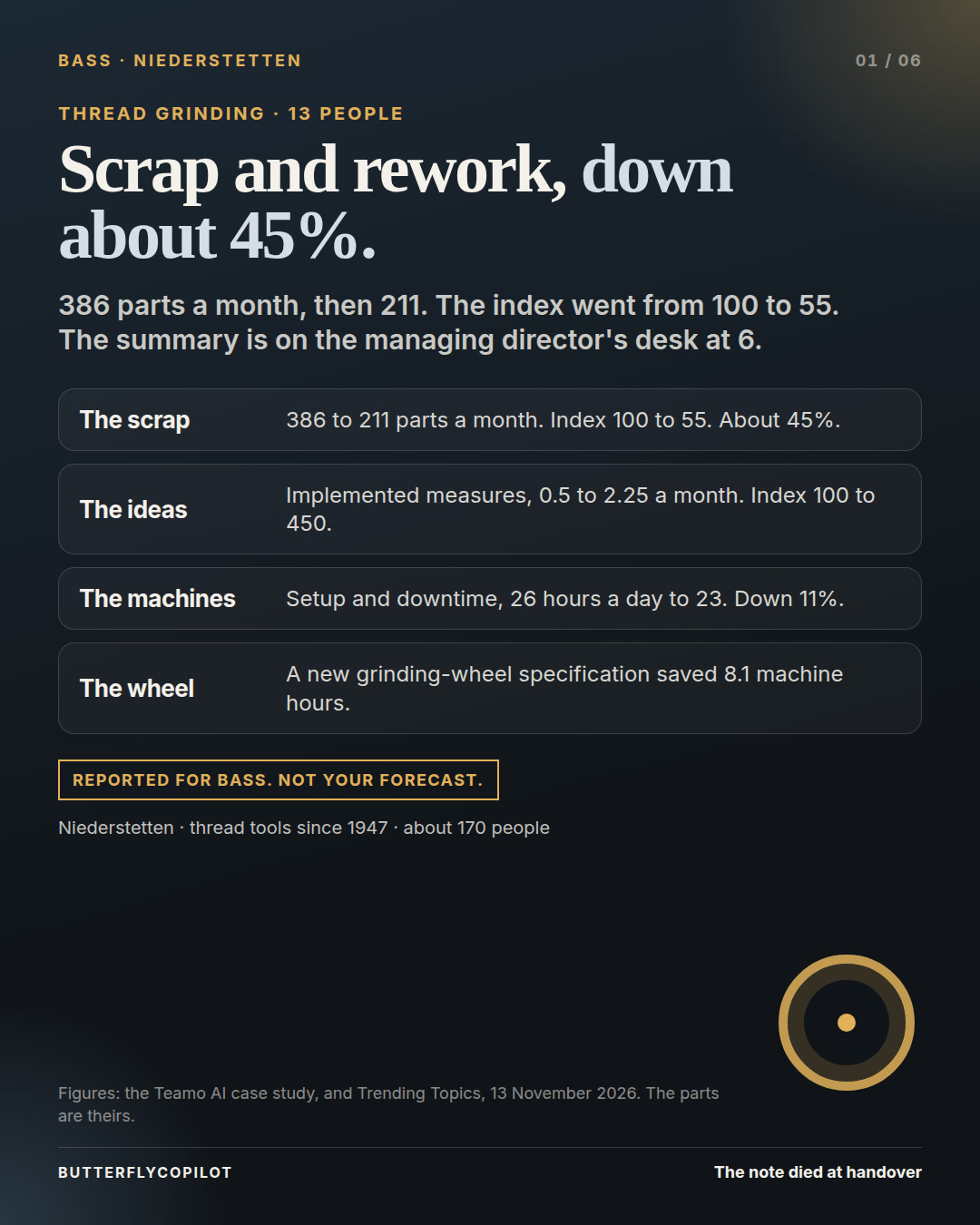
BASS makes the tools that cut an internal thread. The works are at Bassstraße 1 in Niederstetten, in Baden-Württemberg. The firm started in 1947. Taps, thread formers, thread mills, and the chucks that hold them, under the line Technik für Gewinde. The customers are in automotive, aerospace, machine building, and medical technology. Since 2019 the company has been part of the OSG Group. About 170 people work there. Martin Zeller is a managing director. The pilot was the thread-grinding team, thirteen people.
The handover ate the note
That cell grinds the thread on the tool. A problem on a machine tended to show up late. An improvement idea lived for as long as the conversation in the aisle, and then it was gone. The trick of how a workpiece sat on a carrier stayed in the hands of the person who had found it. At the shift handover, the observation left with them.
The records were already scattered in the usual way. Production and customer data in the ERP. PDFs on SharePoint. More of it in email, in chat, and in people's heads. Nobody had a place where the same small note, sent on Tuesday night and again on Wednesday afternoon, could be seen as one thing.
They put Teamo AI on that gap. It comes from teamazing, in Graz.
The channel was WhatsApp, connected within a few days. No new app. No training course. Anyone in the team could send a problem, an improvement idea, or a question about how the job is supposed to run. In 2025 BASS and teamazing built the module they call Vibe Check, and it stayed in the product. Observations from the day go in. The system bundles the reports, finds the theme that keeps returning, sets the company data next to it, and prepares the briefing.
Zeller has the summary at six in the morning. At nine, the points that matter are in the shop-floor meeting. A measure that is taken up is tracked until it is done.
Every morning at six I already have the summary. I can shape my day in a completely different way.
The case study puts the same idea in a longer sentence.
With Teamo AI we turn missing feedback, isolated work, and scattered knowledge into real collaboration and measurable results. For me personally, Teamo AI helps with prioritising, which makes my leadership more effective.
The carrier, and the wheel
Across several shifts, the same observation kept arriving. Workpieces sat better on some workpiece carriers than on others, and only on certain machines. People on the job had already seen it. Each handover dropped it. Once the notes were in one place, the pattern was visible, and the team leads found a fix.
A separate change was a new specification for a grinding wheel. It saved 8.1 machine hours, a full shift.
In that thread-grinding cell, scrap and rework fell by about 45%. The monthly count went from 386 parts to 211, and the index beside it went from 100 to 55. Implemented improvement measures went from 0.5 a month to 2.25, printed as +350%, and the index beside that move went from 100 to 450. Setup and downtime fell 11%, from 26 hours a day to 23. The figures are the plant's own ERP comparison: the first eight months of 2025 against the last four, January through August against September through December. The monthly rates are also described over the six months of the pilot, in a team of 13.
The same record is plain that the software did not do this alone. A developed shop-floor management, and the training that went with it, had been running since the spring of 2025. It is one cell, and the windows are short. What the system is credited with is getting the day's observations into a form a lead could see, and keeping a measure in view until someone closed it.
In June 2026 BASS signed a three-year contract and took the system across the company, by then nearly 170 people. The same month it received the Deutscher Excellence Preis in silver.
A WhatsApp note, a voice note, a photo
        ↓
A class, and a machine that is actually on the master
        ↓
The same observation, on a later shift, becomes a theme
        ↓
A briefing at 06:00. An agenda at 09:00. A measure with an owner
        ↓
The reporter hears when it closes. Code adds the ERP rows
The boxes are the instruction file. They follow the shape of the job: one channel the team already opens, three kinds of message, a theme that has to survive a handover, a morning file, a measure with a name on it. They are not a reconstruction of the screens in Niederstetten. No model name, no prompt, no cost, and no architecture of that deployment is public. This page does not invent them.
What a smaller plant should steal
If the handover still drops the thing the night shift saw, the first stretch is one cell. The works council signs before a body is stored. People opt in, and a photo is a separate yes. The scrap and the downtime are exported for a window that has already closed, so the baseline exists before the first message. Six months on that cell. A director signs before the next cell starts. The thresholds, the retention, and the windows are numbers the plant types, because Niederstetten does not publish them and they must not be guessed.
The model may propose a class. It may not invent a machine, a transcript, or a part count. It may not rank a person. It may not edit a work instruction. Version 1 writes files. A briefing is not a sent message until the lead accepts the send. An accepted idea is not a new instruction on the machine.
On the fixture, which is ours, two grinders and one part run in a cell that does not exist. Three notes about a carrier called NEST-2, on an early shift, a late shift, and a night shift, become one theme. A fourth note, sent by the same person an hour later, is a duplicate and does not count twice. A German sentence about a different carrier on the other grinder stays out of that theme, even though the words overlap. A question about a wheel cites the work instruction and only that text. A question about a coating the file does not contain is handed to an expert, and the reply does not borrow the wheel instruction. Scrap on the fixture rows is 40 parts, then 28. The delta is minus 12, which the file stores as minus 3000 basis points. It does not write a percent. None of those parts is a month at BASS.
Wolfspeed is the shift desk on this site, for a tool that has already gone down. This desk is the observation that never became the note. The two hours on that page stay on that page.
One cell, opt-in, a baseline you export yourself
        ↓
Six months of notes, themes, and measures a lead still accepts
        ↓
The reporter hears the close. The instruction PDF does not change here
        ↓
The next cell waits for a signature. The case figures stay on the case
Count the stretch you already have. How many notes arrived, and how many were refused because nobody had opted in. How many themes actually opened, across more than one shift. How many measures the lead accepted, and how many reached done with a message back to the person who sent the idea. Scrap parts and downtime minutes, baseline window beside pilot window, both from the export, with the basis points beside them and no percent pasted over the top. Briefings a person used, edited, or ignored. Messages this agent sent with no signature. People it ranked. Work instructions it wrote back. Those last three stay at zero.
The 45%, the 386 and the 211, the indexes, the 0.5 and the 2.25, the 11%, the 26 hours and the 23, and the 8.1 hours are this plant's published story. They are not one equation, and they are not a line in a proposal. Do not paste them onto yours.
What the instruction file will make an agent do
The file below is the brief. It is not their ERP, their thresholds, or their works-council minutes. None of that schema is public. The blanks are yours.
It will make the agent:
- Refuse to run while a
REPLACEline is empty, or while anEXAMPLErow is still in a live master. Refuse a scrap target, and refuse 386, 211, 2.25, 8.1, 45%, 11%, 350%, 10x, and 0.5 as a setting. - Take a WhatsApp Business Cloud API webhook, check the signature, and normalise a Telegram or Teams message into the same shape. Store a text, a voice note, or a photo only after opt-in. If speech-to-text fails, store nothing.
- Classify into a problem, an improvement idea, or a knowledge question. Resolve the machine, the cell, the shift, the part, and the order. Leave an unknown id unresolved.
- Mark a resend from the same person on the same shift as a duplicate. Open a theme only when enough distinct reports arrive across enough shifts, and refuse to glue two notes together when the machines or the carriers clash.
- Answer a knowledge question by copying a cited chunk, or by asking the named expert. Leave the work instruction untouched unless the process owner signs a proposal, and even then write a file rather than the PDF.
- Render the 06:00 briefing and the 09:00 agenda from the template, with scrap and downtime filled by code from the ERP export. Reject a sentence that smuggles in a percent or a number the export did not print.
- Turn an accepted idea into a measure with an owner, a due date, and a status. Follow up on WhatsApp only after the lead approves the draft. Close the loop to the reporter when the owner marks it done.
- Hide names when pseudonymising is on. Refuse a ranking. Purge bodies on the retention the plant typed. Wipe one person on request without wiping the others.
The tests are in the file. The duplicate that must not count twice. The carrier theme that must open, and the other grinder that must stay out of it. The citation that must be the chunk, and the coating question that must not invent one. The 40 and the 28 that are not added into a percent. The send that stays a draft. The instruction whose bytes do not change. If the agent clears any of those by storing a message with no opt-in, ranking a person, editing the PDF, or writing 45% into the config, the test fails.
The instruction file
The brief has the role, the tables a WhatsApp export and an ERP dump can fill, the signature check, the classifier, the cluster rule, the cited answer, the two templates, the measure, the KPI division, the works-council and retention rules, the six-month calendar, and the program that has to pass before a worker is asked to send a live message.
Replace every REPLACE line. Delete every EXAMPLE row. Let it sit beside one cell for a month people still finish by handover, before anyone treats a briefing as the meeting they have already had.
Sources
The address, the founding, the products, the OSG Group, and the managing directors are from BASS. The pilot, the WhatsApp channel, the Vibe Check, the 06:00 briefing, the 09:00 meeting, the carrier, the wheel, the monthly counts, and both of Martin Zeller's sentences are from teamazing and from the two November 2026 reports. The blockquotes above are English renderings. The German is the source. teamazing also prints a tenfold return in six months and does not show the sum. This page leaves that claim off the story. None of this is a forecast for another plant.
- teamazing, "Wie BASS den Ausschuss mit KI im Betrieb um 45% reduziert hat." BASS GmbH, Niederstetten, about 170 employees, precision thread tools. Pilot in the thread-grinding team, 13 people, six months. Problems spotted late, ideas lost in informal talk, knowledge stuck with individuals. Teamo AI connected within a few days to WhatsApp, no new app, no employee training. Problems, improvement ideas, and knowledge questions. Daily structured briefings for shift leads and management. Martin Zeller, Geschäftsführer: "Mit Teamo AI verwandeln wir fehlendes Feedback, isoliertes Arbeiten und verstreutes Wissen in echte Zusammenarbeit und messbare Ergebnisse. Mir persönlich hilft Teamo AI bei der Priorisierung, wodurch meine Führungsarbeit wirksamer wird." The page also prints "10x ROI in 6 Monaten" without a formula. The FAQ states the pilot figures: scrap and errors down 45% in six months, from 386 to 211 parts a month; KVP measures up 350%, from 0.5 to 2.25 a month; setup and downtime down 11%, from 26 to 23 hours a day. After the pilot, rollout across the company for nearly 170 people. The page describes the fit as manufacturing firms of 30 to 500 people, starting with one team for six months.
- teamazing, "Teamo AI." The product page repeats the BASS rates with a footnote: data from the thread-grinding team of 13 over six months, and the decision to roll out from those data. It also prints the 10x claim. A further sentence from Martin Zeller on that page: "Teamo AI hat uns geholfen zu verstehen, was unsere Teams wirklich brauchen — bevor kleine Probleme groß wurden." The page says the customer chooses a model, lists model families as options, and describes GDPR, the EU AI Act, European hosting, and an anonymity and rights system as product properties. The sample dialogues and sample scores on that page are not the BASS measurement.
- Trending Topics, 13 November 2026, Georg Haas, "teamazing hilft Industriebetrieb, Ausschuss um 45 Prozent zu senken." BASS GmbH, Niederstetten, Baden-Württemberg, about 170 employees. Production and customer data in the ERP, PDFs on SharePoint, more in email, chat, and people's heads. Vibe Check, developed the previous year by BASS and teamazing and now part of Teamo AI. Observations from the working day are bundled, recurring themes are detected, and a briefing is prepared. Martin Zeller receives the summary every morning at 6, and relevant points go into the shop-floor meeting at 9. "Ich sehe jeden Morgen um 6 Uhr schon die Zusammenfassung. Ich kann meinen Tag ganz anders gestalten." The carrier example: across several shifts, workpieces fitted better on some workpiece carriers, at certain machines; individuals had noticed; the information was lost at handover; the bundled reports made the pattern visible and a fix was found with the team leads. Figures from BASS's own ERP, pilot area thread grinding, first eight months of the prior year against the last four. Scrap and rework index from 100 to 55, about 45%. Implemented KVP measures, index from 100 to 450. A new grinding-wheel specification saved 8.1 machine hours, a full shift. The results are not attributed to the AI alone: shop-floor management and training had run since the spring of the prior year; one pilot area; short periods. Three-year contract signed in June. Deutscher Excellence Preis in silver, the same June. The piece also notes a case study prepared with Constanze Peterseim, and that the practical experience feeds a Humboldt University case project. It also covers a KPMG Austria partnership that is outside this story.
- brutkasten, 16 November 2026, Lea Baumgartner, "Grazer Startup teamazing setzt nach Existenzkrise auf KI." Vibe Check developed with BASS in 2025. In thread grinding, the scrap and rework index fell from 100 to 55 between January–August 2025 and September–December 2025, a 45% decline. Shop-floor management and training also contributed. Three-year contract signed in June 2026. The rest of the article is the company's history and is not a BASS operating result.
- BASS, "Technik für Gewinde" and "Impressum." BASS GmbH, Bassstraße 1, 97996 Niederstetten. Founded 1947. Tools for industrial internal threads: taps, thread formers, thread mills, tapping chucks. Customers in automotive, aerospace, machine building, and medical technology. Part of the OSG Group since 2019. Represented by Takashi Gamano, Oliver Schunter, and Martin Zeller.