
How CIMC Tianda Cut Production Routing Time with AI Agents
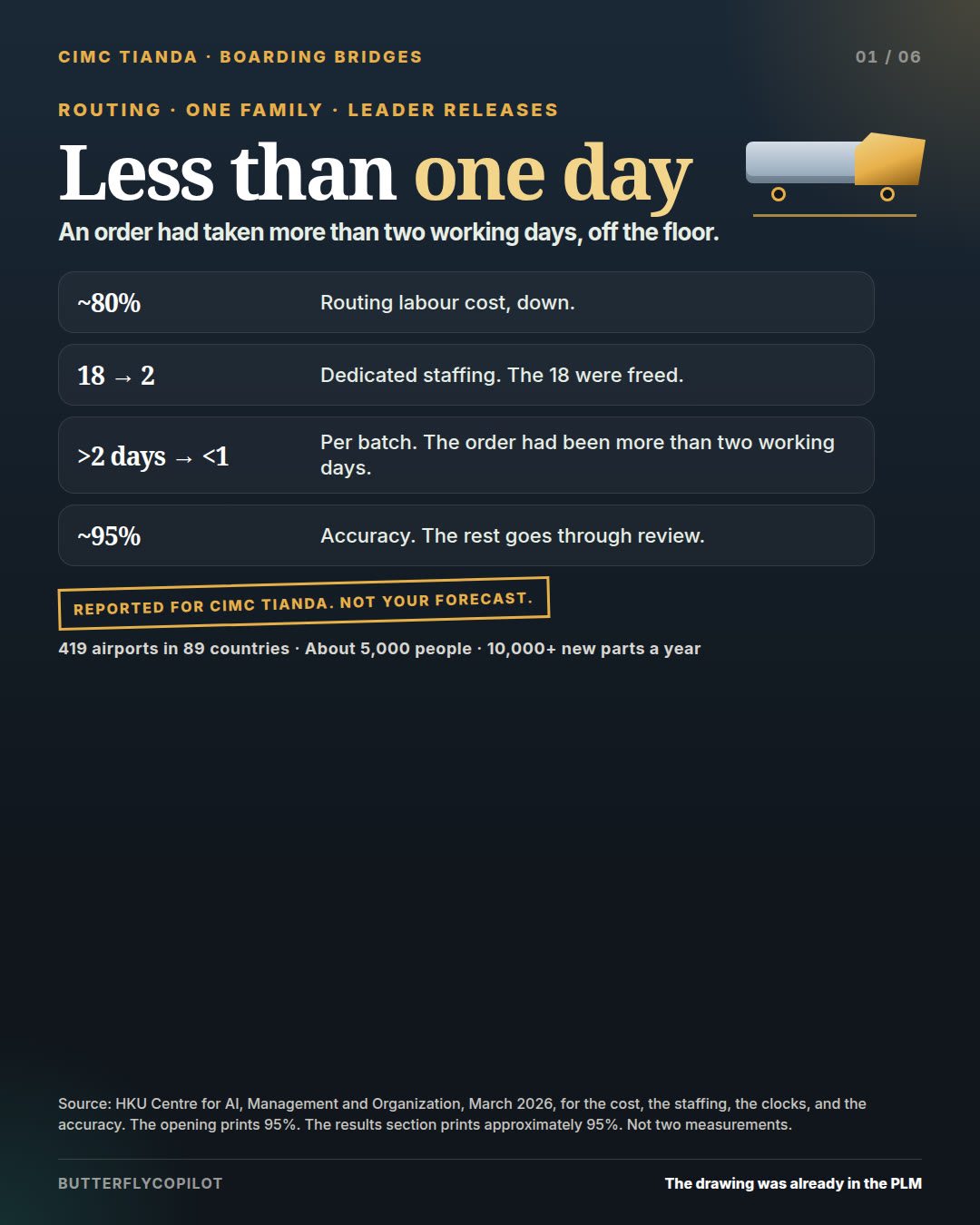
Eighteen team leaders spent more than two working days turning a drawing into a route. The draft comes back in less than a day, and a feature with no rule still does not get a workstation.
ButterflyCopilot
0106
The part was already designed.
CIMC Tianda builds the enclosed passage from the terminal to the aircraft, the passenger boarding bridge. It sits inside CIMC Group. The public account of the routing desk gives the group over 300 member companies and revenue of RMB 177.664 billion in 2024, from containers, road vehicles, airport ground equipment, and logistics. Tianda, in that same account, has more than 50 member companies, about 5,000 people, and work across more than 130 countries. The bridges cover 419 airports in 89 countries.
The company pages count that footprint in other words. Nearly 5,000 employees on the about page, against the case's about 5,000. More than 300 airports for airport equipment, against 419 for the bridges. A product page counts bridges delivered through 2025 at 429 airports in 91 countries and regions. This page leaves the figures where each page printed them.
What piled up was not the bridges. It was the parts. Over 10,000 new parts a year, and every one of them needed a route before it could be made. Which steps, from the list they use: milling, bending, drilling, rolling, welding, assembly. Which workstation. The budgeted hours. Which crew.
Eighteen experienced team leaders did that by hand. They pulled the documents, read the CAD, estimated the flow, calculated the hours, and dispatched the route. An order took more than two working days. The hours came out of the job they were actually there to do, which was leading the crew on the floor.
What they stood up
The routing agent takes the bill of materials and the CAD drawings from the product-lifecycle system. It finds the features that need a process. Bending, milling, and drilling are the examples the account gives. It drafts a route: the workstation, the labour hours, the instructions for production. The team leaders no longer start from a blank drawing. They review the draft, adjust it, and release it.
No single model could read the drawings. The drawings are specialised, and one model on the whole sheet was the wrong shape. So the build is three layers. Image processing extracts the features. A visual reasoning model interprets what that extraction produced. A structured knowledge base holds the workstation rules, the process definitions, and the labour-time logic. The minutes live in that base. The model does not get a vote on them.
They used AI on the knowledge itself, to annotate and structure the drawing data the base had to learn from, so a person was not the only one typing the examples. Around the agent they kept the things a shop actually needs once the draft exists. A knowledge base the team leaders can update when the process changes. Progress a person can see. A way to correct any output by hand. A log of every change.
BOM and CAD, out of the PLM
        ↓
Features off the drawing
        ↓
Rules: workstation, process, labour time
        ↓
A draft route
        ↓
The team leader reviews, adjusts, and releases
        ↓
Instructions to production
Routing labour cost came down by about 80 percent. The dedicated staffing on that work went from 18 people to 2. Cycle time went from over two days per batch to less than one day. Accuracy reached about 95 percent, and the rest has a review-and-correction path. The opening of the same account prints the accuracy as 95 percent. The results section prints approximately 95 percent. This page treats that as one result, stated twice.
The 18 team leaders were freed. They went back to managing the crew, the quality, and the floor. The route stopped being something only one person could hold in their head. Workstation, process, and labour time sat in a base another team could run.
A feature with no rule is not a process
Speed is how a tidy agent types a bend the drawing never had, prices an unknown thickness as the nearest band, keeps the holes and quietly drops the feature it cannot name, or sends a route nobody released.
The file for a smaller fabricator keeps the shape and drops the plant. One part family. A BOM export and the drawing, DXF when the shop has it, PDF when that is what the customer sent. The model may propose features from a page image. It may not invent a count, a thickness, a workstation, or a minute. A DXF is measured in code. A hole is a circle. A bend is an axis-aligned line on the bend layer. A diagonal line stops the route. It does not become a hypotenuse someone guessed.
The standards are a spreadsheet the team leader can edit. Process, workstation, setup, and a rate per hole or per millimetre. The formula is in the file, in integer minutes, so a builder can check it. On the fixture, a bracket with four 8 mm holes and 160 mm of bends comes out at 22 minutes of bending and 15 minutes of drilling, 37 together. The batch quantity is 4. The minutes stay 37. Quantity is printed on the packet. It is not a multiplier.
If the DXF says four holes and the vision model says five, there is no route. Nobody averages them to four and a half. A person picks a source, with a reason. A thickness the rule does not cover, even by a thousandth of a millimetre past the band, stops the whole route. The holes do not ship alone. A rounded minute of zero stays zero. The minimum on the standard does not promote it into a real step.
The release is a person. IMS Gear kept the price in the tables and the signature on a person. This desk keeps the minutes in the standards and the release on a team leader. The packet is a file. dispatched stays no. A person carries it to the floor. There is no tool that takes a name off the roster. The 18 went back to the crew. A smaller shop does not get a headcount button in their place.
The lock is a set of past routes, with the hand minutes stored, routed again after every standard change. A route that matched has to match. The file has no tolerance that turns a red row green. Go-live stays shut while the run is red.
Their PLM, and the send into production, are a later file. Version 1 reads an export. It writes a packet.
What a smaller shop should steal
If a route still lives in one person's head, the first month is one part family and twenty batches a person already finished.
One family
        ↓
Twenty past routes, with the hand minutes stored, and a stopwatch on the office hours a person already spends
        ↓
Thirty days where the draft sits beside that hand route, and nothing is released
        ↓
Thirty days where the team leader may release, and the packet stays on disk
        ↓
A person still carries it to the floor. The next family waits for its own twenty.
Time the stretch you already have. Office minutes from the drawing in hand to a route someone will release. How many of the old routes still match after a standard change. How many routes go out untouched, how many the leader corrects, how many they kill. How many features had no rule. How many times the drawing and the vision model disagreed. How many of those routes the floor later revised. How many minutes, workstations, or people this agent created. How many routes it dispatched. Those last counts stay at zero.
The 80 percent, the move from 18 to 2, the clocks, the 95 percent, and the 10,000 parts are CIMC Tianda's published story. They are not a line for a proposal. The 18 were freed. That sentence travels with the headcount, or the headcount does not travel at all.
What the instruction file will make an agent do
The file below is the brief. It is not their PLM, and it is not a model the source never named. None of that schema is public. The blanks are yours. The vision endpoint is a slot. A hosted vision model, or an open-weight one on the shop network, are recommendations. They are not a finding about CIMC.
It will make the agent:
- Refuse to run while a
REPLACEline is empty, or while anEXAMPLErow is still in a live sheet. - Read a BOM export and an ASCII DXF in millimetres. Refuse a DWG that has no DXF beside it, refuse inches, and refuse a diagonal bend line.
- Treat a PDF as a vision proposal. Strip any minute, process, or workstation the model adds. If the DXF and the vision list disagree, write no route until a leader picks a source.
- Route from the tables with the integer formula in the file. The fixture's bracket comes out at 22 minutes of bending and 15 minutes of drilling, 37 together, on a quantity of 4. A weldment with two child lines comes out at 25 minutes of welding and 14 of assembly, 39 together. The child quantity of 10 is not the assembly count.
- Stop the whole route when one feature has no rule. A thickness of 8.001 against a band that ends at 8.000 does not leave the holes priced.
- Treat a blank quantity as missing. Treat a blank thickness as missing. Treat a rounded minute of zero as a stop, not as the standard's minimum.
- Ask only the missing fields, in a fixed order. Only the team leader may fill them. A field named minutes is refused on that form. A minute the leader wants changed is a correction, logged, and the formula result stays on the trace.
- Re-run every stored hand route after a standard change. Moving the bend rate from 75 to 100 fails go-live and leaves the golden at 22 minutes. A roll-rate change that no golden uses can go through.
- Release only from the form, only by the team leader, with a reason long enough to read. Write a packet only after that release and the later flag. Leave the dispatch flag at no. There is no PLM tool and no tool that removes a person.
- Write a morning file from this shop's own counts. No comparison with the case study.
The tests are in the file. The bracket at 37 minutes, with quantity 4 left unmultiplied. A vision count of 5 against four DXF holes, and no average. Steel against the word aluminum, with no route. A 10 mm bend whose material rounds to nothing. A regression that stays red when the bend rate changes, and a go-live that does not stick. A packet that reads 22 minutes and 15 minutes and does not contain the secret note buried in the DXF. If the agent clears any of those by copying an old route, pricing the holes and dropping the bend, or dispatching to the floor, the test fails.
The instruction file
The brief has the role, the tables a spreadsheet can hold, the DXF reader, the vision prompt, the labour formula, the questions for the leader, the correction and the release, the regression set, the ninety days, and the tests that decide when a route may be shown.
Replace every REPLACE line. Delete every EXAMPLE row. Let it sit beside one family's routes for a month a person still builds by hand, before anyone treats a file as a route the floor has already been given.
Sources
The 18 leaders, the two working days, the layered agent, the knowledge base, the 80 percent, the staffing, the batch cycle, and the accuracy are from the HKU nanocase of March 2026. The company pages are the other counts of people, airports, and bridges. The figures are as those pages report them. They are not an independent audit, and they are not a forecast for another shop. About 5,000 and nearly 5,000 are two presentations of the workforce. This page does not average them. 419 airports in 89 countries, more than 300 airports, and 429 airports in 91 countries and regions are three presentations of coverage. This page does not average them. Over 10,000 new parts a year is the routing volume in the case. Nearly 10,000 boarding bridges delivered is a different count, on a different page.
- HKU Centre for AI, Management and Organization, Jie Gong, Augustus Pan, and Harry Zhang, “Scaling Expert Knowledge with AI at CIMC,” March 2026. PDF: 2026-03-30_CIMC_Edited-1.pdf. CIMC Group: over 300 member companies, revenue of RMB 177.664 billion in 2024, containers, road vehicles, airport ground equipment, logistics. CIMC Tianda: passenger boarding bridges; more than 50 member companies; about 5,000 people; more than 130 countries across six continents; boarding bridges covering 89 countries and 419 airports. Over 10,000 new parts a year. The route names milling, bending, drilling, rolling, welding, and assembly, plus workstation, budgeted work hours, and crew. Eighteen experienced team leaders retrieved documents, interpreted drawings, estimated the flow, calculated hours, and dispatched routes. Each order typically took more than two working days. The agent extracts BOM and CAD from the PLM, detects features that need bending, milling, or drilling, drafts workstation assignments and labour-hour estimates, and sends instructions to production. Leaders review, adjust, and release. No single model could read the drawings: image processing, then a visual reasoning model, then a knowledge base of workstation rules, process definitions, and labour-time logic. AI also annotated and structured the drawing data. Operational support: a knowledge base leaders can update, progress tracking, manual correction of any output, a change log. Results: routing labour cost down by approximately 80 percent; dedicated staffing from 18 people to 2; cycle time from over two days per batch to less than one day; accuracy approximately 95 percent; review and correction for exceptions. The opening prints the same change as 18 dedicated team members and more than two days, now less than one day, at an accuracy rate of 95 percent. The 18 team leaders were not eliminated. They were freed.
- CIMC Tianda, “About us.” More than 50 member companies, nearly 5,000 employees, operations and branches in more than 130 countries and regions on six continents. Airport equipment products and services cover more than 300 airports. Passenger boarding bridges are named as the start of the business. The English home page is the company site.
- CIMC Tianda, passenger boarding bridge page (Chinese). Products taken to 429 airports in 91 countries and regions. Nearly 10,000 boarding bridges delivered as of 2025. Predecessor work from 1989. First bridge at Tianjin airport in 1990. That bridge count is not the case's count of new parts a year.