
How IMS Gear Cut Quote Time with AI Agents
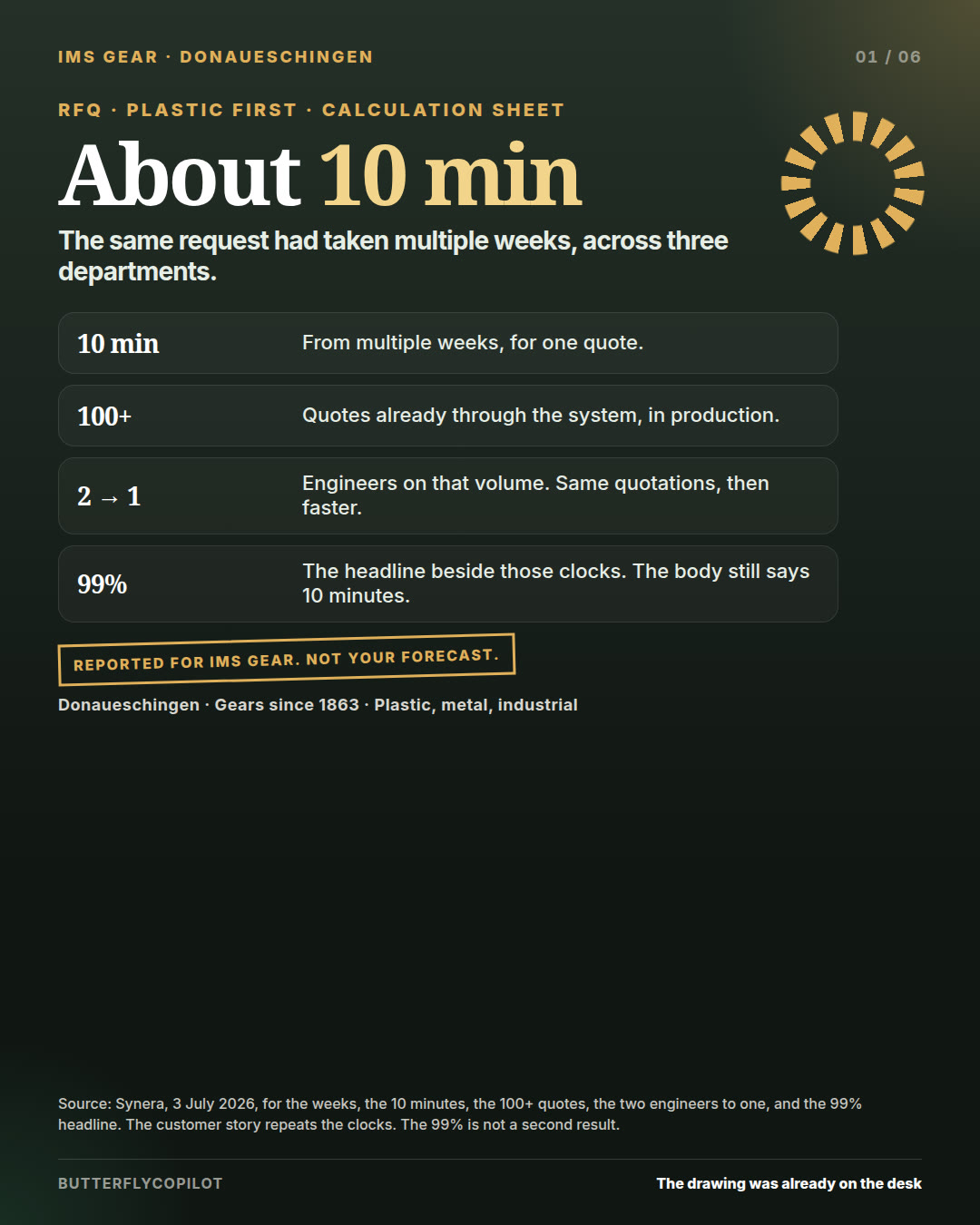
The quote went through three departments and took multiple weeks. It comes back in about 10 minutes, and a blank on the drawing still does not become a price.
ButterflyCopilot
0106
The request was already on the desk.
IMS Gear, in Donaueschingen, has made gears since 1863, from the clock trade in the Black Forest. The work now is gears, gearboxes, and actuators. Automotive is about 90 percent of sales. Industry, medical engineering, and lighter mobility, including e-mobility, are the rest. Headquarters are in Donaueschingen, with eight more plants in that part of the country, and production or sales in the United States, Mexico, China, Japan, Croatia, and South Korea.
The 2025 sustainability report puts sales at €534 million, after about €578 million the year before, and the workforce at about 2,860 people: 1,540 in Germany, 750 in North America, and 570 in China. The company page prints the same €534 million and rounds the workforce to 2,900.
A quote did not start as one person's spreadsheet and stay there. It went through what Dr. Jens Fechler, head of R&D, calls companies inside the company. A metal department, a plastic department, and an industrial department, in sequence. An engineer retyped a number from one tool into the next and passed a PDF across the desk. The next department waited on the previous one. The customer waited multiple weeks.
Fechler wanted the quotation in the customer's hands faster than that.
What they stood up
They had already used Synera on another engineering job. When an agent could sit on the tools they had, their own engineers built the quote path. Eric Stähle, a development engineer, put the shape of it in one line. The process stayed. Synera and the agent orchestration connected the CAD, the PDM, the calculation sheets, and the costing tool.
Three layers.
The data layer takes the incoming PDF and the CAD file, classifies them, and loads them into the product data system.
The workflow layer is rules. Engineering workflows read the request against IMS Gear's tables, with an in-house algorithm refined over years. The model is not the place the number is decided.
The agentic layer is a supervisor and three domain agents. The supervisor routes the request to plastic, to metal, or to industrial. The domain agent confirms a handful of details with the engineer and compiles the result into the calculation sheet the company already used.
They started with plastic. That department is the bulk of the business. The loop was the same each time they tightened it. Run the RFQ by hand. Run it through the system. Compare the numbers. Tighten the rules. Run the set again, and a quote that was correct the last time has to come out correct this time. Four iterations. The fourth went to production. Metal and industrial are next. So is the API into the costing tool.
A request arrives as a PDF and a CAD file
        ↓
The files are classified and loaded
        ↓
The rules read the company's tables
        ↓
A supervisor sends the request to one domain
        ↓
The engineer confirms the fields the tables still need
        ↓
The calculation sheet is compiled
        ↓
A person signs it before a customer sees it
The published account calls that change 99 percent faster. The clock it prints is multiple weeks down to about 10 minutes. More than 100 quotes have been through the system in production. The volume that had taken two of Fechler's engineers is handled by one, at the same amount of quotations, and then faster. What came out of the sheet stopped depending on which engineer had the file. Some overlapping software licences were retired. The pages do not say what those licences cost.
“At the beginning, I needed two of my engineers doing the RFQs, but today it can be done by one. Doing the same amount of quotations, and then going even faster.”
The work that came off the desk was the retyping. Fechler calls it donkey work, moving data from one tool to the other. The engineer goes back to the decision. He has said the rest of the company is now looking at that desk, and at which other processes can move the same way.
A blank on the drawing is not a dimension
Speed is how a tidy agent types a volume the drawing never stated, prices an unknown resin as the nearest nylon, runs a steel part through the plastic tables, or emails a sheet nobody signed.
The file for a smaller manufacturer keeps the shape and drops the platform. One domain. The tables the company will actually defend, in a spreadsheet on a shared drive when that is where the calculation sheet lives. The model may copy what the email and the PDF text already say. It may not invent a quantity, a volume, a material, or a price. A STEP file is classified and stored. It is not read as a number. A blank quantity is not zero. A material cost the formula rounds down to nothing is not a free part.
The supervisor is code. Plastic, metal, or industrial. Two departments named on one request become a question. They do not become an average. A material that belongs to the other department is left unpriced. The engineer fills the missing field on a form. The value has to be one the tables can use. A new rate is a person editing the table, and then the old quotes are run again.
That re-run is the part their four iterations make concrete. A set of past quotes, with the hand price stored, is priced again after every table edit. A quote that matched has to match. The file has no tolerance that turns a red row green. Go-live stays shut while the run is red.
The costing API they named as next is a later file. So is any send. Printcious can return one rate-sheet row for a standard item while the buyer is still in the chat. This file is the request that does not have a row yet. The number is still the rules.
What a smaller manufacturer should steal
If a quote still walks through two people and a spreadsheet, the first month is one product family and twenty quotes a person already finished.
One domain
        ↓
Twenty past quotes, with the hand price stored, and a stopwatch on the hours a person already spends
        ↓
Thirty days where the sheet sits beside that hand price, and nothing is shown as a quote
        ↓
Thirty days where the engineer may sign, and the pack stays on disk
        ↓
The customer email still leaves from a person. The next department waits for its own twenty.
Time the stretch you already have. Minutes from the request in hand to a sheet someone will sign. How many of the old quotes still match after a rule change. How many questions the sheet had to ask. How many sheets the engineer edits, and how many they kill. How many of those quotes you later revise. How many prices, materials, or customers this agent created. How many emails it sent. Those last counts stay at zero.
The 10 minutes, the 99 percent, the 100 quotes, the move from two engineers to one, and the retired licences are IMS Gear's published story. They are not a line for a proposal.
What the instruction file will make an agent do
The file below is the brief. It is not Synera, and it is not IMS Gear's algorithm. None of that formula is public. The blanks are yours.
It will make the agent:
- Refuse to run while a
REPLACEline is empty, or while anEXAMPLErow is still in a live sheet. - Read the email and the PDF text. Classify a STEP file and store it. Refuse to parse the solid, and refuse a volume the model typed.
- Route in code. One domain. A steel callout against the word plastic is a conflict, and there is no price. A second department is outside the pilot, and there is no price.
- Price from the tables with the integer formula in the file. The fixture's housing comes out at 41 cents of piece price and 700000 cents of tooling. The old quote at 999 cents, on the same part name, is listed and left unused.
- Treat a blank quantity as missing. Treat an unknown grade as unknown. Treat a material cost that rounds to zero cents as a stop.
- Ask only the missing fields, in a fixed order. Only the engineer may fill them. A field named price is refused.
- Re-run every stored hand quote after a table change. A moved price fails go-live and leaves the expected number where it was.
- Sign only from the form, only by the quote engineer, with a reason long enough to read. Write a customer pack only after that signature and the later flag. Leave the email flag at no. There is no costing-API tool.
- Write a morning file from this company's own counts. No comparison with the case study.
The tests are in the file. The housing at 41 cents, with the prior 999 left unused. A blank quantity that is not stored as zero. A resin named peek that does not become a new row. Steel against the word plastic, with no price. A volume of 0.100 that rounds the material to nothing and does not become a piece price. A regression that stays red when the resin price changes, and a go-live that does not stick. A pack that reads 0.41 EUR and 7000.00 EUR and does not contain 999. If the agent clears any of those by copying the old price, pricing the steel on the plastic tables, or emailing the customer, the test fails.
The instruction file
The brief has the role, the tables a spreadsheet can hold, the supervisor, the formula, the questions for the engineer, the signature, the regression set, the ninety days, and the tests that decide when a sheet may be shown.
Replace every REPLACE line. Delete every EXAMPLE row. Let it sit beside one domain's quotes for a month a person still prices by hand, before anyone treats a file as a quotation the customer has already been sent.
Sources
The departments, the retyping, the weeks, the 10 minutes, the 99 percent headline, the 100+ quotes, the two engineers and the one, the licences, the three layers, the four iterations, and the words from Fechler and Stähle are from Synera's news story of 3 July 2026. The customer story repeats the clocks and the headcount. The company page and the 2025 sustainability report are the founding year, the plants, the sales, and the workforce. The figures are as those pages report them. They are not an independent audit, and they are not a forecast for another company. The 99 percent and the move from multiple weeks to 10 minutes are two sentences about one change. This page does not divide them into a ratio. About 2,860 people and 2,900 people are two presentations of the workforce. This page does not average them. Synera's page says 106 years. The company's pages say 1863. This page uses 1863.
- Synera, “IMS Gear: 99% faster RFQ with agentic AI,” 3 July 2026. A team of agents on Synera turns an RFQ into a quote in about 10 minutes, from multiple weeks. 100+ quotes in production. Dr. Jens Fechler, Head of R&D, on "companies inside the company" (metal, plastic, industrial), on quotations in weeks, on already using Synera, and on two engineers becoming one at the same volume and then going faster. Eric Stähle, Development Engineer, on connecting the existing process. Three layers: a data agent that ingests PDF and CAD, classifies them, and loads them into PDM; rule-based workflows against the company's tables and an in-house algorithm; a supervisor that routes to the plastic, metal, or industrial domain agent, which confirms a handful of details with the engineer and compiles the calculation sheet. Four iterations, starting with plastic, the bulk of the business. The loop is hand, system, compare, tighten, and re-run so a previously correct quote stays correct. The fourth iteration went to production. Metal, industrial, and a costing-tool API are named as next. CAD, PDM, calculation sheets, and the costing tool, with no new platform. Consistent outputs. Some overlapping software licences retired, with no amount given. The headline says 99 percent faster. The lesson as that page states it: the LLM interprets while the rules decide. The same page summarizes a 2025 Center for Automotive Research update (program cycles, RFQ volume up 62 percent, hours per RFQ from 134 to 157, nearly 90 percent of suppliers on turnover). Those industry figures are Synera's summary. This page did not re-audit the CAR update, and it does not use the figures as a forecast.
- Synera, “How IMS Gear cut quote time by 99% with Synera.” The same clocks: 10 minutes, down from multiple weeks. 100+ quotes in production. Two engineers to one, at the same volume. Fechler's sentence on the two engineers. The 62 percent is attributed there to CAR Group, 2025. No formula, no table, and no screen.
- IMS Gear, “Your partner for drive solutions and gearing technology.” Donaueschingen. Eight further plants in the area. Production and sales in the United States, Mexico, China, Japan, Croatia, and South Korea. Founded in the clock trade in 1863. Drive solutions for automotive, industry, medical engineering, and e-mobility. The page prints 2.900 employees and a 2025 turnover of 534 million euros.
- IMS Gear SE & Co. KGaA, sustainability report 2025. Founded 1863. Sales of 534 million euros in 2025, after about 578 million euros the year before. About 2,860 employees: 1,540 in Germany, 750 in North America, 570 in China. Automotive about 90 percent of sales. Gears and other parts in metal, plastic, or combinations, plus assemblies and gearboxes. Industry and light mobility sit beside the automotive core. The report's "about 2,860" and the company page's 2,900 are left as the two pages print them.