
How Cosasco Cut Engineering Work Time with AI Agents
The requirement was already in the site annex. It was found after the metal was made. A lethal-service assessment that took about 40 hours then took 8, and an engineer still has to sign the page.
ButterflyCopilot
0106
The requirement was already in the annex. Manufacturing had already started.
Cosasco has spent more than 70 years on corrosion monitoring and measurement. Access fittings, retrievable instruments, monitoring systems, on oil and gas pipelines, offshore platforms, and processing facilities. The work is there so corrosion does not become a failure. It is a Halma company. Head office in Santa Fe Springs, California. The leadership page names Los Angeles, Houston, Aberdeen, Dubai, and Kuala Lumpur. Halma's description adds erosion monitoring and chemical injection, and the industries run out through petrochemical, water treatment, chemical, pulp and paper, pharmaceutical, and utilities. Third-party profiles, Tracxn among them, put the company at around a hundred people.
The slow part was not the fitting. It was the paper around the fitting.
Three layers, and the one that got missed
Every large oil and gas project arrives as a stack. The facility owner has requirements. The engineering firm running the job adds a layer. The place adds a third: Abu Dhabi, the Arctic, Morocco, each with its own annex, its own regional rules, its own weather. One owner with assets in more than one region can have more than one of those stacks live at once.
Bidding and engineering read that stack. Thousands of pages. The expensive miss was a requirement buried in the site annex, found after the metal was already made. Delay, rework, and a customer relationship that took the damage. Leadership went looking for another way to read.
They looked at CPQ tools and at soft-matching tools. Those could pull up an answer the company had given before. They could not work a job the plant had not seen. Other platforms wanted a long engineering build before anything ran. They chose Cassidy. The vendor's people were in the room from the first day, building, testing, and refining, rather than handing over a product and leaving.
Eric Goodyear, Engineering Lead, on that choice:
There wasn't anybody else that had anything quite like what you did out of the box. You helped us get to a workable, viable product almost instantly. The collaboration was really great.
The calculation has to be a calculation
The agent they stood up is grounded on the standards the industry already uses: ASME, ASTM, ISO, API. Fixed frameworks. The agent works the calculation, checks the requirement against them, cross-references the stack, and writes code when the calculation is a special one. Wake and drag force is the example they gave. A senior engineer would open a scratch file for that. The agent writes the code and runs it.
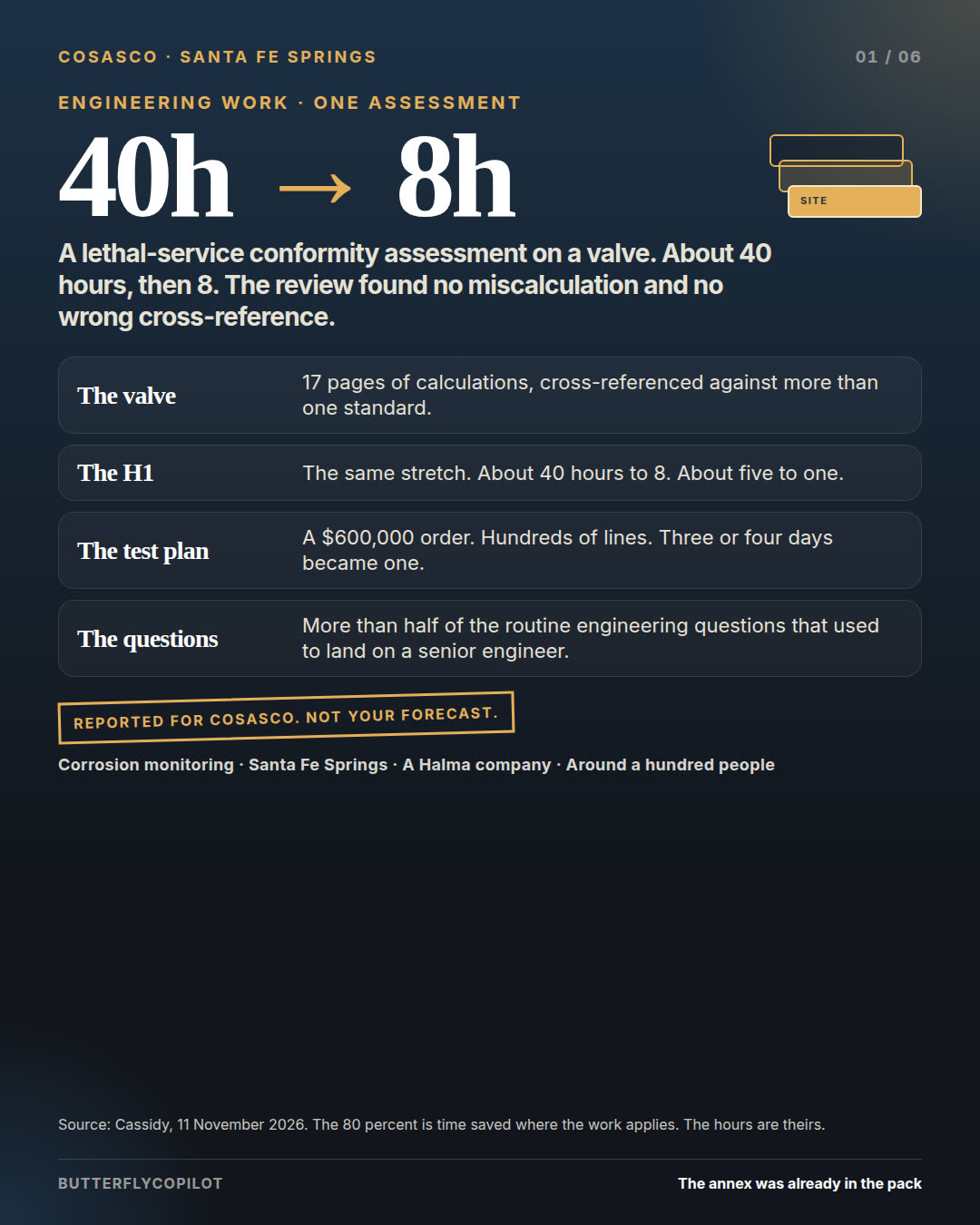
The first real test was a lethal-service conformity assessment on a valve. Seventeen pages of calculations, pointed at more than one standard. The team reviewed it. No miscalculation. No wrong cross-reference. A job of about 40 hours took 8.
I was able to go through and do a lethal service conformity assessment for a valve which ended up being 17 pages of in-depth calculations. Not a single mistake, not a single wrong cross-reference, not one.
The same stretch showed up again on an H1 assessment. About 40 hours, then 8, in a day. Goodyear called the ratio about five to one, and about 80 percent of the time where the work applies. The hours are what he timed. The 80 percent is that ratio, held, on the work it applies to. Those are the same family of sentence. They are still his clock, on his assessments.
A spec pack arrives as three layers
        ↓
Each layer is in the folder, or the run stops
        ↓
A requirement is a sentence the file actually contains
        ↓
The force is computed in code, twice, and the two answers have to match
        ↓
An engineer signs, or the conflict stays open, or the pack is blocked
        ↓
The runner does not send the file to the customer
The boxes are the instruction file. They follow the shape the story describes. They are not a reconstruction of Cosasco's screens, and they are not Cassidy's project plan.
Then a $600,000 order, hundreds of line items, an inspection test plan for a customer who scrutinizes. Three or four days became one. The customer, usually hard to move, accepted it, because every justification pointed at that customer's own specification.
I was able to get a customer that would normally be quite intractable to agree to something very good — because it justified every answer against their own specifications.
The rest of the desk, after the first assessment worked
Quoting and compliance came next. Quote verification, technical clarification, contract review, the documents that hand a job to the project team. After a bid goes in, they run it back against the customer's documents and look for what does not match, before that mismatch shows up later. The Middle East bidding team became some of the heaviest users. Compliance questions, contract reviews, and the work in between.
Field services commission equipment and write the day up at the end of a long shift. Reports that had taken multiple days took hours, and they came out more consistent across the team. Coupon analysis, which had no tool of its own, went on the same platform.
Sharon White, Operations, on the change in the room:
It used to be that everyone was a little nervous about trying the tool. Now it's more like, 'Wait, I have another idea for Cassidy. Can it do this too?'
Adoption was not a memo. It was tied to the workflow a person already had, and to that person's goals. Weekly reports showed use by team and by person, which made the gaps visible and started a certain amount of competition. Offices in the Middle East and in India ask in their own languages and get the answer in English. The documentation that had been hard to enter became something the team could use.
The 80 percent, on the engineering work it applies to, has held since that first valve assessment. When people left, the company did not have to scramble to fill the seat before the work could move. More than half of the routine engineering questions that used to land on a senior engineer are handled by the agent. Customers push back less. Internal reviews move faster.
Across the board, the quality of the output — not only does it do it quickly, it's better. It's professional. It doesn't brook as much questioning. It's flawless every time.
What is still ahead, on their own account: 20 years of data sheets and customer submissions, turned into a corpus someone has checked. Deeper ties into the product data, the kind that is relational and not a pile of files. More of the field reporting. By their own measure they are at what they call evolution B, with several leaps still ahead.
A tidy citation is not a signed assessment
Speed is how a plant with an empty standards folder expects 8 hours in the first month. Speed is how a confident agent marks a valve conforming because someone else's review found no error. Speed is how the stricter of two layers gets picked in silence, because 8 millimetres sounds safer than 6 and nobody had to choose. Speed is how a missing annex is assessed on the two layers that did arrive, which is the original failure, only faster.
The file below keeps the shape and drops the plant. One assessment type, the lethal-service conformity check, because that is the one they tested first. The owner's specification, the engineering firm's layer, and the site annex are the company's. The standards are the clauses the company is allowed to store. The model may copy a sentence the file already contains. It may not recite a standard from memory. It may not type a force. The force comes from code the runner executes, and from a second copy of that arithmetic that does not trust the first. If they disagree, the pack stops. The disagreed numbers are shown. Neither one is filed as the answer. Two layers that name two different minimums are both shown. The agent does not pick. An engineer signs a clean assessment, one pack at a time. The person who may approve go-live cannot sign the technical page. Nothing in the file is sent to the customer.
On the fixture, which is ours, a made-up valve has a wall of 9.000 millimetres against a minimum of 8.000 that the owner and the engineering firm both wrote down. A fictional regional annex limits drag. The code returns 47,812,500 micronewtons, which is 47.8125 newtons, under a 50-newton limit that was also written down. A thinner valve fails the wall and cannot be signed. A pack whose region file is missing cannot be called met on the other two layers. A script that simply returns the right integer is refused. Those rows exist so a builder can test the citation, the arithmetic, and the refusals. They are not a Cosasco datasheet, and they are not a valve anyone should cut metal for.
ROBEL is the other long-document desk on this site. That one is a railway tender, many departments, a requirement list a person can argue with. This desk is the engineering assessment. The hours on that page do not belong on this one. The 40 and the 8 on this page do not belong on that one.
The useful caution is the library. A result like the one in the story sits on standards and customer specifications that already exist in a form an agent can point at. An empty folder will not get 17 pages of real cross-references in the first month. The file spends that month loading the three layers and checking that the annex is actually there.
The original sits on Cassidy, which is a no-code platform. Buying that path is a real option. The vendor's team is the reason they gave for getting to something that worked quickly. The file is the other path: folders, the standards the company may store, a Python runner, and a model that is allowed to read. The gates are the same on both. An engineer signs. A number comes from code.
What a smaller manufacturer should steal
If the work is still a stack of specifications, and the expensive miss is the line in the annex, the first month is one assessment type and the three layers you are willing to get wrong in private.
Let the model read. Let the library decide what may be quoted. Let the code decide the number. Keep a person on the signature, including after a review comes back clean. Give a disagreement between layers to that person with both numbers visible. Refuse the old failure mode, which was to finish the review on the documents that were easy to find.
One assessment type
        ↓
Thirty days of ingestion, hashes, and a stopwatch on assessments a person already does
        ↓
Thirty days where the code's number sits beside the engineer's, and nothing is signed
        ↓
Thirty days where a clean pack may be signed, and still is not sent
        ↓
The inspection plan, the bid check, the field report, and the coupon path wait
Time the stretch you already have. Minutes from a complete pack in hand to a page an engineer will sign. How the pile splits across a clean pack, a conflict, a failed comparison, a missing annex, a citation that does not resolve, and a calculation the two implementations did not agree on. How many of those pages the engineer edits. How many requirements still turn up after manufacturing. How many files this agent sent to a customer. That last count stays at zero.
Cosasco's scoreboard is not your forecast. About 40 hours to 8, about 80 percent where it applies, 17 pages with no error found on that review, an inspection test plan from three or four days to one, a $600,000 order, more than half of routine questions, and field reports from days to hours are this company's published story. "Flawless every time" is a sentence in that story. It is not a test you can paste over an empty exception folder. Around a hundred people is a third-party profile of this company. It is not a hiring plan, and it is not your headcount. Measure your own minutes.
What the instruction file will make an agent do
The file below is the brief. It is not Cassidy, and it is not Cosasco's valve. None of that schema is public. The blanks are yours. The same assessment works as a JSON file an engineer can open.
It will make the agent:
- Refuse to run while a
REPLACEline is empty, while anEXAMPLEid is still in a live folder, or while anyone has typed 80 percent, 40 hours, 8 hours, 17 pages, or $600,000 into the config. - Take one assessment type. Lethal-service conformity. The inspection test plan, the bid comparison, the field report, and the coupon analysis return a locked scope until a person turns one on, after this set has passed.
- Require the owner, the engineering firm, and the site annex. A missing annex blocks the pack. Nothing in that pack is marked met.
- Keep a requirement only when the excerpt hash matches the excerpt, and the clause hash matches a row in the library. A standard the library does not hold is not quoted from memory.
- Show both values when two layers disagree. It does not pick the stricter one.
- Compute drag force as an exact integer division. The fixture answer is 47,812,500 micronewtons. A script that types that integer is refused. A second implementation that returns a different integer blocks the pack. The model column
999is stripped and does not appear in the file. - Refuse a signature from anyone but the engineer, and refuse it on a failed comparison, a conflict, or a block. The signed file still is not released to the customer.
- Write a morning file from this company's own counts: ready, conflict, failed, blocked, citation failures, disagreements, missing layers, minutes. No comparison with the case study. No percent.
The tests are in the file. The hashes of the clean assessment, the conflict, the thin valve, the discarded 999, the literal script, the missing annex, the morning file, the audit, and the engineer's token are locked. A customer email on that run fails the test. If the agent clears any of those by inventing a clause, typing a force, picking a layer, or sending the file, the test fails.
The instruction file
The brief has the role, the three layers a spreadsheet can hold, the requirement record, the citation record, the assessment schema, the extraction prompt, the calc prompt, the integer drag formula, the review token, the four workflows that stay off, the audit, the three metrics, the ninety days, the risks, and the tests that decide when a file may be treated as an assessment an engineer has been asked to sign.
Replace every REPLACE line. Delete every EXAMPLE row. Let it sit beside one assessment type for a month a person still does by hand, before anyone treats a file as a page the customer has already accepted.
Sources
The company, the agent, the quotes, and the figures in the story are from the pages below. The head office and the industries are from Halma's company page. The office list is from Cosasco's leadership page. The size is from a third-party profile, and this page says "around a hundred people" for that reason. The figures are as those pages report them. They are not an independent audit, and they are not a forecast for another manufacturer. The Cassidy page is the vendor's own customer story. That is noted here, once.
- Cassidy, "How Cosasco Cut Engineering Work Time by 80%," 11 November 2026. Cosasco, a global leader in corrosion monitoring and measurement for more than 70 years. Access fittings, retrievable instruments, and monitoring systems on oil and gas pipelines, offshore platforms, and processing facilities. Headquarter Santa Fe Springs, California. Layered specifications: facility owner, engineering firm, and location, with Abu Dhabi, the Arctic, and Morocco named as examples. Thousands of pages. A missed requirement in a site-specific annex, found after manufacturing: delays, rework, and damage to the customer relationship. CPQ and soft-matching tools could retrieve prior answers and could not reason through novel situations. Other platforms needed significant engineering investment. Cassidy was chosen, and the Cassidy team helped build, test, and refine from day one. The engineering agent is grounded on ASME, ASTM, ISO, and API. It works through calculations, reviews compliance, cross-references requirements, and writes code for specialised calculations such as wake and drag force analysis. First test: a lethal-service conformity assessment on a valve, 17 pages, no miscalculation and no wrong cross-reference on review, roughly 40 hours to eight. H1 assessment: about 40 hours to eight, about five to one. About 80 percent of the time where it is applicable, held consistently. A $600,000 order, hundreds of line items, inspection test plan, three to four days to one day, accepted because each justification was grounded in the customer's own specifications. Then quote verification, technical clarification, contract review, project handoff documents, and comparison review of a submitted bid against the customer's documentation. The Middle East bidding team among the highest-volume users. Field reports from multiple days to hours. Coupon analysis, which had no purpose-built tool. Adoption tied to individual workflows and goals, weekly usage by team and by individual, and offices in the Middle East and India asking in their own languages and receiving English. More than 50 percent of routine engineering questions that used to land on senior engineers handled by the agent. No rush to backfill after attrition. Customers push back less. Reviews faster. Next: 20 years of data sheets and customer submissions as a structured, validated corpus, deeper integrations for relational product data, and more field reporting. Eric Goodyear, Engineering Lead, in the quotations above. Sharon White, Operations, in the quotation above, and: "I think that part has been super helpful — having your team grow along with us in our journey, brainstorming different ideas, and having different people in the organization talking to your team about how they're using it on the daily."
- Halma, "Cosasco." Corrosion and erosion monitoring and chemical injection for oil and gas, petrochemical, water treatment, chemical, pulp and paper, pharmaceutical, and utilities. Head office: 11841 Smith Avenue, Santa Fe Springs, CA 90670, USA. This page uses Halma for the parent, the industries, the chemical-injection line, and the street address. It does not use Halma for the agent results.
- Cosasco, "Leadership." The same Santa Fe Springs street address. Worldwide offices named on the page: Los Angeles, Houston, Aberdeen, Dubai, and Kuala Lumpur. This page uses the leadership page for that office list. It does not use the page for a headcount or for the agent results.
- Tracxn, Cosasco company profile. Used only for the phrase "around a hundred people." Not used for a revenue, a product, or a result of the agent.