
How ROBEL Cut Tender Review Time with AI Agents
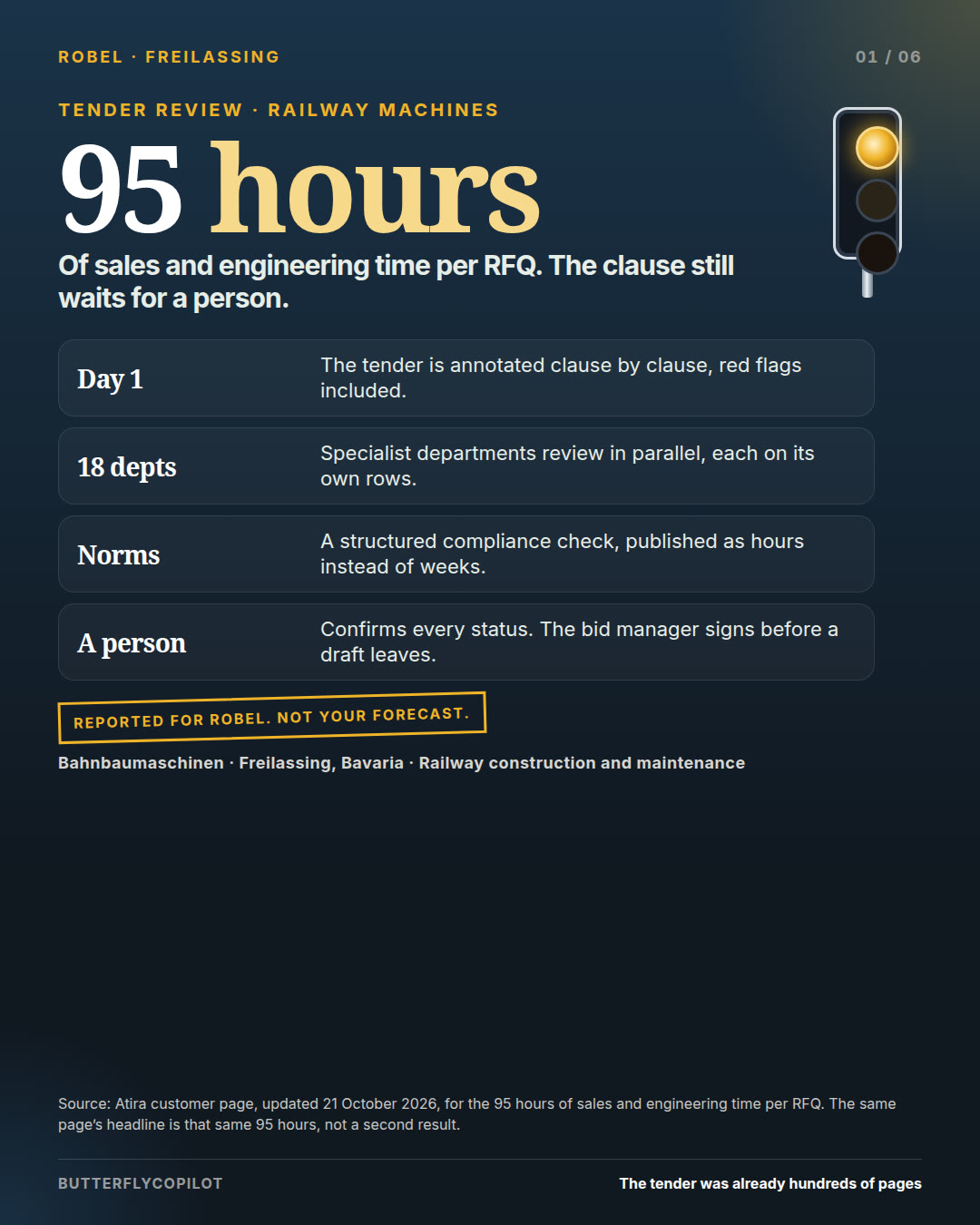
The tender ran to hundreds of pages, and the answer lived in Excel. Atira reports 95 hours of sales and engineering time saved per RFQ. A person still confirms every clause, and the bid manager signs before a draft can leave.
ButterflyCopilot
0106
The tender was already hundreds of pages. The slow part was knowing what the company could say, and who had to say it.
ROBEL Bahnbaumaschinen GmbH builds machines, systems, and services for railway construction and maintenance, from Freilassing in Bavaria. It is part of the ROBEL Group. The brand is more than 150 years old. The file factory started in Munich in 1875, and in 1901 Karl Langkammerer set up the track-machine works. Small-machine production moved to Freilassing in 1989. Administration and sales followed in 1999, the year the history page titles ROBEL Bahnbaumaschinen GmbH. The company page counts five business units and 1033 employees across its companies, all of them on rail infrastructure. That 1033 is the group's published headcount. It is not a tender-desk headcount.
The machines the customer page describes run from hand-guided equipment and tools to on-track vehicles and mobile maintenance systems, for contractors in more than 70 countries. The operations named there are drilling, cutting, grinding, wrenching, clipping, tamping, and transport, including battery-powered and low-emission equipment. The company page names three fields its customers buy for: rail management across the lifecycle, track construction and maintenance, and urban work in tunnels and stations, including emission reduction.
When a railway operator issues a tender, the pack can run to hundreds of pages. Technical requirements. Safety certifications. Vibration limits. Environmental criteria. Compatibility with the infrastructure already in the ground. Working out what ROBEL can offer, what has to be customized, and how to line up the internal answer used to take weeks or even months, and it lived in Excel. The proposal process involved more than 18 specialist departments. They often answered the same questions again, because there was no central system of record. A tender in another language had to be translated by hand before the technical work could start. Cross-referencing standards, preparing sub-supplier requests, and writing the technical documents were manual too.
The track still had to be maintained. The tender sat in a spreadsheet until the departments had all looked.
What they stood up
Atira put agents on that tender response. The customer page's own summary is the one this story uses: with Atira, ROBEL saves 95 hours of sales and engineering time per RFQ, identifies hidden red flags, and improves the quality of the requirement review. The headline on the same page is the same 95 hours. It is not a second result.
The list exists on day 1. The tender is annotated clause by clause, with deviations, risks, and open questions, and with reasoning and a stakeholder on the clause. What used to be a cold start on hundreds of pages starts from a draft a person can argue with.
The 18 specialist departments review that annotated tender at the same time. Each sees what is relevant to them, plus the drafts. They can pull the tender together with internal specifications and with answers the company has already given.
Norms are the quiet bulk of a railway tender. The document cites dozens of them and does not include the text. The agent matches each cited norm against the requirement, and it checks the country-specific rules. A structured compliance assessment now takes hours instead of weeks of manual lookups.
Sub-suppliers are in the same path. ROBEL often has to ask a supplier to comment, or to offer, on one slice of the tender. An agent pulls the technical and commercial content for that slice and writes a first draft of the request.
The proposal documents the page names are a technical summary and a test plan. In their product, the required documents can be picked out in one click, and configured agents write the first drafts. Around that sits an inbound system with 20 or more internally developed Atira agents in the tender process.
Atira's LinkedIn post on the same rollout says the desk was live within one week. Irfan Coskuner, Team Lead Tender Projects at ROBEL, said this:
Atira impressed us by their ability to really meet and enhance our current processes and a solution that was implemented and working productively within a week.
That week is their published go-live. A smaller builder that still has to trust the file should not put the week on the plan.
The tender package is in the store
        ↓
Every numbered clause is quoted
        ↓
A status, from the company's own spec, or a question where the spec is silent
        ↓
A cited norm is opened only if the company holds the file
        ↓
Each department confirms its own rows
        ↓
A sub-supplier draft, a technical summary, a test plan
        ↓
The bid manager signs. A person sends
The boxes are the instruction file. They follow the shape the accounts describe. They are not a reconstruction of Atira's screens, and they are not ROBEL's project plan.
A silent clause is a question
Speed is how a tidy agent marks a paint colour compliant because the rest of the tender looked familiar. Speed is how a cited norm gets a paragraph the model remembers from training, when the company's folder does not contain that standard. Speed is how "approved" in a chat becomes a signature, and how a draft request goes to a supplier because the file looked finished.
The file below keeps the shape and drops the plant. One product family. The standards are the company's. The departments are names the company types, because the public story says 18 departments and does not name them. The model may copy a clause the tender already printed. It may not invent a capability, a department, a norm, or a send.
On the fixture, which is ours, a clause asks for at least 40 cuts an hour and the held spec says 30. That row is a deviation. A vibration limit of 2.5 m/s2 against a held measurement of 2.1 is compliant, because the sentence is in the file. A paint colour the spec never mentions stays an open question. A cited norm with no file stays an open question, and the draft does not grow the missing text. A helicopter delivery is not applicable only because the company's own table says the family excludes it. Delete that row and the clause becomes a question. It does not stay "not applicable" because a model finds the request absurd. A past answer about 30 cuts is shown beside the clause that says 40, and it is not copied. A package declared in another language stops. The original is stored. Nothing is translated. The accounts describe translation as work people used to do before the technical review. They do not say the agents translate, and this file does not add it.
The supplier draft on that fixture asks about the 40-against-30 clause and says it has not been sent. It does not ask for a price. The technical summary and the test plan are the two documents the ROBEL account names. A price sheet on the checklist stops both drafts. The test plan copies a method token only when the spec file contains it. The bid manager signs the list hash. Opening the link does not sign. A model that types "approved" is ignored. The outbox, when a person later allows one, carries a sidecar that says it was not transmitted. Version 1 does not email a customer or a supplier. The person sends from the mailbox the company already uses.
SIP Manufacturing is the quote desk on this site: a rate card, a total, a person, then a template. This desk does not price a tender. The 93 percent on that page does not belong on this one, and the 95 hours do not belong on that one.
What a smaller machine builder should steal
If a tender still starts as a PDF and a spreadsheet, and the same question still goes to several people, the first month is one product family and one tender a person has already marked by hand.
The useful part of ROBEL's story is the decision, not the hour count. Put the agent on the clause list. Give each department only its rows. Hold compliance to sentences the company has on file, including the norm and the country line the company wrote down. Draft the sub-supplier request and the two proposal pieces, and leave them unsigned until the bid manager has the list. Keep the original language in the folder until a person has put the review-language text beside it.
One product family
        ↓
One tender a person already marked, with the spec files they actually used
        ↓
Thirty days where the draft sits beside that markup, and nothing is sent
        ↓
Departments confirm. A silent clause marked compliant holds the gate
        ↓
The bid manager signs. The outbox file still says it has not been sent
        ↓
The next family waits for its own tender
Time the stretch you already have. Seconds from the package in hand to a list someone can open. How many clauses a person changed. How many compliant marks had no sentence behind them. How many norm sentences appeared that are not in a file. How many outbox files had no signature. How many emails this agent sent. Those last four stay at zero.
ROBEL's scoreboard is not your forecast. The 95 hours, the week, the hours-instead-of-weeks on the compliance check, the 18 departments, and the 20 or more agents are this company's published story. Measure your own seconds. Do not paste their numbers onto a proposal, and do not invert 95 hours into a before-time the sources never printed.
What the instruction file will make an agent do
The file below is the brief. It is not Atira, and it is not ROBEL's archive. None of that schema is public. The blanks are yours.
It will make the agent:
- Refuse to run while a
REPLACEline is empty, or while anEXAMPLErow is still in a live sheet. Refuse a flag that would translate, recall a norm, transmit mail, or edit a standard. - Read a folder in the approved store. A path outside that store writes nothing. A declared language outside the company's list writes no clauses.
- Quote every numbered clause. On the fixture there are seven. The paint clause stays an open question. The missing norm stays an open question with empty evidence.
- Mark 40 against a held 30 as a deviation, and 2.1 against a limit of 2.5 as compliant, only because the sentences are in the fixture files. A past answer about 30 cuts is shown and unused.
- Assign an owner from the company's keyword table. The fixture department codes are placeholders. The public accounts do not name ROBEL's 18 departments, and the file does not invent them.
- Match
EN 00000-1:2099only against the fixture file, including the country line written in that file. That identifier is a fixture. It is not a real standard and not one ROBEL cited. - Let a department confirm only its own rows. A model that says "approved" is ignored. Opening the link does not confirm and does not sign.
- Draft the sub-supplier request, the technical summary, and the test plan. The locked hashes are in the file. A price in any of them is refused. The bid manager signs the list before an outbox exists.
transmittedstays false.
The tests are in the file. The hash of the fixture list is locked. A compliant mark on the paint clause fails. A norm sentence that is not in the store fails. An outbox without the signature fails. An email without a person fails, because the program cannot send one. If the agent clears any of those by inventing a capability, recalling a standard, or writing to a supplier, the test fails.
The instruction file
The brief has the role, the tables a spreadsheet can hold, the path from folder to signed list, the prompts, the status rules, the norm file, the department gate, the two drafts, the bid-manager signature, the audit, the ninety days, and the tests that decide when a file may be treated as ready for a person to send.
Replace every REPLACE line. Delete every EXAMPLE row. Let it sit beside one family's tenders for a month a person still marks by hand, before anyone treats a file as a deviation list the customer has already been sent.
Sources
The company, the tender workload, the 95 hours, the day-1 annotation, the parallel review, the norm check, the sub-supplier draft, the proposal drafts, the agent count, the one-week go-live, and Irfan Coskuner's sentence are from the pages below. The 1033 employees, the five business units, the 150 years, and the Munich-to-Freilassing dates are from ROBEL's own pages. The figures are as those pages report them. They are not an independent audit, and they are not a forecast for another manufacturer. This page uses the customer-page sentence "95 hours of sales and engineering time per RFQ." The schema headline on that page, "95 hours of engineering time per RFQ reclaimed," and the LinkedIn line "95 hours of engineering time per RFQ," are the same 95 hours. This page does not turn them into a before-time, and it does not add a translation feature the solution sections do not describe.
- Atira, "ROBEL," published 17 June 2026, updated 21 October 2026. ROBEL Bahnbaumaschinen GmbH, Freilassing, Bavaria, founded 1901 in that account, part of the ROBEL Group. Railway construction and maintenance technology. Hand-guided machines, tools, on-track vehicles, mobile maintenance systems, and specialized railway applications, for contractors in more than 70 countries. Operations named: drilling, cutting, grinding, wrenching, clipping, tamping, and transport, with battery-powered and low-emission technologies. A railway tender can run to hundreds of pages, covering technical requirements, safety certifications, vibration limits, environmental criteria, and compatibility with existing infrastructure. The old response took weeks or even months and relied heavily on Excel. More than 18 specialist departments, repeated questions, no central system of record. Foreign-language tenders were translated manually. Cross-referencing standards, sub-supplier requests, and technical documentation were manual. "With Atira, ROBEL saves 95 hours of sales and engineering time per RFQ, proactively identifies hidden red flags, and improves the quality of requirement reviews." Clause-by-clause annotation on day 1, with deviations, risks, open questions, reasoning, and stakeholder allocation. 18 specialist departments review in parallel, each seeing what is relevant to them, with access to tender details, internal specifications, and historic responses. Referenced norms matched against the requirements, including country-specific rules. "A structured compliance assessment now takes hours instead of weeks of manual lookups." A first draft of a sub-supplier request. Proposal documents identified in their product, with first drafts of technical summaries and test plans. "20+ internally developed Atira Agents" in the tender response process. The page's schema headline is "95 hours of engineering time per RFQ reclaimed," the same 95 hours.
- Atira, LinkedIn, "How is ROBEL using Atira agents to win railway tenders faster?" The same story, worded as "95 hours of engineering time per RFQ" and "live within one week." Hundreds of pages, 18 departments, 20 or more agents, clause-by-clause annotation on day one, parallel review, norms in hours instead of weeks, first drafts of sub-supplier requests and proposals. Irfan Coskuner, Team Lead Tender Projects at ROBEL: "Atira impressed us by their ability to really meet and enhance our current processes and a solution that was implemented and working productively within a week."
- ROBEL, "Unternehmen." "Alle fünf Business Units, alle 1033 Beschäftigten in unseren Unternehmen." Five business units, 1033 employees across the companies, on rail infrastructure. The brand for more than 150 years. Three customer fields: rail management across the lifecycle, track construction and maintenance, and urban competence, including tunnels, stations, and emission reduction. Timeline notes on that page: 1875, Feilenfabrik Georg Robel in Munich-Thalkirchen; 1901, Karl Langkammerer founds Gleisbaumaschinenfabrik Georg Robel & Co.
- ROBEL, "Geschichte." The same origin. 1989: small-machine production moves to Freilassing. 1999: administration and sales move from Munich to Freilassing, and the page titles that year ROBEL Bahnbaumaschinen GmbH.