
How Cosentino Cleared Credit-Blocked Orders with AI Agents
The slab was already sold. Credit still held the order, sometimes for a month, sometimes past the day the site was waiting. A credit manager still owns the risky ones.
ButterflyCopilot
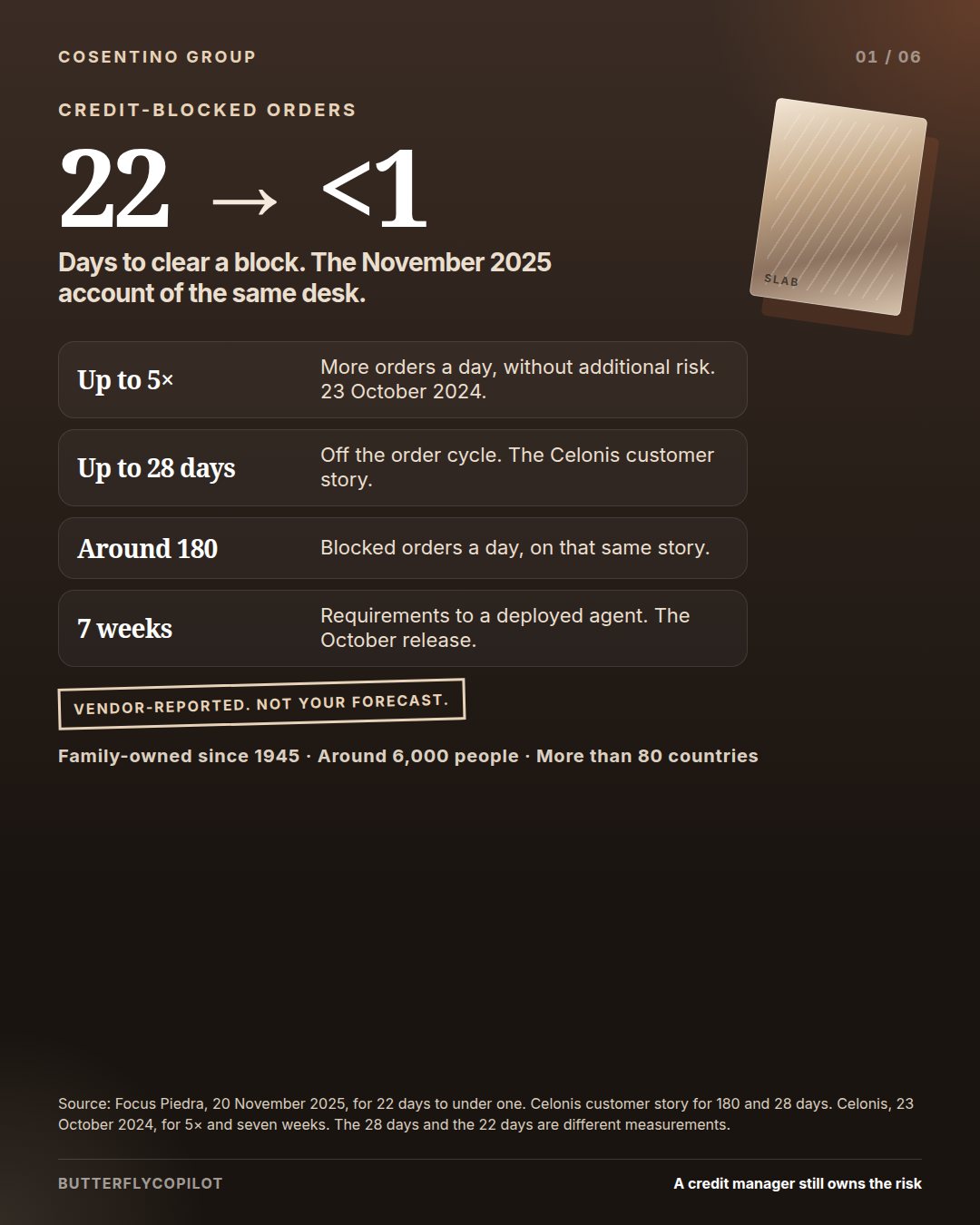
0106
The block was the job.
Cosentino makes surfaces in Cantoria, in Almería. The company is family-owned, and it has been at it since 1945. Around 6,000 people. Silestone and Dekton are the names a specifier already knows. The surfaces sell in more than 80 countries, and a large share of them go into buildings. A kitchen, a facade, a fit-out with other trades queued behind the delivery.
A sales order could be real and still not move. Credit policy had blocked it. A credit manager took each one and sat with finance. The relationship. The payment history. The risk. Then a yes, or a hold. An order could sit for up to a month. Sometimes the date the customer had been promised went past while the block was still open. On a building site, the slab is not a late email. The rest of the job waits, and the invoice waits with it.
What they stood up
Cosentino built the desk with Celonis, on Process Intelligence, using AI Annotation Builder. Seven weeks, from the requirements and the data through to a deployed agent. The credit managers work in a screen the story calls the Credit Block App.
The path is short enough to copy.
A sales order is blocked for credit
        ↓
The agent reads across the systems that already hold the facts
        ↓
Order value, available credit, block-removal rate, payment history
        ↓
A recommendation, in seconds, with the facts beside it
        ↓
Release, or keep the block, sometimes asking for proof the invoices were paid
        ↓
Some orders release on their own
        ↓
The rest wait for one click, or a rejection the agent learns from
The sources do not name the ERP. They say the data was pulled from several IT systems. The recommendation uses the order value, the customer’s credit, and the process figures. Available credit balance is the example they give for the credit file. The customer’s block-removal rate is the example they give for the KPI. The reasoning is meant to be something a person can check. Rafael Domene, the global CIO, put the aim as an agent that could take a process as well as a person could, provided it had the data, the process, and someone watching it.
Some orders now release without a click. The others land with the credit manager. Accept is one click. Reject comes with a reason, and that reason is what the agent is supposed to learn from. The time that comes back is aimed at the high-risk orders, which stay with a person.
The desk handles around 180 blocked orders a day. Credit managers get through at least five times as many as they did, and the account of the rollout says they do it without taking on more risk. Order cycle time is down by as much as 28 days. The October 2024 announcement states the same five-times pace, and the seven weeks. Focus Piedra, in November 2025, times the old wait to clear a block at 22 days, and the new one at under a day. The figures are vendor-reported. The 28 days and the 22 days are different measurements, and this page leaves them that way.
The credit agent is the first of a wider programme. Clar sits with the sales team. C-Brain watches the market. HR agents take leave, certificates, and onboarding. Microsoft and Celonis are the partners named for the model layer, with the stated intention of staying free to change it. The next work on this desk, as Cosentino describes it, is more of order management, then receivables and inventory, toward the digital workforce they have been talking about. That sequence is theirs. A smaller plant does not start there.
A click is not a signature from the model
Speed is how a tidy agent “clears” a block by raising the credit limit, or by believing a PDF.
The balance covers the order, the customer pays on time, and the removal rate is high. That order can leave the queue. The balance does not cover, a few named invoices would, and the customer is allowed to be asked. The block stays, and the request that goes out is for proof of those invoices, not for a bank account. The customer is new, or the risk is high, or legal has a hold on the account. The card still shows a recommendation. The release belongs to the credit manager, and a legal hold belongs to that manager together with finance.
A rejection is the lesson. It is stored against the order and the customer. It can put a customer back on the human queue. It cannot quietly raise the amount that releases on its own. A manager who wants a higher line types the higher line. The model does not get a button, and a delivery date that has already slipped does not lower the bar. The site is waiting. That is a reason to look, not a reason to skip the check.
RENNER’s desk starts when a supplier confirmation arrives. This one starts earlier in the wrong direction. The customer’s own order is already blocked. The work is the credit decision, and the person who owns the risky ones is still named.
What a smaller manufacturer should steal
If blocked orders already land in one queue, and a person still rebuilds the customer from three screens, the first seven weeks are one credit manager and one segment.
One credit manager, one segment
        ↓
A week of exports, and a stopwatch on the blocks they already clear
        ↓
Two weeks of shadow cards, beside the decisions they still make
        ↓
Two weeks of one-click accept or reject, while they still key the release
        ↓
Two weeks where the dull, covered, low-risk orders may release on their own
        ↓
High risk stays. A proof PDF is not cash. The limit does not move.
Time the stretch you already have. Hours from the block to a decision a person will stand behind. How the queue splits across release, keep, and a proof request. How often a person accepts, and how often they reject. How many releases you later reverse. How often a released customer is overdue inside the month. How many proof requests show up later as a real payment, and how many do not. How many orders are still blocked after the date you promised. After the segment is live, time the same things. Those pairs are your result.
The 180 a day, the five times, the 28 days, the 22 days to under a day, and the seven weeks are Cosentino’s published story. They are not a line for a proposal.
What the instruction file will make an agent do
The file below is the brief. It is not the Credit Block App, and it is not Cosentino’s limits, rates, or timers. None of that wiring is public. The blanks are yours.
It will make the agent:
- Refuse to run while a
REPLACEline is empty, or while anEXAMPLErow is still in a live sheet. - Start only when an order is blocked. Read the order value, the available credit, the credit limit, the overdue position, the disputes, the block-removal rate and its sample size, and the payment history. If a file is missing or older than the plant allows, the run stops. A blank balance is not zero.
- Recommend release, keep, or a proof request, in code. The model may phrase the sentence. It may not pick the action. A number the sentence adds, and the files do not contain, is dropped.
- Release on its own only when every automatic predicate holds: low risk, covered with the headroom the plant typed, inside the amount the plant typed, a removal rate at or above the automatic line, a reason the plant marked as automatic, and no hold a person has already taught it. High risk, a strained account, a new customer, and anything over the line stay with the credit manager.
- Put the rest on a desk with one click to accept and a rejection that requires a reason. The model cannot click. A hard hold, legal or fraud, needs finance as well.
- Ask for proof with a fixed note that names the invoices and does not ask for a bank account. A reply is filed. It does not post cash and it does not release the order. The next credit export is what moves the balance.
- Learn in one direction. Enough “we kept this” rejections can put that customer back with a person. A string of releases cannot loosen the cap.
- Write a release file the ERP already knows how to import, and only after the seven-week gates. The file does not carry a new credit limit. The sources never name the ERP, and the brief does not invent one.
- Write a daily file from this plant’s own baseline. No comparison with the case study’s counts.
The tests are in the file. A covered order that is eligible and still does not write while the flags are off. The same order writing a release file when the flags are on, without a credit limit in the payload. A gap that becomes a proof request and stays blocked after the customer replies. A high-risk order that looks clean and still will not release itself. A legal hold the manager cannot clear alone. A blank balance that is not stored as zero. A model that tries to click accept. A sentence that invents a balance. Three rejections that put the next order back with a person, and three releases that do not raise the cap. A stale export. If the agent clears any of those by moving a limit or by releasing a hold it was told to keep, the test fails.
The instruction file
The brief has the role, the file connector for whatever system already blocks the order, the data model, the decision rules, the prompts, the one-click desk, the proof request, the feedback loop, the seven weeks, and the tests that decide when a manager may let a dull order release on its own.
Replace every REPLACE line. Delete every EXAMPLE row. Let it sit beside the blocks a person still clears, before anyone treats a recommendation as a release the customer has already been promised.
Sources
The desk, the 180, the 28 days, and the five-times throughput are from Celonis’s Cosentino customer story. The seven weeks and the five-times wording are also in the Celonis release of 23 October 2024, which Cosentino posted on its own newsroom. The 22 days to under a day is from Focus Piedra on 20 November 2025. The figures are vendor-reported. They are not an independent audit of a baseline, and they are not a forecast for another plant. The 28 days are a reduction in order cycle time. The 22 days are a time to resolve a blocked order. This page does not merge them.
- Celonis, “Cosentino + Celonis.” Undated customer story. Family-owned Spanish manufacturer, around 6,000 people, surfaces in more than 80 countries. Credit-blocked orders reviewed by a credit manager with finance, on relationship, payment history, and risk. Delays of up to a month, sometimes past the expected delivery date, on products used in building projects. An agent built in seven weeks with AI Annotation Builder, reading multiple IT systems. Inputs named: order value, customer credit information, process KPIs such as block removal rates. Recommendation in seconds, with fact-based reasoning. Some orders unblocked automatically. Others accepted with one click in the Credit Block App, or rejected with feedback. Around 180 blocked orders a day. Up to 180 orders reviewed each day. Up to 28 days of reduction in order cycle time. 5x more orders handled per day. Credit managers handle at least five times as many blocked orders without any additional risk, with time back for high-risk orders. Next: more order management, then accounts receivable and inventory, toward a digital workforce. Rafael Domene, Global CIO.
- Celonis, “Cosentino Drives Business Transformation with AI Powered by Celonis Process Intelligence,” 23 October 2024, New York and Munich. Since 1945. Family-owned. Silestone and Dekton. Deployed within seven weeks. The assistant reads order value, credit information such as available credit balance, and process KPIs such as block removal rate. It recommends removing the block, or keeping it and asking for proof that outstanding invoices have been paid. Managers accept with a click or reject and give a reason. Up to 5x more orders per day without additional risk.
- Cosentino newsroom, “Cosentino drives business transformation with AI powered by Celonis Process Intelligence.” The company posting of the 23 October 2024 announcement.
- Focus Piedra, “Cosentino activa su plan de IA con agentes inteligentes y diseño generativo,” 20 November 2025. Blocked orders went from 22 days to resolve to under a day. Clar, a sales assistant. C-Brain, market-scanning agents. HR agents for leave, certificates, and onboarding. Microsoft and Celonis named as partners. José Luis Cobas, communications director, on an architecture meant to stay independent of a single vendor.