
How RENNER Kompressoren Cut Order-Confirmation Checks by 85% with AI
The purchase order was already in the ERP. The confirmation still landed on a buyer’s desk. A person approves the reply before it goes back to the supplier.
ButterflyCopilot
0106
The confirmation was the job.
RENNER GmbH Kompressoren builds compressed-air systems in Güglingen, in Baden-Württemberg, and at a second plant in Bautzen. Annette and Bernt Renner started the company on 1 July 1994. The anniversary note from 2024 counts more than 220 people, in several countries. Screw compressors are the specialty. Piston compressors sit beside them, and so does oil-free air. The catalogue runs past 6,000 models, and a customer can have one adapted. What leaves the shop is often a brochure model rebuilt for one job.
That is a good factory and a hard inbox. A custom compressor changes the supplier, the part, and the project. The purchase order can be raised once. The order confirmation, the Auftragsbestätigung, comes back as a PDF, a spreadsheet, or a few lines in the mail, in whatever layout that supplier used this month. Buyers were checking more than 8,000 of those a year by hand.
The OCR tool was already there. It was unreliable, and it took maintenance whenever a format moved. EDI was too costly to carry past a handful of suppliers. Older confirmation tools, the kind that sit inside an ERP and wait for a template, had a habit of making more work. A new supplier, or a small change in a defined layout, and someone had to decide again what was automatic and what was still by hand. The people who knew the parts were spending the day on the check.
What they stood up
Zalion put an agent on the mailbox the buyers already shared. No new ERP. No template per supplier. No pile of old confirmations to train on. The case study says it was live within a few days.
The agent watches that mailbox. It reads the confirmation whether it arrived as a PDF, an Excel file, or the body of the email. It pulls the open purchase order from the ERP through a file export. It checks material, quantity, price, and delivery date. When the four agree, it updates the ERP. When they do not, it tells the person who can answer: the requester when the date moved, procurement when the price moved. It drafts the email back to the supplier. A buyer approves that draft before it is sent. The thread stays open until the difference is resolved or the case is escalated, and every decision stays where a person can read it later.
A confirmation lands in the shared mailbox
        ↓
The agent reads the PDF, the spreadsheet, or the mail
        ↓
The open purchase order comes from a file the ERP already exports
        ↓
Material, quantity, price, and date are matched in code
        ↓
A match writes a confirmation file the ERP can import
        ↓
A difference opens one task for the right person
        ↓
The supplier email waits until a buyer approves it
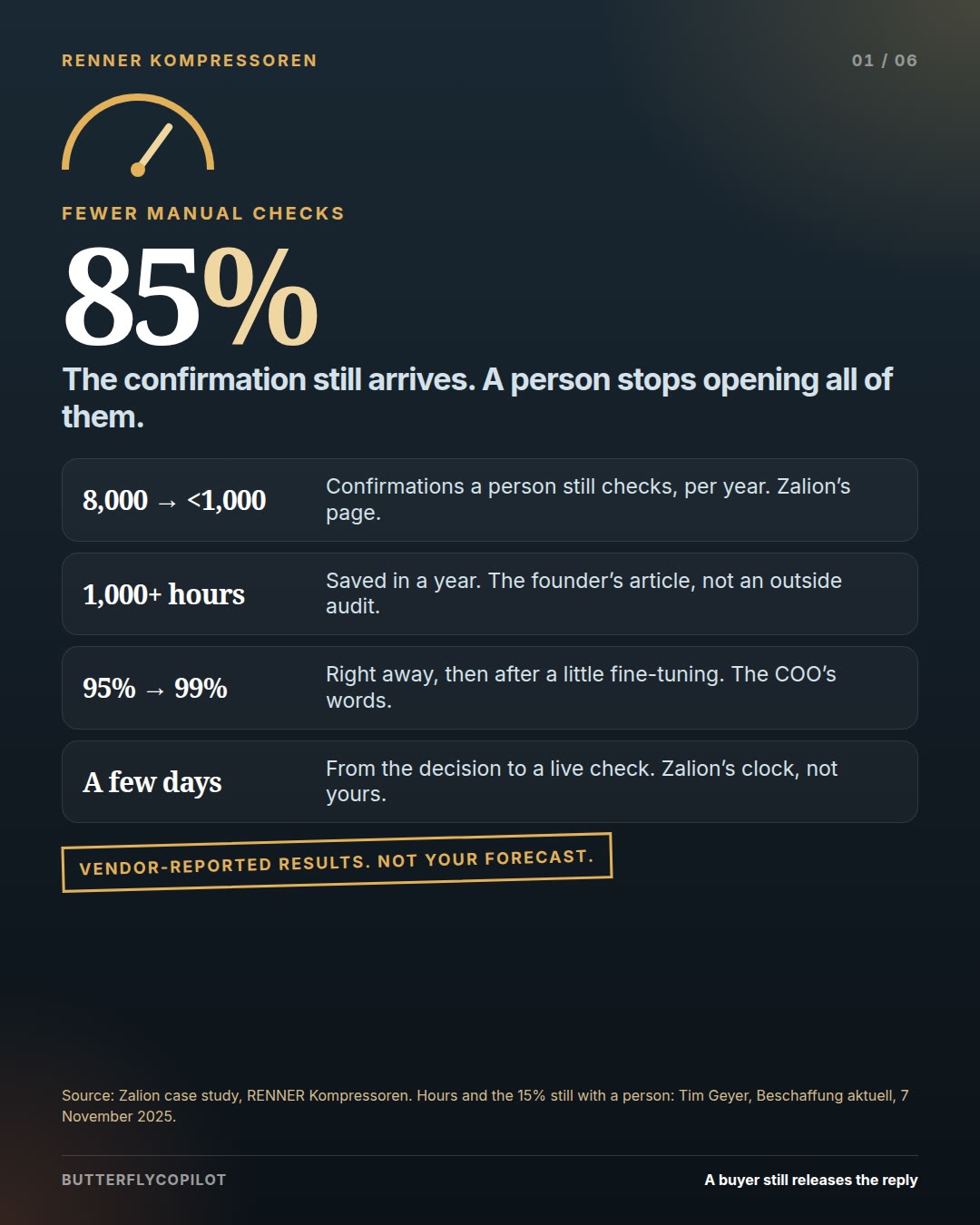
On that desk, the Zalion case study reports manual checks down 85%, from 8,000 a year to under 1,000. In Beschaffung aktuell, Zalion’s founder Tim Geyer reports more than 1,000 hours a year saved on this work. He is writing as the vendor. Björn Neubig, the COO, said the agent checked 95% correctly right away, without a single day of training, and that with a little fine-tuning it is now above 99%. He had not seen a team that happy on a software rollout. Those sentences belong to this company and this project. A plant with a shorter supplier list does not inherit them by turning a mailbox rule on.
The same shape shows up at Anton Debatin, a packaging maker with about 174 people. There the published book is about 2,700 confirmations a year from about 330 suppliers, and about 80% now pass without a buyer touching them. The ERP link was an import of the orders, a forward of the mailbox, and a CSV written back, stood up in one to two days. Different company. Different tool. A smaller book. The files are what a plant can copy. The scoreboard is not.
The line that does not match
Speed is how a tidy agent accepts a bad price.
The purchase order says ten seals at 18.50, for the 15th. The confirmation says ten at 19.00, for the 20th. If the agent updates the ERP so the documents agree, the plant has recorded a concession nobody made. If it confirms the line that matched and leaves the other line quiet, the shop inherits half an order. If it emails the supplier a cheerful acceptance, the guardrail was a sentence in a kickoff, and the supplier has it in writing.
The rollout is plain about who is told. A date goes to the requester. A price goes to procurement. The email back to the supplier waits until purchasing releases it. The sources do not print the tolerance, and they do not print how many reminders become an escalation. Those blanks are the part a smaller plant types for itself. Zero is a legal tolerance. It means the date, the price, and the quantity must match exactly. A blank is not zero, and it is not a reason to guess.
About 15% of the confirmations still need a person. That is the useful figure, and it comes from the same article as the hours. The agent can read a layout it has not seen before. It cannot supply the judgment when a supplier offers a different part for a custom build, or when the fix needs someone who knows the customer. The instruction file holds the whole confirmation when one line is wrong. It does not talk the supplier into a discount. It writes the purchase order’s own price on a clean import. A different price lands in the ERP only after a named person accepts it on a form.
The tool that came before is the other trap. A template per supplier works until the supplier changes the template, which a list of custom machines does all the time. The agent in the case study has no field map to keep alive. The instruction file keeps that split in a stricter way than a demo. The language model may propose what the document says. A function decides whether it matches. A sentence in the PDF that says to ignore the price is only a sentence. The match still runs.
A few days was Zalion’s clock from the decision to a live check, on a mailbox and an ERP the plant already had. The same account says there was no system change and no training data. The file below is slower on purpose. The first month does not send, and it does not write the ERP. The write, when it comes, is a CSV a person can open. A supplier email never leaves because a model typed the buyer’s name.
Footprint’s buyers had a different hour of the day in front of them. Their agent creates the purchase order from the material plan and goes looking for an acknowledgement. RENNER’s order is already in the ERP. The acknowledgement has already arrived. The work is the check.
What a smaller plant should steal
If the confirmations already land in one mailbox, and a person still opens each one beside the purchase order, the first ninety days are one buyer and one group of suppliers.
One buyer, one group of suppliers, direct materials only
        ↓
Thirty days of exports, and a stopwatch on the checks they already do
        ↓
Thirty days of drafts a buyer may release, while they still key the ERP
        ↓
Thirty days where a clean match may become the import file
        ↓
A price, a quantity, or a date outside the tolerance still waits for a person
Time the week you already have. Minutes to check a confirmation. How many a person still opens. Hours from the mail to a matching import or to a task. How the tasks split across material, quantity, price, and date. How many drafts waited until a buyer released them. How often a confirmation had to be undone. After the group is live, time the same things. Those pairs are your result.
The 85%, the drop from 8,000 to under 1,000, the 1,000 hours, the 95% and the 99%, the few days, and the 15% are RENNER’s published story, as Zalion and its founder tell it. They are not a line for a proposal. Debatin’s 80% and 2,700 are a different plant’s story.
One side effect is worth parking, and worth leaving in a person’s hands. Confirmations often carry a country of origin, a customs tariff number, a manufacturer part number, an EAN. The article’s point is that the ERP link built for the check can feed a later agent that fills those master-data fields. The instruction file copies them onto a list a person reviews. It leaves the item master alone.
What the instruction file will make an agent do
The file below is the brief. It is not Zalion. It is not RENNER’s mailbox, tolerances, or ERP. None of that wiring is public. The blanks are yours.
It will make the agent:
- Refuse to run while a
REPLACEline is empty, or while anEXAMPLErow is still in a live sheet. - Read a purchase-order export, the item and supplier masters, a part map, and the buyers. If one of them is missing or older than the plant allows, the run stops. A stale file is not a quiet morning with nothing to check.
- Trust the sender. The address has to be the supplier’s domain, or an address the plant has listed. A perfect PDF from a stranger does not confirm an order.
- Let the model propose what a PDF, a spreadsheet, or an email body says. No template per supplier. The match itself is code. A missing price is a failure, and it is not stored as zero.
- Match material through the part map, then quantity, price, and delivery date. Both the percent and the absolute test have to pass, and the plant types them. Zero means exact. One bad line holds the whole confirmation.
- Route a date to the requester and a price to procurement. Quantity goes to procurement too, and the requester is copied when the quantity or the date is the problem. That last split is ours. The case names the date and the price.
- Draft one fixed email that lists the differences and does not accept them. A named buyer approves it on a form before it can be released. The model cannot approve. The first thirty days do not release.
- Keep one case per purchase order. A later message matches again. After three supplier messages, or 72 hours, the case escalates and the drafting stops. Those two limits are ours. The sources say the thread continues until it is resolved or escalated, and they do not print the numbers.
- Write a CSV the ERP can import, and only after the gates. A clean row carries the purchase order’s price and quantity, and the supplier’s date. An accepted difference carries the supplier’s figure only with the person’s name on the row.
- Park country of origin, tariff numbers, manufacturer parts, and EAN codes in a review file. It does not write the item master.
- Write a daily file from this plant’s own baseline. No comparison with the case study’s counts.
The tests are in the file. A clean confirmation. A write that tries to smuggle a new price. A price and a date on the same line, routed once. A model that tries to approve. A short note. A requester who tries to accept a price. A buyer who accepts it, with their name on the file. An unmapped part, which gets a task and no email. A stranger’s perfect document. A calendar week, refused until the plant says how to read it. A stale export. A fourth reply that escalates. A clock that hits 72 hours. A daily file that tries to borrow 85%. If the agent clears any of those by confirming the order or by sending mail it was told to hold, the test fails.
The instruction file
The brief has the role, the file connector for whatever ERP the plant already runs, the mailbox, the match, the routing, the draft, the approval, the escalation, the import, the log, the ninety days, and the tests that decide when a buyer may let a file write back.
Replace every REPLACE line. Delete every EXAMPLE row. Let it sit beside the confirmations a person still checks, before anyone treats a draft as a reply the supplier has already accepted.
Sources
The counts and the COO’s words are from Zalion’s RENNER case study. The hours, the 15%, the approval gate, the escalation, and the master-data side effect are from an article by Zalion’s founder, Tim Geyer, in Beschaffung aktuell. That article does not name RENNER. Its compressed-air example matches the case study, and this post treats them as one rollout. Neither page is an independent audit of a baseline, and neither is a forecast for another plant. The company description is from RENNER’s own site. Debatin’s figures are from that case alone.
- Zalion, “How RENNER Kompressoren cut manual order confirmation checks by 85% with AI agents.” Güglingen, Baden-Württemberg. Screw compressors, piston compressors, and custom systems. More than 8,000 order confirmations a year checked by hand. OCR unreliable and maintenance-heavy. EDI too costly, and only feasible with a handful of suppliers. Skilled people tied up in operational work. Agent live within a few days, no system migration, no training data. Shared mailbox. PDF, Excel, email, or any other format, with no templates. Match on material, quantity, price, and delivery date. A date goes to the requester. A price goes to procurement. Supplier communication runs through to a resolution. A correct confirmation updates the ERP. 85% fewer manual checks, from 8,000 down to under 1,000 a year. Scepticism turned into enthusiasm. Björn Neubig, COO: 95% correct right away without a single day of training, above 99% after minimal fine-tuning, and a team happier than he had seen on a software rollout. This page does not publish the 1,000 hours or the 15%.
- Tim Geyer, founder of Zalion, “Wo KI-Agenten im operativen Einkauf heute den Unterschied machen,” Beschaffung aktuell, 7 November 2025. Vendor-authored. The compressed-air example is not named in the article. More than 8,000 confirmations a year, customer-specific work, changing suppliers, components, and projects. OCR judged not helpful. EDI not feasible across that supplier list. Classic tools, with SAP-integrated given as an example, sometimes created more work. A shared mailbox, a file-based ERP comparison, the right person on a difference, an automatic ERP update when the data agree. The agent drafts the supplier email and waits for purchasing to approve it, continues until resolution or an occasional escalation, and leaves a reviewable trail. The ERP record is described as complete. Results stated there: 85% fewer manual checks, with over 1,000 hours a year saved. Separately, 85% of confirmations fully handled by agents, and the remaining 15% still needing a person’s expertise. A side effect, once the ERP link exists: a further agent can pick up country of origin, manufacturer part numbers, customs tariff numbers, and EAN codes. The article’s second example, a gear-and-transmission component maker and its tail-spend figures, is not used here. “A few weeks” in the article is said of both examples together. It is not a second go-live clock for RENNER.
- RENNER GmbH Kompressoren, “30 Jahre RENNER,” 1 July 2024. Annette and Bernt Renner started the company on 1 July 1994. Over 220 people in several countries. Headquarters in Güglingen and a production site in Bautzen. Address Emil-Weber-Straße 32, D-74363 Güglingen.
- RENNER GmbH Kompressoren, “Kompressoren von RENNER.” Family-run. Screw compressors as the specialty, piston compressors, oil-free compressed air, made in Germany. More than 6,000 models, adaptable to the customer. The homepage says over 200 people and a garage start with three. This article uses the dated anniversary note for the headcount and the Bautzen plant, and does not average the two pages.
- Tacto, “How Anton Debatin automates order confirmations with AI agents.” A separate case. Packaging maker, about 174 people. About 2,700 confirmations a year from about 330 suppliers. About 80% then processed without a buyer. ERP connection quoted from Matthias Sorg, head of IT, as one to two days: import orders, items, and suppliers; forward the mail; write a CSV back. Not used as a RENNER result.