
How Deutsche Gasrußwerke Lifted Margins with AI Scheduling Agents
Six furnaces, more than thirty grades, and a schedule that took a day. The next one comes back in under a minute. A person still accepts it.
ButterflyCopilot
0106
The schedule took a day. By the afternoon the oil had moved, and someone started again.
Deutsche Gasrußwerke makes carbon black on the Dortmund harbour, at Weidenstraße 70–72. The firm began in 1936, as Russwerke Dortmund. Gas black from 1938. Furnace black from 1956. More than thirty grades leave the works for tyre makers and chemical plants, as a reinforcing filler and as a pigment for paint, print, and plastics. The same site has burned its residual gas for electricity since 1983, and since 1994 it has put the leftover heat into Dortmund's district network, today through DEW21. In 2022 that heat, growing with the network, stood in for a fossil plant. The company puts the climate figure at 45,000 tonnes of CO₂. That number belongs to the city. It is not a scheduling result.
A day, and then another pass
Six furnaces. More than thirty grades. Oil blends that do not hold still. Silos with a floor and a ceiling. An emissions limit. A truck or a rail car with a window that closes. The plan lived in Excel, and in the heads of the people who kept the Excel honest. One schedule could take the whole day. Forty percent of the orders then had to be planned again. A plan that was merely possible was as far as the day would stretch.
They put Juna's production scheduling agent on that day.
The agent sits on a twin of the works. The orders and the prices from the ERP. The furnaces as they are actually running. The silos. The utilities. The trucks already promised. The emissions number the plant has to live inside. One model, instead of six conversations. On the model sits a solver: mixed-integer programming, and a learning half the public account does not describe. It holds the constraints. It trades cost against emissions and against a delivery. It returns a feasible schedule in under a minute. When a furnace drops, or an order cannot wait, or the feedstock moves, it solves again. A person can see what it did. A person still decides.
Peter Hartmann, the chief executive, put the point of it in one place.
Working with Juna unlocked performance improvements we didn't think were possible. Their agents deliver significant daily savings through higher reactor utilization and lower raw material usage, and turn data from a fragmentation pain into a strategic lever.
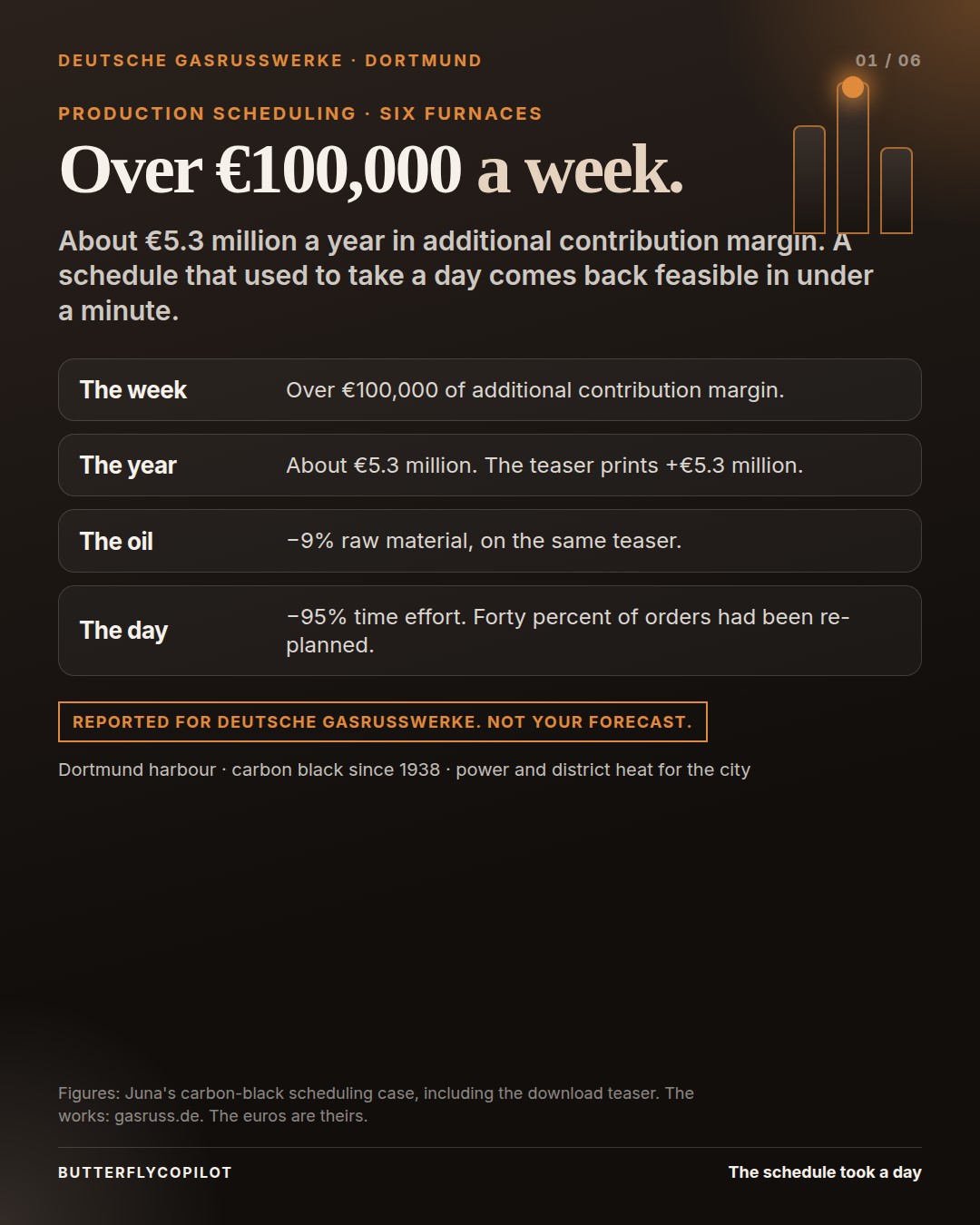
Juna's case study puts the gain at more than €100,000 of additional contribution margin a week, about €5.3 million a year. The download line beside that case reads + €5.3 Mio, −9% raw material, −95% time effort. The planning day got drastically shorter. Scheduling stopped being a firefight and became something the works could aim. No timeline, no model name, no team size, and no picture of the solver is public. This page does not invent them.
Orders, grades, silos, tanks, the cap, the slots
        ↓
One snapshot, as fresh as the export
        ↓
A mixed-integer program. Campaigns, blends, heels, power
        ↓
A candidate, with the cents recomputed from the schedule itself
        ↓
A person accepts. Nothing is written back
The boxes are the instruction file. They follow the shape of the job: one twin, a solver that owns every kilogram, a freeze when the plant moves, a planner on the gate. They are not a reconstruction of the screens in Dortmund.
The heel is not a spare tonne
Speed is how an agent calls a guessed blend a recipe, treats a stale tank as empty, and books the gap as money already earned. Speed is how €100,000 a week slides into the config of a plant that has not exported a schedule. Speed is how a feasible file becomes the instruction a furnace is already following.
The file for a smaller works keeps the jobs and drops the tenant. One planner. One furnace, in shadow, while the rest of the plant keeps the spreadsheet. The cap, the penalties, the cost of a changeover, and the length of a campaign are numbers the plant types, because Dortmund does not publish them and they must not be guessed. The model may explain a schedule the solver has already printed. It may turn a sentence into a downtime, a rush, or a price, and only when the planner named every field. It may not invent a kilogram. It may not approve itself. It may not write to the ERP. Version 1 writes files.
On the fixture, which is ours, two furnaces and three grades run for four periods of the file's own clock. The grades are called GA, GB, and GC. They are not a specification anyone in Dortmund makes. The spreadsheet leaves both furnaces on for every period. It meets two of the orders and misses 9,000 kilograms of the third. Contribution margin on that plan is 2,274,000 cents. The penalty for the missed kilograms is 1,800,000 cents. The file does not add those two numbers, and it does not call either of them a saving. The solver turns a furnace off when the order and the silo do not need it, pays for one changeover, and meets all three orders. Margin on that schedule is 2,750,000 cents. The emission cap in the fixture is 300,000 grams, and the solved plan sits on the cap, so the cheaper oil is not simply poured in until the tank complains. A breakdown on the first furnace, with the opening period held frozen, still meets the orders, at 2,725,000 cents. A rush of 4,000 kilograms of GB, inside the same freeze, is met, at 2,840,000 cents. None of those cents is a week at the harbour.
Suzhou Universal is the scheduling sentence on this site. A person asks, a draft comes back, a person compares. This desk is the program under a sentence like that: the campaigns, the silos, the cap, and the cents, in code. The 70% on that page stays on that page.
What a smaller works should steal
If the plan is still a spreadsheet, and someone can already point at the furnace, the silo, and the due time, the first month is one planner and one furnace.
Let the solver own the kilograms. Let a stale export stop the run. Let the frozen hours stay frozen, including when that means the solve refuses to move a furnace that has just gone down. Keep the margin in one column and the penalties in another. Show the candidate to the person who already carries the day, and do not write it back until that person, outside this file, says the spreadsheet is no longer the record.
One furnace, in shadow, caps you type yourself
        ↓
Thirty days of exports a person already trusts
        ↓
Thirty days where the candidate sits beside the plan they would have issued
        ↓
Thirty days where an accepted file is the note they type from
        ↓
The ERP does not change inside the tool. The next furnace waits.
Count the stretch you already have. Minutes from a changed order to a schedule someone has checked, on a clock you started before the tool existed. Margin on the candidate, beside margin on the plan you actually issued. Penalties in the other column. Unmet kilograms, and late kilograms. Emissions against the cap you typed. Candidates you used unchanged, candidates you edited, candidates you killed. Schedules this agent wrote into the ERP. That last count stays at zero.
The weekly figure, the year, the 9%, the 95%, and the 40% are this works' published story. They are not one equation, and they are not a line in a proposal. Do not paste them onto yours.
What the instruction file will make an agent do
The file below is the brief. It is not their ERP, their caps, or their approval screen. None of that schema is public. The blanks are yours.
It will make the agent:
- Refuse to run while a
REPLACEline is empty, or while anEXAMPLErow is still in a live sheet. Refuse a margin target, and refuse 5.3, 100,000, 95%, and 40% as a setting. - Build one snapshot from the ERP, the historian, and the MES. A stale export stops the solve. It does not become an empty order book.
- Solve the program. One grade at a time. A campaign with a minimum length. A changeover charged once, on the start. A silo heel that cannot be shipped to make an order look whole. A blend window. A power cap. An emissions cap. A logistics slot. The objective is contribution margin, minus feedstock, energy, and changeovers, and then, in a separate subtraction, lateness and unmet kilograms.
- Solve again when a furnace goes down, an order rushes, or a feedstock price changes. Hold the frozen periods. If the frozen period is the one that just went down, stop and say so.
- Explain a schedule only with integers the solver printed. A percent does not get through. The model does not get to approve.
- On the fixture, put 2,750,000 cents against the filed plan's 2,274,000, and put 476,000 cents of margin beside 1,800,000 cents of penalty, unadded. In shadow, leave the second furnace on the old plan and show the 150,000 cents of energy that costs.
- Accept a candidate only from the named planner, on the form. Accepting writes a file. It does not write the ERP.
The tests are in the file. The heel. The freeze that overlaps a breakdown. The two columns that are not a sum. The sentence that smuggles in a percent. If the agent clears any of those by relaxing a cap, adding the penalty into the margin, or posting a schedule, the test fails.
The instruction file
The brief has the role, the tables a planning export can fill, the snapshot, the program, the events, the ledger, the ninety days, and the solver that has to pass before a file is treated as a note a planner has not yet used.
Replace every REPLACE line. Delete every EXAMPLE row. Let it sit beside one furnace for a month a person still finishes by hand, before anyone treats a candidate as a schedule the works has already started.
Sources
The harbour, the founding, the grades, the power, and the heat are from Deutsche Gasrußwerke's own profile. The scheduling job, the weekly margin, the year, the teaser, and Peter Hartmann's sentence are from Juna. The case page describes a German carbon-black producer and does not print the legal name. Juna's homepage names Deutsche Gasrußwerke and prints the sentence. Founderland, on 3 March 2026, reports that the scheduling case is this company. The 133,000 tonnes and the 45,000 tonnes of CO₂ are the profile, not the scheduler. They are not a forecast for another works.
- Juna AI, "Agentic Scheduling: How a Carbon Black Producer Increased Contribution Margin by €5.3M per Year." Dated 1 June on the case list. A German carbon-black producer with more than 90 years in the field, and more than 30 specifications, for chemical and rubber customers. Six furnaces. Fluctuating oil blends, silo constraints, emissions limits, tight logistics windows. Manual and Excel planning of up to a full day. 40% of orders re-planned. A live digital twin of ERP data, real-time production signals, silo levels, utility constraints, logistics commitments, and sustainability metrics. A hybrid engine of mixed-integer programming and AI-based learning. Feasible, cost-efficient schedules in under one minute, re-optimised for downtime, urgent orders, and supply fluctuations. Over €100,000 of additional contribution margin per week. Planning effort drastically reduced. Scheduling shifted from daily firefighting to a strategic capability.
- Juna AI, "case study download." The teaser prints
+ €5.3 Mio - 9% Raw Material - 95% Time Effort. - Juna AI, "homepage." Names Deutsche Gasrußwerke and quotes Peter Hartmann, CEO: "Working with Juna unlocked performance improvements we didn't think were possible. Their agents deliver significant daily savings through higher reactor utilization and lower raw material usage, and turn data from a fragmentation pain into a strategic lever."
- Founderland, 3 March 2026, "Juna AI Launches Factory OS to Automate Industrial Plants with AI Agents." Reports that the carbon-black scheduling case, the digital twin, and the €5.3 million figure are Deutsche Gasrußwerke.
- Deutsche Gasrußwerke, "Profil." KG Deutsche Gasrußwerke GmbH & Co, Weidenstraße 70–72, 44147 Dortmund, at the harbour. Founded 1936 as Russwerke Dortmund. Industrial gas-black production from 1938. Furnace black from 1956. Electricity from residual gas since 1983, expanded in 1989. District heat to Dortmund since 1994, today DEW21. The 4 millionth tonne in 2006. A production record of 133,000 tonnes in 2017. Rail tank-car unloading finished in 2020. In 2022 the growing heat supply, with DEW21's network build-out, replaced a fossil plant, a saving of 45,000 tonnes of CO₂. More than 30 grades for the tyre and rubber industry and for paint, printing, and plastics. The profile page is the longer history. The German home page carries the same address and the same products.