
How FABco Freed Procurement Capacity with AI Agents
The truck was in the yard. The bill of lading was still paper. Half the procurement and accounts-payable desk came back to strategy, in six months.
ButterflyCopilot
0106
The truck was in the yard.
FABco, in Houston, sells rebar, fabricates it, and installs it. Ancillary concrete and construction products ride with the steel. About 1,300 people, across five states. Around 200,000 tons of rebar a year. Around 3,000 SKUs. Some of the steel is bought overseas.
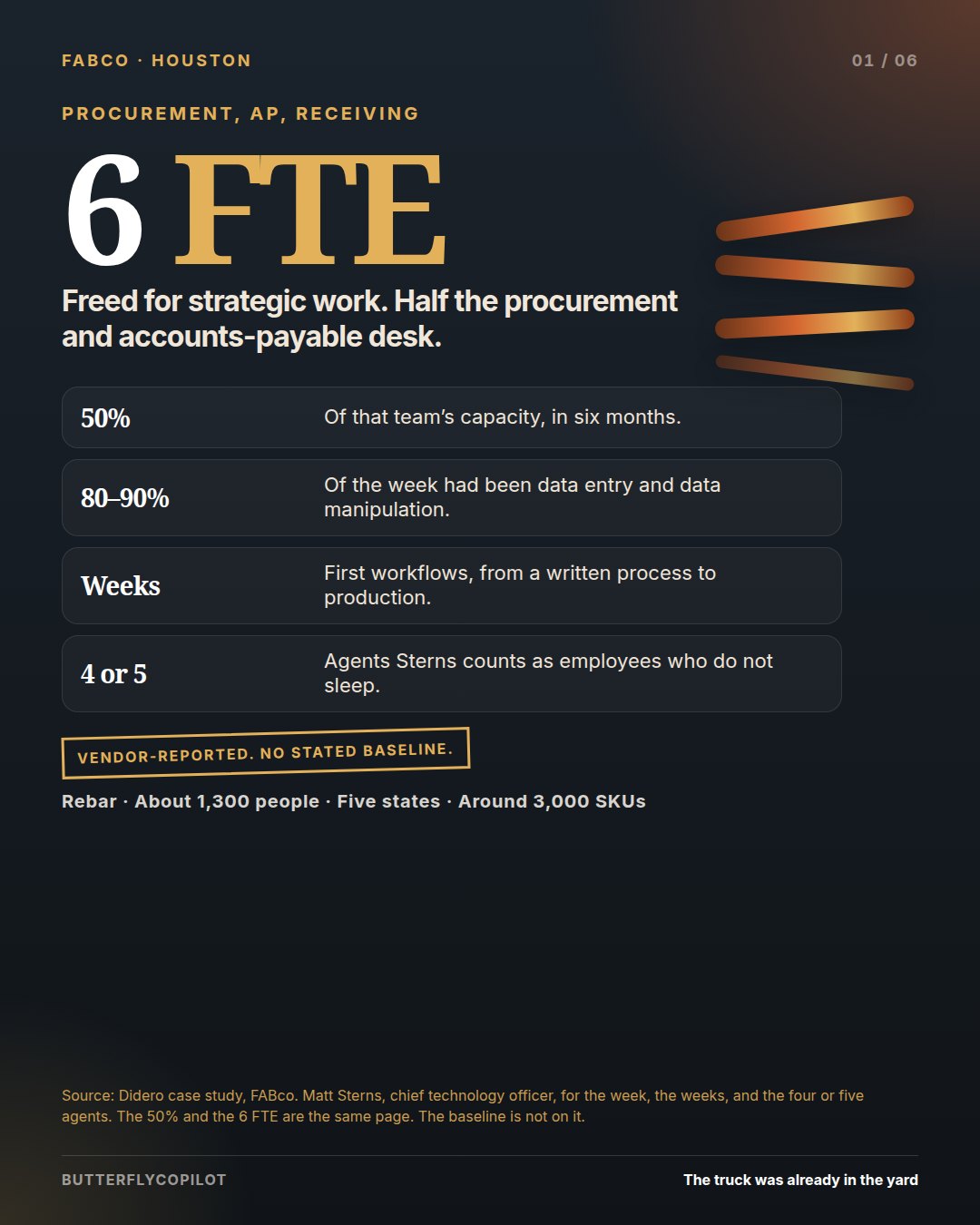
The procurement week did not look like that scale. It looked like keystrokes. Matt Sterns, the chief technology officer, put the week in one sentence. Data entry and data manipulation were 80 to 90 percent of their time. Paper got printed. It moved through Excel. It was copied into the next system. The bill of lading, the paper that says what the truck actually brought, was keyed into receiving by hand. When that keying slipped, production waited, and the customer delivery waited with it.
The invoice had its own pile. A three-way match, and the exceptions around it, were done by hand inside a legacy accounts-payable package. The purchase order, the receipt, and the invoice had to be brought to the same line. The package is not named. The ERP is not named either.
What they stood up
Didero put agents on the work. Not one bot labeled procurement. Four jobs. Sterns counts four or five of them as FABco employees, the kind that never sleep.
The receiving job takes the bill of lading and enters it into the ERP, in place of the hand keying that held up the yard.
The accounts-payable job runs the three-way match, and the exception handling that used to live in the legacy package.
The purchasing job drafts orders from annual usage and from what is already on hand.
The sourcing job runs a competitive event on direct materials. It looks for a supplier the plant does not have, and it puts a market price next to the one they pay. The people take the time that comes back and spend it on supplier relationships, on pricing, and on the higher-value work the week had crowded out.
The first of those workflows went from a written process, through testing, and into production in a matter of weeks. Sterns said doing it on that clock blew people’s minds. Six months in, the published result is capacity equal to six full-time people, half of the procurement and accounts-payable team, back on strategic work. Didero published that capacity figure. The page does not state the baseline it was measured from.
The truck arrives with a bill of lading
        ↓
The agent reads the document into lines: supplier, purchase order, item, quantity, unit
        ↓
A line that matches an open order becomes a receipt draft
        ↓
A line that does not match becomes one exception, with the document attached
        ↓
A person approves what may post
        ↓
The ERP gets a receipt. The finance system, later, is where a person pays.
Then the invoice. It has to meet two documents, not one. The price meets the purchase order. The quantity meets what was received, not what was ordered on a line nobody has received yet. Anything outside the band becomes one task. A match means the invoice is ready for the clerk to look at. It does not mean the money moved.
The reorder runs the other direction. Annual usage and the inventory file say what a cover of stock looks like. The draft carries the price on the item master. At the start it does not leave the building. A buyer sends it.
Sourcing, when a plant turns it on, builds the comparison and the request for quotation. The award stays with the person who owns the supplier.
A blurry photo is not a quantity
Speed is how a tidy agent types 11,000 pounds because the photo was soft, or pays the invoice because the match looked close, or sends the purchase order because the draft was confident.
A quantity the document does not contain is not zero, and it is not a number hiding in a note. A unit the plant has not converted, tons against pounds with no factor on the sheet, does not get a factor invented on the way into the ERP. A bill of lading that names two purchase orders waits. A second copy of the same bill of lading does not become a second receipt. An item the master does not know does not become a new SKU on the dock.
On the invoice, a price that misses the purchase order, or a quantity that misses the receipt, holds the whole invoice. The agent does not edit the purchase order so the invoice will match. It does not release a payment, store a bank account, or call a matched invoice a paid one. The clerk still pays in the finance system the plant already runs. This desk prepares the match. It does not spend.
A purchase order over the limit the plant typed does not leave because the model was sure. Neither does one under the limit. Approval is a form a named buyer fills. A model that types the buyer’s name has not approved anything. A sourcing note that says “award us” is a quote. The comparison can be sorted. The award is not a tool this agent has.
Footprint’s buyers had a different hour of the day. Their agent creates the purchase order from the material plan and goes looking for the acknowledgement. This desk starts when the truck arrives, when the invoice has to meet the receipt, and when usage says it is time to buy again. Same class of product. Different work. The acknowledgement chase is not this file.
What a smaller manufacturer should steal
If the bill of lading is still keyed by hand, and a late keying date already delays a job, the first month is one dock and one supplier. The case does not say which workflow reached production first. Starting at the dock is our choice, because that is the delay the page ties to production and to the customer.
One dock, one supplier
        ↓
Thirty days of bills of lading, and a stopwatch on the receipts a person already keys
        ↓
Thirty days where a receiver approves, and only then may the receipt post
        ↓
Thirty days of three-way match, exceptions as tasks, and no payment
        ↓
Thirty days of purchase-order drafts. Every send waits for a buyer.
        ↓
Sourcing last, and only if someone asks. The award is still theirs.
Time the stretch you already have. Hours from the bill of lading in hand to a receipt someone will stand behind. How many of those receipts you later reverse. How invoices split across a clean match, a price miss, a quantity miss, and a missing receipt. How many drafts a buyer sends unchanged, how many they edit, how many they kill. How many sends happened with no name on the form. How many payments this agent released. Those last two stay at zero. After the supplier is live, time the same things. Those pairs are your result.
The six people, the half of the team, the six months, the 80 to 90 percent, and the weeks are FABco’s published story. They are not a line for a proposal, and they are not a dollar saving.
What the instruction file will make an agent do
The file below is the brief. It is not Didero. It is not FABco’s ERP, tolerances, or send limit. None of that wiring is public. The blanks are yours.
It will make the agent:
- Refuse to run while a
REPLACEline is empty, or while anEXAMPLErow is still in a live sheet. - Read a bill of lading, a supplier invoice, and a quote into JSON. The model may copy what is printed. It may not invent a quantity, a price, or a unit conversion. A blank quantity is not zero.
- Draft a receipt only against an open purchase order for that supplier. A partial shipment inside the cap is a normal receipt. Over the cap, the receiver can approve the document’s quantity. The file does not quietly cut it down. An unreadable page, an unknown item, a duplicate bill of lading, and a missing conversion cannot be approved into a post.
- Post that receipt only after the gates, and only after the receiver approves on a form. The payload has quantities. It has no price and no payment.
- Match the invoice in code. Price against the purchase order, quantity against the posted receipt, and both the percent and the absolute test have to pass. One bad line holds the invoice. A credit memo is a task, not a net. Freight the plant has listed is set aside. It is still not a payment.
- Write
payment_releasedfalse on every match. A payload that carries a pay amount does not get called. There is no tool that pays. - Draft a reorder from annual usage, on-hand stock, and what open purchase orders already cover. Blank usage is not zero demand. A suggestion below the minimum is not rounded up. The price is the item master. A quote does not get a vote.
- Refuse to send any purchase order until a named buyer approves it on the form, including one under the limit. A new supplier and a total over the limit wait for that same person. The model cannot type the approval.
- Build a sourcing comparison only when the plant turns it on. Rank the quotes. Show the gap. Draft an RFQ to suppliers who have not quoted. Do not award. A decision named award is refused, even from the buyer’s form. The buyer awards outside this agent.
- Write a daily file from this plant’s own baseline. No comparison with the case study’s counts.
The tests are in the file. A clean bill of lading that drafts and does not post. Eleven thousand pounds that stays eleven thousand, unposted, until a receiver approves it. A ton that converts only when the sheet says 2,000 pounds, and a kilogram that does not invent a factor. A second copy of the same bill of lading. An invoice at 0.46 against a purchase order at 0.45, held for price. An invoice quantity with no receipt, held, and not matched to what was ordered. A reorder of 160 that is not raised to a minimum of 200. A draft at 8,000 that does not send. A model that tries to approve, to pay, or to award. If the agent clears any of those by posting a guess, paying an invoice, or sending mail it was told not to send, the test fails.
The instruction file
The brief has the role, the file connector for whatever ERP already holds the purchase order and the receipt, the bill of lading, the three-way match, the usage draft, the optional RFQ, the approval form, the four months, and the tests that decide when a receiver may let a receipt post.
Replace every REPLACE line. Delete every EXAMPLE row. Let it sit beside the bills of lading a person still keys, before anyone treats a draft as a receipt the yard has already accepted.
Sources
The company, the four jobs, the quotes, and the capacity figure are from Didero’s FABco case study. The six months are on that page. The baseline those figures were measured from is not. They are not an independent audit, and they are not a forecast for another plant. The homepage repeats the capacity claim and spells the company FABCO. Its 18-day product line is not this rollout.
- Didero, “FABco.” Houston rebar manufacturer that sells, fabricates, and installs rebar and ancillary concrete and construction products. About 1,300 employees across five states, international steel sourcing, around 3,000 SKUs, roughly 200,000 tons of rebar a year. Procurement spent 80–90% of the week on data entry and data manipulation. Manual three-way match and exception handling in a legacy accounts-payable package. Paper, Excel, and bill-of-lading data keyed into ERP receiving by hand. Late receiving delayed production and customer deliveries. Agents on accounts payable, receiving, purchase-order creation from annual usage and inventory, and competitive sourcing on direct materials. 50% of procurement and accounts-payable capacity freed for strategic work, stated as 6 FTE, under the heading “in six months.” First workflows from process definition to production in a matter of weeks. Matt Sterns, Chief Technology Officer.
- Didero, “homepage.” “50% — Team capacity freed up in 6 months,” next to Matt Sterns, Chief Technology Officer, FABCO. The “18 days from ERP connect” line on the same page is a product claim, not the FABco case.
- UsedBy, “How Fabco uses Didero.” Confirms the 50% figure and the “employees that never sleep” sentence are printed on Didero’s page. UsedBy did not measure the result. Latest check line, 21 October 2026.
- Agent Use Case Index, “FABco,” reviewed 16 October 2026. Restates the Didero page and notes that the 6 FTE figure is vendor-published with no stated baseline. Its control label, people on exceptions, is the index’s. Didero’s page says exception handling was automated. The instruction file uses the stricter rule and labels it as ours.
- WOP, Daniel Barnes, “Didero: vendor at a glance and WOP member assessment,” 11 October 2026. Treats the FABco capacity claim as vendor-published and unverified. A capacity count is not a financial saving and not proof of error-free execution. Separates the homepage’s 18 days from a customer’s own clock. Describes Didero’s accounts-payable product as matching and payment readiness, with the finance system keeping the release of money. That product description is not a FABco screen.