
How Fernau Cut Order Setup Time with AI Agents
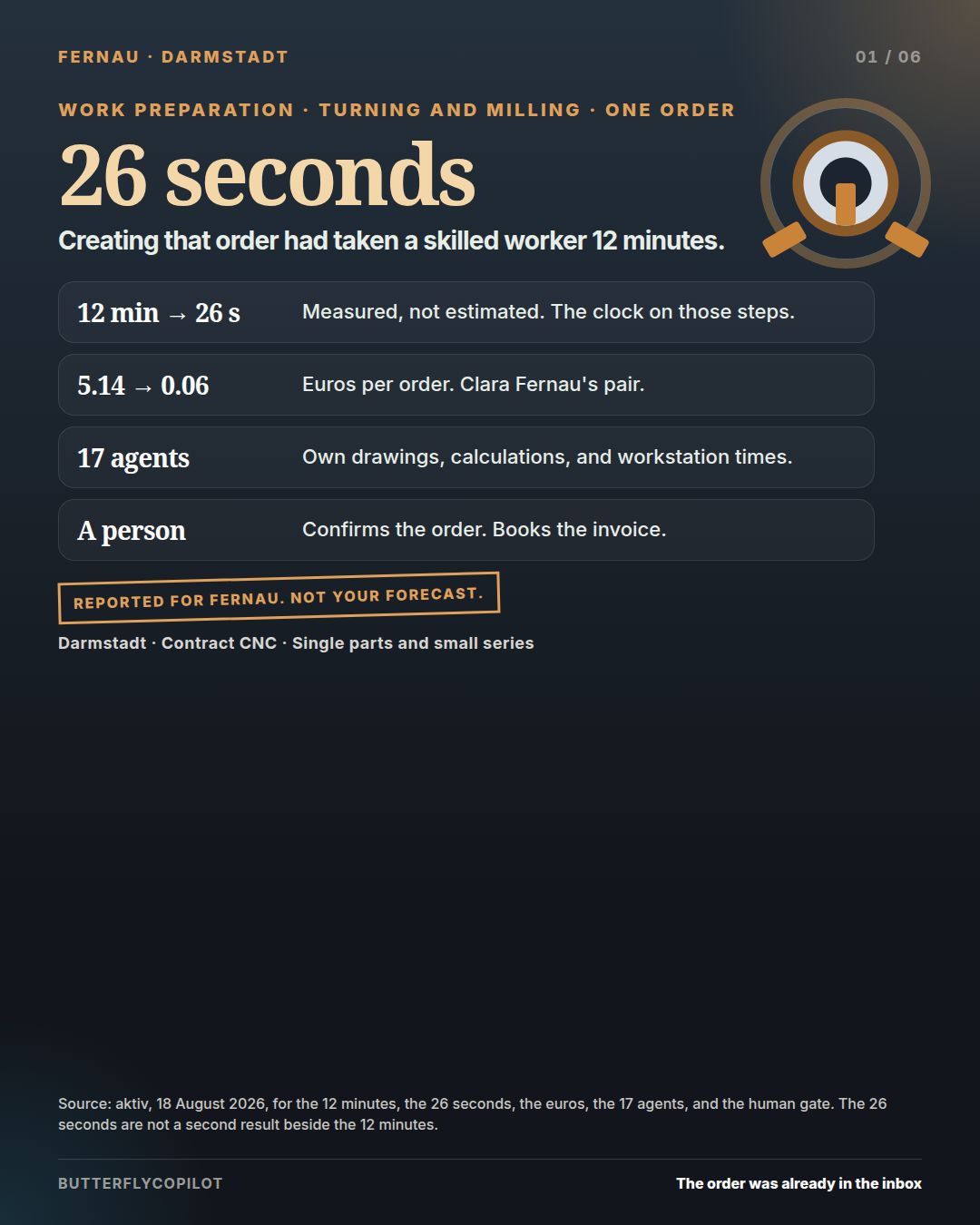
Creating one order took a skilled worker 12 minutes. Those steps come back in 26 seconds, and confirming the order still does not leave the person.
ButterflyCopilot
0106
The order was already in the inbox.
Fernau Präzisionstechnik is a contract shop in Darmstadt. CNC turning and milling, single parts and small series. Lars Zimmermann runs it with Clara Fernau and Theodor Fernau. The company site puts the founding year at 1995 and the machine list at 11. Eleven is a count of machines. No headcount is published. That is the useful part. This is a small shop, the kind of shop an SME owner can actually compare with their own, not a group with a separate digital division.
Creating one order in work preparation took a skilled worker 12 minutes. Search the data. Type it. Check it. Correct it. Reconcile the duplicate entry. Zimmermann measured that. He did not estimate it, and then he changed it. At about 1,200 orders a year, the company puts the total at 75 working days.
What they stood up
He built an AI-supported ERP. The core is a network of 17 AI agents that take on the work-preparation tasks themselves.
An order arrives by email. It is recognised, classified, and read into the system. The agents reconcile the master data, generate the production order, and check capacity. Those steps now take 26 seconds.
Clara Fernau puts the cost of one order at 5.14 euros before and 6 cents after. The people who used to type the order have that time for other work. She does not say how many people. This page does not invent the number.
The module is not trained on an industry average. It is trained on Fernau's own production: almost 3,000 technical drawings from 15 years, linked to the historical calculations and to the production times on each workstation.
Booking an invoice, or confirming an order, still goes to a person.
"Die KI darf vorbereiten, aber die Entscheidungen trifft der Mensch."
AI may prepare. People make the decisions.
A customer order arrives by email
        ↓
Recognised, classified, read into the system
        ↓
Master data reconciled, against this shop's own rows
        ↓
A production order, then a capacity check
        ↓
A person confirms the order. A person books the invoice
The same clocks show up again on his auditor profile and in a Hessenmetall interview: 12 minutes to 26 seconds, and 5.14 euros to 6 cents, measured rather than estimated. The profile also prints a 99 percent drop in process cost, and its own "roughly 75 days." Those are that page's words. This page does not divide 6 cents by 5.14 euros, and it does not merge the two 75s into one equation.
A time the table does not hold is not a time
Speed is how a tidy agent types a setup the shop never recorded, borrows an industry average so the draft can leave, mints a part number for a drawing it cannot find, merges a duplicate because the PO looks familiar, or confirms the order nobody accepted.
The file for a smaller job shop keeps the shape and drops the plant. One family. Turned shafts, if that is the work. The drawing index, the calculation ids, and the workstation times the shop will actually defend, in a spreadsheet when that is where they live. The model may copy the purchase order, the drawing number, and the quantity the email already states. It may not invent a revision, a routing, or a second. A German date written as 20.11.2026 stays a question. It does not become an ISO date the message never contained.
The times are integer seconds, setup once plus run per piece, from a row marked as the shop's own history. On the fixture, a shaft with a 1,080-second setup and 45 seconds a piece, quantity 25, plus a milling operation, comes out at 2,205 seconds of turning and 1,350 seconds of milling. Those seconds are fixture rows. They are not a Fernau routing, and they are not a published standard time. A second row that says "industry average" does not get a turn. Two own-history rows do not get averaged.
Capacity is the exported calendar inside the due date, or it is unknown. The code does not fill an eight-hour day to be helpful. A shortfall is shown to the planner. Nothing else on the board is moved.
The release is a person. CIMC Tianda kept the minutes in the standards and the release on a team leader. This desk keeps the seconds in the shop's own time rows and the confirmation on the planner. The import is a file. erp_posted stays no. The confirmation is a file. Sent stays no. The invoice is not prepared here at all. Booking it was named as a high-risk action. A draft that looks ready to post would be the wrong kind of preparation.
Their ERP, and any send, are a later choice. Version 1 reads text the company already has. It writes a production-order draft.
The website is a side effect, not this desk. Zimmermann rebuilt fernau-gmbh.de and der-ki-auditor.de for ordinary search and for AI search. Inbound enquiries on the company site went from zero to more than 30 a month, many from abroad. He has since qualified as an auditor, including PECB certificates for ISO/IEC 42001 and ISO/IEC 27001. Useful, and not a step in the order pipeline. The file does not build a search agent, and it does not treat the enquiry count as a result of the 26 seconds.
What a smaller shop should steal
If an order still starts with someone retyping the email into the ERP, the first month is one part family and twenty orders a person already finished.
Fernau is the right size of example for that month. A small contract shop, eleven machines, single parts and small series. The lesson is not "hire a digital unit." The lesson is that the rows were already in the building: the drawings, the old calculations, the time each workstation had actually taken. The agents prepared. A person still decided.
One family
        ↓
Twenty past orders, with the hand times stored, and a stopwatch on the seconds a person already spends
        ↓
Thirty days where the draft sits beside that hand order, and nothing is released
        ↓
Thirty days where the planner may release, and the import stays on disk
        ↓
The customer confirmation still leaves from a person. The next family waits for its own twenty.
Time the stretch you already have. Seconds from the email in hand to a draft. Seconds a person still spends checking it. Keep those two clocks apart. Cost per order, from the wage you actually pay and the seconds you actually measured. How many of the old orders still match after a time change. How many orders the planner edits, and how many they kill. How many duplicates the desk caught instead of merging. How many items, times, confirmations, or invoices this agent created. Those last counts stay at zero.
The move from 12 minutes to 26 seconds, and from 5.14 euros to 6 cents, is Fernau's published story. It is not a line for a proposal. The 75 working days are the total the company puts on its own year. Do not recompute them, and do not paste them onto yours.
What the instruction file will make an agent do
The file below is the brief. It is not their ERP, and it is not their training run. None of that schema is public. The blanks are yours. The article names no model. A parser slot can point at one, or at none, if the email fields are already in the sheet. That choice is a recommendation. It is not a finding about a second system inside Fernau.
It will make the agent:
- Refuse to run while a
REPLACEline is empty, or while anEXAMPLErow is still in a live sheet. - Read an email in German or English. Refuse to turn 20.11.2026 into an ISO date. Refuse to read a drawing it was not given as text.
- Classify. An invoice is not booked. A quote with no purchase order is not a production order. A change to an order that is already released is held, not edited.
- Match a customer, a drawing, and a revision to the masters. An unknown drawing does not become a new item. Two active revisions do not get a guess. A grade the email names, when it fights the master, does not overwrite the master.
- Time from the shop's own rows with the integer formula in the file. The fixture's shaft comes out at 2,205 seconds of turning and 1,350 seconds of milling, 3,555 together, on a quantity of 25. A row marked industry average comes out with no time at all.
- Check capacity on the exported calendar inside the due date. Quantity 25 on the fixture is short by 405 seconds. Quantity 16 lands exactly on the remaining seconds and is not short. A missing day is not filled with eight hours.
- Ask only the missing fields, in a fixed order. Only the planner may fill them. A field named touch time is refused on that form.
- Re-run every stored hand order after a time change. Moving the turning setup fails go-live and leaves the golden at 2,205 seconds.
- Release only from the form, only by the planner, with a reason long enough to read. Write an import file only after that release and the later flag. Leave the ERP-posted flag at no. Accept only after release, write the confirmation to disk, and leave the sent flag at no. Booking an invoice is refused even for the planner.
- Write a morning file from this shop's own counts: time per order, cost per order, and the zeros. No comparison with the case study.
The tests are in the file. The shaft at 3,555 seconds, with the turning shortfall at 405. A blank quantity that is not stored as zero. A drawing named D-9999 that does not become a new item. An industry-average time that does not become a setup. A German order, with no model in the loop, at 1,260 and 720 seconds. A regression that stays red when the setup changes. An import that reads the two operations and does not contain a secret buried in the drawing file. If the agent clears any of those by copying an old time, averaging two rows, emailing the customer, or booking the invoice, the test fails.
The instruction file
The brief has the role, the tables a spreadsheet or a typical ERP export can hold, the six agents, the prompts, the time contract, the capacity window, the questions for the planner, the release and the acceptance, the duplicate rules, the regression set, the ninety days, and the tests that decide when an order may be shown.
Replace every REPLACE line. Delete every EXAMPLE row. Let it sit beside one family's orders for a month a person still types by hand, before anyone treats a file as a production order the floor has already been given.
Sources
The 12 minutes, the 26 seconds, the 5.14 euros, the 6 cents, the 17 agents, the email steps, the own-data corpus, the human gate, and the website enquiries are from aktiv's report of 18 August 2026. The profile and the Hessenmetall interview repeat the clocks and name the certificates. The company site is the address, the founding year, the machine count, and ISO 9001:2015. The figures are as those pages report them. They are not an independent audit, and they are not a forecast for another shop. 12 minutes and 26 seconds are one change, described as order creation, order capture, and as the named agent steps. This page does not turn them into a ratio. 5.14 euros and 6 cents are Clara Fernau's pair. The profile's 99 percent is that page's sentence. This page does not divide the cents to check it. Exactly 75 working days at 1,200 orders, and roughly 75 days a year per skilled worker, are two presentations. This page does not recompute either one, and it does not average them. Zero website enquiries and "practically zero" are two presentations of the before. This page uses the article's zero.
- aktiv, Maja Becker-Mohr, "Fernau Präzisionstechnik senkt Kosten dank Digitalisierung drastisch," 18 August 2026. Fernau Präzisionstechnik in Darmstadt. Lars Zimmermann runs the shop with Clara Fernau and Theodor Fernau. Contract CNC turning and milling of single parts and small series. Creating one order in work preparation took a skilled worker 12 minutes: searching data, typing, checking, correcting, reconciling duplicate entries. At 1,200 orders a year, exactly 75 working days. Zimmermann: "Ich habe das nicht geschätzt, sondern gemessen – und dann geändert." An AI-supported ERP whose core is a network of 17 AI agents that autonomously handle work-preparation tasks. Incoming customer orders by email are recognised, classified, and read in. The agents reconcile master data, generate production orders, and check capacities. Those steps take 26 seconds. Clara Fernau: cost per order from 5.14 euros to 6 cents, and staff can use the time for other tasks. The AI module is trained on the shop's own data, not industry averages: almost 3,000 technical drawings from 15 years of production, linked to historical calculations and production times per workstation. High-risk actions, booking invoices or confirming orders, always go to a person. Photo caption: "Die KI darf vorbereiten, aber die Entscheidungen trifft der Mensch." Body: "KI darf vorbereiten, Entscheidungen trifft ausschließlich der Mensch." He rebuilt der-ki-auditor.de and fernau-gmbh.de himself, aimed at search engines and AI search tools. Website enquiries from zero to more than 30 a month, many from abroad. He is a certified AI auditor and AI implementer and audits companies across Europe. He says vendors do not know a company's processes, so the responsibility stays with the company. The same article summarizes an IW Consult study, including a figure of about 40 percent of companies using AI. That study is not this case, and this page does not use it.
- Lars Zimmermann, "Über mich." PECB-certified ISO/IEC 42001 Senior Lead Auditor and Senior Lead Implementer, and ISO/IEC 27001 Lead Auditor and Lead Implementer, Darmstadt. At FERNAU, an AI-supported ERP with 17 autonomous agents that he developed. Order creation from twelve minutes to 26 seconds, process cost per transaction down 99 percent, "rund 75 Tage pro Jahr und Fachkraft," measured in the running shop, not estimated. The profile also names predictive maintenance, a shop-floor knowledge bot, and a restructuring result from −8,800 euros to +71,000 euros covering ISO 9001, the AI-ERP, and lean. This page does not use those as results of the work-preparation clock. Website wording on that page: practically zero enquiries before, more than 30 a month after, including from abroad, built without an agency. Clara Fernau, owner and managing director. Theodor Fernau, founder and senior managing director. Lars Zimmermann, operational managing director. Address: FERNAU Präzisionstechnik GmbH, Merianstraße 5a, 64291 Darmstadt. "Der KI-Auditor" is a brand of the GmbH.
- Hessenmetall, "Vier Fragen an: DER KI-AUDITOR." Lars Zimmermann, founder of DER KI-AUDITOR and managing director of FERNAU Präzisionstechnik GmbH. He rebuilt the ERP with AI in the running shop, detours included. Order capture takes 26 seconds instead of 12 minutes. Process cost per transaction is 6 cents instead of 5.14 euros. Both measured, not estimated. He says he is open about mistakes, money burned, and what did not work, and he does not list those failures on the page. Certificates named: ISO/IEC 42001 Senior Lead Auditor and Senior Lead Implementer, ISO/IEC 27001 Lead Auditor and Lead Implementer, IHK AI manager. The interview's sparring format, and the consultant fees he mentions there, are not this order desk.
- FERNAU Präzisionstechnik GmbH, fernau-gmbh.de. Darmstadt, Merianstraße 5a, 64291 Darmstadt. Founded 1995. CNC turning and milling, single parts and small series. The page prints 11 machines. ISO 9001:2015. Eleven is a machine count, not a headcount, and not a result of the agents.