
How HD Hyundai Robotics Cut Robot Troubleshooting Time with AI Agents
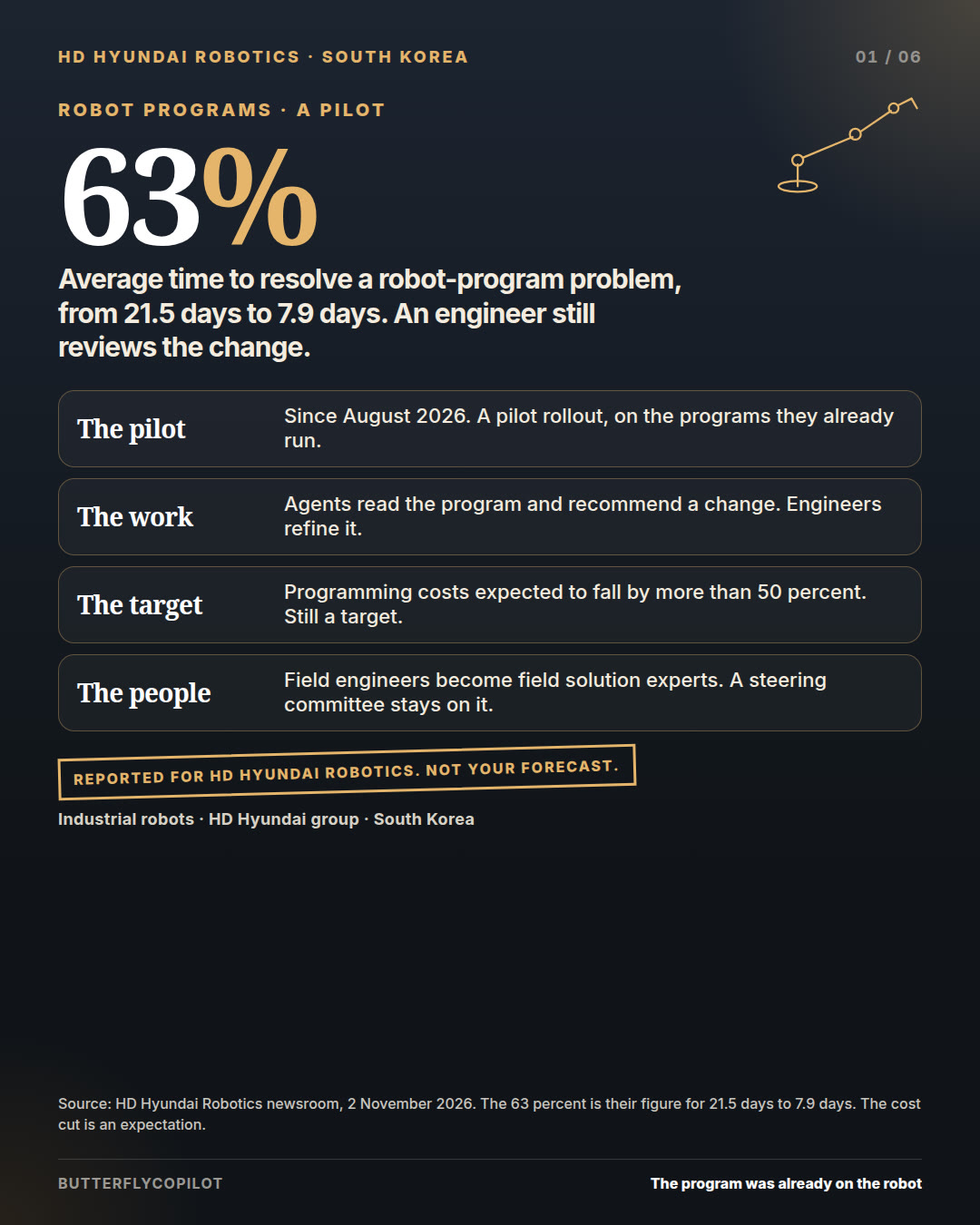
The program was already on the robot. An experienced engineer was still watching the motion and editing the sequence by hand. In a pilot that started in August 2026, the average time to resolve a robot-program problem fell from 21.5 days to 7.9 days, and an engineer still reviews the change.
ButterflyCopilot
0106
The program was already on the robot. Someone was still rewriting it by watching.
HD Hyundai Robotics builds industrial robots under HD Hyundai. The work in this story is not a new arm. It is the program already running on one: the sequence, the path, and the speed.
When a program underperformed, an experienced field engineer went to the cell, watched the motion, and adjusted those three by hand, again and again. The result depended on who was standing there. It was hard to standardize, and hard to hand to the next person. The ticket sat open while the adjustments accumulated. On the numbers the company later published, that stretch averaged 21.5 days.
What they stood up
They built the agents with Palantir. The workflow they describe puts three things in one loop: the agent, a simulation, and the engineer.
The agent reads the robot program that is already running. It analyzes that program and recommends a change. The engineer reviews the recommendation and refines it from field experience, the part of the job the file does not have. The change goes back to the cell after that review.
A robot program is already running
        ↓
The agent reads it and recommends a change
        ↓
The engineer reviews the recommendation and refines it
        ↓
The program changes after that review
The boxes are the instruction file. They follow the shape the company described. They are not a reconstruction of HD Hyundai Robotics' screens, and they are not Palantir's project plan.
A pilot rollout started in August 2026. From then to the announcement, the average time to resolve robot-program problems fell from 21.5 days to 7.9 days, about 63 percent. The company expects robot programming costs to fall by more than 50 percent. The time is the result they measured. The cost cut is the result they expect. Those are different sentences, and this page keeps them apart.
Ahn Seong-hwan, executive vice president and chief technology officer, presented the work in a keynote at Palantir's Sovereignty Bootcamp in New York. The company published the account on 1–2 November 2026. The bootcamp, launched in July 2026 and then in its third edition, is about using AI while protecting the data and the business information a company does not want to give away. About 450 executives from more than 250 organizations have been through it.
The same plan changes the job of the person at the cell. Field engineers are to move past programming, installation, and commissioning, and past the basic programming and the test runs, into what the company calls field solution experts: people who define the on-site problem and use AI to work it. The two companies will hold regular steering-committee meetings of their senior executives to choose what that work is.
Ahn's line on the direction, from the account of the keynote: "We plan to identify ways to address challenges on the ground more quickly and effectively while expanding the scope of our physical AI solutions business."
A tidy sequence is not a program the cell has run
Speed is how a plant with an empty archive expects 7.9 days in the first month. Speed is how a confident agent loads a revised sequence because someone else's pilot hit 63 percent. Speed is how a cause that has never been logged becomes the cause, because the sentence was fluent.
The file below keeps the shape and drops the company. One site. One cell, a robot cell or a CNC. The programs, the alarms, the cycle times, and the old fixes are the plant's. The agent may replay an edit a closed fix already made, when the current line still matches the line that fix started from. It may name a cause only when that fix used it. It may check the proposal against points and limits the plant typed. It may not open a socket. The engineer approves. When a later gate allows a file at all, the first line of that file says it is for the engineer to load.
On the fixture, which is ours, a made-up job has a fast move at sequence 20. A past fix slowed that move from 80 to 35. The current revision put the 80 back, and added a wait at sequence 50. The proposal slows sequence 20 again and leaves the wait where it is. A cause called servo fault sits on the list so a guess has a name, and the proposal does not contain it. A G-code line that drives Z below the envelope fails the check and stops. Those rows exist so a builder can test the replay and the refusals. They are not an HD Hyundai Robotics program, and they are not a motion anyone should run.
Linamar is the manual on this site: the page in the book while the robot is down, and a technician still on the step. This desk is the program itself. The 63 percent on this page does not belong on that one. The 70 percent on that page does not belong on this one.
The useful caution is the archive. A result like the one in the pilot sits on programs, fixes, and outcomes that already exist in a form an agent can compare. A plant that opens an empty folder will not get that result in the first month. The file spends that month logging. The log is the work.
What a smaller plant should steal
If an engineer is still at the cell, watching a motion and editing a sequence by hand, the first month is one cell and the fixes you already make.
The useful part of HD Hyundai Robotics' story is the split, not the clock. Let the agent read the program you already have. Let it recommend a change from fixes you have already logged. Keep the engineer on the review, including after the tests pass. Keep the controller off the machine that runs the agent. Give the first thirty days to the log: the program before, the program after, the cause, the days, the hours, and whether the first fix held. A proposal that arrives before that log is a guess with a confident tone.
One cell
        ↓
Thirty days of logged fixes, and no proposal
        ↓
Thirty days where the proposal sits beside the revision the engineer still ships
        ↓
Thirty days where a passed check may become a file the engineer loads
        ↓
The next cell waits for its own programs
Time the stretch you already have. Days from the ticket to a fix a person will sign. The fraction of those fixes that held the first time, written as a count over a count. Engineer hours on the tickets. How many proposals the engineer rewrote. How many exports left the folder. How many times this agent wrote to a controller. That last count stays at zero.
HD Hyundai Robotics' scoreboard is not your forecast. 21.5 days, 7.9 days, about 63 percent, an expected programming-cost cut of more than 50 percent, a pilot since August 2026, and a keynote in New York on 1–2 November 2026 are this company's published story. Measure your own days. Do not paste their 63 into a threshold, and do not put 7.9 days on a proposal as a promise. Do not book the 50 percent. They have not booked it either.
What the instruction file will make an agent do
The file below is the brief. It is not Palantir, and it is not HD Hyundai Robotics' program store. None of that schema is public. The blanks are yours. The same proposal works as files an engineer can open, and later as a text file a person loads at the cell.
It will make the agent:
- Refuse to run while a
REPLACEline is empty, while anEXAMPLErow is still in a live folder, or while anyone has typed 21.5, 7.9, 63 percent, or 50 percent into the config. - Take one site and one cell, robot or CNC. A second cell stops.
- Read program text in a small grammar: a sequence, a move or a wait, a point or a signal, and a speed, or a G-code subset with integer words. A vendor binary is the parser's problem, before this folder exists.
- File a small history: cell, part, program, issue, fix, outcome, plus alarms, cycle times, and a change that ties a fix to a before and an after.
- Stay in logging until the plant says otherwise. In that mode an open ticket can show similar old fixes, and it cannot produce a proposal.
- Refuse to propose when the cell has fewer closed fixes than the floor the plant typed. The suggestion is 8. The published pilot is not a reason to set the floor to zero.
- Score similar closed fixes from the alarm, the part, and the words. Replay one applicable edit. Keep a line the fix did not touch. Name only the cause that fix already used.
- Check the proposal against the envelope, the points, and the max speed or the max feed. A failed check cannot be approved. A skipped check can sit in shadow, and it cannot be exported.
- Leave
approvedfalse until the engineer's token checks. Leavecontroller_writtenfalse on every object. There is no deploy tool. The export, when the gate allows one, begins with the wordsFOR_ENGINEER_LOAD. - Write a morning file and a KPI file from this plant's own counts: days to resolve, first-time-fix as a fraction, engineer hours. No comparison with the case study.
The tests are in the file. The hashes of the retrieval, the diff, the proposal, the approval, the morning file, and the KPI file are locked. Sequence 50 survives. The servo-fault cause does not appear. A G-code line below the envelope fails. An export in shadow writes nothing. If the agent clears any of those by inventing a line, naming a cause the history does not hold, or opening a path to a controller, the test fails.
The instruction file
The brief has the role, the four actors, the tool schemas, the object files, the line grammar, the retrieval score, the diff, the replay, the offline check, the approval token, the golden set, the go-live gate, the audit log, the ninety days, the three KPIs, the cost caps, and the tests that decide when a file may be offered to an engineer to load.
Replace every REPLACE line. Delete every EXAMPLE row. Let it sit beside one cell for a month while a person still logs the fixes by hand, before anyone treats a file as a program the machine has already run.
Sources
The company, the pilot, the workflow, the quotes, and the figures are from the pages below. The figures are as those pages report them. They are not an independent audit, and they are not a forecast for another plant.
This page uses the company newsroom for the workflow, the 21.5 days, the 7.9 days, the approximately 63 percent, the expected cost cut of more than 50 percent, the field-solution-expert plan, the steering committee, Ahn Seong-hwan's title, and the August introduction. It uses Seoul Economic Daily for the words "pilot rollout," and for the shift away from basic programming and test runs. It uses The Korea Herald for Ahn's quoted sentence. It does not treat "more than 50 percent" as a saving already taken. It does not treat the pilot as a finished deployment across a fleet. Where a later article calls the same work production rather than a pilot, this page follows the pilot wording.
The newsroom says the company announced the keynote on 2 November 2026. Seoul Economic Daily says the company said it on 1 November 2026. This page says the account was published on 1–2 November 2026. Seoul Economic Daily romanizes the CTO as Ahn Sung-hwan and describes the title as executive director. This page uses the newsroom's Ahn Seong-hwan, executive vice president and chief technology officer.
The Robotics Media account says the agents flag likely causes of underperformance and propose revised sequences, which engineers refine before the update is used. That is the same workflow the newsroom describes as analyzing the program and recommending an improvement. This page does not treat the more specific verbs as a published schema. The cause codes and the line replay in the instruction file are our design for that shape.
Tech Times names Palantir's Artificial Intelligence Platform, Foundry, and Ontology, and says a result of this kind depends on historical program data already structured, so a first-time adopter without that history will not reproduce it immediately. The company newsroom does not print those product names, and it does not print a year-count of archived programs. This page does not install that platform. The instruction file's first thirty days of logging are our reading of the warning. Tech Times also prints industry figures and a group history, including a share of cell cost, a global programming-cost estimate, a Davos meeting, a shipbuilding rate, a controller, and an investment. Those are not facts of this pilot, and this page does not use them. Tech Times also says the work is operating in production rather than a pilot. Seoul Economic Daily says pilot. This page says pilot.
- HD Hyundai Robotics, "HD Hyundai Robotics CTO Delivers Keynote Address at Palantir's Sovereignty Bootcamp," 2 November 2026. A robotics solutions provider under HD Hyundai. Ahn Seong-hwan, executive vice president and CTO, keynoted Palantir's Sovereignty Bootcamp in New York. The bootcamp, launched in July 2026, was in its third edition, with about 450 executives from more than 250 organizations, on protecting data and critical business information while using AI. Experienced engineers had manually monitored robot movements on site and repeatedly adjusted work sequences, movement paths, and operating speeds, an experience-dependent process that was hard to standardize and replicate. The companies are integrating AI, simulation, and human engineering expertise. AI agents analyze existing robot programs and generate recommendations. Engineers review and refine them from field experience. Field engineers are to become "field solution experts" beyond programming, installation, and commissioning. Programming costs are expected to fall by more than 50 percent. Since the agents were introduced into problem-solving in August, average time to resolve issues fell from 21.5 days to 7.9 days, approximately 63 percent. Regular steering-committee meetings of key executives are planned.
- Lim Ye-jin, The Korea Herald, "HD Hyundai Robotics cuts troubleshooting time 63% with Palantir AI," 1 November 2026. The South Korean firm, the 63 percent, 21.5 days to 7.9 days since the August deployment, and the expectation of cutting robot programming costs by more than 50 percent. Agents analyze existing programs and suggest improvements. Engineers review and refine them. Roles expand beyond programming and installation. Senior executives will hold regular steering-committee meetings. Palantir chief revenue officer Ryan Taylor pledged support for expansion using Palantir's AI platform. The article does not print a direct quote from Taylor. Ahn: "We plan to identify ways to address challenges on the ground more quickly and effectively while expanding the scope of our physical AI solutions business."
- Yoo Hyun-wook, Seoul Economic Daily, "HD Hyundai Robotics Cuts Problem-Solving Time by 63% With Palantir AI," 1 November 2026. A pilot rollout of the AI agent began in August. Average time to resolve robot-program problems fell to 7.9 days from 21.5 days. The company expects robot programming costs to fall by more than 50 percent. Field engineers are to move away from basic programming and test runs toward experts who define on-site problems and devise solutions. Regular steering-committee meetings of senior executives. Ahn: "We are expanding cooperation with global companies to advance our physical AI capabilities. We plan to identify tasks that allow us to solve on-site problems more quickly and effectively, and to broaden the scope of our physical AI solutions business."
- Kaan Tınmaz, The Robotics Media, "HD Hyundai Robotics Cuts Robot Troubleshooting Time 63% With Palantir AI Agents," 1 November 2026, updated 11 November 2026. The same 21.5 to 7.9 days and the same cost expectation. Agents introduced in August 2026 analyze an existing program, flag likely causes of underperformance, and propose revised sequences. Engineers review and refine them before the update is used. The article names Palantir's AIP platform. It attributes the cost sentence to The Korea Times as well. The company newsroom already states the expectation, so this page does not depend on that attribution. "Nearly three weeks," "roughly eight days," and "a single quarter" are this article's gloss of 21.5, 7.9, and the August-to-November span. This page uses the published numbers, not the gloss.
- Brandon Fisher, Tech Times, "AI Agents Cut Industrial Robot Programming 63%: HD Hyundai, Palantir Compress 21-Day Cycle," 2 November 2026. The same 21.5 to 7.9 days and the same cost target. This is the page that names AIP, Foundry, and the Ontology, and that states the historical-data caveat this instruction file teaches. It is also the page whose production-versus-pilot sentence this page does not follow, and whose industry figures and group history this page does not use.