
How Linamar Cut Machine Troubleshooting Time with AI Agents
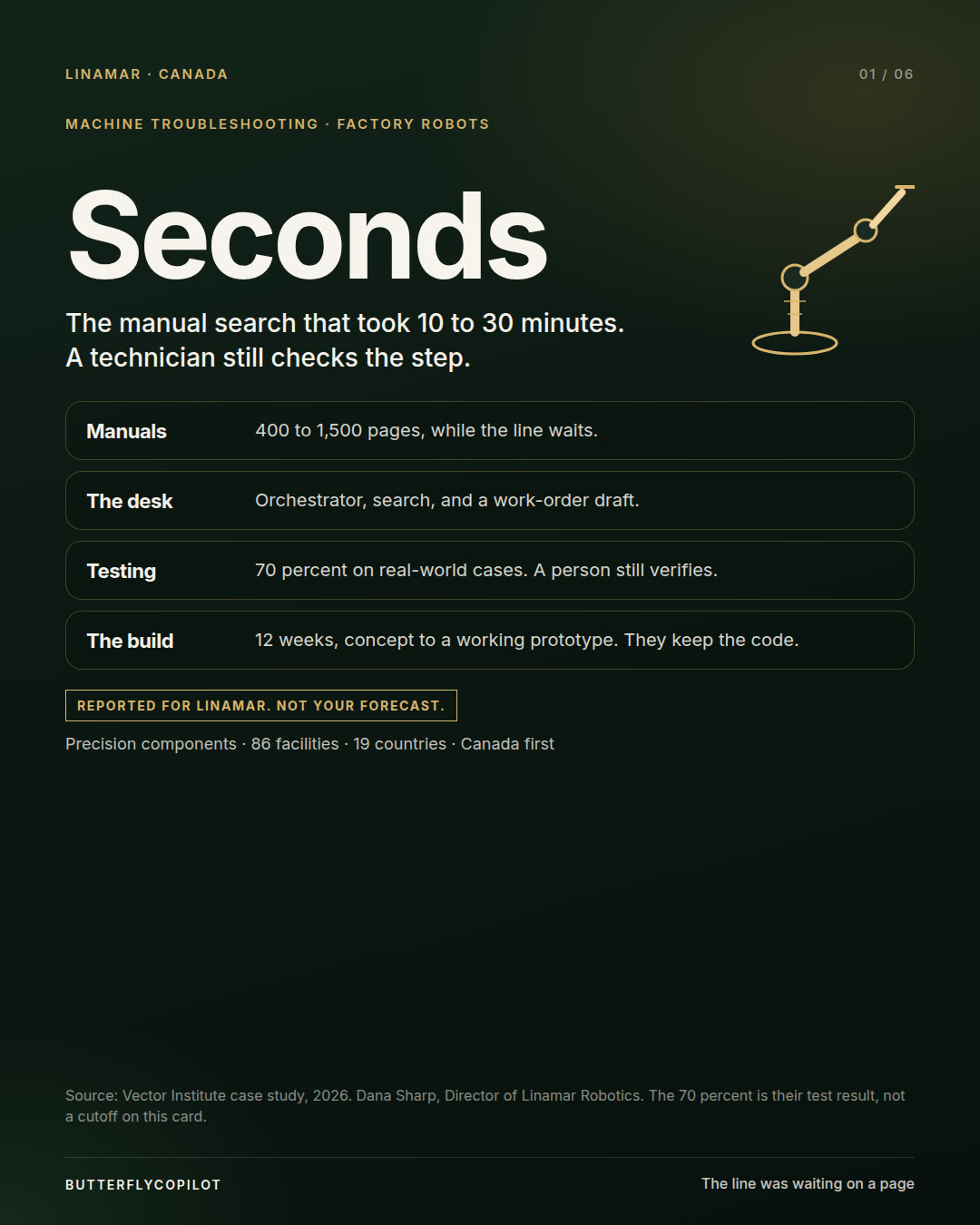
The robot was stopped. The technician was still in a manual of 400 to 1,500 pages. The search that took 10 to 30 minutes now comes back in seconds, with the page attached, and a person still checks the step.
ButterflyCopilot
0106
The line was already waiting. The technician was still looking for the page.
Linamar makes precision-machined components, modules, and systems for automotive powertrains and industrial equipment. Eighty-six facilities. Nineteen countries. The build in this story starts at home, in Canada, on the factory robots. The MVP the team stood up in the bootcamp is for the ABB robots those technicians troubleshoot and maintain.
When one of those robots stops, the fix is somewhere in a manual. The manuals run from 400 pages to 1,500. Finding the page takes 10 to 30 minutes. Unplanned downtime is the expensive kind, the kind where the line is up on the schedule and down on the floor, and the person who can start it is still turning pages. The work order gets typed after the search, in the tracking system the plant already has. A quality audit later wants to know which page the step came from.
Dana Sharp, Director of Linamar Robotics, put the sequence in the order they actually used. They validated the use case with a low-code proof of concept. Then a team joined Vector Institute's Agentic AI Bootcamp to build the capability inside the company, with Vector's researchers alongside them from June to September 2025. Twelve weeks from concept to a working prototype. The code, the intellectual property, and the knowledge to extend it stay with Linamar.
Sharp's line on why they bothered to own it: the focus is flexible architectures, and understanding the agent mechanics, so the same engineering can move to the next problem on the floor. A rented black box would have left with the vendor.
What they stood up
The system is three jobs, with an orchestrator holding the list. The search agent queries the equipment manuals with hybrid search. The work-order agent writes the maintenance record in the format the existing tracking system already accepts. The whole thing sits against the ERP environment they already run, and it keeps a trail a quality audit can follow. The team evaluated more than one model. Gemini 2.5 Pro took the complex reasoning. Gemini 2.5 Flash took the faster, cheaper tasks.
Mackenzie Kuntz, Data Science and AI Specialist at Linamar, credited the practical engineering support from Vector. That support was the difference between understanding the AI in theory and deploying it.
The shape is the part worth stealing. One actor accepts the fault and refuses an asset that is not on the list. A second actor searches one manual. A third actor drafts the record from what the search returned. Nobody in that chain is a general assistant with the keys to the cell.
The asset is on the list, and the manual is the one named for that family
        ↓
Hybrid search, inside that manual, with the fault code intact
        ↓
Every step quotes the page it came from
        ↓
The work order is a draft in the shape the tracking sheet already has
        ↓
A technician confirms before anything is released
The boxes are the instruction file. They follow the shape the story describes. They are not a reconstruction of Linamar's screens, and they are not Linamar's project plan.
Seconds, and a test score of 70 percent
Twelve weeks from concept to a working prototype. Troubleshooting that took 10 to 30 minutes of searching now surfaces in seconds. The technician gets the steps, and a direct link to the section of the manual those steps came from.
During testing, the system reached 70 percent accuracy on real-world cases. A result of 70 percent means a person still checks the step. The case does not describe an unattended release, and a maintenance instruction is a bad place to invent one. The prototype is the start of an architecture they can extend to other equipment. It is the work they are proving in Canada before they judge what belongs in the other facilities. Eighty-six sites is the footprint of the company. It is not a count of sites already on the agent.
What comes next, in Sharp's account, is the same mechanics on other high-value problems on the floor. Same ownership. The code stays in the building.
A nearby page is not the procedure
Speed is how a page about a different fault becomes the answer because both pages say "the cell." Speed is how last year's work order, the one that says to spray solvent on the arm, becomes today's step because the fault code matches. Speed is how a published 70 percent becomes permission to skip the technician.
The file below keeps the shape and drops the plant. One site. One asset family. One manual, stored as a page a person can open. The fault code on the pendant has to be the fault code on the page. The quote has to be the whole step line, the line that starts with "Step" and a number. A past work order can be listed so the technician remembers the job. It cannot supply a sentence the manual does not contain. The draft stays unreleased until the technician signs. The sheet, on the day it is allowed to receive a row, receives a draft. It does not receive a closed job.
On the fixture, which is ours, fault E-204 cites page 12 of a made-up manual: lock out the cell, then check connector X13. Page 40 is a gripper fault and stays a gripper fault. Page 7 says "lock out the cell" and is a safety note, so it is not a procedure. An old work order that says to spray the arm with solvent is in the history file, and the draft does not contain the word solvent. Those rows exist so a builder can test the ranker and the refusals. They are not a Linamar manual, and they are not a step anyone should run on a robot.
Wolfspeed is the shift report on this site: the tool's condition, and the notes the last shift already wrote. This desk is the manual on the robot that just stopped. The 70 percent on this page does not belong on that one.
What a smaller plant should steal
If the technician is still walking a binder while the cell is down, the first month is one asset family and the pages you already trust.
The useful part of Linamar's story is the decision, not the clock. Prove the use case in something small before you staff a build. Then build it so the code stays with you. Give the orchestrator the asset list and nothing else. Give the search agent one manual. Give the work-order agent the citations, and a sheet whose columns you can point at a CMMS when you are ready. Make every step quote a page. Make the technician confirm before a record is released. Label a golden set while you are looking at the page, and let the maintenance lead type the pass rate. Leave the published 70 percent in the case study. A second family, and a second site, wait until the first manual is boring.
One site, one asset family
        ↓
The manual as page files a person can open
        ↓
Thirty days where the draft sits beside the search, and nothing is released
        ↓
A golden set the technician labeled from the page
        ↓
The lead types the pass rate. The technician still signs each draft
        ↓
The next family waits for its own manual
Time the stretch you already have. Minutes from the stop to the page. How many steps a technician rewrote after the draft. How many quotes were not on the cited page. How many releases went out with no signature. How many work orders were written while the gate was shut. How many manuals outside the family got opened. Those last three stay at zero.
Linamar's scoreboard is not your forecast. Ten to thirty minutes in the manual, an answer in seconds, 70 percent accuracy on real-world cases during testing, twelve weeks from concept to a working prototype, 86 facilities across 19 countries, and a first build in Canada are this company's published story. The at-a-glance wording, "up to 30 minutes" and "built and deployed in 12 weeks," is the summary of those same sentences. Measure your own minutes. Do not paste their clock onto a proposal, and do not turn 70 percent into a go-live bar the source never printed.
What the instruction file will make an agent do
The file below is the brief. It is not Linamar's repository, and it is not Vector's bootcamp code. None of that schema is public. The blanks are yours. The same draft works as a spreadsheet the maintenance lead can open, and later as a row in whatever CMMS already holds the plant's work orders.
It will make the agent:
- Refuse to run while a
REPLACEline is empty, while anEXAMPLErow is still in a live folder, or while anyone has typed 70 percent into the go-live rate. - Take one site and one asset family. An asset off the list stops. A second family stops.
- Chunk the manual as one printed page per file. Rank with a keyword score the tests can lock. Keep vectors off until the golden set exists. A fault code on the incident has to be the fault code on the winning page.
- Quote full step lines only. A sentence from a past work order, including the fixture's "spray the arm with solvent," never becomes a step.
- Draft a work order whose columns map to a generic CMMS sheet. Status stays
DRAFT.releasedstays false until the technician's token checks. - Keep the CMMS write on the runner. A model that says "release it" is ignored. There is no path where the technician's confirmation is turned off.
- Score a golden set the technician labeled, with a pass rate the lead types. The suggestion in the file is 0.95 on at least 30 labeled cases. The published 70 percent is refused if someone pastes it in.
- Write an audit line for the search, the page, the quote, and the person who approved. Write a morning file from this plant's own counts. No comparison with the case study.
The tests are in the file. The hash of the fixture draft is locked. A quote that is not the whole step line fails. A release with no signature fails. A CMMS row written with the gate shut fails. If the agent clears any of those by borrowing page 40, copying the old work order, or skipping the technician, the test fails.
The instruction file
The brief has the role, the three actors, the tool schemas, the page-file rules, the hybrid rank, the citation rules, the work-order columns, the approval token, the golden set, the go-live gate, the audit log, the ninety days, the cost caps, and the tests that decide when a draft may be treated as a record the sheet has accepted.
Replace every REPLACE line. Delete every EXAMPLE row. Let it sit beside one family's manual for a month a person still searches by hand, before anyone treats a file as a step the line has already run.
Sources
The company, the manuals, the bootcamp, the architecture, the quotes, and the figures are from the pages below. The figures are as those pages report them. They are not an independent audit, and they are not a forecast for another plant.
This page uses the body of the Vector case for the search time, "10 to 30 minutes," and for the span, "twelve weeks from concept to working prototype." The at-a-glance lines, "up to 30 minutes" and "built and deployed in 12 weeks," are that same story in the summary's wording. This page does not treat "deployed" as a second measurement, and it does not treat 86 facilities as the number of sites already running the agent. The case says the build begins with targeted domestic implementation in Canada. Seventy percent is the accuracy the case reports on real-world cases during testing. The case does not print the size of that test, the scoring rule, or an unattended release. The technician's signature in the instruction file is this page's design, because a 70 percent test result is not a warrant to release a step with no person looking. "Seconds" is their published clock for how fast the information now surfaces. It is not a latency budget. The phrase about the multi-million-dollar cost of unplanned downtime is the case's description of the cost class. It is not stored here as a Linamar loss.
- Vector Institute, "How Linamar built production-ready AI through Vector's Agentic AI Bootcamp," 2026. Linamar manufactures precision-machined components, modules, and systems for automotive powertrains and industrial equipment, and operates 86 facilities across 19 countries. The build starts with targeted domestic implementation in Canada. Technicians spent 10 to 30 minutes searching manuals of 400 to 1,500 pages during robot downtime. The at-a-glance summary says up to 30 minutes, and says the system was built and deployed in 12 weeks. The body says twelve weeks from concept to working prototype. A low-code proof of concept came first. From June to September 2025 the team worked with Vector researchers in the Agentic AI Bootcamp. Linamar retains the code, the intellectual property, and the in-house capability. An orchestrator coordinates sub-agents. A search agent uses hybrid search over the manuals. A work-order agent generates maintenance records for the existing tracking system. The system integrates with the ERP environment and keeps traceability for quality audits. The team evaluated multiple models and selected Gemini 2.5 Pro for complex reasoning and Gemini 2.5 Flash for faster, cost-effective tasks. During testing, 70 percent accuracy on real-world cases. Troubleshooting information now surfaces in seconds, with step-by-step instructions and direct links to the relevant manual sections. Dana Sharp, Director of Linamar Robotics: "After validating the use case through a low-code proof of concept, we had a team participate in Vector Institute's Agentic AI Bootcamp to intentionally build internal capability. This allowed us to move beyond experimentation and develop more robust, agentic solutions that scale to higher-impact operational use cases." And: "Our focus is on building flexible architectures rather than relying on black-box vendor solutions. Retaining the intellectual property and understanding the underlying agent mechanics allows us to apply these same engineering principles to other high-value problems across the manufacturing floor." Mackenzie Kuntz, Data Science and AI Specialist at Linamar: "Our collaboration with Vector gave us the practical engineering support we needed to move quickly. That hands-on support made the difference between understanding the AI in theory and deploying it successfully."
- Oliver Olejar, LinkedIn post. The MVP helps technicians troubleshoot and maintain ABB robots in manufacturing plants, built as part of Vector Institute's training program, with teammates Mackenzie Kuntz, Max Mercer, and Haroon Pehlvi. The post says the system gives Linamar's on-site field engineers retrieval-augmented information and streamlines a maintenance session into a report. It also names a vector database, Langfuse, and OpenAI's Agent SDK. Those three names are not in the Vector case study. This page uses the post for the robot brand. The architecture in the story is the one the case study prints.