
How JPW Industries Cut Order Processing Time with AI Agents
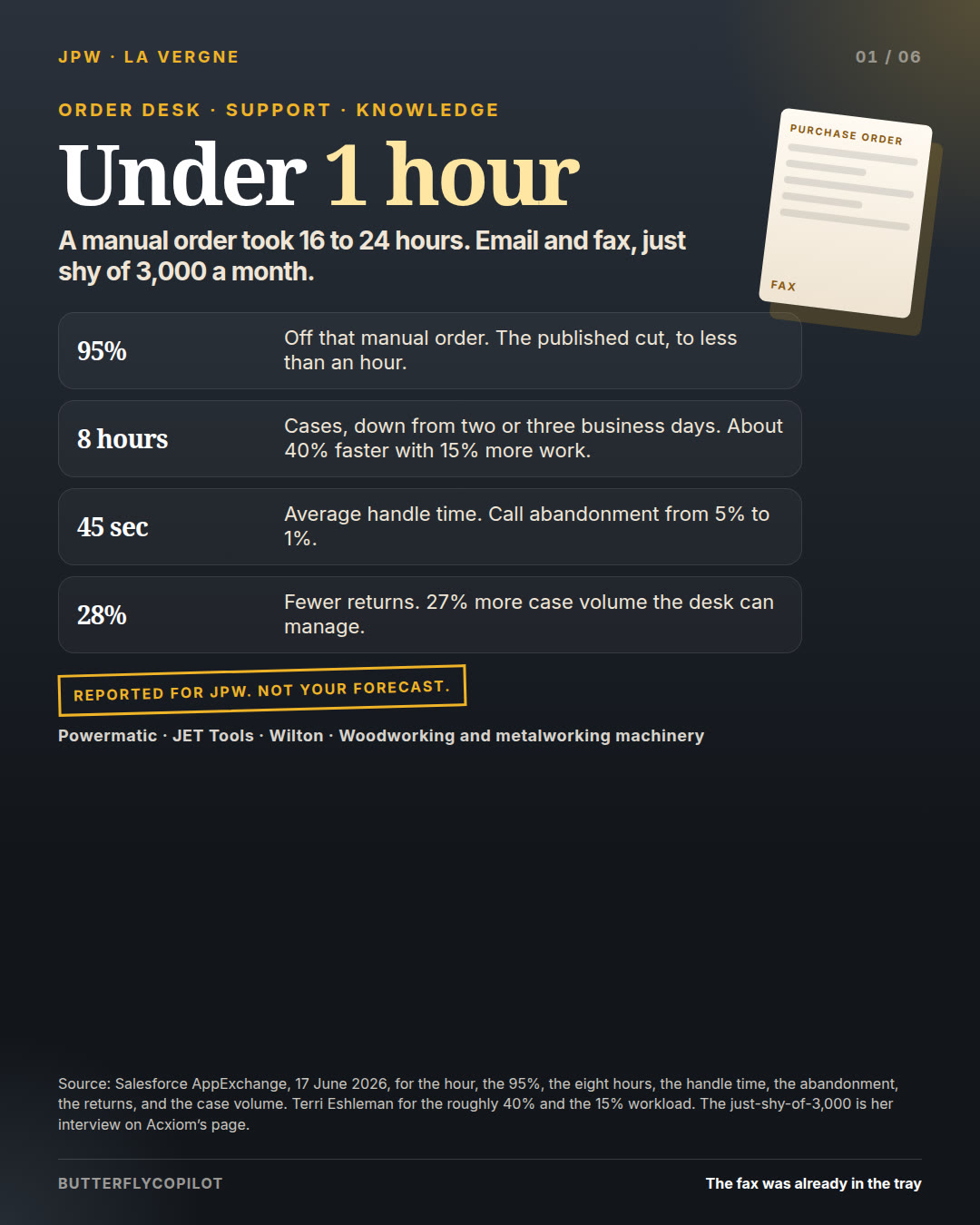
The purchase order was already in the inbox, or on the fax. A manual order took 16 to 24 hours. It takes less than an hour now, and a page nobody can read still does not become a line.
ButterflyCopilot
0106
The purchase order was already in the building.
JPW Industries, in La Vergne, Tennessee, makes woodworking and metalworking machinery. Powermatic, JET Tools, Wilton. The orders did not arrive as a clean file from the customer's system. They arrived by email, and they arrived by fax. Terri Eshleman, VP of Customer Experience and Direct Sales, put the month at just shy of 3,000.
A manual order took 16 to 24 hours. Peak season was met with more people, brought in for the season, so the turnaround would hold. The same wait sat on the call center, on technical support, and on direct sales. The order desk was the bottleneck those teams felt.
JPW is six companies that merged over time. Decades of how a machine comes apart lived in a person's head, or a shared drive, or a catalog, or a manual. A new person on the service desk took six months to train. A high-value machine in the field was often worked from a photograph or an email, with the technician on the phone and the answer somewhere in that pile.
What they stood up
They already ran Salesforce. They brought in Acxiom. The project started as a way to get the purchase orders off the keying desk. It spread. Call centers, technical support, and direct sales came into the same piece of work, because that was where the delay landed.
Three jobs.
The order job reads a purchase order from email or from fax, reviews it, and processes it. Intelligent document processing takes the page apart. The order data moves from Salesforce into SAP. A person is no longer the only way a cell gets from the page into the system.
The support job takes the repetitive questions. The complicated ones stay with a person.
The knowledge job is the cure for the shared drive. One base, articles the desk can trust, for the service rep and for the field technician who is in the middle of a live repair. That repair is how a machine stays in the customer's shop instead of coming back as a return.
A purchase order arrives by email or by fax
        ↓
The page is read into a customer, a purchase-order number, and lines
        ↓
Each line is checked against the account, the item, the price, and the ship-to
        ↓
A clean order becomes a draft the ERP can take
        ↓
A miss becomes one exception, with the page attached, for a person
A question takes the other door. If the answer is a published article, or the status of one order that belongs to that customer, the reply can be that text. If the message is a photograph, a return, a repair, a request for the invoice, or a booking, it waits for a person, and the article that might help is attached for them. It is not sent as if the model had stood over the machine.
Terri put the order clock in one sentence. They used to take 16 to 24 hours to process a manual order. They reduced that to less than an hour. Case resolution came down in the neighborhood of 40 percent while the workload went up 15 percent.
The same account of the rollout times case resolution from two or three business days to eight hours or less, and calls that clock change more than 50 percent. It also records a 45-second average handle time on the calls, abandonment from 5 percent down to 1 percent, returns down 28 percent, and the volume of cases the desk could manage up 27 percent. Order processing itself is the 95 percent cut, the 16 to 24 hours against the hour. Those are one rollout's published results. An earlier four weeks, after the service agent and the visual assistant were live and before the fuller agent launch she was still describing, is a different count: 900 more cases than the month before, closure four hours faster, 15 percent more cases handled, responses 12 percent faster, and the machinery return rate down 2.2 percent where that visual assistant was used. This page leaves the four weeks and the later scoreboard as two measurements.
The desk, which had been business hours, could take a question outside them. People who had been tied to keying moved toward actual service problems, and two new roles were created on that operation. Keying errors came down with the retyping.
“We used to take 16 to 24 hours to process a manual order. We've reduced that time to less than an hour. Our case resolution time has been reduced in the neighborhood of 40% while taking on a 15% increase in workload.”
Before any of that could be true, the data had to be fit to use. Terri's account of the build is that the team had to stop and look at how information was stored, down to how an agent fills in a field, or the model had nothing solid to stand on. People worried the tools were there to replace them. Her answer was that the customer still wants a person for the conversation that matters, and that the repetitive work is what comes off the desk. She has called that layer an invisible army. The relationship stays with the employee.
A blank line is not a quantity
Speed is how a tidy agent types a quantity the fax never showed, prices a line that is not on the customer's list, opens an account so the order will go through, or tells a customer why the motor is smoking.
The page that cannot be read is an exception. It goes to a clerk with the file attached. It does not become the model's best sketch of a purchase order. A blank quantity is not zero. A unit the company has not converted, a box against an each with no factor on the sheet, does not get a factor invented on the way into SAP.
A price inside the band the company typed still posts at the list price. A price outside that band waits. The list itself does not move to make the purchase order match. A customer on credit hold does not get a quiet release so the draft can leave. Cosentino's credit desk is the place a blocked order is the whole job. This one only refuses to step over the hold.
A part number the item master does not know does not become a new item. A ship-to the account does not have does not get created between the fax and the import. An order confirmation, a copy of the invoice, and a booked appointment stay with a person. Those are easy to call repetitive. They are also easy to send to the wrong customer.
On the question side, the reply is an article a person published, or the status and the date that are actually on the order. Hours. A parts page. A manual. One open order, named in the message. Two open orders, and no number to choose by, is a person. A photograph is a person. The technician still looks at it. Pelangi's coordinators read a customer's purchase order in a different trade, and a person still checks the extraction before the order continues. Same gate. Different catalog.
What a smaller distributor should steal
If purchase orders still arrive as email and fax, and someone still keys them, the first month is one inbox and the customers you are willing to get wrong in private.
One inbox
        ↓
Thirty days of documents, and a stopwatch on the orders a person already keys
        ↓
Thirty days where a clerk approves every clean draft, and nothing imports until the tests pass
        ↓
Thirty days where a clean order at or under a cap you typed may write the import
        ↓
Replies only for a published article, or for one order's status. The photograph waits.
Time the stretch you already have. Minutes from the document in hand to a draft a person will stand behind. How the pile splits across a clean draft, a price miss, an unknown item, a duplicate purchase-order number, a credit hold, and a page nobody could read. How many drafts a clerk approves unchanged, how many they edit, how many they kill. How many of those orders you later reverse. How many prices, customers, or items this agent created. How many holds it released. Those last counts stay at zero.
On the questions: how many replies were a published article or an order status, how many went to a person, how many of the sent ones a person later reopened, how many contained a number the article and the order do not contain. How many photographs received a repair procedure from the agent. That last one stays at zero.
The 95 percent, the hour, the eight hours, the 40 percent, the 45 seconds, the abandonment, the returns, and the case volume are JPW's published story. They are not a line for a proposal.
What the instruction file will make an agent do
The file below is the brief. It is not Agentforce, and it is not JPW's Salesforce org or SAP map. None of that wiring is public. The blanks are yours.
It will make the agent:
- Refuse to run while a
REPLACEline is empty, or while anEXAMPLErow is still in a live sheet. - Read a purchase order from text that email or an upstream OCR step already produced. The model may copy what is printed. It may not invent a quantity, a price, a customer, or a total. A blank quantity is not zero. An empty fax is
unreadable, and the lines the model still offered are thrown away. - Match the customer by account id, then by a whole alias. Match the item the same way. Convert a unit only when the sheet has a factor for that item. Price the line from the list. Keep the document's price beside it. Inside a percent band and a cents band, both required, the draft still uses the list. Outside either band, the order waits.
- Hold the whole order when any line fails. Write every code, so the clerk sees the price miss and the unknown ship-to together. A duplicate of an open purchase-order number does not become a second order.
- Leave a credit hold blocked. Approval does not clear it. There is no tool that creates a customer, creates an item, edits the price list, or sends an order confirmation.
- Write an ERP import file only after the gates, and only for a clean order a clerk approved, or a clean order at or under the cap once automatic draft is on. The file has quantities and prices. It has no payment and no new master record. SAP is what JPW loaded. The brief does not pretend to be a SAP session.
- Classify an inquiry in code. Hours, a parts article, a manual, and the status of one named order can become a reply, and the reply text is the article or the template. A model sentence that adds a number the source does not contain is dropped.
- Route a photograph, a repair, a return, an invoice request, an appointment, an unknown sender, and two matching orders to a person. Internal articles may sit on the task. They are not mailed to the customer. A tool that looks at the picture is refused.
- Write a morning file from this company's own baseline. No comparison with the case study's counts.
The tests are in the file. A two-line order at 122.00 that stays a draft while the import flag is off. A price of 10.04 that still posts at 10.00, and a price of 10.50 that waits. A box of six that converts, and a kilogram that does not. A blank quantity that is not stored as zero. A penny line at 0.500 that becomes one cent, and 0.499 that becomes a zero-total exception. A hold the clerk cannot approve through. A hours reply that is the article, including the refusal of "24/7". An order status that quotes the date on the file. A stranger who does not receive that date. A smoking motor, with a photo, that gets no repair sentence. A model that tries to approve, to create the customer, or to look at the picture. If the agent clears any of those by posting a guess, releasing a hold, or sending a sentence it was told not to send, the test fails.
The instruction file
The brief has the role, the file connector for whatever ERP already takes a sales order, the purchase-order checks, the exception queue, the knowledge-base replies, the approval form, the ninety days, and the tests that decide when a clerk may let a dull order import on its own.
Replace every REPLACE line. Delete every EXAMPLE row. Let it sit beside the purchase orders a person still keys, before anyone treats a draft as an order the warehouse has already been told to pick.
Sources
The company, the three jobs, the quote, and the later scoreboard are from the Salesforce AppExchange story of 17 June 2026. The document path into SAP, the six companies, the six-month training, the just-shy-of-3,000, and the four-week service numbers are from Acxiom's case study, which prints Terri Eshleman's interview. JPW's own post of 6 December 2024 is that interview at an earlier moment. The figures are as the pages report them. They are not an independent audit, and they are not a forecast for another company. The 95 percent on order processing and the 95 percent on outage recovery are different sentences. The roughly 40 percent and the more-than-50-percent clock change are two descriptions on the same AppExchange bullet. The 2.2 percent and the 28 percent are different windows.
- Salesforce AppExchange, Amanda Skanderup, “How JPW Industries Used Agentforce to Slash Manual Order Processing Times by 95%,” 17 June 2026. Industrial machinery. Powermatic, Wilton, and JET Tools. Thousands of purchase orders a month by email and fax. Seasonal labor. A manual order took 16 to 24 hours. Partner Acxiom. Agentforce across order management, support triage, and a knowledge base, including field technicians on live repairs. Order processing down 95 percent, to less than one hour. Case resolution from two to three business days to eight hours or less, called more than 50 percent faster, and roughly 40 percent faster with a 15 percent higher workload. Average handle time 45 seconds. Call abandonment from 5 percent to 1 percent. Returns down 28 percent. Manageable case volume up 27 percent. Terri Eshleman, VP of Customer Experience, on the hour and the roughly 40 percent.
- Acxiom, “How JPW Industries is transforming customer experience with AI.” Undated. Woodworking and metalworking tools. Agentforce, Einstein AI, and MuleSoft Intelligent Document Processing. Order data from Salesforce to SAP. Natural-language search, case summaries, classification, and brand-aligned replies. Headline tiles: 80 percent reduction in response time, 45-second average handle time, 75 percent reduction in case turnaround. Body: order processing from days to hours, system-outage recovery improved by 95 percent, manual-entry errors lowered with no rate given, two new roles created, no headcount given. The same quote, with the title VP of Customer Experience and Direct Sales. The interview: just shy of 3,000 orders a month, six merged companies, six months to train a new agent, remote repair from photos or email, the reset of Salesforce fields, the worry about replacement, Agentforce as an invisible army for work such as invoices and appointments. Four weeks after Einstein Service Agent and Visual Remote Assistant: 900 more cases than the prior month, closure four hours faster, 15 percent more cases, response time down 12 percent, machinery return rate down 2.2 percent on the visual assistant. In that interview, Agentforce itself was still about to launch.
- JPW Industries, “How JPW Industries Is Transforming Customer Experience With AI,” 6 December 2024, dateline La Vergne, Tennessee, 29 October 2024. The interview before the measured results. One week from launching Einstein AI for service. The partner named on this page is RafterOne. Just shy of 3,000 orders, six companies, six-month training, remote repair. The result quote and the later percentages are not on this page. The result pages name Acxiom. This story uses Acxiom for the rollout that carries the figures, and it does not treat the two partner names as one company.
- Salesforce, Maddy Nelson, “From Hours to Minutes: How JPW Industries Transformed Customer Service Automation with Salesforce and AI,” 2 June 2025. Acxiom. The quote. Thousands of orders by email and fax. Knowledge base and shorter training, with no new duration. Coverage past business hours. The four-week case and response figures, and a line about lower rental return rates. The 2.2 percent machinery figure used in the story is the Acxiom interview, not the rental wording.