
How Julian Soler Automated Recipe Formulation with AI
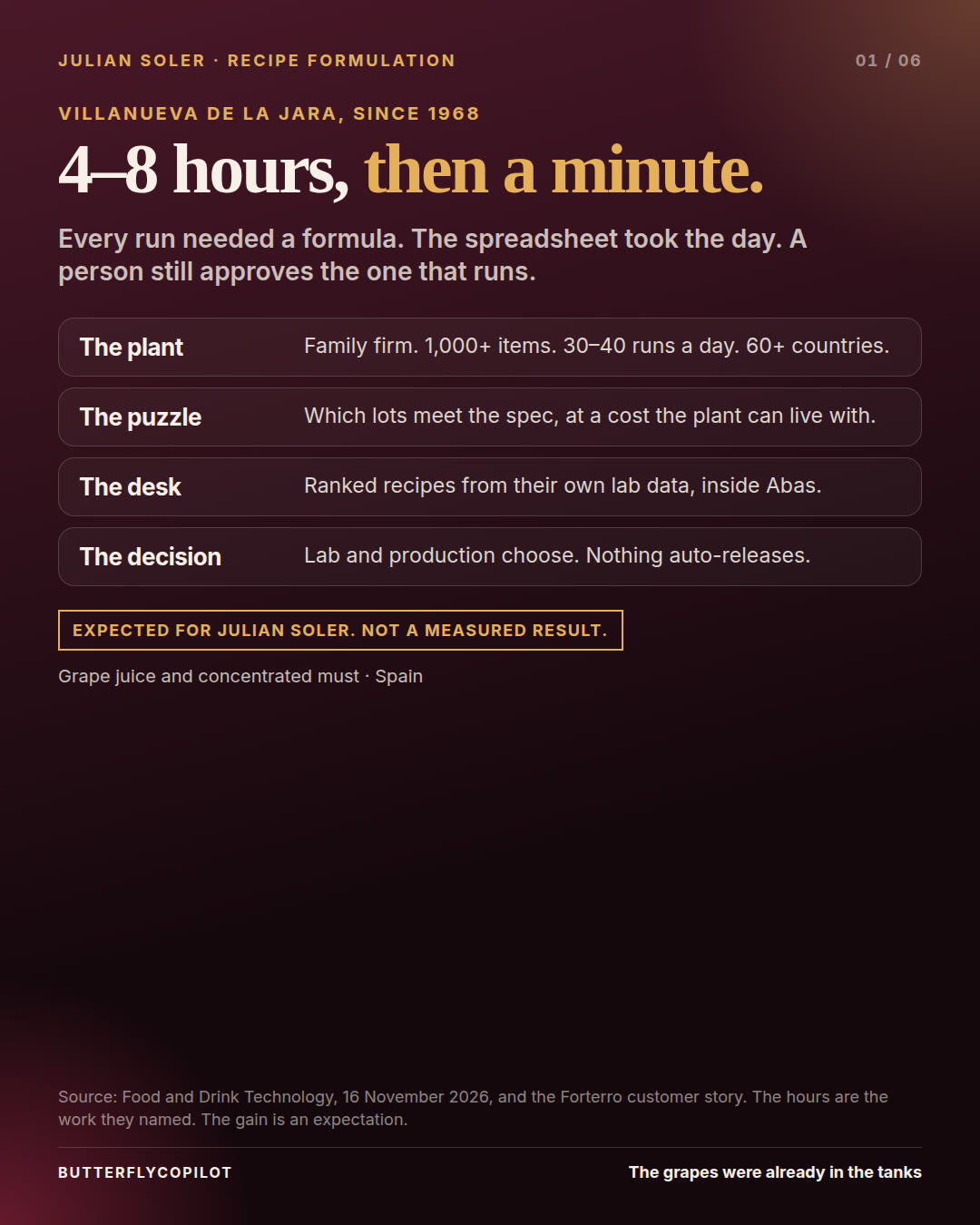
Every production run needed a formula, and the spreadsheet took 4 to 8 hours a day. The optimiser ranks blends from the plant's own lab data. A person still approves the one that runs.
ButterflyCopilot
0106
The grapes were already in the tanks. The hours went on the spreadsheet.
Julian Soler presses grapes in Villanueva de la Jara, in Spain. The company was founded in 1968, and it is still family owned. It produces grape juice and concentrated grape must, and it sells those ingredients to more than 60 countries on five continents. The customers make soft drinks, wine, vinegar, confectionery, and infant food.
A day there is 30 to 40 production runs, against a catalog of more than 1,000 items. Each batch is watched from the moment the grapes come in until the shipment leaves. The characteristics they check are the ones a buyer has already written down. Concentration. Acidity. pH. Colour.
The spreadsheet knew the spec and still took the day
Every one of those runs needs a formula. The lots in the yard are not the lots that were there last week. One is sweeter. One is sharper. One is darker. The customer's specification is a window, not a single number, and the cost of a lot is not the cost of the lot beside it. Someone has to pick a combination that lands inside the window and does not waste the expensive tank.
That puzzle lived in Excel. It took 4 to 8 hours every day.
The thing they built sits inside their Abas ERP, on MyForterro.ai, Forterro's AI platform for the industrial mid-market. It uses the company's own production, laboratory, and quality data. It calculates the combinations of raw materials that can meet the specification, and it ranks them by cost and by how close they come to what that customer asked for. Lab and production look at the ranking before the run starts. A person decides. The tool does not release the batch.
Antonio López Soler put the speed of it in one sentence. "AI gives you in one minute what a person might take much longer to calculate." He put the condition in the next one. "Without the production, quality and laboratory data, we could not have implemented this solution."
Alice Taylor, head of AI at Forterro, has described formulation as a high-stakes decision a food and beverage plant makes dozens of times a day, and the point of the tool as hours of spreadsheet work replaced by ranked recommendations a person can act on.
The production order, and the customer's window
        ↓
The lots, with the lab and the cost, or a reason they are out
        ↓
The optimiser, in code
        ↓
A ranked list
        ↓
Lab and production approve. A draft. No release.
The boxes are the instruction file. They follow the shape of the job: read the spec, rank the blends, leave the decision with a person. They are not a reconstruction of Julian Soler's screens, and they are not a Forterro project plan.
What has been published about the result is an expectation, not a measurement. They expect the 4 to 8 hours a day of calculation and review to come back. They expect a production optimisation of 5 to 10 percent, also worded as up to 10 percent, from putting the cost of the raw material into every formula. They expect fewer manual errors, because the result is predicted before anything is processed. No measured figure has been published.
What they have named as next is a purchase delivery note read from a PDF, agents that work from the raw-material record, and the same kind of help on other functions inside Abas.
The lab book is the moat
A model that has read about grape juice is not a formulation system. It does not know which tank was tested on Tuesday, or that the cheap lot is on hold, or that this customer's colour window is tighter than the last one's. López Soler said the quiet part. Without the production, quality, and laboratory data, the solution does not exist. The spreadsheet was slow because a person was carrying that data in their head and in a workbook. The useful version of this desk refuses a lot the lab has not cleared, and it refuses to average two pH numbers into a third.
Minsawi is the mill on this site where the gain is in the press. This one is the blend written down before the run starts. The extraction points on that page do not belong here. The hours on this page do not belong there.
The file below keeps the shape and drops the plant. One product family, one plant, because that is the first version a smaller manufacturer can check by hand. Juices, concentrates, syrups, chemicals, feed. The lots are the company's. The spec is the customer's. The solver mixes what mixes in a straight line, by mass: concentration, acidity, sulphur dioxide, and, with the approximation written down, colour. Water is a lot with zeros. pH is not in the arithmetic. A stale test stays stale even when another test on the same lot is fresh. The model may read a specification and explain why rank 2 costs more than rank 1. It may not invent a kilogram. An approve writes a draft bill of materials. Release stays a separate act, in the ERP, by a person.
On the fixture, which is ours, a made-up winery asks for 1000 kilograms inside a window, and the lots are invented. The cheapest sheet that hits the targets uses three of them and water. The next sheet hits the same targets and costs more. The sheet after that is cheaper than the second and sits off the colour target, so it ranks lower. A lot with a fresh brix and an old acidity is left out. A lot whose acidity was written in grams per litre is left out. Those rows exist so a builder can test the mix, the exclusion, and the refusal. They are not a Julian Soler tank, and they are not a juice anyone should ship.
It started small, on purpose. A two-day hackathon, run by Forterro's Abas teams. Julian Soler did not arrive with a programme about the future of the plant. They arrived with a job the plant already does every day. After the two days, their own team configured the agent, adjusted the prompt, and chose the models, with Abas specialists beside them. The people who live with the spec are the people who should own the tool. A hackathon that ends with a slide does not shorten the spreadsheet.
The useful caution is the baseline. An expectation like the one in the announcement sits on a lab book the company already keeps, and on a clock someone started before the tool existed. An empty export will not tell you whether yesterday's formula was expensive. The file spends the opening fortnight on a stopwatch and on the orders the plant has already run.
The original system is theirs: MyForterro.ai, inside Abas. Buying that kind of platform is a real option. The file is the other path. Postgres. A solver that is allowed to do the arithmetic. A model that is allowed to read one specification and explain one ranking. A draft the ERP can hold. The gates are the same on both. A person approves. A kilogram comes from code.
What a smaller manufacturer should steal
If the work is still a person rebuilding yesterday's blend in a workbook, the first month is one family, one plant, and a clock on the days you already spend.
Let the model read the specification. Let the code pick the kilograms, drop the stale lot, and rank the rest by cost and by distance from the target. Show the predicted parameters next to the window, and the margin that is left. Keep a person on the approve, including after a clean first week. Refuse the old failure mode, which was to type the doubtful lot so the run could start.
One family, one plant
        ↓
Two weeks with a stopwatch on the days a person already finishes
        ↓
The lab loaded, and the locked tank marked
        ↓
Shadow, while the spreadsheet is still how the formula is chosen
        ↓
A draft the ERP can hold. A person still releases the order
Count the stretch you already have. Minutes from the spec in hand to the formula you will actually run, as a median you measured. How many of your own past orders the top-ranked recipe would have met, as a count, not as a percent copied from a case study. The cost against the recipe you did run, and only on the orders where both would have met the spec. How many drafts were written with nobody's name on the approve. That last count stays at zero.
Julian Soler's scoreboard is not your forecast. 4 to 8 hours a day, a calculation that a person described as a minute, an expected production gain of 5 to 10 percent, 30 to 40 runs, more than 1,000 items, and more than 60 countries are this company's published account. The gain is an expectation. No measured before-and-after has been published. It is not a hiring plan, and it is not your headcount. Measure the day you actually have.
What the instruction file will make an agent do
The file below is the brief. It is not Julian Soler's tenant, and it is not a MyForterro.ai connector. None of that schema is public. The blanks are yours.
It will make the agent:
- Refuse to run while a
REPLACEline is empty, while a fixture plant id is still in a live folder, or while anyone has typed 4 to 8 hours, one minute, 5 percent, or 10 percent into the config as a target. - Take one product family at one plant. A second family, a released production order, and a delivery-note reader return a locked scope.
- Load kilograms as integer grams, and refuse a quantity with more than three decimal places. Refuse an acidity written in grams per litre. The company converts that with a density it measured. The agent does not invent one.
- Leave out a lot that is on hold, blocked, short of the minimum draw, in the wrong family, forbidden, missing a lab, carrying a stale cost, or carrying a stale test. The oldest required test is the one that counts.
- Solve the blend in code. Mass-linear parameters by grams. pH stays out of the arithmetic. Water, if the spec allows it, is a lot with zeros and does not count toward the lot cap.
- Rank the top recipes by cost plus a weighted miss against the target, then forbid the previous set of lots and solve again. A cheaper sheet that misses colour ranks below a dearer sheet that hits it.
- Explain a ranking only from the fact sheet the solver returned. A number that is not on the sheet is not said. A what-if is another call to the solver, not a guess.
- Accept an approve only from QA or production, with a reason, and write a draft bill of materials with release set false. The agent cannot approve. A second click returns the same draft. A request to release returns a refusal.
- Write a morning file from this company's own counts: orders re-solved, top ranks inside spec, cost pairs, the two time medians. No comparison with the expectation. No percent.
The tests are in the file. The hashes of the ranked recipes, the excluded lots, the approve, the draft, and the whole bundle are locked. A recipe that appears when the problem is infeasible fails the test. A release flag set true fails the test.
The instruction file
The brief has the role, the one family a single plant can hold, the tables, the blend equation, the weights, the worked fixture, the prompt, the tools, the draft that goes back to the ERP, the screen, the back-test, the twelve weeks, and the tests that decide when a draft may be the document production starts from.
Replace every REPLACE line. Delete every EXAMPLE row before a live tank is read. Let it sit beside one family for the orders a person still builds in a workbook, before anyone treats a ranked recipe as a batch the cellar has already been told to pump.
Sources
The company, the spreadsheet, the optimiser, and the figures in the story are from the pages below. The founding, the place, the products, the countries, the catalog, and the daily runs are as those accounts give them. The 4 to 8 hours are the calculation they described. The minute is Antonio López Soler's description. The 5 to 10 percent, and the wording up to 10 percent, are the published expectation for a production gain from putting raw-material cost into the formula. They are not a measured result, and they are not a forecast for another manufacturer.
- Food and Drink Technology, "Julian Soler presses ahead with AI," 16 November 2026.
- Forterro, Julian Soler customer story.
- ERP News, "Julian Soler AI recipe optimization."
- Forterro, "MyForterro.ai," the industrial AI platform the optimiser runs on.