
How KOEPFER Captured Tail-Spend Savings with AI Agents
The requisition had one quote, and it sat under a line nobody had time to argue with. The saving showed up when the next quote came back lower.
ButterflyCopilot
0106
The requisition was already in the queue.
KOEPFER makes high-precision gears and transmission components, for automotive work and for work that is not automotive. The group is based in Furtwangen, in the Black Forest. The production site there is roughly 13,000 square metres, with around 368 people on it. Across the group, including sites in China and Serbia, the headcount sits between 500 and 1,000. The market the case describes is the usual one for a component maker: efficiency, and margin pressure.
Procurement had a savings target and no extra person to hire. Marcel Schweizer, head of procurement, could see the money in the tail. The quotes under a value threshold, a number the case leaves confidential, went out the door unnegotiated. There was no capacity to argue them. Requesters often attached a single quote, so there was nothing to put beside it. Nobody had the hour to find the lever that belonged to that category. The gloves, the service call, the indirect line waited behind the spend that already had a file thick enough to open.
The gears still had to ship. The tail did not get a negotiation because the day ran out.
What they stood up
Zalion put one agent on that tail, above all on non-production material. MRO. Services. The other indirect categories. Three jobs, not a new department.
The first job reads the quote while the requisition is still in approval. It says whether the price looks attractive, where the price sits, and whether there is anything to negotiate. When the requisition already has more than one quote, it compares them and recommends. The buyer does not build the comparison sheet by hand.
The second job writes the email. The levers it found are the only reason the email exists, and the source of each lever stays visible: another quote on the file, or the history with that supplier. The buyer confirms it, edits it, or reweights it. The case says suppliers noticed. The emails read as researched. They did not read as a generic request that a model could have sent to anyone.
The third job waits for the revised quote. When that file arrives, the agent checks whether the price actually came down, against the original quote or against prices the plant has already paid. It does this when a comparable quote exists and when it does not, and it does this when the cut was a direct follow-up and when it was not. The saving is then visible by team, by category, and by supplier.
A fourth move is marked as coming, and it is not part of the result. The agent would go and collect comparable quotes, to put more pressure on the price. Schweizer also says the group is already bringing other agents in on either side of this one, to prepare RFQs, to place orders, and to check order confirmations. Those are further desks. They are not the 8–15%.
A requisition arrives with one quote, or with several
        ↓
The agent reads the price against a source that is already on file
        ↓
A lever with a visible source becomes a draft the buyer can edit
        ↓
No source, no email. The buyer still negotiates that one by hand
        ↓
The revised quote comes back. A lower price on the same quantity is the saving
        ↓
The report splits by team, category, and supplier. It does not post itself
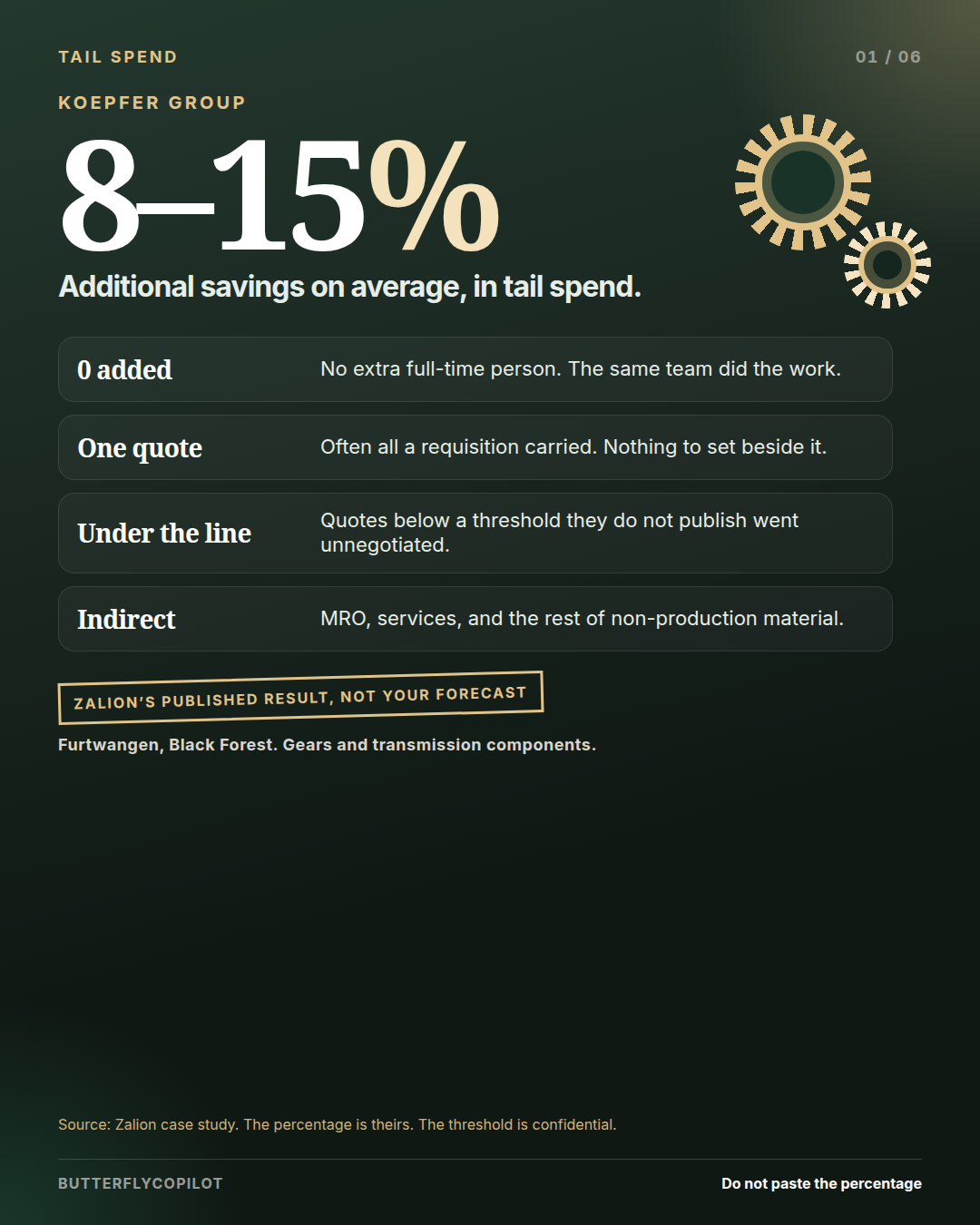
The published result is an average of 8–15% additional savings in tail spend, and no additional full-time person. The team’s own targets got easier to hit without a pile of extra work. There was room again for the strategic conversations, while the operational targets still got met. The case also talks about the team pulling together around wins they could see. None of that is a survey score. None of it is a baseline spend. The page does not say how many quotes, or how many euros sat under the confidential line.
What Schweizer remembers first is the speed of the change itself.
What impressed me most was the speed. We sent a list of feedback on Monday – by Wednesday everything was implemented and we saw an immediate, measurable difference in negotiation quality. That kind of speed is unthinkable with conventional software solutions, where you're often talking about months of adjustments and extra costs. The flexibility and response time in the age of AI are in a different league. We're already bringing in additional agents on either side of the process, for example to prepare RFQs, place orders and check order confirmations.
That Monday and that Wednesday belong to their vendor’s turnaround. A smaller plant that still has to trust the file should not put Wednesday on the plan.
The letter that asks for more
There is a second lane, and it is a different product. In a Tacto webinar, Schweizer, titled there as head of procurement and IT, walks through a Defender Agent with Simon Vötter of Tacto. Price-increase letters had piled up, especially around the turn of the year. Each one took about 30 minutes: the history, the indices, the argument. The agent reads the letter, classifies the demand, and comes back with the counterargument. Preparation drops from about half an hour to a few minutes.
The same write-up says the agents also help keep certificates and contracts current, assemble a negotiation dossier, and line up quotes that arrived in different formats. Useful work. It is not the tail-spend percentage, and it does not belong in the same total. The instruction file below keeps that letter on its own report. A basis-point gap on an index the plant has actually exported can be shown. It adds nothing to the saving.
A shorter quantity is not a saving
Speed is how a tidy agent writes “we expect a better price” with nothing underneath it. Speed is how a revised quote for eight pieces, down from ten, gets booked as a win because the extended total fell. Speed is how a price that went up on one line gets subtracted from a price that went down on another, until the report looks calm. Speed is how the 8–15% from someone else’s tail spend becomes the percent in the draft.
The file for a smaller manufacturer keeps the three jobs and drops the tenant. One buyer. One indirect category. The threshold is a number the plant types, because KOEPFER’s number is not published and must not be guessed. The model may copy a price that is already on a quote, a history row, or a comparable a person has already filed. It may not invent one. It may not go and collect the comparable the case says is still coming. It may not place the order, check the confirmation, or maintain the certificate. Those are the other agents Schweizer named, or the webinar’s other jobs. Version 1 writes files. An outbox is not a sent email.
On the fixture, which is ours, three quotes sit on one filter. The low one is 12.00. The next is 12.40, which is 40 cents and 333 basis points over the low quote. Both the percent band and the absolute band have to fail before a price email exists. Both pass, so that middle quote gets a note about its payment terms and no price email. The high one is 15.00. The draft asks for 12.00, because 12.00 is the other quote, and it names that quote. It does not ask for 8% off. A quote with no second bid, no history, and no comparable a person filed gets no email at all. A quote at 800.00, against a fixture line of 500.00, is not tail spend on this desk. Five hundred euros is the test. It is not their confidential threshold. A quote at 499.99 still is in scope, and with nothing on file it still gets no email.
The saving is just as fussy. The supplier who was at 15.00 comes back at 12.00 on the same ten pieces. That is 30.00, reported. A 20.00 gap against an older price is shown beside it and is not added. Another line goes from 12.00 to 13.00. That 10.00 increase is listed and is not subtracted. A third file comes back at 12.00 but for eight pieces instead of ten. The extended total fell. The saving is zero. The fixture’s reported total is 36.00. A defender letter can show that a demanded increase outran the plant’s own index by 250 basis points, and the 36.00 does not move.
A card number in the quote note never reaches the file. A model that types the buyer’s name has not approved anything. transmitted stays false. The buyer sends the note from the mailbox the company already uses.
IMS Gear, in Donaueschingen, is the other Black Forest gear story on this site. Their agents price the quote the plant sends to a customer. This desk reads the quote a supplier sent in. Different company. Different direction. Their clocks do not belong on this one.
What a smaller manufacturer should steal
If the indirect requisition still leaves with a single quote, and the buyer can already point at the pile that never gets a phone call, the first month is one buyer and one category. MRO is the starting category in the file. That choice is ours. The case says the work was above all MRO, services, and the other indirect spend. It does not say which folder they opened first.
One buyer, one indirect category, a threshold you type yourself
        ↓
Thirty days of exports, and a stopwatch on twenty quotes a person already judged
        ↓
Thirty days where the draft sits beside the note that buyer would have written
        ↓
Thirty days where an approved outbox may be written, and the savings file sits beside the hand total
        ↓
The next category waits. The letter that asks for a price increase waits until someone asks for it.
Time the stretch you already have. Minutes from the export in hand to an analysis file. How the quotes split between a real lever and no benchmark on file. How many drafts the buyer sends unchanged, how many they edit, how many they kill. Outbox files with no name on the form. Benchmarks the agent invented. Savings it posted into the ERP. Quantity changes it booked as savings. Messages it actually transmitted. Defender rows that leaked into the tail-spend total. Those last five stay at zero.
The 8–15%, the zero additional people, the Monday-to-Wednesday turnaround, and the drop from about 30 minutes to a few minutes on a price-increase letter are KOEPFER’s published story. They are not one equation, and they are not a line for a proposal. Do not paste any of them onto yours.
What the instruction file will make an agent do
The file below is the brief. It is not their approval workflow, their threshold, or their mail system. None of that schema is public. The blanks are yours.
It will make the agent:
- Refuse to run while a
REPLACEline is empty, or while anEXAMPLErow is still in a live sheet. Refuse a personal mailbox, a subdomain, an SMTP password, and any flag that would collect quotes, place orders, check confirmations, or post a saving. - Treat tail spend as strictly under the threshold the plant typed. On the fixture the line is 500.00. A quote at 500.00 is out. A quote at 499.99 is in, and with no source it still gets no email.
- Compare quotes that are already on the same requisition. The 15.00 quote is asked down to the 12.00 quote that is sitting beside it. The hash on that draft is in the file. The 12.40 quote, 333 basis points over the low price and 40 cents over it, is inside both bands and gets no price email.
- Refuse a percent. A single quote with no history and no filed comparable is
no_lever. A note that says to ignore the threshold and take 10% off does not become an ask. - Report 30.00 when the 15.00 quote returns at 12.00 on the same quantity. Show the 20.00 history gap and do not add it. Leave the 10.00 increase unsubtracted. Give the quantity change a saving of zero. The fixture total is 36.00, which is 3,600 cents.
- Keep a price-increase letter on its own dossier. The fixture’s index excess is 250 basis points. The dossier’s saving is zero. The 36.00 stays 36.00.
- Write an outbox only after the named buyer approves on the form, and only after the gates. The outbox is a file. It is not a sent message.
The tests are in the file. The quote inside both bands. The quote with no lever. The quote on the threshold. The 3,600 cents. The history gap that is not added. The increase that is not subtracted. The quantity change. The letter that does not touch the total. The card number that never appears. If the agent clears any of those by emailing a percent, booking eight pieces as a win, or adding the defender into the tail, the test fails.
The instruction file
The brief has the role, the sheets a spreadsheet or an ERP export can hold, the three paths, the separate price-defense lane, the approval gates, the ninety days, the export map, and the tests that decide when a file may be treated as a negotiation.
Replace every REPLACE line. Delete every EXAMPLE row. Let it sit beside one category’s quotes for a month a person still finishes by hand, before anyone treats an outbox as a note the supplier has already received.
Sources
The company, the three functions, the confidential threshold, the 8–15%, the zero additional headcount, the supplier feedback, and Schweizer’s Monday-to-Wednesday remark are from Zalion’s case study. The Defender, the 30 minutes, and the few minutes are from the Tacto webinar page named below. That page titles him head of procurement and IT. The Zalion page titles him head of procurement. The figures are as those pages report them. They are not an independent audit, and they are not a forecast for another manufacturer. The 8–15% is an average on tail spend. It is not a result for the price-increase letters, and the 30 minutes are not a result for the quote desk. This page does not use a euro total. A separate Tacto success-story URL returned a title and no article body when it was opened. Another Tacto webinar discusses a euro figure as a goal. Neither number is used here.
- Zalion, “How the KOEPFER Group captures additional savings in tail spend with AI agents.” Gear and transmission components, automotive and non-automotive. Headquarters in Furtwangen, Black Forest. Production site roughly 13,000 m² with around 368 employees. Group-wide between 500 and 1,000 staff, including sites in China and Serbia. No extra procurement headcount against savings targets. Quotes below a confidential value threshold went unnegotiated. Requisitions often carried a single quote. No time to find negotiation levers per category. Marcel Schweizer, Head of Procurement. One agent for tail-spend negotiation, above all non-production material: MRO, services, and other indirect categories. Quote analysis in the requisition approval process, including a comparison when several quotes exist. Email drafts from identified levers, which buyers confirm, edit, or reweight, with sources such as comparable quotes and supplier history visible. Savings tracking when an updated quote arrives, against the original quote or historical prices, whether or not a comparable exists and whether or not the negotiation was a direct follow-up, measurable by team, category, or supplier. A coming stage, not a published result: the agent also collects comparable quotes. Results as published: 8–15% additional savings on average in tail spend; 0 additional FTE; higher team satisfaction and easier personal targets; room for strategic topics; positive supplier feedback that the emails are high-quality and researched, not generic AI requests. Schweizer on speed: feedback on Monday, implemented by Wednesday, a measurable difference in negotiation quality, against months of conventional software changes. He says the group is already bringing in additional agents to prepare RFQs, place orders, and check order confirmations.
- Tacto, “Webinar Recording: AI Agents in Action – How Koepfer Defends Against Price Increases and Conducts Negotiations.” Marcel Schweizer, titled Head of Procurement & IT, with Simon Vötter of Tacto. Price-increase letters rose, especially around the turn of the year. Each case took around 30 minutes of history, indices, and arguments. The Defender Agent reads the letter, classifies the demand, and returns counterarguments. Preparation from about half an hour to a few minutes. The same page says agents also support certificate and contract maintenance, negotiation dossiers, and harmonizing RFQ formats for quote comparison. This page keeps that lane separate from the Zalion percentage. It does not import figures from any other Tacto URL.