
How Kuken Industries Cut Drawing Search Time with AI
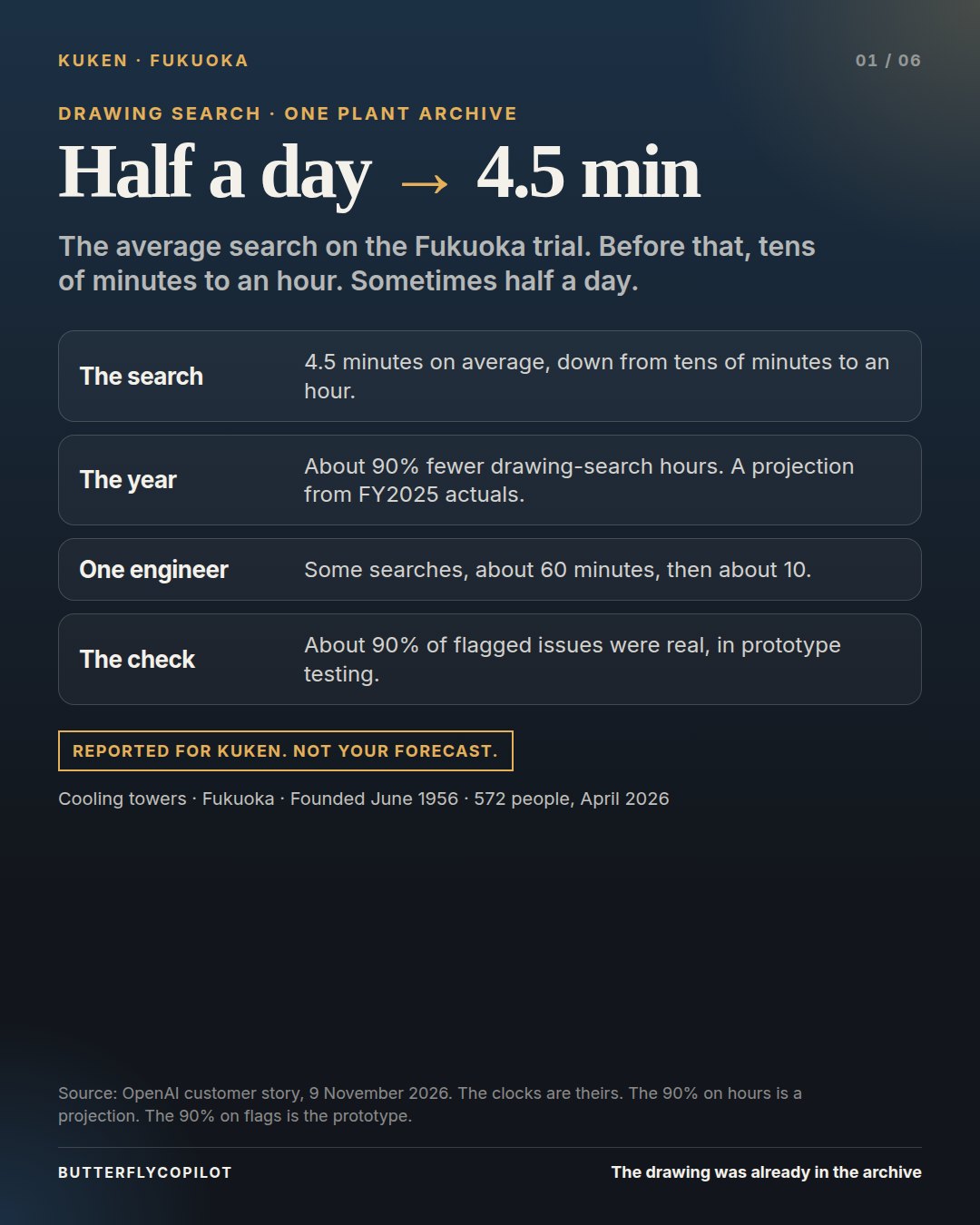
The drawing was already in the archive. Finding the sheet that matched the tower took a veteran, and sometimes half a day. On the Fukuoka trial the average search was 4.5 minutes, and the engineer still decides which page is the one.
ButterflyCopilot
0106
The drawing was already in the archive. The time went on finding the sheet that matched the tower.
Kuken Industries (空研工業株式会社) builds cooling towers, air diffusers, dampers, and the other HVAC equipment around them, in Fukuoka. The company was founded in June 1956. In April 2026 it had 572 people. It holds a top-class share of the cooling-tower market in Japan. The units serve commercial buildings, hospitals, factories, and data centres. A tower that went up in one decade is still a maintenance job in another.
The slow part was not the fan. It was the sheet that said how that fan was built.
A scan is not a search
Seventy years of drawings and technical documents. The paper had been digitised. The format and the notation had not stayed still. A revision number, a 枝番, a character that drifted between one era's draughting office and the next, and an ordinary search returned the wrong sheet or no sheet. Finding the drawing for a unit that was already installed took tens of minutes, or an hour, and sometimes half a day.
Which page to trust sat with the veterans. A newer engineer asked a senior colleague. That was the index. A part made this year does not always fit a tower from another decade. Without the original drawing, the replacement can end up designed from scratch.
There was a second job, at quote time. The specs on the factory order notice (工場仕切通知書) have to show up on the outline drawing (外形図) and on the delivery specification (納入仕様書). People held the pages next to each other and looked.
The desk was built with Recursive, the Tokyo firm, an OpenAI partner, on the OpenAI API. Recursive's forward-deployed team sat with the field engineers, asked which clues they actually used when a search failed, and tried the checks on real documents. Several models were compared on accuracy and on cost. The OpenAI models did best. Kuken has not published the architecture, the model names, or what the calls cost. This page does not add them.
Two jobs, and a person at the end of both
What they put in front of the engineers is a web app. They describe it as an AI knowledge base. It does two things.
Drawing search. The engineer types a drawing number or a part number, or uploads an image, a PDF, or a screenshot of a drawing or a parts list. The system pulls the numbers out and looks across the seventy years. It returns the exact page, and the pages that differ by a revision, a 枝番, or a string that is close, with a preview, including similar designs. The engineer checks the tower's specs and the record of what was replaced before, and decides.
Drawing check, used when a quote or a proposal is being prepared. The order notice goes in with the outline drawing or the delivery specification. The system pulls the model, the dimensions, and the notes, compares them with the reference, and shows a candidate difference at its place on the page. It also looks for the items that belong on that kind of drawing: a mandatory note that is missing, a balloon that does not point at a part. It does not catch every handwritten note, and it does not catch every layout error. In prototype testing, about 90 percent of the issues it flagged were genuine discrepancies. That figure is from the prototype. The engineer makes the call.
On the trial at the Fukuoka factory, the average drawing search was 4.5 minutes. The same kind of search had taken tens of minutes to an hour, and sometimes half a day. From last year's figures they project about a 90 percent reduction in drawing-search hours across a year. That is a projection, not a year that has already been measured. One engineer, on the OpenAI video, described some searches that had taken about 60 minutes and then took about 10. Veterans put the recovered time into mentoring, and into the harder jobs. Newer engineers take more of the work without waiting on a senior colleague. Review happens in the app, so fewer drawings get printed.
A number, or a photo of the parts list
        ↓
The page is read into a fixed record
        ↓
Exact match, then the other revision, then a near string
        ↓
The engineer looks at the original and confirms
        ↓
The drawing file is not edited, and the quote is not rewritten
The boxes are the instruction file. They follow the shape of the two jobs: find the page, compare the documents, leave the decision with the engineer. They are not a reconstruction of Kuken's screens, and they are not Recursive's project plan.
What they have named as next is the reading of old drawings and of handwritten notes, a cleanup of the data, and the security and access checks. A full rollout at the Fukuoka and Chiba factories is targeted within 2026.
The line the companies have kept: the system searches and compares. The engineer checks the original and decides.
The veteran was the index
A scanned archive feels like the job is done. The file is in a folder. The folder has a name. Then a tower on a hospital roof needs a casing that was drawn in another decade, the revision is a suffix nobody searches for, and the person who knows which scan is the real one is in a meeting. Digitised means the paper survived. Findable means a newer engineer can get to the right page without that meeting.
The other trap is the empty check. A screen that says the order notice and the outline drawing agree is a quote waiting to go out wrong, if the handwriting was skipped or the tolerance was averaged away. The useful version of this desk shows candidate differences and refuses to announce that it found none of importance. The engineer still reads the page.
ONG&ONG is the project archive on this site. That one searches a firm's past jobs. This one searches drawing sheets and then checks two documents against each other. The minutes on that page do not belong on this one. The 4.5 minutes on this page do not belong on that one.
The file below keeps the shape and drops the plant. One product family, one plant's archive, because that is the first version a smaller manufacturer can label by hand. The scans are the company's. The title-block crop is the company's, since old sheets do not all put the block in the same corner. The model may copy a number off the ink. The grammar decides which part of it is the revision and which part is the 枝番. A length is compared in code, in integer micrometres, against the tolerance printed on the order. about 1500 stays unparsed. A balloon with no part number is a flag from the code, not a guess at the nearest callout. The engineer confirms one page. Confirm does not edit the drawing and does not touch the quote.
On the fixture, which is ours, five made-up sheets share a family. A full-width ABC-123 lands on the exact page, with the revision and the 枝番 beside it as the next candidates, and a one-character lookalike further down at low confidence. A parts-list number in full-width digits finds the sheet through the bill of materials, and the revised part comes back as the same base with a different suffix. 1.5 m against 1500 mm is not a difference. 1503 mm against 1500 ± 2 mm is. A sentence that says "about 1500 mm" does not become 1500. An empty difference list is still not a claim that the pages match. Those rows exist so a builder can test the key, the rank, and the refusal. They are not a Kuken data sheet, and they are not a tower anyone should fabricate.
The useful caution is the baseline. A result like the one in the trial sits on an archive the engineers already know, and on a clock someone started before the tool existed. An empty gold set will not tell you whether the exact page is coming back first. The file spends the first fortnight on a stopwatch and on one hundred searches whose correct page is already known.
The original sits with Recursive and with OpenAI. Buying that kind of engagement is a real option. The people in the room with the field engineers are the reason the trial has a number at all. The file is the other path: folders, a grammar for the numbers the company is willing to trust, Postgres, and a model that is allowed to read one page. The gates are the same on both. A person confirms. A suffix comes from code.
What a smaller manufacturer should steal
If the work is still a veteran who knows which scan is the real one, the first month is one family, one plant, and a stopwatch on searches you already do.
Let the model copy the ink. Let the code decide the revision and the 枝番. Show the exact page first, then the other issues of the same sheet, then the lookalikes, and say why each one matched. Keep a person on the confirm, including after a clean first week. Refuse the old failure mode, which was to treat a scanned folder as an index, and to treat a quiet check as a quote that can go.
One family, one plant
        ↓
Two weeks with a stopwatch on searches a person already finishes
        ↓
Four weeks of ingest, title blocks, and numbers checked by hand
        ↓
Four weeks in shadow, while the old way is still how the page is found
        ↓
The engineer may confirm. The quote is still edited by a person
Count the stretch you already have. Minutes from a clue in hand to the correct page on screen, as a median you measured, split by who did the search if both a veteran and a newer engineer do the job. How many of your own gold searches put the right page first, and how many put it in the first five, as two integers, not as a percent. How many flags an engineer called real, over how many they labeled. How many planted mistakes came back. How many drawing files this agent changed. That last count stays at zero.
Kuken's scoreboard is not your forecast. 4.5 minutes, against tens of minutes to an hour and sometimes half a day, a projected cut of about 90 percent in drawing-search hours from last year's figures, a prototype in which about 90 percent of the flags were genuine, and one engineer's remark that some searches went from about 60 minutes to about 10, are this company's published trial. 572 people is the headcount given for April 2026. It is not a hiring plan, and it is not your headcount. Measure your own minutes.
What the instruction file will make an agent do
The file below is the brief. It is not Recursive's application, and it is not Kuken's archive. None of that schema is public. The blanks are yours.
It will make the agent:
- Refuse to run while a
REPLACEline is empty, while an example plant id is still in a live folder, or while anyone has typed 4.5 minutes, 90 percent, 60 minutes, or 10 minutes into the config. - Take one product family at one plant. A second plant, a quote write-back, and a drawing edit return a locked scope.
- Normalise a number in code. Full-width digits, stray hyphens,
REV.02, and枝1come off in the grammar. A bare-02stays in the base. The model does not own the key. - Rank an exact identity above the same sheet with another revision or 枝番, then a similar string, then words, then a visual neighbour. A lookalike does not outrank the page the number names.
- Compare lengths in integer micrometres against the order's tolerance.
1.5 mmatches1500 mm.about 1500 mmstays unparsed. A balloon with no part number is flagged by code. - Refuse to store a claim that the documents have no errors. An empty difference list still says it is not that claim.
- Accept a confirm only from an engineer, and leave the drawing bytes and the quote untouched.
- Write a morning file from this company's own counts: gold size, top-1, top-5, flags seen and real, seeded errors found, two medians. No comparison with the trial. No percent.
The tests are in the file. The hashes of the sixteen numbers, the seven searches, the nine checks, the title-block and skew flags, the balloon with no part number, the confirm, and the whole bundle are locked. A quote written on that run fails the test. If the agent clears any of those by inventing a digit, promoting a lookalike over an exact page, or announcing that the documents match, the test fails.
The instruction file
The brief has the role, the one family a single plant can hold, the ingestion steps, the extraction prompt, the grammar, the Postgres tables, the search rank, the check, the screen, the gold set, the security and the daily call cap, the twelve weeks, and the tests that decide when a candidate may be treated as a page an engineer has been asked to confirm.
Replace every REPLACE line. Delete every EXAMPLE row before a live plant. Let it sit beside one archive for a month a person still searches by hand, before anyone treats a confirm as a quote the customer has already been sent.
Sources
The company, the two jobs, and the figures in the story are from the pages below. The founding, the headcount, the products, and the market position are as those accounts give them. The 4.5 minutes are the Fukuoka trial average. The cut in annual drawing-search hours is a projection from FY2025 actuals, not a measured year. The share of flags that were genuine is from prototype testing. The 60 minutes and the 10 minutes are one engineer's remark about some searches. They are not a forecast for another manufacturer.
- OpenAI, "Kuken Industries," 9 November 2026. The customer story of the drawing-search and drawing-check trial.
- Recursive, press release, 4 November 2026, Japanese.
- MONOist, 6 November 2026. Article.