
How Luda Technology Cut Quote Time with AI Agents
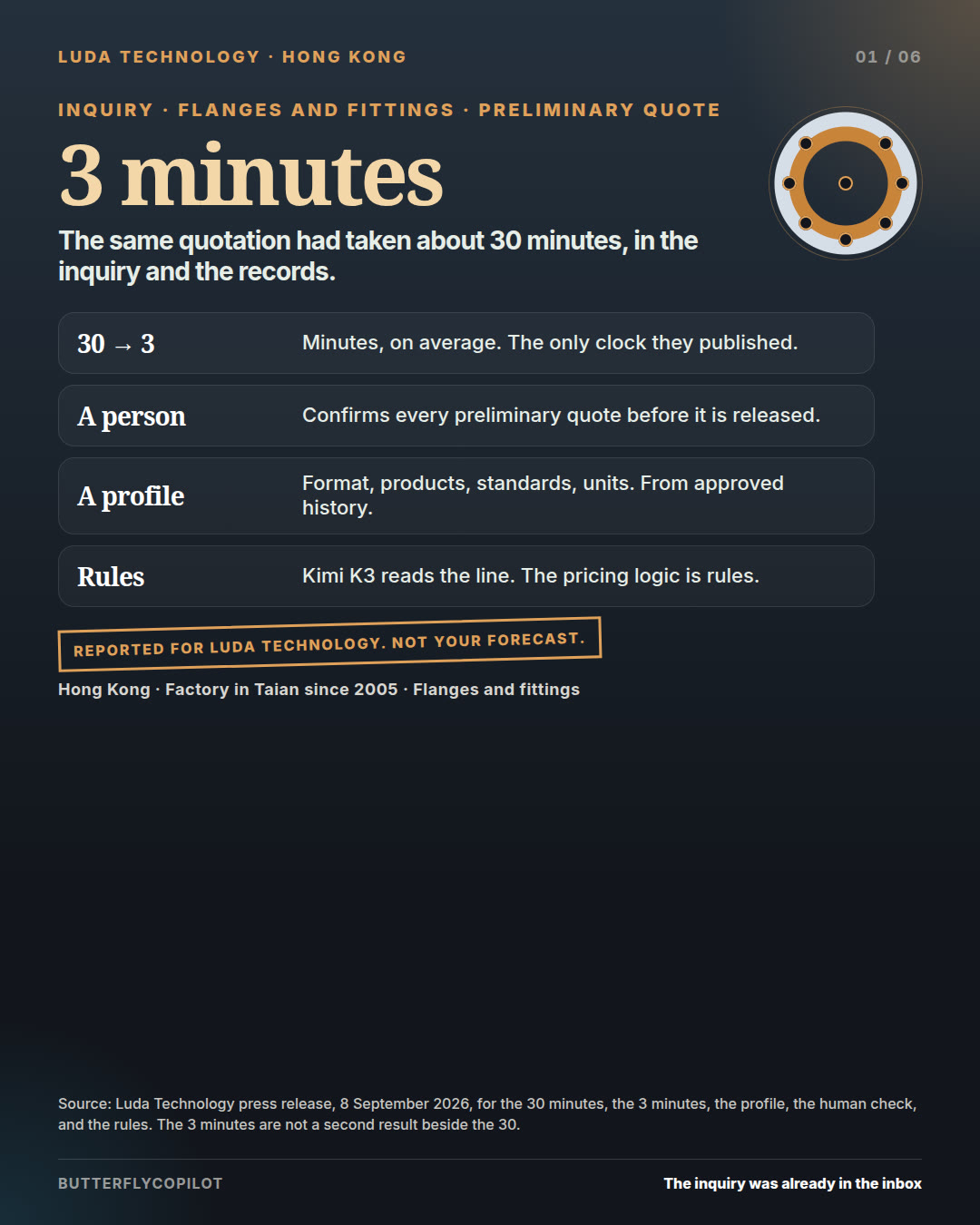
The quote took about 30 minutes in the inquiry, the spreadsheet, and the weight. It comes back in 3 minutes, and it still does not leave until a person confirms it.
ButterflyCopilot
0106
The inquiry was already in the inbox.
Luda Technology Group (NYSE American: LUD) makes and trades stainless steel and carbon steel flanges and fittings. The head office is in Hong Kong. The factory is Luda (Taian) Industrial Company Limited, in Taian, Shandong, set up in 2005, after Luda Development Limited was incorporated in Hong Kong in 2004 to trade the same goods. More than 20 years on, the company also trades steel pipes, valves, and other steel tubing.
Customers sit across China, South America, Australia, Europe, Asia, and North America. They are manufacturers and traders in chemical, petrochemical, maritime, energy, and general manufacturing.
The Form 20-F for the year ended 31 December 2025, filed 15 May 2026, prints revenue of US$33,535,351, which that filing calls approximately US$33.5 million, and US$44,863,430 for 2024, which it calls US$44.9 million. That year had closed before this desk was announced in September. The revenue is the company. It is not a result of the quote.
A quotation was a person and a pile of records. Staff read the customer inquiry, the spreadsheets, and the internal records, looking for the product spec, the item weight, and the pricing inputs. The average took about 30 minutes.
What they stood up
The inquiry and quotation system reads the incoming inquiry. It searches validated internal data. It writes a preliminary quotation for review. It keeps a profile for each client, built from approved history: the way that client usually writes an inquiry, the products they usually ask for, the standards they prefer, the units they usually use.
Every preliminary quote is checked and confirmed by authorised staff before it is released. When those people correct a quote, the correction is captured. On a similar inquiry later, it is applied. The release calls that loop controlled.
The model they name is Moonshot AI's Kimi K3. Around it: a multi-agent architecture, retrieval-augmented generation, intelligent data search, and rules-based pricing logic.
The aim they state is to answer international stockists faster, to take more inquiries without a matching rise in headcount, and to move experienced people onto technical review, customer work, and the commercial decision. No headcount figure is printed next to that aim.
"This system marks the beginning of AI integration within our operations and demonstrates our effort to use leading technology to improve operational efficiency."
That is Ma Biu, the chief executive. The beginning is the word to keep. One clock is published. The check stays with a person.
An inquiry comes in
        ↓
The system reads it and searches validated internal data
        ↓
A preliminary quote, priced by rules
        ↓
Authorised staff check it and confirm it
        ↓
An approved correction is kept, and applied on a similar inquiry later
The average quotation processing time went from about 30 minutes to 3 minutes.
A missing grade is not a price
Speed is how a tidy agent types a weight the table does not hold, turns 4 inch into 101.6 millimetres and calls it a DN, prices a grade the book does not stock, or sends the quote nobody confirmed.
The file for a smaller flange and fittings maker keeps the shape and drops the plant. One family. Flanges. The catalogue, the weights, and the rates the company will actually defend, in a spreadsheet when that is where they live. The model may copy the line the customer wrote. It may not invent a size, a grade, a weight, or a price. Four inch on the fixture's ASME table is DN 100 because the row says so. It is not 4 times 25.4. A decimal nominal stops. It does not get rounded to the nearest size.
The price is integer cents. Grams, times the rate per kilogram, plus a process amount for the flange type. The fixture's 4 inch weld neck, class 150, raised face, A105, quantity 10, comes out at 862 cents a piece and 8620 cents on the line. Those grams and those rates are fixture rows. They are not a published flange weight, and they are not Luda's price. A second customer in the same fixture, with a 5 percent discount the file uses only as an example, comes out at 819 cents a piece and 8190 cents on the line. The formula line still reads 862.
A blank grade stays a question. A105 is not the default. An unknown grade does not become a new row. A line the catalogue does not have stays off the quote. The agent does not mint a SKU so the email can leave. Class 150 and PN 16 on the same line are a question. They are not an equivalence this file invented. A second currency stops. It does not get converted. Ten kilograms is not ten pieces.
The release is a person. IMS Gear kept the price in the tables and the signature on an engineer. This desk keeps the cents in the rate card and the confirmation on authorised staff. The pack is a file. Sent stays no. A price the reviewer changes is logged, and the formula result stays on the trace. That override is not the next inquiry's price. An approved alias can travel forward. The next line is still priced by the formula.
Their model endpoint, and any send, are a later choice. Version 1 reads text the company already has, from the email, the WhatsApp export, the PDF, or the sheet. It writes a preliminary quote.
What a smaller maker should steal
If a quote still starts with last month's spreadsheet, the first month is one flange family and twenty inquiries a person already finished.
One family
        ↓
Twenty past inquiries, with the hand line and the hand price stored, and a stopwatch on the minutes a person already spends
        ↓
Thirty days where the draft sits beside that hand quote, and nothing is released
        ↓
Thirty days where authorised staff may confirm, and the pack stays on disk
        ↓
The customer email still leaves from a person. The next family waits for its own twenty.
Time the stretch you already have. Minutes from the inquiry in hand to a quote someone will confirm. How many lines match the catalogue exactly. How many of the old quotes still match after a rate change. How many lines the reviewer corrects, and how many they drop. How many quotes you later revise. How many weights, prices, or customers this agent created. How many quotes it sent. Those last counts stay at zero.
The move from about 30 minutes to 3 minutes is Luda's published story. It is not a line for a proposal. The headcount sentence is an aim. It is not a number. Do not invent the number.
What the instruction file will make an agent do
The file below is the brief. It is not their Kimi deployment, and it is not their rate card. None of that schema is public. The blanks are yours. Kimi K3 is the model they named. The price path does not call it. A parser slot can point at Kimi, or at another model, or at no model if the lines are already in the sheet. That choice is a recommendation. It is not a finding about a second system inside Luda.
It will make the agent:
- Refuse to run while a
REPLACEline is empty, or while anEXAMPLErow is still in a live sheet. - Read an email, a WhatsApp export, PDF text, and spreadsheet rows. Refuse to turn 4 inch into 101.6 millimetres. Refuse to read a drawing it was not given as text.
- Match a line to the catalogue by standard, type, size, pressure, facing, and material. ASME B16.5, EN 1092-1, and JIS B2220 are rows the company fills. They are not a claim about Luda's book.
- Price from the tables with the integer formula in the file. The fixture's weld neck comes out at 862 cents a piece and 8620 cents on ten pieces. The old quote at 9999 cents, on the same part, is listed and left unused. The 5 percent example comes out at 819 cents and 8190 cents, and the formula line still reads 862.
- Treat a blank quantity as missing. Treat a blank grade as missing. Treat an unknown grade as unknown. Treat a weight that rounds the material to zero cents as a stop. Treat a line with no catalogue row as off the quote.
- Ask only the missing fields, in a fixed order. Only the reviewer may fill them. A field named price is refused on that form. A price the reviewer wants changed is an approved override, logged, and the formula result stays on the trace. The override is not the next inquiry's price.
- Re-run every stored hand quote after a rate change. Moving the A105 rate fails go-live and leaves the golden at 862 cents.
- Confirm only from the form, only by authorised staff, with a reason long enough to read. Write a customer pack only after that confirmation and the later flag. Leave the sent flag at no.
- Write a morning file from this company's own counts. No comparison with the case study.
The tests are in the file. The weld neck at 862 cents, with the prior 9999 left unused. A DN of 101.6 that does not become 100. A blank grade that does not become A105. A grade named F321 that does not become a new row. Class 150 and PN 16 on one line, and no price. A euro amount on a US dollar desk, and no conversion. A regression that stays red when the rate changes. A pack that reads 8.62 USD and 86.20 USD and does not contain 9999. If the agent clears any of those by copying the old price, multiplying 4 by 25.4, or emailing the customer, the test fails.
The instruction file
The brief has the role, the tables a spreadsheet can hold, the six agents, the prompts, the pricing contract, the questions for the reviewer, the confirmation, the correction loop, the regression set, the ninety days, and the tests that decide when a quote may be shown.
Replace every REPLACE line. Delete every EXAMPLE row. Let it sit beside one family's quotes for a month a person still prices by hand, before anyone treats a file as a quotation the customer has already been sent.
Sources
The before-and-after, the 30 minutes and the 3 minutes, the profiles, the human check, the closed loop, the model, and the words from Ma Biu are from Luda's press release of 8 September 2026. The Form 6-K filed the same day exhibits that release. The Form 20-F filed 15 May 2026 is the company: the dates, the factory, the trading line, and the revenue. The figures are as those pages report them. They are not an independent audit, and they are not a forecast for another maker. Approximately 30 minutes and 3 minutes are one sentence about one change. This page does not turn them into a ratio. Approximately US$33.5 million and US$44.9 million are the filing's own rounding of US$33,535,351 and US$44,863,430. This page does not invent a third figure. The press release lists customers across Asia. The Form 20-F's geographic table splits People's Republic of China from Asia excluding the PRC. This page does not average those two presentations into a new map. The revenue year had closed before the September announcement. It is not a result of the desk.
- Luda Technology Group Limited, "Luda Technology Group Limited Implements AI-Enabled Multi-Agent Inquiry and Quotation System to Accelerate Order Processing," Hong Kong, 8 September 2026 (Globe Newswire). The same text is on Globe Newswire. Manufacturer and trader of stainless steel and carbon steel flanges and fittings. Also trades steel pipes, valves, and other steel tubing products. Hong Kong headquarters. Luda Development Limited incorporated in Hong Kong in 2004. Luda (Taian) Industrial Company Limited established in 2005, self-owned factory in Taian, Shandong. More than 20 years. Customers across China, South America, Australia, Europe, Asia, and North America, in chemical, petrochemical, maritime, energy, and general manufacturing. Average quotation processing time reduced from approximately 30 minutes to 3 minutes. Aim: respond to international stockists faster, handle higher inquiry volumes without a corresponding increase in headcount, and direct experienced personnel toward technical review, customer engagement, and commercial decision-making. Before: staff manually reviewed inquiries, spreadsheets, and internal records for product specifications, item weights, and pricing inputs. The system interprets inquiries, searches validated internal data sources, and generates a preliminary quotation for review. Client profiles from approved history: usual inquiry format, commonly requested products, preferred standards, customary units. Every preliminary quotation is checked and confirmed by authorised personnel before release. Approved corrections are captured and applied to similar future inquiries. Powered by Moonshot AI's Kimi's K3 model, with a multi-agent architecture, retrieval-augmented generation, intelligent data search, and rules-based pricing logic. Ma Biu, Chief Executive Officer: "This system marks the beginning of AI integration within our operations and demonstrates our effort to use leading technology to improve operational efficiency." The comment continues that the company is targeting progressive scaling of AI across further functions, combining AI with established product knowledge and more than two decades of commercial experience. The company site named in the release is www.ludahk.com.
- Luda Technology Group Limited, Form 6-K, filed 8 September 2026, exhibit 99.1 the press release of that date. Signed by Ma Biu, Chief Executive Officer.
- Luda Technology Group Limited, Form 20-F for the fiscal year ended 31 December 2025, filed 15 May 2026. Ordinary shares trade on NYSE American under LUD. Principal executive offices in Hong Kong. Luda Development Limited incorporated 20 February 2004. Luda (Taian) Industrial Company Limited incorporated 4 April 2005. Manufacture and sale of stainless steel and carbon steel flanges and fittings, and trading of steel pipes, valves, and other steel tubing products. Manufacturing base in Taian, Shandong. Sales network across China, South America, Australia, Europe, Asia excluding the PRC, and North America. The geographic table prints those regions separately, with the PRC as its own line. Customers include manufacturers and traders in chemical, petrochemical, maritime, energy, and general manufacturing. The filing says the company can manufacture in conformance with various countries' standards. It does not name ASME B16.5, EN 1092-1, or JIS B2220. Revenue for the years ended 31 December 2025 and 2024: US$33,535,351 and US$44,863,430. The filing's words: approximately US$33.5 million and US$44.9 million, respectively. Those figures are not a result of the quotation system announced the following September.