
How Maschinenfabrik Reinhausen Cut Spec Analysis Time with AI
The rating was already in the table. It still took about five hours to get it out. A 70-page specification then took about 12 seconds, and a person still has to accept the match.
ButterflyCopilot
0106
The rating was already in the table. Getting it out was the job.
Maschinenfabrik Reinhausen builds the equipment that keeps voltage under control while a transformer stays on load. On-load tap-changers, de-energized tap-changers, sensors, automation, analytics. The company page puts the start in Regensburg in 1868, a majority family-owned business in its sixth generation, with around 5,900 people at the Reinhausen GmbH headquarters and in 42 associated companies in 26 countries. It says 50 percent of the electrical energy transported worldwide is regulated using MR solutions. The customers it names are energy producers, grid operators, and transformer manufacturers. The case study that follows still uses the name Maschinenfabrik Reinhausen, MR, and calls the company a global leader in transformer control and regulation technology.
The slow part was not the tap-changer. It was the customer specification in front of it.
A different shape every time
A specification arrived as a long PDF. The structure was not the same as the last one. Somewhere in it were the ratings, the duties, the exceptions, the table that actually governed the job. Someone who knew the product, and who knew how that region wrote a spec, pulled the key lines out by hand and then held them against the products MR was willing to offer.
That reading was slow. It was easy to miss a line. Two people could come back with two different sets of requirements, and the difference tracked who had done it and where they worked. The project with appliedAI, in Munich, was stood up to take that extraction and the product match that follows off the individual reader.
The build was a six-month project in two phases. First the design and a prototype. Then the hardening, and the move into production. The timeline drawn on the case study runs from November 2024 to November 2025. The engineers on the vendor's side worked with MR's domain experts. The point, across both phases, was that MR would be able to run it, change it, and extend it without the project staying in the vendor's hands.
What they put in front of those experts was three things at once. A chat, so a person could ask a question of a long specification and get an answer. A pipeline that read the specification and wrote the relevant requirements out in the customer's own output shape. And a match of those requirements against selected MR products. The case study describes the whole of that as sitting in an architecture MR controls.
The figures that follow are from that published case study. They are not an independent audit, and they are not a forecast.
Twelve seconds, and the detailed miss
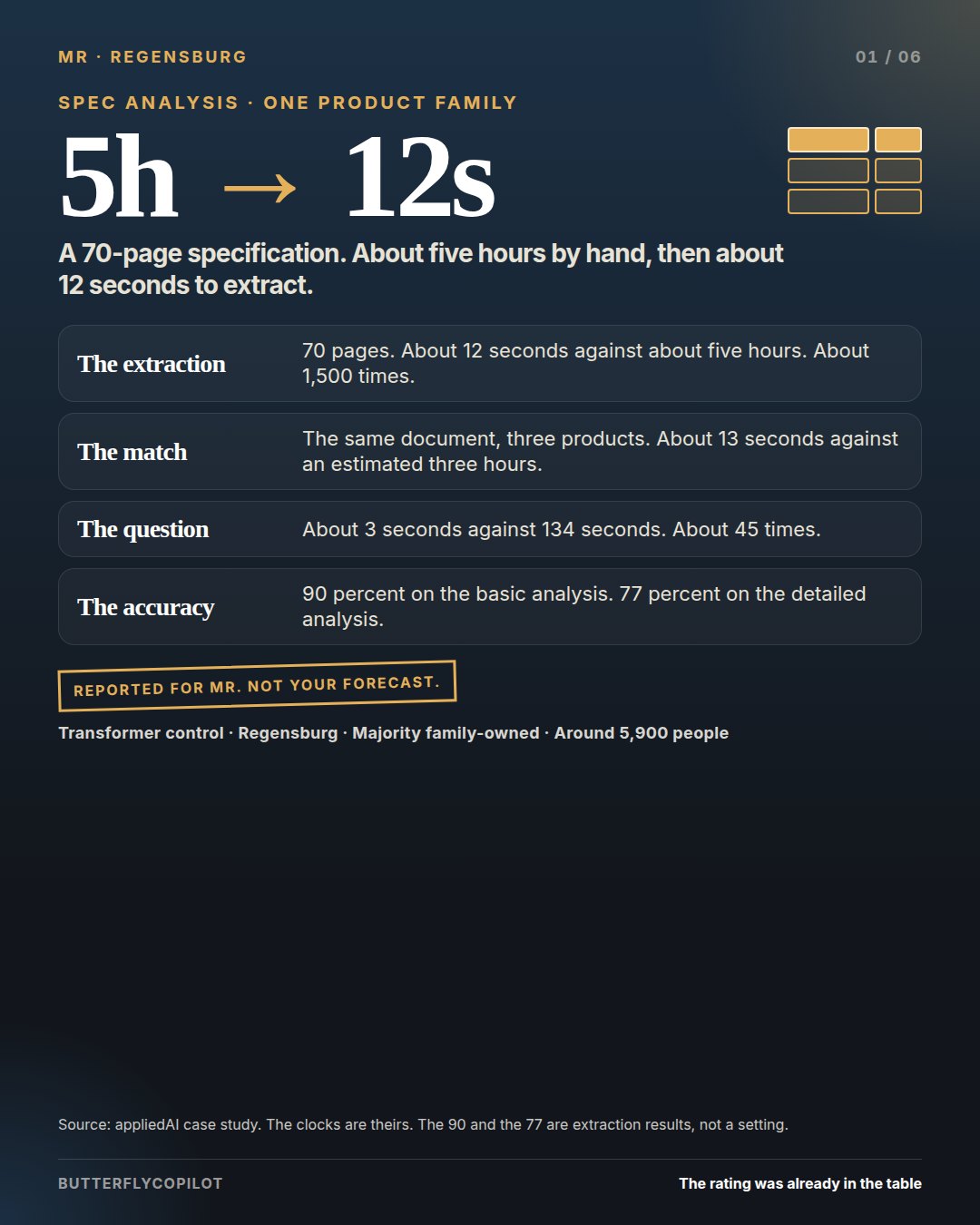
A 70-page specification that had taken about five hours to extract came back in about 12 seconds. About 1,500 times. Matching that same document against three products, estimated at three hours by hand, took about 13 seconds. About 830 times. A question against the document came back in about 3 seconds, where a person had taken 134. About 45 times.
The accuracy was not one number. Basic analysis extraction was reported at 90 percent. Detailed analysis extraction was reported at 77 percent. The same vendor's product page, measuring the deployment at MR, puts extraction accuracy at 90 percent at component level, and repeats the 12 seconds and the 13 seconds. It describes the reading as page by page and table by table, every parameter traced to a page, a paragraph, or a table cell, a person on the critical fields, and several product options rather than a drift toward the usual one. Export, on that page, is Excel, JSON, or ReqIF.
The solution is in production. Domain experts at MR use it.
A specification arrives as a PDF
        ↓
Pages and tables are stored before anyone names a unit
        ↓
A field is a cell the company already knows how to read
        ↓
The grammar writes the number. A typed number is thrown away
        ↓
Products that pass are ranked, with the gaps still showing
        ↓
A reviewer accepts. The runner does not send a quote
The boxes are the instruction file. They follow the shape the story describes: a document in, requirements out, a match against a catalogue, a person still in the loop. They are not a reconstruction of MR's screens, and they are not appliedAI's project plan.
What they named as next is the part that makes a desk like this survive contact with the catalogue. A knowledge base a non-technical person can edit, so products and the extraction rules are not a ticket to engineering. A configuration store that feeds what the experts correct back into the pipeline. A connection into product management and quoting, including the enterprise catalogue and help generating the quote. Connectors onward, into ERP and the systems around it.
A tidy table is not a signed match
Speed is how a plant with an empty header list expects 12 seconds in the first month. Speed is how "about 7.5 kW" becomes 7500 watts because the model has seen that sentence before. Speed is how a second ratio in the same table is averaged away, because one number is easier to match than two. Speed is how the largest unit in the family wins, because it usually does, and the specification's shaft size was a detail. Speed is how a torque written out in words is filled from the product row, which makes every product pass a constraint it never had to meet.
The file below keeps the shape and drops the plant. One product family, because that is the first version a smaller manufacturer can actually label by hand. The customer's PDF is the company's. The headers, the phrases, and the digit patterns are the company's. The model may point at a cell. It may not type the watts. The grammar reads 7.5 kW as 7500 watts by scaling the digits, with no floating point in the middle. A cell it cannot read stays unparsed. A phrase that is not on the list stays unknown. Two values for the same rating are both shown. The agent does not pick. Products that fail a known constraint are listed as near misses, not nudged over the line. A reviewer accepts one option, one specification at a time. The person who may approve go-live cannot accept the technical match. Nothing in the file is a quote.
On the fixture, which is ours, a made-up family of helical gear units has three rows. A clean specification asks for 7.5 kW, a ratio of 3.55, a foot mount, 150 Nm, and a 30 millimetre shaft. Two units pass. The larger flange-mounted unit fails the ratio, the mount, and the bore, and its extra power does not move it up the list. A cell that says "about 7.5 kW" blocks the job. A model that types 999 has that number counted and then deleted. "Base mounted" is not stored as foot. A required 35 millimetre bore matches nothing, and the 30 millimetre units are not offered as close enough. A torque written as words stays unknown, which is why the fixture's detailed count is one short of its detailed labels. Those rows exist so a builder can test the citation, the grammar, and the refusals. They are not an MR data sheet, and they are not a gearbox anyone should cut.
SIP Manufacturing is the quote desk on this site. That one prices a job and keeps a person on the send. This desk stops at the match. The percents on that page do not belong on this one. The 12 seconds and the 90 percent on this page do not belong on that one.
The useful caution is the header list. A result like the one in the story sits on specifications and a product table an agent can point at. An empty synonym file will not trace a 70-page document to a cell in the first month. The file spends that month loading one family and checking that a missing mount still stops the run.
The original sits with appliedAI. Buying that path is a real option. The vendor's engineers in the room are the reason the case study gives for a system MR's own experts now use. The file is the other path: folders, the headers the company is willing to trust, a Python runner, and a model that is allowed to point. The gates are the same on both. A person accepts. A number comes from code.
What a smaller manufacturer should steal
If the work is still a stack of customer specifications, and the expensive miss is a rating that depended on who read it, the first month is one product family and the headers you are willing to get wrong in private.
Let the model point at the cell. Let the grammar decide the number. Keep unknown flagged. Show several options, and show the constraint each one failed. Keep a person on the accept, including after a clean first specification. Refuse the old failure mode, which was to finish the match on the lines that were easy to find and the product the company usually sells.
One product family
        ↓
Thirty days of headers, phrases, and a stopwatch on specifications a person already matches
        ↓
Thirty days where the parsed value sits beside the person's, and nothing is accepted
        ↓
Thirty days where a clean match may be accepted, and still is not quoted
        ↓
The question bot, the price, and the catalogue sync wait
Count the stretch you already have. Minutes from a specification in hand to a match a reviewer will accept. How the pile splits across a clean match, a partial, a conflict, a block, a near miss, and a citation that does not resolve. How many basic fields and how many detailed fields match a label a person wrote, as two pairs of integers, not as a percent. How many values the agent invented. How many unknowns are still flagged. How many quotes this agent released. That last count stays at zero.
MR's scoreboard is not your forecast. About 12 seconds against about five hours, about 13 seconds against an estimated three hours, about 3 seconds against 134 seconds, 90 percent on the basic analysis, 77 percent on the detailed analysis, and a system in production with the domain experts, are this company's published story. Around 5,900 people is the company page's account of Reinhausen. It is not a hiring plan, and it is not your headcount. The company page does not state a revenue, and this page does not add one. Measure your own minutes.
What the instruction file will make an agent do
The file below is the brief. It is not appliedAI's application, and it is not MR's catalogue. None of that schema is public. The blanks are yours. The same match works as a JSON file a reviewer can open, and as two CSV files Excel can open.
It will make the agent:
- Refuse to run while a
REPLACEline is empty, while anEXAMPLEid is still in a live folder, or while anyone has typed 90 percent, 77 percent, 12 seconds, 13 seconds, or 1,500 into the config. - Take one product family. The question bot, the quote, ReqIF, and the catalogue sync return a locked scope until a person turns one on, after this set has passed.
- Parse the fixture page by page and table by table. A live PDF adapter has to emit the same rows. The runner does not interpret a unit inside the parser.
- Keep a field only when the grammar can read the cited cell or the cited sentence.
7.5 kWbecomes 7500 watts in code.about 7.5 kWdoes not.base mounteddoes not become foot. - Show both values when two cells disagree. It does not pick, and it does not average.
- Strip a model-typed
999. The digits do not appear in the job. A proposal does not replace a header the company already registered. - Rank the units that pass every known constraint, smallest sufficient power first. A 30 millimetre bore does not satisfy a required 35. The largest unit does not win on size.
- Refuse an accept from anyone but the reviewer, and refuse a partial option unless the action is the partial one. The accepted file still is not a quote.
- Write a morning file from this company's own counts: ready, conflict, no fit, blocked, basic correct and seen, detailed correct and seen, invented values, unknowns flagged. No comparison with the case study. No percent.
The tests are in the file. The hashes of the clean match, the partial, the word "about", the discarded 999, the missing citation, the two ratios, the out-of-range ambient, the unknown mount, the bore that fits nothing, the low-confidence pointer, the words-only torque, the morning file, and the reviewer's token are locked. A price on that run fails the test. If the agent clears any of those by inventing a watt, picking a ratio, preferring the big unit, or releasing a quote, the test fails.
The instruction file
The brief has the role, the one family a spreadsheet can hold, the field record, the citation, the match schema, the pointer prompt, the integer grammar, the review token, the four workflows that stay off, the audit, the basic and detailed counts, the ninety days, the risks, and the tests that decide when a file may be treated as a match a reviewer has been asked to accept.
Replace every REPLACE line. Delete every EXAMPLE row. Let it sit beside one product family for a month a person still matches by hand, before anyone treats a file as a quote the customer has already accepted.
Sources
The company, the pipeline, and the figures in the story are from the pages below. The founding, the ownership, the headcount, the 50 percent, and the product names are from Reinhausen's company page. That page does not state a revenue, and this article does not add one. The clocks, the accuracies, the six months, and the next steps are as the case study reports them. They are not an independent audit, and they are not a forecast for another manufacturer. The case study is the vendor's own customer story. That is noted here, once. The product page is a second vendor page. Its component-level 90 percent is a different sentence from the case study's 90 percent on basic analysis, and this article does not merge them.
- appliedAI, "From Specification to Quote in Minutes: How Maschinenfabrik Reinhausen Automates Product Configuration and Matching with AI." Maschinenfabrik Reinhausen (MR), a global leader in transformer control and regulation technology, with an AI solution from appliedAI for specification documents, product configuration, and quoting. The timeline line on the page reads "Timeline from Nov 24 to Nov 25 for the project described in 2 seperate phases." The problem as written: low process efficiency and a high susceptibility to errors. Key information extracted by hand from specifications with varying structures, time-consuming, prone to mistakes, inconsistent outcomes. Interpretation quality varies with individual expertise, experience, and regional working practices. The aim: automate specification extraction and the following product match, reduce processing time and cost, and raise and standardise output quality. Delivery: AI engineers with domain experts at MR. An AI chatbot for questions and answers on specification documents, a fully automated pipeline that extracts the relevant details and supports customer-specific output formats, and a match of those requirements against selected MR products, in a secure enterprise-grade architecture that remains under MR's control. A six-month project in two phases: design and prototyping, then hardening and the transition into production, with MR able to run, improve, and scale it. Results, as written: about 45 times for Q&A, an average LLM response of about 3 seconds against 134 seconds manual; about 1,500 times for automated extraction, a 70-page document in about 12 seconds against about 5 hours manually, on the line that reads "for asic analysis and detailed analysis"; about 830 times for automated product matching, a 70-page document and 3 products in about 13 seconds against an estimated 3 hours manually; 90 percent for basic analysis extraction results; 77 percent for detailed analysis extraction results; production-ready and actively used by domain experts. The speed line is missing the letter b in "basic." The accuracy lines spell "basic analysis" and "detailed analysis." This article uses basic for that speed line and does not add a third analysis type. Next steps, as written: a no-code editable knowledge base so non-technical users can maintain products and configure extraction and matching pipelines; a central configuration database as a feedback loop; integration with product management and quoting tools, synchronising with the enterprise product catalogue and using LLMs for quote generation; connectors to further internal systems, with ERP, analytics, and CMS given as examples. appliedAI Initiative GmbH, August-Everding-Straße 25, 81671 München.
- appliedAI, "Industrial Document Intelligence." The productised application. Used here for the description of page-by-page and table-by-table extraction, traceability to a page, a paragraph, or a table cell, human validation on critical fields, catalogue matching that proposes several options without a bias toward known standard solutions, and export to Excel, JSON, or ReqIF. The measurements it attributes to production use at Maschinenfabrik Reinhausen are about 12 seconds instead of about 5 hours for full specification extraction (1,500 times), about 13 seconds instead of about 3 hours for automated product matching (830 times), and 90 percent extraction accuracy at component level. This article does not treat that 90 percent as the same sentence as the case study's 90 percent for basic analysis, and it does not use this page's marketing ranges (hundreds of hours, hundreds of pages, a 4-to-6-week package) as facts about MR's project.
- Reinhausen, "Company." Founded in Regensburg, Germany, in 1868. Majority family-owned, sixth generation. Around 5,900 employees at the Reinhausen GmbH headquarters in Regensburg and in 42 associated companies in 26 countries. 50 percent of the electrical energy transported worldwide is regulated using MR solutions. Products named on the page: on-load tap-changers and de-energized tap-changers, sensors, automation technology, analytics, and digital solutions. Named examples: VACUTAP on-load tap-changer, TAPCON voltage regulator, ETOS transformer operating system, MTraB intelligent dehydrating breather, TESSA asset performance management. Customers named: energy producers, public and industrial grid operators, and transformer manufacturers. This page uses the company page for that background. It does not use the page for a revenue, and it does not use the page for the agent results. A facts panel on the same page states the headcount as 5,900 worldwide and states a different 50 percent sentence ("of the world's electricity flows through MR products"). This article uses the prose sentences, not that second 50 percent line.