
How SIP Manufacturing Cut Quote Prep Time with AI Agents
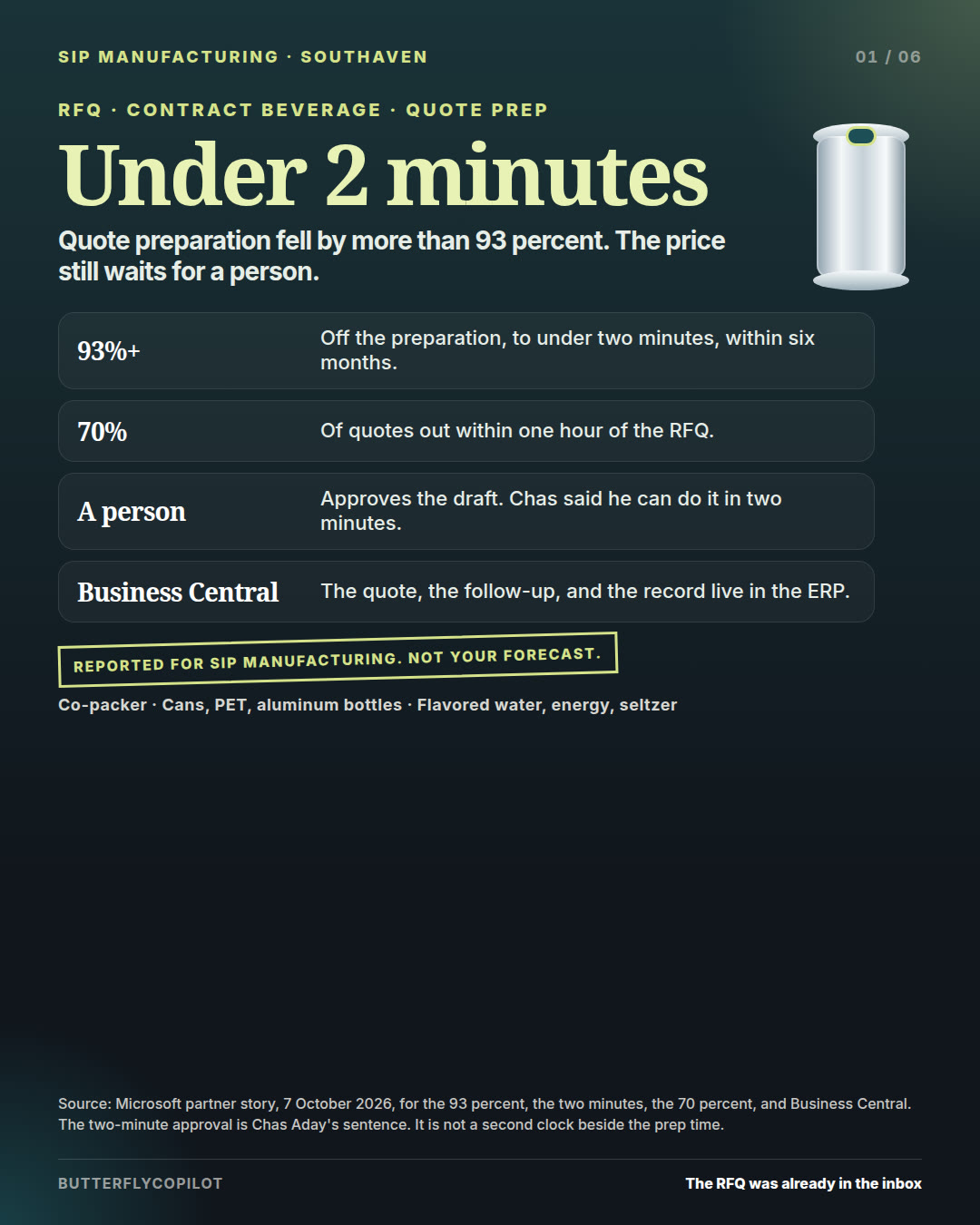
The quote lived in a spreadsheet, a sticky note, and the inbox. Preparation fell by more than 93 percent, to under two minutes, and the price still does not leave until a person approves it.
ButterflyCopilot
0106
The RFQ was already in the inbox. The quote was the slow part.
SIP Manufacturing (SIP Manufacturing 2.0, LLC) is a US contract beverage manufacturer. The work runs from product development through shipment. The packages are aluminum cans, PET bottles, and aluminum bottles. The drinks are flavored waters, energy drinks, and hard seltzers. Chas Aday is the founder and the CEO.
In Southaven, Mississippi, the company is putting more than $100 million into the operation and 187 jobs with it. The new plant is open. On the line that is already running, output is 600,000 cans a day, two new facilities are going up, 180 people are being hired, and capacity is set to quadruple. Chas was still carrying a large share of the sales work. The days were going into spreadsheets, sticky notes, and email.
Those two pictures are not one arithmetic. The investment and the 187 jobs are the state's account of Southaven. The cans per day, the two facilities, the 180 hires, and the quadrupling are the operating picture Forgepoint's founder, Jack Strauss, posted. This page does not add 180 to 187.
What they stood up
SIP put Forgepoint's agent Frank on the quoting. Frank is an AI inside sales rep. It works with Microsoft Dynamics 365 Business Central, and it takes the quoting, the follow-ups, and the record updates that used to sit with the team.
Within six months, quote preparation time was down by more than 93 percent, to under two minutes. Seventy percent of quotes were out within one hour of the RFQ. Customer records and sales activity update in the ERP. Chas and his team still approve.
Before Forgepoint, we were building quotes by hand and barely keeping up. Now, Frank drafts and I can approve it in two minutes.
That is Chas. Onboarding, run by Alisha Anderson, was handled in a few clicks. The clicks are not a procedure this page can reconstruct. The result that matters is the one he named: a draft he can approve, and the approval still his.
The shape of the desk, across the way Forgepoint describes Frank, is a mailbox of its own on the company domain. It learns the shop's SOPs, the pricing rules, and who has to say yes. It reads the RFQ, the drawings, and the attachments. It pulls the spec. When a fact is missing it emails the customer. It drafts the cost from past jobs and the pricing model, and it asks a colleague to review. After the yes, it writes the quote in the company template, sends it, follows up, and files the correspondence in the CRM or the ERP.
An RFQ hits the agent's own mailbox
        ↓
The spec comes off the email and the attachments
        ↓
A missing fact goes back to the customer, with no price in that note
        ↓
A draft, from the shop's rules, with a past job beside it
        ↓
A person approves
        ↓
The template goes out, a follow-up follows, the ERP record is written
Across Forgepoint's customers, the company reports monthly quote throughput up 30 percent on average, and time-to-quote down more than 55 percent. Those are not SIP's 93 percent and not SIP's 70 percent. They do not get averaged into a third number here.
A past job is not a price
Speed is how a tidy agent turns 12 ounces into a millilitre by multiplying, prices a hard seltzer on a still-water card, copies last month's total because it is nearby, and sends the mail because the draft looked finished.
The file below keeps the shape and drops the plant. One format. A 12 ounce aluminum can, if that is a format the shop actually runs. The rates are the shop's. The mailbox is the shop's. The person who approves is the shop's. The model may copy a phrase the customer wrote. It may not invent a fill, a case pack, a freight lane, or a dollar.
On the fixture, 10,000 cases of that can, 24 to a case, customer-supplied cans and formula, still water, comes out to 1,825,000 cents. That is 18,250.00 dollars: 18,000.00 of toll and 250.00 of setup. The same job with the house supplying the cans comes out to 60,250.00 dollars. A past total of 999,900.00 dollars sits on the draft under a heading that says it was not used. Those cents are fixture rows so a builder can test the arithmetic. They are not a SIP price, and they are not a quote anyone should send.
Twelve ounces becomes 355 millilitres only because the shop's alias table says so. It does not become 354.882. An energy drink on that fixture is out of the pilot. A request to cost the ingredients does not get a toll "in the meantime." A request for freight to Memphis can still price the fill, and it cannot be approved until a person accepts that freight is not in the number.
The send is a person, and then a flag that person turns on. Luda Technology kept the cents in a rate card and the confirmation on staff. This desk does the same, and after the gates it is allowed to send, because the published SIP desk does send. It is not allowed to send the unapproved draft. Business Central gets the sales quote only after the same yes, and only if the total read back matches to the cent. A mismatch stops the email. The agent does not patch the price to force the match.
What a smaller co-packer should steal
If a quote still starts as an email and a spreadsheet, the first month is one package and twenty RFQs a person already finished.
The useful part of SIP's story is the decision, not the can count. Put the agent on the quoting admin. Give it a mailbox that is not the founder's. Price from rules the shop will defend. Leave the yes on a screen a person can finish from a phone. Write the quote into the ERP the company already runs, and keep an audit that does not get trimmed. Do not start by posting to the production company because a sandbox felt slow.
One format
        ↓
Twenty past RFQs, with the hand total stored, and a stopwatch on the seconds a person already spends
        ↓
Thirty days where the draft sits beside that hand quote, and nothing is sent
        ↓
A clarification may leave once a person has read ten of them and none carried a price
        ↓
A sandbox quote matches to the cent, and only then does a person turn the customer email on
        ↓
The next package waits for its own twenty
Time the stretch you already have. Seconds from the RFQ in hand to a draft someone can approve. The share of sends that leave within 60 minutes, with the unsent ones older than that counted beside it, not hidden. How many clarifications went out. How long the approval actually took. How many quotes you later revised. How many prices, customers, or emails this agent created without a matching approval. Those last counts stay at zero.
SIP's scoreboard is not your forecast. More than 93 percent, under two minutes, and 70 percent within an hour are this company's published story, over six months. The 30 percent and the 55 percent are Forgepoint's figures across its customers. Measure your own seconds. Do not paste their numbers onto a proposal, and do not invert 93 percent into a before-time the sources never printed.
What the instruction file will make an agent do
The file below is the brief. It is not Frank, and it is not SIP's rate card. None of that schema is public. The blanks are yours. Business Central is the ERP the case names. The price path does not care which ERP stores the total, as long as it can return the total you just wrote.
It will make the agent:
- Refuse to run while a
REPLACEline is empty, or while anEXAMPLErow is still in a live sheet. - Read a mailbox the agent owns. Store drawings. Price only from email text and from attachment text the company has already extracted.
- Match one pilot format from the shop's tables. On the fixture, 12 ounces is 355 millilitres because the alias says so. Sixteen ounces does not borrow that row.
- Price from the formula in the file. The fixture's customer-supplied can run is 18,250.00 dollars. The past total of 999,900.00 dollars is listed and left unused. The house-supplied twin is 60,250.00 dollars.
- Treat a blank class, a blank case count, or a blank supply mode as a question. The question email contains no dollar sign. An energy drink on the fixture does not get that email. It stops for a person.
- Approve only from the form, only by the reviewer or the backup, only for the hash of that draft. A model that says "approved" is ignored. Opening the phone link does not approve.
- Post a Business Central sales quote only after that approval, then read
totalAmountExcludingTaxback. 18,250.00 matches. Anything else does not send. A second quote for the same RFQ is refused. - Follow up on day 3, day 7, and day 14, our calendar, not a published SIP cadence. The note does not restate the price.
- Write a morning file from this company's own prep seconds and its own share of sends within an hour. No comparison with the case study.
The tests are in the file. The hash of the fixture draft is locked. A unit price of 1.80 that a builder turns into 180 fails the read-back. A clarification that grows a price fails. A follow-up that includes the total fails. If the agent clears any of those by copying the old quote, multiplying 12 by 29.57, or emailing the customer early, the test fails.
The instruction file
The brief has the role, the tables a spreadsheet can hold, the path from mailbox to send, the prompts, the pricing contract, the clarification, the phone approval, the Business Central calls, the follow-up days, the audit, the ninety days, and the tests that decide when a quote may leave.
Replace every REPLACE line. Delete every EXAMPLE row. Let it sit beside one format's quotes for a month a person still prices by hand, before anyone treats a file as a quotation the customer has already been sent.
Sources
The company, the Southaven project, the operating picture, the six-month quoting results, Chas Aday's sentence, and the description of Frank are from the pages below. The figures are as those pages report them. They are not an independent audit, and they are not a forecast for another co-packer. This page does not add the state's 187 jobs to the 180 hires, and it does not turn "more than 93 percent" into a before-time.
- Mississippi Development Authority, "SIP Manufacturing locating operations in Southaven," 22 July 2026. SIP Manufacturing 2.0, LLC. US third-party contract beverage manufacturer and co-packer, product development through shipment. Aluminum canning, PET bottle, and aluminum bottle packaging. Flavored waters, energy drinks, hard seltzers. CEO and founder Chas Aday. Southaven, Mississippi: more than $100 million of corporate investment, 187 jobs.
- The Canmaker, "Beverage co-packer SIP opens new plant in Mississippi," 3 August 2026. The new plant is open.
- Jack Strauss, LinkedIn, "SIP Manufacturing has a problem most manufacturers...." Founder of Forgepoint. SIP already runs 600,000 cans a day, is building two new facilities, is hiring 180 new team members, and is quadrupling capacity. Chas still handled much of the sales work. The team's days disappeared into spreadsheets, sticky notes, and email.
- Microsoft partner success story, "Forgepoint helps manufacturers accelerate revenue growth with AI-powered quoting on Dynamics 365 Business Central," 7 October 2026. Also the Dynamics 365 Partner LinkedIn post and Jack Strauss's note on the Microsoft story. Frank, Forgepoint's AI inside sales rep, on SIP's quoting, with Dynamics 365 Business Central. Within six months: quote preparation time down by more than 93 percent, to under two minutes, and 70 percent of quotes out within one hour of the RFQ. Customer records and sales activity update in the ERP. Approvals stay with Chas and his team.
- Sovereign Magazine, "AI quoting software Forgepoint." Chas Aday: "Before Forgepoint, we were building quotes by hand and barely keeping up. Now, Frank drafts and I can approve it in two minutes." Onboarding run by Alisha Anderson, handled with a few clicks. Frank's own mailbox on the company domain. It learns SOPs, pricing rules, and approval requirements, reads RFQ emails, drawings, and attachments, extracts specs, emails when details are missing, drafts from past jobs and the pricing model, asks a colleague to review, and after approval produces the company template, sends it, follows up, and records the correspondence. Across Forgepoint customers, company-reported: monthly quote throughput up an average of 30 percent, time-to-quote down more than 55 percent. Forgepoint raised a $9.8 million seed from Primary Venture Partners and a16z speedrun.