
How Mossberg Cut Production Planning Time with AI
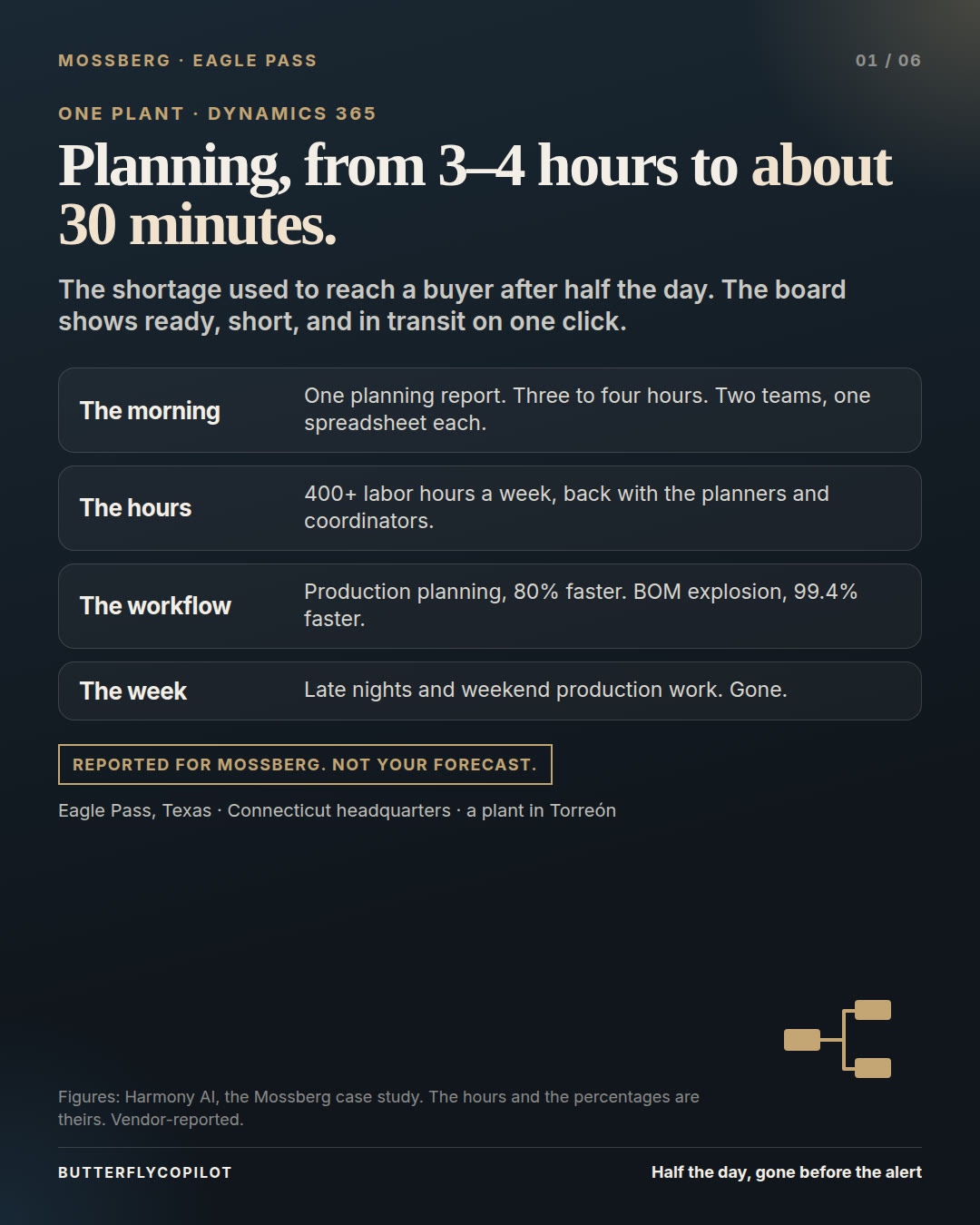
The report took three to four hours. By the time a buyer heard about the shortage, half the day was gone.
ButterflyCopilot
0106
The export finished. The morning had not.
Jesus Gomez's team pulled warehouse receipts, sales orders, and assembly completions out of Microsoft Dynamics 365 and into Excel. The formulas crossed the bill of materials against the inventory. A firearm can take up to 200 components. Abraham Rodriguez's team, on the materials side, ran a parallel report the same morning. One planning report took three to four hours.
Creating a single planning report took three to four hours. By the time you identified a shortage and sent an alert to buyers and work centers, half the day was already gone.
Abraham Rodriguez is the materials manager. By the time the shortage had a name, the line had already been waiting.
The whiteboard was the other system
O.F. Mossberg & Sons has been making shotguns, rifles, and accessories since 1919. Headquarters are in Connecticut. Nearly all of the manufacturing is at a plant in Eagle Pass, Texas, with a secondary plant in Torreón, México. It is the world's largest maker of pump-action shotguns, holds more than 100 patents, and was the first long-gun maker certified to ISO 9001. The customers on the case include Cabela's, Academy, Sportsman's Warehouse, RSR Group, and Lipsey's. The ERP and the warehouse system are the same product: Dynamics 365.
The size is not the lesson. The lesson is a morning in which two teams rebuild the same picture, and the buyer hears about the missing part after lunch.
Work in process did not live in the spreadsheet. Enrique Gomez, IT business analyst and warehouse manager, and his team walked the departments, machining cells, wood shops, bluing lines, because a report is a snapshot and a part can move after it is printed. What the department knew was on a whiteboard, or it was said out loud at the shift change. People stayed late. They came in on weekends. Wes Beighley, the chief information officer, sat at headquarters, about a thousand miles from Eagle Pass. The picture he had was whatever someone had time to phone in.
He looked at enterprise platforms. None of them showed the assembly lines in a way the floor would actually open, on a clock the plant could live with.
Six weeks, on the floor
They put Harmony AI on it.
Harmony sent engineers to Eagle Pass and left them there for weeks. They shadowed Enrique, Jesus, Abraham, and the people who take a production order from Dynamics 365 to a finished firearm. When the teams tried a report and said what was wrong with it, the change came back within a day. Six weeks later the plant had a custom operational intelligence platform sitting on the systems it already ran. Dynamics stayed. Nothing was ripped out and replaced.
The platform reads the ERP records and the transactions. It explodes the bills of materials and crosses hundreds of components in seconds. It sets what the order needs against the inventory that is there and against the purchase orders that are still open. One screen, one click.
With just a single click, we can see which production orders are ready to build, where specific component shortages sit, and which replenishment parts are in transit.
That is Enrique Gomez. The walk and the spreadsheet were the same job. The board took it over.
A single component came up 3,690 short and stopped an assembly run. The board showed which orders that one part was holding, and what could still be built around it. The planning work that had taken the morning took about 30 minutes. The case study's words are "just 30 minutes." The late nights and the weekends spent on production went away. The spreadsheets became one set of numbers, which is the only version of a shortage a buyer and a coordinator can argue about usefully.
The figures are from Harmony's case study. Across the planners and coordinators, 400+ labor hours a week came back. Production-planning workflows ran 80% faster. BOM explosion ran 99.4% faster.
The case describes that platform. It does not describe an agent at Eagle Pass releasing production orders or sending suppliers a note on its own. Harmony's site, on other pages, describes manufacturing agents that watch a signal, propose a reschedule or a replenishment, and wait for a person to approve. This page does not claim Mossberg has switched those on. The file below is our build for a plant that wants that next layer, with the arithmetic still in code.
What they have named as the next step is scenario planning, and a way to ask a question of the production data in ordinary language. The board is the thing the question has to stand on. A question that invents the shortage is worse than the spreadsheet.
Dynamics 365, around the clock. Receipts, orders, completions
        ↓
A bill of materials, exploded in seconds, not in a workbook
        ↓
On-hand that can actually be used, and purchase orders already placed
        ↓
Ready, short, or in transit. One click. The same numbers for everyone
        ↓
A person reallocates, or tells the buyer, while the day is still young
What a smaller plant should steal
If the morning still starts in Excel, the first fortnight is a clock and a list of bins. Time how long the report takes, for ten working days, before anyone installs a thing. Mark the locations that are not really available: quarantine, hold, the lot that is in the building and cannot be issued. Write down which purchase-order date the buyer trusts, the confirmed one, and refuse the date that is only a hope. That list is the whole product. A board that counts quarantine as on-hand is the spreadsheet with a new coat of paint.
Layer it on the ERP you have. Mossberg did not replace Dynamics 365. The receipts were already being scanned. The sales orders were already there. The completions were already there. The missing piece was a calculation the plant was doing by hand, twice, every morning. Six weeks, with people standing on the floor, is their published timeline. It is not a sentence to paste onto a proposal. A vendor who will not shadow the report you already hate is selling you a different project.
One set of numbers. The coordinator and the materials manager were building two reports because neither report was the plant's. The moment both of them are looking at the same ready, the same short, and the same in-transit line, the argument moves from "whose spreadsheet" to "which order do we run."
The arithmetic does not belong to the model. Exploding a bill of materials, netting a quarantine location out, and deciding which order gets the last bin of a scarce part are ordinary programs. They are testable. The model can say, in a sentence, what the program already concluded. It can draft the note to the buyer and the note to the work center. It does not get to subtract, and it does not get to release the order. On the fixture, which is ours, a component called CMP-A is uncovered by 22 after the free stock and the purchase order that actually arrives in time. One order is ready. One is covered only because a confirmed receipt lands by the due date. One stays blocked, and an alternate component would let two units be built without changing that status. None of those rows is a Mossberg order. 3,690 is their example. 22 is our test. Neither number goes in a config.
Special Flanges prices the expedite once you already know which order is in trouble. This desk is the question before that one: can we build it, and if we cannot, what is the part.
Two weeks of minutes, and a list of locations that are not really stock
        ↓
Two weeks of a back-test against orders you already built or already stopped
        ↓
Two weeks of the board beside the spreadsheet, with nobody released from it
        ↓
A person may copy a draft they signed. The ERP is not written
        ↓
The case figures stay on the case
Count the stretch you already have. Minutes on the report, from a log with dates on it. How often a clear-to-build call matched an order that actually built, and how often a shortage call matched an order that actually stopped. Hours from the shortage appearing to a decision that has a name on it. Production orders this agent released. Purchase orders it changed. Messages it sent. Those last three stay at zero.
The 400 hours, the 80%, the 99.4%, the 30 minutes, and the 3,690 are this plant's published story. They are not one equation, and they are not a line in a proposal. Do not paste them onto yours.
What the instruction file will make an agent do
The file below is the brief. It is not their Dynamics tenant, their bins, or their approval screen. None of that schema is public. The blanks are yours.
It will make the agent:
- Refuse to run while a
REPLACEline is empty, or while anEXAMPLEid is in a live file. Refuse 80%, 99.4%, 400+, 3,690, 30 minutes, and "three to four hours" as a setting. - Stop on a stale export, and on a full extract whose row count has collapsed. A short file is not a plant with nothing to build. An incremental hour with no changes is allowed.
- Explode the active bill of materials, multi-level, with effectivity and a scrap factor that rounds up in integers. Leave an alternate off the demand. Hold a make item that has no bill of materials. Do not explode the sales order on top of the production order.
- Net only stock that is available and nettable, then subtract what is already allocated. Quarantine stays visible and does not count.
- Give scarce parts to orders in a fixed order: due date, then customer priority, then age. Cover what is left with an open purchase order whose ETA is confirmed and falls on or before the due date. An unconfirmed ETA covers nothing.
- Mark the order ready, covered by that purchase order, or uncovered. Separately, say how many units on-hand can build, how many the purchase order adds, and how many an alternate would add. The alternate does not change the mark.
- Draft the shortage note and the expedite note in code. Record approve, reject, or snooze from the form. Leave the production order, the purchase order, and the outbox where they were.
The tests are in the file. The 50 on the shelf and the 30 in quarantine, and the free quantity of 40. The purchase order dated next month, which does not cover. The unconfirmed line of 100, which does not cover. The order that is ready, the order the receipt saves, and the order that stays blocked with 22 uncovered. The sequence change that makes the blocked order ready and uncovers the one that was due first. The approval that does not release anything. If the agent clears any of those by writing 80% into the config, counting quarantine as stock, or releasing the order, the test fails.
The instruction file
The brief has the role, the tables an export can fill, the schema, the nightly and intraday extract, the explosion, the allocation, the seven tools, the prompt, the fixture, the program, the six weeks, and the test that has to pass before a card is treated as an order the plant has already released.
Replace every REPLACE line. Delete every EXAMPLE row. Let it sit beside one plant for a month a person still finishes in the spreadsheet, before anyone treats a draft as a note the buyer has already received.
Sources
The products, the plants, the people, the spreadsheet, the platform, the quotes, and the results are from Harmony's Mossberg case study. The agent patterns, the reschedule and the replenishment that wait for a person, are from Harmony's own site and are not what the case says Eagle Pass runs. The 400 hours, the 80%, the 99.4%, the 30 minutes, and the 3,690 are the vendor's published case. None of this is a forecast for another plant.
- Harmony AI, "How Mossberg saves 400+ labor hours weekly with Harmony AI." O.F. Mossberg & Sons. American firearms manufacturer. Shotguns, rifles, and accessories. Connecticut headquarters, primary facility in Eagle Pass, Texas, secondary plant in Torreón, México. Supplies Cabela's, Academy, Sportsman's Warehouse, RSR Group, and Lipsey's. World's largest pump-action shotgun manufacturer. 100+ design and utility patents. First ISO-9001-certified long-gun manufacturer. Founded 1919. Microsoft Dynamics 365 as ERP and WMS. Nearly all manufacturing at Eagle Pass. Scanned warehouse receipts, sales orders, and assembly-line completions flowed into Dynamics 365 around the clock. Production Coordinator Jesus Gomez and his team exported the data to Excel and cross-referenced bills of materials against inventory. Materials Manager Abraham Rodriguez and his team ran a parallel process every morning. Abraham Rodriguez: "Creating a single planning report took three to four hours. By the time you identified a shortage and sent an alert to buyers and work centers, half the day was already gone." And: "We spent most of our day responding to issues instead of looking for ways to improve. Our team regularly stayed past hours and came in on weekends just to figure out what went wrong and which orders we had to fulfill next." Firearms require up to 200 components. Enrique Gomez, IT Business Analyst and Warehouse Manager, walked machining cells, wood shops, and bluing lines because reports were point-in-time snapshots. Status was on whiteboards or shared verbally. Wes Beighley, Chief Information Officer, is described as about a thousand miles from the plant. Harmony embedded engineers on site for weeks, shadowed the team, and turned changes around within a day. A custom operational intelligence platform was deployed within six weeks, layered on existing systems, without a rip-and-replace. It ingests Dynamics 365 records and transactions, explodes bills of materials, cross-references hundreds of components in seconds, and reconciles required parts against live inventory and open purchase orders. Enrique Gomez: "With just a single click, we can see which production orders are ready to build, where specific component shortages sit, and which replenishment parts are in transit." And: "Harmony AI consolidated our scattered spreadsheets into one central source of truth, so everyone across our plant is finally looking at the exact same numbers." A 3,690-unit shortfall of one component blocked an assembly run. The platform showed which orders it affected and what could be built around it. Planning workflows cut to just 30 minutes. Late-night and weekend production work eliminated. Results stated on the page: 400+ labor hours saved weekly, 80% faster production planning workflows, 99.4% faster BOM explosion. Next step named on the page: scenario planning and a conversational interface for questions against production data. Wes Beighley: "Harmony didn't just sell us software; they shadowed our team on the plant floor for weeks. In my 35-year career, I've never had a vendor show that level of passion, learn our business so closely, and deliver real value in six weeks." The page does not name a model, a prompt, a schema, or an agent releasing orders.
- Harmony AI, "AI Agents for Scheduling Changes." A scheduling agent detects a disruption from machine, order, material, or staffing signals, assesses which jobs are affected, proposes a new sequence with reasons, and a planner approves, edits, or rejects. The page says the agent owns detection, assembly, and drafting, and the human owns the decision. This is not the Mossberg case. This page does not claim Eagle Pass runs it.
- Harmony AI, "Agentic AI in Manufacturing." Describes an agent that replans affected lines and, once a person approves, updates the schedule, and the same pattern drafting a purchase order or issuing a work order, each action approvable before it lands. Human approval is required for anything that commits money, changes the plan, or touches product disposition. This is not the Mossberg case.
- O.F. Mossberg & Sons, "mossberg.com." The company site. Used here as the company link. The operating facts in this story are the Harmony case study, not the product catalog.