
How Special Flanges Cut Emergency Expedites with AI Agents
Three companies, three ERPs, and a morning that still started with the same question. Which fire is real?
ButterflyCopilot
0106
The morning started with a list, and the list was all fires.
A ring promised for the end of the week. A billet that would not be here until next month. A forge week already given to a stock job. A pile of finished flanges that had not moved since summer, kept because more stock felt like service. Somebody was going to raise an expedite before lunch. The costly habit was raising it on the wrong fire.
Special Flanges forges the piece that does not come off a shelf. Rings, discs, flanges, and the part that leaves fully machined, in special alloys, from forging through machining, in house. Headquarters are in Cesano Maderno (MB), at Via de' Medici 7. The firm started in 1984. It is privately owned and family-run. Just over 100 people work at the Italian company. The make-to-order book runs to more than 600 clients in about 90 countries: hydrogen, LNG, bio-refineries, carbon capture, semiconductors, power generation, refineries, cryogenics, marine. The commercial promise is flexibility and a short lead time. It has grown into a group.
Which fire is real
Sales, backlog, production, purchasing, and inventory sat in the ERP systems of three operating companies. The picture had to be rebuilt before a decision could start. Which delayed order actually needed a hand. Whether that hand was purchasing, production, or stock. Where the stock was protecting a customer, and where it was only holding cash.
The trade is the one a make-to-order shop already lives with. Put one order first and another order waits on the same hours. Buy more and the date is safer and the cash is stuck. Hold a purchase and today's inventory looks lean, until tomorrow's expedite arrives with a premium on it.
They put Natzka on that picture. Natzka is in Lugano.
One operating context connects the orders, how far each job has got, the cost, the purchases, and the stock, raw material and work in progress and finished goods, across the three companies. Decision logic and agents flag the delayed order, the constraint that is forming, and the inventory that has fallen out of balance. They put the situations that need a person at the top. They prepare a response from purchasing, from production, and from stock. The commercial owner and the operational owner decide. Then the plan moves. A trade that still depends on the customer, or on the shop, is not taken by the software.
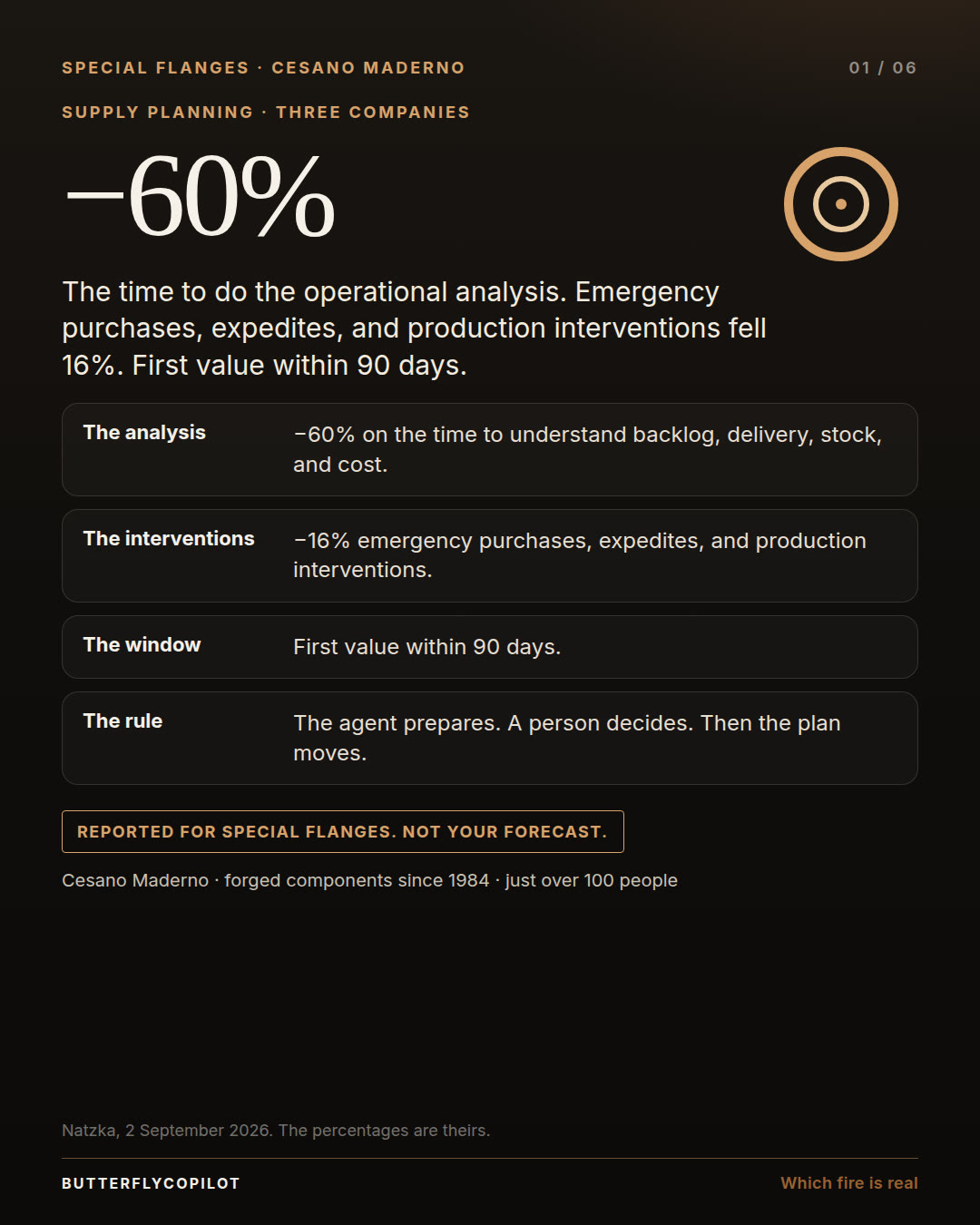
The figures are from the vendor's published case study. Time on the operational analysis fell by 60%. Emergency purchases, expedites, and production interventions fell by 16%. First value came within 90 days.
The same firm runs a second workflow with Natzka, on the close rather than the shop. Across seven companies the monthly consolidation cycle is 30% shorter, closing and intercompany exceptions take half the time, and more than 90% of intercompany balances match before the final close. Repeatable entries move inside rules finance has already approved. People stay on the exceptions that are material. That desk is not this one.
Three ERPs. Orders, routing, purchases, stock
        ↓
One picture, as fresh as the export
        ↓
Code flags the late order, the shortage, the full week, the quiet stock
        ↓
A priced response from purchasing, production, or stock
        ↓
A person approves. Nothing is placed, moved, or promised from the card
The boxes are the instruction file. They follow the shape of the job: one picture, a flag that is arithmetic, a price on each way out, a named person on the gate. They are not a reconstruction of the screens in Cesano Maderno. No model name, no prompt, and no schema of that deployment is public. This page does not invent them.
More stock is the lazy answer
An agent in a hurry expedites the billet when the forge was the constraint, calls a quiet flange a crisis because the stock value is large, and copies 60% into a config the plant has not measured. An agent in a hurry turns a projected Thursday into the Thursday a customer has already been told.
The file for a smaller make-to-order shop keeps the job and drops the tenant. One buyer, one planner, one sales owner. One entity first. A second and a third only when a person has mapped the item codes. The margin, the charge for a late day, the carrying rate, and the overtime hour are numbers the plant types, because this case does not publish them and they must not be guessed. The model may explain a card the code has already priced. It may not invent a date. It may not approve itself. It may not place the purchase order. Version 1 writes files.
On the fixture, which is ours, a tier A ring is short two billets. The open purchase order is confirmed for December. The projected finish is six days past the promise, and the exposure on that lateness is 30,000 cents. Buying the two pieces from an alternate supplier costs 4,000 cents and clears the date. The net is 26,000 cents. Expediting the whole receipt also clears the date. The fee plus the carrying cost of pulling that stock forward is 20,246 cents, and the net is 9,754. A transfer from the sister company costs 4,000 cents of freight and still leaves the ring three days late, a net of 11,000. The card shows all three. The label prefers the one that clears. A buyer who would rather accept the three days can still take the transfer. The sister company keeps the four billets its own demand still needs.
A disc that is already late sits behind a stock job on the forge. The week wants 2,880 minutes and has 2,400. Putting the disc first recovers 8,000 cents of exposure and spends no premium. It does not make the disc on time. The promise was already behind it. Doubling the shift clears the overload, uses 1,440 extra minutes, and costs 108,000 cents. The net is −100,000. Subcontracting the same operation reaches the date the resequence already reached, for 45,000 cents, and the net is −37,000. The disc's own card has no positive net. The forge card does. Thirty flanges that have not moved in 146 days carry 18,000 cents a year. They rank under the orders. Approving that card does not book the 18,000 as a saving.
An operation filed with no planned minutes is held. It is not reported as on time.
Deutsche Gasrußwerke is the schedule a solver returns, with a person still on the accept. This desk does not reschedule the plant. It prices the exception and stops. The euros on that page stay on that page. technotrans watches a price the plants already pay. This desk starts from the order that will miss, the material under it, and the week on the machine.
What a smaller shop should steal
If Monday is still a reconstruction, the first fortnight is a time log and one entity. Count the expedites in a definition you write down before you open the export. The case had first value inside 90 days. The strip below is our calendar for a shop that has not had that project. It is not theirs.
Fourteen days of minutes, and three months of expedites from your own ERP
        ↓
Thirty days of a back-test, each flag marked by the planner who lives with it
        ↓
Thirty days of a morning queue beside the meeting you already hold
        ↓
Thirty days in which a signed card may be copied into a mail a person sends
        ↓
The purchase order does not move inside the tool. The next entity waits.
Count the stretch you already have. Minutes logged, and the per-week figure that falls out of them. Emergency purchases, expedites, and production interventions. Flags a planner called useful, and flags they called noise. Hours from a flag to a decision that has a name and a reason on it. OTIF, expedite spend, and inventory value, taken from the ERP. Purchase orders this agent placed. Production orders it moved. Dates it promised. Messages it sent. Those last four stay at zero.
The 60%, the 16%, and the 90 days are this company's published story. They are not one equation, and they are not a line in a proposal. Do not paste them onto yours.
What the instruction file will make an agent do
The file below is the brief. It is not their ERP, their rates, or their approval screen. None of that schema is public. The blanks are yours.
It will make the agent:
- Refuse to run while a
REPLACEline is empty, or while anEXAMPLErow is still in a live export. Refuse 60%, 16%, and a target of 90 days to first value as a setting. - Stop on a stale export, and on an export whose row count has collapsed. A short file is not a plant with nothing late.
- Project a finish from the minutes still on the routing and from the date the material is covered. Discount an open purchase order by the supplier's on-time record, in integer arithmetic. Hold an operation whose planned minutes are zero.
- Flag the late order, the shortage, the overloaded week, and the quiet stock. Score an order on its value. Score stock on its carrying cost, with the days capped, so a flange does not outrank a promise.
- Price the alternate, the expedite, the transfer, the resequence, the overtime, the subcontract, a partial shipment, and an internal note about the date. Leave a negative net below doing nothing.
- Give purchasing the buy, planning the week, and sales the date, without showing sales the supplier's price.
- Answer a what-if by running the same functions again. Refuse a what-if that arrives with the date already filled in.
- Draft the expedite and the internal note in code. Record approve, reject, or snooze from the form, with a reason. Leave the purchase order, the routing, and the customer date where they were.
The tests are in the file. The two billets that clear the ring for 4,000 cents. The expedite that carries 246 cents of working capital and nets 9,754. The transfer that leaves three days. The overtime at −100,000 cents. The item with no map, which does not move. The four billets the sister company still needs, which stay there. The sentence that smuggles in a digit. The approval that does not place the order. If the agent clears any of those by writing 60% into the config, transferring stock that was never mapped, or promising a date, the test fails.
The instruction file
The brief has the role, the tables an export can fill, the schema, the nightly extract, the rules, the money, the six tools, the prompt, the fixture, the program, the ninety days, and the test that has to pass before a card is treated as a purchase order the plant has already placed.
Replace every REPLACE line. Delete every EXAMPLE row. Let it sit beside one entity for a month a person still finishes by hand, before anyone treats a draft as a note the supplier has already received.
Sources
The headquarters, the ownership, the headcount, the products, and the sectors are from Special Flanges. The three companies, the questions, the operating context, the 60%, the 16%, and the 90 days are from Natzka's supply-planning case of 2 September 2026. The consolidation figures are from Natzka's second case, the same day, and they are not the build on this page. The June 2025 acquisition is the Wise Equity statement, used here only to say the firm has grown into a group. No source used here gives a group headcount, an ERP name, a formula, or a project plan. None of this is a forecast for another shop.
- Natzka, 2 September 2026, "Supply Planning & Constraint Management." Special Flanges. Industrial manufacturing. Company size listed as 100+. Custom-engineered forged components for more than 600 customers in approximately 90 countries. Make-to-order, depending on flexibility and short lead times. Sales, production, inventory, and purchasing sat across the ERP systems of three operating companies. The questions were which delayed orders genuinely needed intervention, whether the response should come from purchasing, production, or inventory, and where stock was protecting service and where it was absorbing cash. Natzka connects orders, production progress, costs, purchases, and inventory across the three companies, including raw materials, work in progress, and finished goods. Decision logic and AI agents flag delayed orders, emerging constraints, and inventory imbalances, prioritise the situations that need attention, and prepare responses across purchasing, production, and stock. Commercial and operational owners decide before the plan is adjusted. Trade-offs that depend on customer and operational context are not automated. Result stated on the page: 60% less time for operational analysis, 16% fewer emergency purchases, expedites, and production interventions, first value within 90 days.
- Natzka, 2 September 2026, "Group Financial Consolidation Decision Workflow." The same company, seven companies in the consolidation. Monthly consolidation cycle time reduced by 30%. Time to resolve closing and intercompany exceptions reduced by 50%. More than 90% of intercompany balances matched before the final close. Repeatable accounting decisions move inside approved rules. Finance stays on material exceptions. This page does not turn that case into a build.
- Special Flanges, "the company" and "headquarters." Privately owned, family-run, just over 100 people. Custom-engineered components: rings, discs, flanges, and other tailored parts. Address on the headquarters page: Via de' Medici 7, 20811 Cesano Maderno (MB). Sectors named there include hydrogen, LNG, bio-refineries, carbon capture, semiconductors, power generation, refineries, cryogenics, and marine. The page describes flexibility and short lead times as the model.
- Wise Equity, "Special Flanges acquires 100% of Vilmar." June 2025. Vilmar S.A., Râmnicu Vâlcea, Romania, thereafter Special Flanges Romania. Cited only for the fact that the firm has grown into a group. This page does not state a group headcount.