
How Pamarco Automated the Financial Close with AI Agents
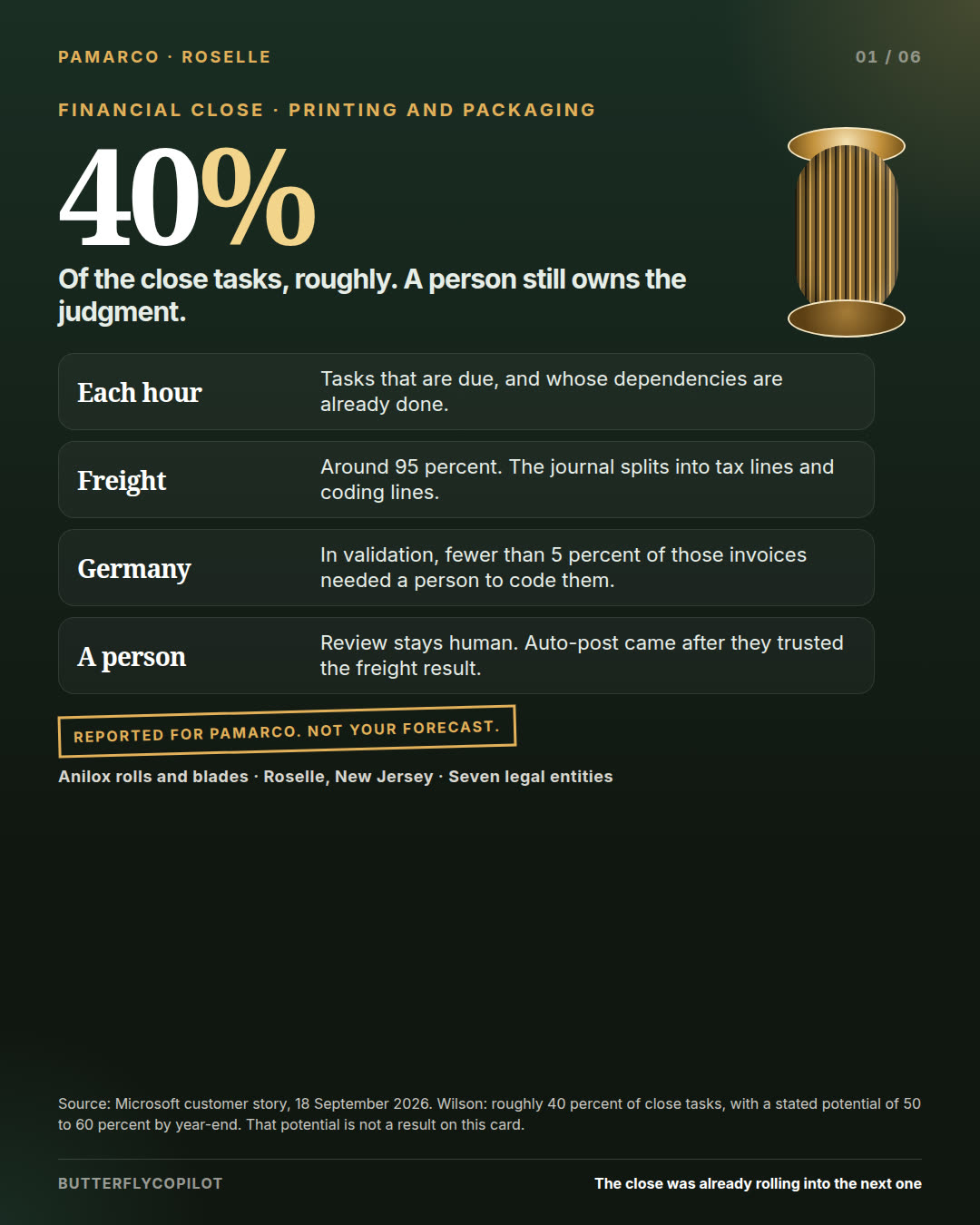
The close kept rolling into the next one. Roughly 40 percent of the close tasks now run on agents, freight coding lands around 95 percent, and a person still owns the judgment.
ButterflyCopilot
0106
The month was already closed on the calendar. The people were still inside it.
Pamarco makes precision-engineered anilox rolls, blades, accessories, and technical services for printing and packaging. The work shows up in corrugated packaging, flexible packaging, coating and laminating, and towel and tissue. About 225 people. Operations in the United States and Europe. Customers in almost 70 countries. Seven legal entities, and one system under all of them. The company's own pages place Pamarco Inc in Roselle, New Jersey.
John Burgess, President of the Flexo Division, put the shape of the place in one sentence. The business is decentralized, and it runs across many platforms. For the last 18 years, the Microsoft ERP has been the common thread. Dynamics 365 Finance and Dynamics 365 Supply Chain Management hold the financial, operational, production, and sales data for those seven entities.
The finance team is small, and it is spread out. Accountants and operational leaders carry work that is not only finance, so an urgent request can pull a person off the monthly close. As the business grew, the close grew more complex with it. The time that disappeared was the time to compare this month with the last one, to ask why a number moved, and to do something about it before the next close started. Invoice coding, the coordination of the close itself, the assembly of reports, and the ad hoc questions all sat on the same people.
Burgess said the business is better served when the senior finance team has a role in management decisions. They were so busy rolling from close to close that it was not possible.
What they stood up
The board and the chief executive asked the technology team to look at AI. Glyn Wilson, the chief information officer, started with finance. The data was already there. The workflows were understood. The tasks repeated, and a repeated task can be timed.
They stayed inside the Microsoft estate they already had. Copilot Studio agents. The Dynamics 365 ERP MCP Server, so an agent can reach the system without a custom integration for every job. Dataverse skills for the specific work. Microsoft partner Crowe helped them get an early proof of concept off the ground and talked through the direction. Microsoft specialists walked the team through Copilot Studio, the Dynamics connection, and MCP. Wilson's team then fitted that to the way Pamarco actually closes.
The rule they kept is the one worth stealing. Each agent has a defined workload, the permissions for that workload, and a time saving someone can measure. A general assistant with the keys to the ledger was never the design.
The close itself uses the financial period close workspace in Dynamics 365. A task has an owner, a due date, and dependencies. Once an hour, a check looks for tasks that are due and whose dependencies are already complete. The agent for that task does the work, marks the task complete, and emails the result. A task that needs judgment or review stays with a person. Wilson's account of the progress is the one this page uses. They have automated roughly 40 percent of the financial close tasks. He sees a path to 50 or 60 percent by year-end. That second figure is the distance he thinks is still ahead. It is not a second result.
The close list already has an owner, a due time, and a predecessor
        ↓
Once an hour, take the tasks that are due and unblocked
        ↓
The agent for that kind of work does it, and emails what it did
        ↓
A person keeps the task that needs a judgment
        ↓
A journal posts only after the company has decided it may
The boxes are the instruction file. They follow the shape the story describes. They are not a reconstruction of Pamarco's screens, and they are not Pamarco's project plan.
The freight bill, and the German invoices
Most of the invoices that arrive without a purchase order are freight. One bill can carry more than one tax code. The agent splits the journal into the tax lines and the coding lines. Wilson's verdict, after they had watched it work, was that it was doing a good job, around a 95 percent success rate, and that they were confident enough to turn on auto-posting for all non-purchase-order invoices. The confidence came after the result. It was not the starting position.
Then an acquisition in Germany. The US finance team had to code that entity's invoices, in German. Wilson built skills that code those invoices and email the US team a summary of how each one was coded. During validation, fewer than 5 percent of the invoices still needed a person to code them. Late vendor payments get less likely when the pile moves. The company estimates that if the process is fully adopted, a daily task that takes an hour could come down to about five minutes. That is their estimate of a process people are actually using. It is not a stopwatch result this page can treat as already banked.
The same scheduled habit now feeds the people who run the plants and the people who sit on the board. Wilson set up a virtual user in Copilot Cowork. It runs daily, weekly, and monthly routines off the sales and manufacturing data already in Dynamics 365, and the output lands in Power BI, Excel, Word, email, and a presentation. Each Monday at 8:00 a.m. the plant managers get a report of the jobs that did well and the jobs that need attention, in time for the weekly meeting. Daily and weekly summaries cover sales, cash, and banking. A sales director who used to spend about five hours a month building the board sales pack now gets a generated presentation on the sixth working day. The figures are already in it. The fields for the business context are still there, because the sentence about what the numbers mean is still a person's sentence.
Wilson has been clear about what this is for. They do not think about it as reducing headcount. It means the same people can skip the repetitive work and spend the hour on the work people are better at. Burgess wanted finance in the management conversation. The close had been eating that conversation.
What comes next, once the finance pattern is deeper, is the commercial work: sales, quoting, order entry, customer response, and vendor communications. Same rule. A defined job, a defined permission, a result someone can time. Historical transactions and prices are the raw material they expect to use for quotations. That work is still ahead of them.
A percentage is not a permission
Speed is how a tidy agent posts a freight bill because someone else's month hit 95 percent. Speed is how a German line gets an account the chart does not contain, because the model has seen a similar word. Speed is how a review task gets marked complete because the hour was quiet and the predecessor looked finished.
The file below keeps the shape and drops the plant. One legal entity. The accounts, the tax codes, and the vendors are the company's. The close list is the list the company already keeps, with an owner and a predecessor on every row. The model may copy a charge label the invoice already printed. It may not choose the account, the tax, or the amount.
On the fixture, which is ours, an 80.00 dollar linehaul and a 20.00 dollar liftgate become two lines, 8,000 cents and 2,000 cents, and they sum to the invoice. They do not post. A detention charge with no row in the table stops, and the coder sees an exception instead of a guessed account. A task owned by a person stays open even when the hour arrives. A report copies the sales, cash, and bank figures from the export and leaves the word CONTEXT where the director's sentence will go. Those rows exist so a builder can test the arithmetic and the refusals. They are not a Pamarco invoice, and they are not a journal anyone should post.
FABco is the procurement desk on this site: a truck in the yard, a bill of lading, a match. This desk does not buy, and it does not match a purchase order. A purchase-order invoice stays with the people who match receipts. The 40 percent on this page does not belong on that one.
The other thing the story leaves in plain sight: 40 percent of the tasks is not 40 percent of the hours. The published account does not say which tasks moved, or how long each one used to take. A short task and a long task both count as one. Anyone planning a hire, or a headcount cut, off that percentage is reading a number the story did not print.
What a smaller finance team should steal
If the close is still a spreadsheet, and the freight bill is still coded by the same person who is trying to read the numbers, the first month is one entity and one period a person has already closed.
The useful part of Pamarco's story is the decision, not the rate. Put the agent on tasks that already have an owner, a due time, and a predecessor. Give each agent one kind of work and a user that cannot do the other kinds. Keep the connection to the ERP on a runner that follows the rules, not on a chat that can click Post. Code from a table the accountant can open and edit. Leave the judgment tasks with a person. Leave auto-post off until drafts have matched to the cent and the allowlist is a list the controller typed. Copy the report figures, and leave the sentence blank. A second entity, and a second language, wait until the first one is boring.
One legal entity
        ↓
One period a person already closed, with the hand coding stored
        ↓
Thirty days where the draft sits beside that coding, and nothing posts
        ↓
An account the table did not contain holds the gate
        ↓
Ten read-backs match to the cent. The controller types the vendors and the cap
        ↓
The next entity waits for its own labels
Time the stretch you already have. Minutes from the first close task to the last human review. How many invoices a person recoded after the draft. How many journals did not balance. How many posts went through with the gate shut. How many human tasks an agent marked complete. How many emails left that a person had not cleared. Those last three stay at zero.
Pamarco's scoreboard is not your forecast. Roughly 40 percent of the close tasks, around 95 percent on the freight coding, fewer than 5 percent of the German invoices needing a person during validation, about five hours a month of board prep, Monday at 8:00 a.m., and the sixth working day are this company's published story. The hour-to-five-minutes line is their estimate of a fully adopted process. The 50 to 60 percent is a potential Wilson named, not a result. Measure your own minutes. Do not paste their rates onto a proposal, and do not turn 40 percent of tasks into hours the sources never printed.
What the instruction file will make an agent do
The file below is the brief. It is not Copilot Studio, and it is not Pamarco's chart of accounts. None of that schema is public. The blanks are yours. Dynamics 365 Finance is the ERP the case names. The same draft works on Business Central, Odoo, Xero, or QuickBooks, with the close list kept in a file where those systems have no close workspace, and with QuickBooks left in the file until a person has agreed that creating a bill is the post.
It will make the agent:
- Refuse to run while a
REPLACEline is empty, while anEXAMPLErow is still in a live sheet, or while anyone has typed a confidence percentage into the config. - Run on the hour, at minute zero. A task that is not yet due waits. A task with an open predecessor waits. A human owner is never completed by the agent.
- Code a non-purchase-order invoice from the company's table. On the fixture, 80.00 and 20.00 become 8,000 and 2,000 cents and sum to the total. A detention line with no rule writes an exception and no journal.
- Code a second entity from labels in that entity's language. On the fixture,
FrachtandMautmap because the table says so. A lowercase twin of the same word does not. The summary copies the label and does not translate it. - Post only when the gate is open: the controller has signed, the vendor is on the allowlist or a person has released that exact draft, the cents are under the cap on the unattended path, and a read-back matches. A miss leaves the draft where it was.
- Write the Monday plant report, the daily and weekly summaries, and the board file on the company's working day. Figures come from the export. The narrative field stays
CONTEXT. - Keep the ERP tools off the model. The runner calls them after the rules pass. A model that says "post it" is ignored.
- Write a morning file from this company's own counts. No comparison with the case study.
The tests are in the file. The hash of the fixture journal is locked. A line that does not sum fails. A human task completed by the model fails. A post with the gate shut fails. A report that replaces CONTEXT with a sentence fails. If the agent clears any of those by inventing an account, translating a label, or posting early, the test fails.
The instruction file
The brief has the role, the tables a spreadsheet can hold, the hourly check, the dependency rules, the coding rules, the auto-post gate, the summary email, the report clocks, the audit, the Dynamics 365 connection, the path for Business Central, Odoo, Xero, and QuickBooks, the ninety days, and the tests that decide when a journal may be treated as posted.
Replace every REPLACE line. Delete every EXAMPLE row. Let it sit beside one entity's close for a month a person still codes by hand, before anyone treats a file as a journal the ledger has already accepted.
Sources
The company, the close, the freight coding, the German invoices, the reports, the quotes, and the figures are from the pages below. The headquarters address is from Pamarco's own imprint and contact page. The figures are as those pages report them. They are not an independent audit, and they are not a forecast for another company.
This page uses Wilson's sentence, "roughly 40% of financial close tasks," with the potential to reach 50% to 60% by year-end. The executive summary's "up to 40%" is that same result in the summary's wording, not a second measurement. For the German entity, this page uses the body of the Microsoft story: during validation, fewer than 5% of invoices required manual coding. The executive summary also says automated invoice coding for that entity reaches an 80% success rate. Those are different published figures. This page does not combine them, and it does not use either one as a threshold. The one-hour daily task and the five minutes are the company's estimate of a fully adopted process, not a measured before-and-after. Forty percent of tasks is not treated as forty percent of the hours, because the story does not say which tasks moved or how long they took.
- Microsoft, "Pamarco accelerates finance operations with autonomous agents and Copilot Cowork," 18 September 2026. Pamarco supplies precision-engineered anilox rolls, blades, accessories, and technical services for corrugated packaging, flexible packaging, coating and laminating, and towel and tissue. About 225 employees, operations in the United States and Europe, customers in almost 70 countries, seven legal entities on Dynamics 365 Finance and Dynamics 365 Supply Chain Management. John Burgess, President, Flexo Division: "We're a decentralized business operating across many different platforms. But for the last 18 years, Microsoft ERP products are the one common thread." And: "Our business is better served when our senior financial team has a role in various management decisions, but they were so busy rolling from close to close that it wasn't possible." Glyn Wilson, Chief Information Officer, started with finance. Copilot Studio agents, the Dynamics 365 ERP MCP Server, and Dataverse skills. Each scenario has a defined workload, permissions, and measurable time savings. The financial period close workspace: tasks have owners, due dates, and dependencies. An hourly check finds tasks that are due and whose dependencies are complete. The agent does the work, marks the task complete, and emails the results. Humans keep judgment and review. Wilson: "We've been able to automate roughly 40% of financial close tasks with autonomous AI agents with the potential to reach 50% to 60% by year-end." The executive summary says agents now automate up to 40% of close tasks. Most non-purchase-order invoices are freight. The workflow splits the journal into tax lines and coding lines. Wilson: around a 95% success rate, and auto-posting turned on for all non-purchase-order invoices. A German acquisition: skills code the invoices and email a summary of how they were coded. During validation, fewer than 5% required manual coding. The company estimates a fully adopted process could reduce a one-hour daily task to about five minutes. The executive summary states an 80% success rate for the German entity's automated invoice coding, which this page does not treat as the same figure. Copilot Cowork virtual user: Monday 8:00 a.m. plant report of jobs that did well and jobs that need attention; daily and weekly summaries of sales, cash, and banking; a board sales presentation on the sixth working day, replacing about five hours a month of a sales director's preparation, with figures filled in and fields left for business context. Outputs also named: Power BI, Excel, Word, email, and presentations. Crowe supported an early proof of concept and the direction. Next: sales, quoting, order entry, customer response, and vendor communications. Wilson: "We don't think about [AI] in terms of reducing headcount; it just means we can achieve more with our employees because they can skip repetitive tasks and focus on things that humans are better at."
- Pamarco, "Pamarco Featured by Microsoft for Innovation in AI and Business Operations," 29 October 2026. Confirms the Microsoft feature and restates, in the company's words, automating approximately 40% of financial close tasks, invoice coding, reporting, and a look ahead at sales, quoting, order processing, and customer communications. It does not publish a separate measurement of the 40%.
- Pamarco, contact page and imprint. Headquarters: Pamarco Inc, 235 East 11th Avenue, Roselle, NJ 07203.
- PYMNTS, "AI Agents Take the Grunt Work Out of Pamarco's Close," 2 November 2026. Restates the Microsoft story, including the roughly 40%, the 50% to 60% potential, the roughly 95% freight coding, auto-posting of non-purchase-order invoices, fewer than 5% of the German invoices needing manual coding during validation, the hourly check, and the five hours of board prep. It adds that automating 40% of tasks does not mean automating 40% of accounting labor, because the case study does not break the tasks out by duration. A separate PYMNTS Intelligence survey in the same article, about other CFOs and integration complexity, is not a Pamarco result and is not used above.