
How Shin Zu Shing Cut Drawing Checks from 4 Hours to 20 Minutes with AI Agents
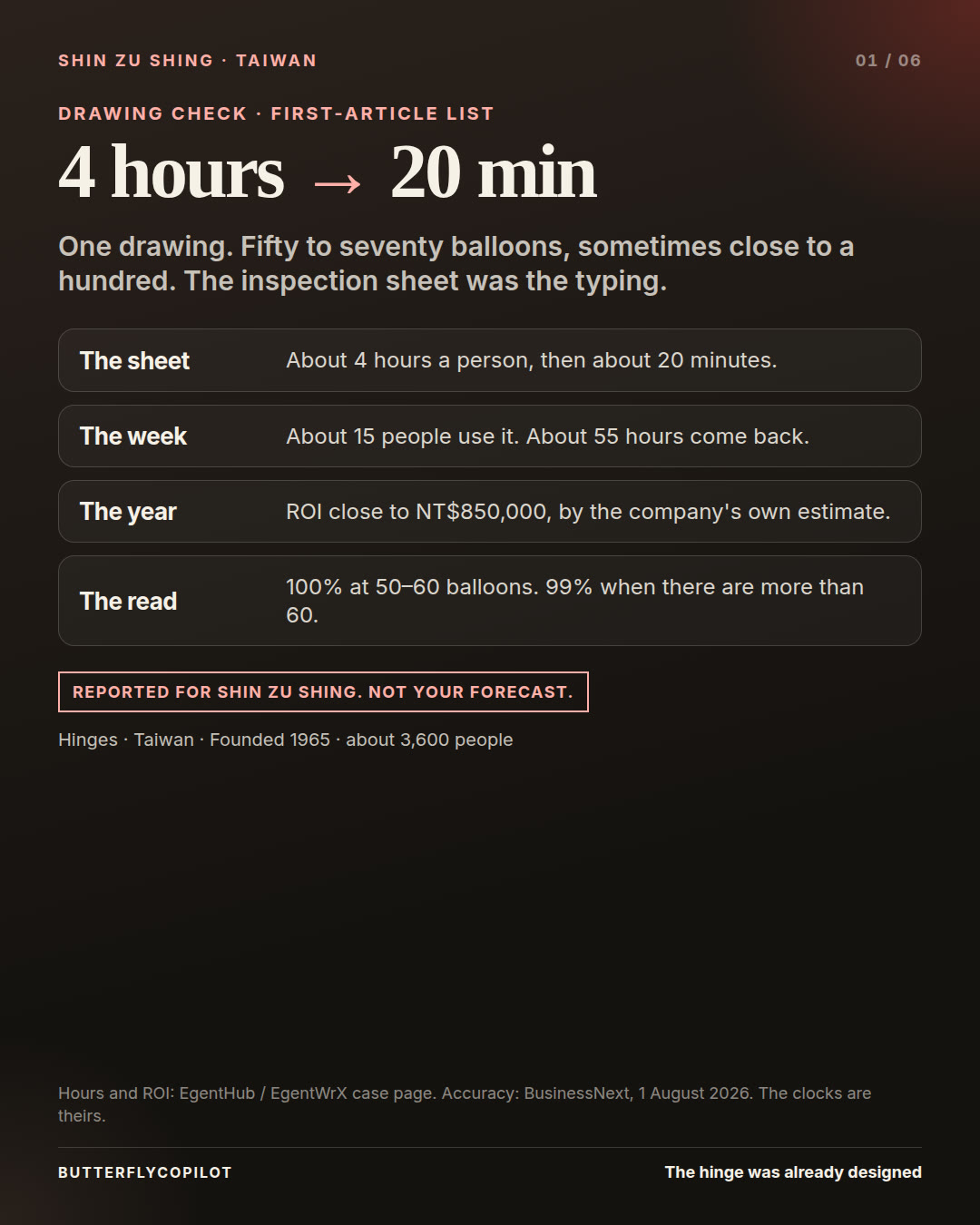
A customer drawing can carry sixty balloons. An engineer was typing each one into the inspection sheet. The same sheet now takes about 20 minutes, and a person still signs every row.
ButterflyCopilot
0106
The hinge in the laptop was already designed. The hours went on the drawing that said how to check it.
Shin Zu Shing (新日興, SZS) makes the hinge. The company was founded in 1965, making ordinary springs, and it is now the largest supplier of laptop hinges in the world, and a main supplier of the hinges in Apple laptops and in AirPods charging cases. About 3,600 people work there. Revenue in 2025 was about NT$10.7 billion. The company holds close to 3,000 patents. Behind the hinge are metal injection moulding, stamping, turning, and milling, in Taiwan.
The market around that part is not a young one. There are on the order of ten times as many competitors as there were twenty or thirty years ago. President Juan Chao-tsung (阮朝宗) has put the shift in one sentence. "We used to compete on technology, now on price." The know-how that still wins a drawing sits with senior engineers. Those engineers are retiring, and the labour to replace them is short.
Sixty balloons, and an Excel sheet
A customer drawing arrives on A3 or A4. It can carry 50 to 70 balloons, and sometimes close to 100. Each balloon is a dimension, or a measurement the customer wants confirmed before mass production. Someone has to read every one and type it into the inspection checklist, the first-article dimension list. Engineers were spending hours on a drawing. It was not the work they were hired to do.
Hsieh Ming-lin (謝明麟), the QC section chief, built the agent that reads the drawing. He did it himself, in one to two months, beside the day job. It reads a 2D drawing and picks out the dimensions, the tolerances, and the geometric features. On drawings with 50 to 60 balloons the read has been reported at 100 percent. On the more complex drawings, the ones with more than 60 balloons, 99 percent. BusinessNext published those two figures in August 2026.
The time moved with the read. A task that took about four hours a person took about 20 minutes. The agent is used by about 15 people a week and gives back about 55 hours a week. Annualised, the return is close to NT$850,000, by the company's own estimate, on the EgentWrX case page.
He has been plain about the first stretch. The work got busier while he was learning the tool. Close to half his time now goes to building the next agents. The company is not planning layoffs. It is still hiring.
Pay for time, then build it inside
The agent did not arrive as a finished product. Late in 2025 the company started a proof of concept with Intellicon Solutions (智慧方案), on a platform called EgentHub. They were already working together before Lunar New Year 2026, and the real push ran from March. The phrase they have used for the arrangement is to pay money to buy time. The consultants get a department to a basic fluency quickly. The point of the fluency is that the department builds its own agents afterwards.
In a little over three months, about 50 agents were in use across the company, and the return on them was calculated, agent by agent. The first wave was the office, not the drawing. HR attendance, the daily reconciliation of who clocked in, went from about two hours of checking to five or ten minutes. Customs duty-refund documents and internal audit got helpers of the same kind.
The drawing agent is the one that sits on the process itself. Around it, the plant now has agents for hinge torque in R&D, for reading more than ten kinds of chart that used to mean JMP, for the work-in-progress a supervisor tracks on the floor, for sintering quality in metal injection moulding, for which cutting tool to requisition given what was bought before, for matching a shaft clip, for a help desk, for pulling fields out of a customs document, and for searching suppliers. Deputy manager 簡柏元 built an R&D knowledge base the company describes as a digital twin of a veteran. It reaches roughly the level of an engineer with about five years' experience, and it lets an engineer put past test data in front of a customer.
Juan treats the software the way the plant already treated a robot. A robot took a motion that was being repeated. The software takes a task that was being repeated. He has also put the commercial reason in a question. "If a client brings a development project and I reply in one day while my competitor takes one or two weeks, who do you think the client goes to?"
Chairman Lu Sheng-nan (呂勝男) wanted a system that understood the language of their processes. Claudia Chen, chief operating officer at Intellicon, is the person who put the company's three choices in one place. A list of the painful jobs across the whole company, rather than a handful of pilots. The agent let into the process itself, rather than a summary of a document or an FAQ. And senior people willing to hand the experience over.
What they have named as next is six more agents in the second half of the year, one of them a statistical-process warning that fires before the quality alarm, a look at hybrid cloud and on-premises so the process data can stay in the building, and then MCP, to connect the agents to the core systems.
A customer drawing, PDF, one sheet at a time
        ↓
The title block, and every balloon, copied off the ink
        ↓
The limit, the fit, and the unit, in code
        ↓
The QC engineer sees the row beside the crop
        ↓
The checklist leaves only after every row is signed
The boxes are the instruction file. They follow the shape of the job: read the drawing, calculate the limit, leave the signature with a person. They are not a reconstruction of Shin Zu Shing's screens, and they are not an Intellicon project plan. The model name, the prompt, and the code they run are not public. This page does not invent them.
The signature is the job
A drawing that looks complete is not yet an inspection sheet. A balloon with no tolerance still has a tolerance, the one in the title block, and applying the wrong class moves every bare dimension on the page. A fit such as H7 is a table, not a guess. A note that says 2X is two holes and one row. A note that says TYP is a warning, because the drawing has not listed the corners. Two reads of the same balloon that disagree are a row for a person, not a number to average.
The useful version of this desk shows the crop beside the row and refuses to release the workbook while any row is still open. Their 20 minutes is how long the task took after a person had built the agent and was still in the loop. It is a result on their drawings. It is not a reason to send the sheet to the floor unread.
Kuken is the drawing archive on this site. That desk finds the sheet. This one reads the balloons on the sheet a customer just sent. The 4.5 minutes on that page stay on that page. The 20 minutes on this page stay on this one.
The file below keeps the shape and drops the plant. One part family, one customer template, because that is the first version a smaller manufacturer can check by hand. The drawings are the company's. The template is the customer's. The model may copy the ink and the box around it. The grammar decides the nominal, the limit, the fit, and the unit. A general tolerance is applied only when the callout has none. A fit the table does not contain does not get a made-up deviation. The QC engineer accepts, edits, or rejects every row. The results column stays empty, because this desk does not measure a part.
On the fixture, which is ours, a made-up bracket carries a handful of callouts. 80 ± 0.1 is 79.900 mm to 80.100 mm. Ø25 H7 is 25.000 mm to 25.021 mm. A bare 40 on an ISO 2768-m title block is 39.700 mm to 40.300 mm. TYP R2 stays one row, and the confidence drops, because typical is not a list of corners. An inch dimension on a millimetre sheet is converted and flagged. ABOUT 20 stays unparsed. A second read that moves the 0.1 to 0.2 is a disagreement, not an average. Those rows exist so a builder can test the parser, the fit, and the refusal. They are not a Shin Zu Shing hinge, and they are not a part anyone should inspect.
The useful caution is the baseline. A result like theirs sits on drawings the QC section already knew, and on a clock someone started before the tool existed. An empty folder of past checklists will not tell you whether the H7 was read right. The file spends the opening fortnight on a stopwatch and on 20 to 30 drawings whose checklists a person has already typed.
The original system is theirs: EgentHub, and a section chief who learned to build on it. Buying that kind of help is a real option. The file is the other path. A folder of PDFs. Postgres. A model that is allowed to read one sheet. A calculator that is not allowed to be the model. A screen with the crop on the left. The gates are the same on both. A person signs. A micrometre comes from code.
What a smaller manufacturer should steal
If the work is still an engineer typing balloons into Excel, the first month is one family, one template, and a clock on the drawings you already check.
Let the model read the ink. Let the code apply the title-block tolerance, the fit table, and the unit. Show the row beside the crop. Keep a person on every row, including after a clean first month. Count the return per agent, the way they did. Put the agent on the checklist itself, where a wrong limit becomes a wrong part, and keep the FAQ for later.
One family, one template
        ↓
Two weeks with a stopwatch on drawings a person already finishes
        ↓
The title block confirmed, and the tolerance class signed by QC
        ↓
Shadow, while the old Excel is still the sheet the shop uses
        ↓
The draft is what gets reviewed. A person still signs every row
Count the stretch you already have. Minutes from the PDF in hand to a checklist a person has signed, as a median you measured. How many of your own gold rows matched on the nominal and on both limits, as a count, split by drawings with 60 balloons or fewer and drawings with more. How many balloons on the sheet came back. How many checklists left the building with a row nobody had accepted. That last count stays at zero.
Shin Zu Shing's scoreboard is not your forecast. Four hours to about 20 minutes, about 15 users a week, about 55 hours a week, a return close to NT$850,000, 100 percent on the 50-to-60-balloon drawings and 99 percent above that, and about 50 agents in a little over three months, are this company's published account. About 3,600 people is the headcount they have given. It is not a hiring plan, and it is not your headcount. Measure the drawings you actually have.
What the instruction file will make an agent do
The file below is the brief. It is not EgentHub, and it is not Hsieh's agent. None of that schema is public. The blanks are yours.
It will make the agent:
- Refuse to run while a
REPLACEline is empty, while anEXAMPLEplant id is still in a live folder, or while anyone has typed 4 hours, 20 minutes, 55 hours, 100 percent, 99 percent, or NT$850,000 into the config. - Take one part family and one customer template. A second template, a CAD model, and a measurement file return a locked scope.
- Copy the ink and the box with the model. Parse the nominal, the limit, the fit, and the unit in code. A fit the table does not contain does not get a micrometre.
- Apply the title-block general tolerance only when the callout has none. Keep
2Xas a quantity on one row. KeepTYPas one row at medium confidence. - Diff two extraction passes. A limit that moved between them stays a disagreement. The two numbers are not averaged.
- Release the workbook only when a named QC person has accepted, edited, or rejected every row, and the kept balloon numbers are unique. A gap stays blocked until that person writes a reason.
- Score a gold set as counts, split at 60 balloons. The gate is 49 correct rows out of every 50 on the drawings with 60 balloons or fewer, on this company's own sheets. The fixture cannot pass the gate.
- Write a morning file from this company's own counts. No comparison with the case. No percent.
The tests are in the file. The hashes of the fits, the clean sheet, the messy sheet, the disagreement, the balloon audit, the released export, and the whole bundle are locked. A checklist released with an unparsed row fails the test. A review submitted by the agent fails the test. A fit on a size the table does not cover fails the test if a limit appears anyway.
The instruction file
The brief has the role, the one family and the one template, the render and the tiles, the extraction prompt, the parser, the ISO fit table, the general tolerances, the Postgres tables, the review screen, the Excel sheet, the gold set, the security and the retention, the twelve weeks, and the tests that decide when a draft may be the checklist a person reviews.
Replace every REPLACE line. Delete every EXAMPLE row before a live drawing is read. Let it sit beside one family for the drawings a person still types by hand, before anyone treats a draft as a sheet the shop has already been told to use.
Sources
The company, the drawing job, and the figures in the story are from the pages below. The founding, the products, the headcount, the revenue, and the patents are as those accounts give them. The four hours and the 20 minutes are the task they described. The 15 users, the 55 hours a week, and the return close to NT$850,000 are the case pages' figures for that agent. The 100 percent and the 99 percent are BusinessNext's August 2026 account of the read, split at 60 balloons. About 50 agents is the count they gave for a little over three months. They are not a forecast for another manufacturer.
- BusinessNext (數位時代), 1 August 2026. The Shin Zu Shing article.
- EgentWrX, Shin Zu Shing case page.
- EgentHub, 新日興 case page.
- Economic Daily News (經濟日報), 新日興.