
How technotrans Cut Procurement Costs with AI Agents
The same bearing had two prices. One plant was buying it from a name that showed up twice a year. The other already had it on a framework agreement.
ButterflyCopilot
0106
The same bearing had two prices.
technotrans builds the machines that hold a temperature. Cooling, temperature control, filtration. The work sits under plastics, healthcare, energy management, laser, and print: a battery on a train, a charging cable, a press, a laser. The parent company is in Sassenberg, in the Münsterland. It has been at this since 1970. Revenue in 2024 was €238.1 million. 1,514 people worked there at the end of that year. Eight production plants: six in Germany, one in Taicang, one in Mt. Prospect, in the Chicago area.
Purchasing was already meant to work as one group. Framework agreements were on the books. A new supplier already had to clear the same standards at every company in the group. After the pandemic, the list the buyers actually lived with was still in pieces. Cooling and mechanical components, electronics, manufactured parts and semi-finished goods: a long tail of small names, used irregularly, and no one file that held the supplier, the price, and the volume for every site. A part could sit on a framework agreement in one plant and on a one-off order in another. Nobody had the row that showed both.
What they stood up
Stefan Cittrich, VP Procurement, took that list to Tacto.
They built one procurement database. Supplier, price, and volume, across the sites. That file is the single source of truth the buyers now share: one view of a category, of what the price has been doing, and of who they actually buy from.
Supplier processes were pulled onto the same rules. Price changes, terms, and supplier performance are detected, scored, and watched by AI agents, so a deviation and a negotiation show up while the order is still a pattern and not a surprise.
The same analysis went looking for the suppliers who should not all be there. Consolidation, and a better way of buying, in the categories where the tail had been longest. In mechanical components, electronics, and manufactured parts, buying the volume together took as much as 3% out of the price.
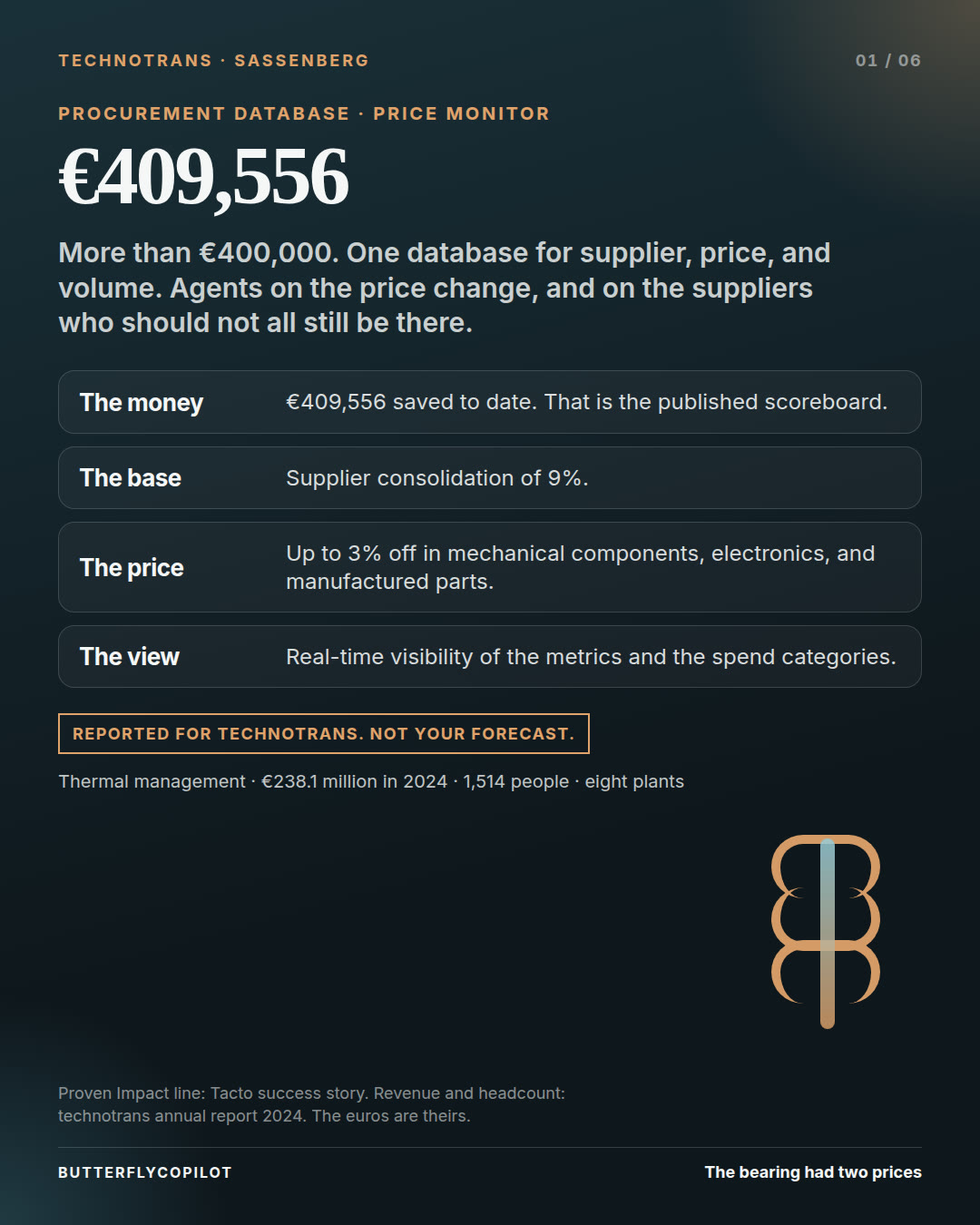
The published saving to date is €409,556. More than €400,000. Supplier consolidation of 9%. The metrics and the spend categories are visible as they move, not at the end of the quarter.
Cittrich put the point of the database in one sentence.
With a single source of truth for suppliers, pricing, and risks, transparency becomes tangible results – measurable in direct and indirect savings.
They are staying with the work. More of the supplier list to consolidate, contracts still to negotiate, category management to extend, and the savings track to keep so a direct saving and an indirect one both stay countable. That is the next stretch. It is not a second total.
Purchase orders and the supplier master, from every site
        ↓
One supplier, one unit, one currency, one category
        ↓
A price rise against the agreement, or against the last price, becomes a brief
        ↓
A small, irregular supplier becomes a proposal, with the volume bundled
        ↓
A person sends the note. A person changes the supplier. The ledger counts only the price that actually fell
The boxes are the instruction file. They follow the shape of the job: one database, a watch on price and terms, a consolidation proposal a person still owns. They are not a reconstruction of the Tacto screens. The model name, the prompt, and the code technotrans runs are not public. This page does not invent them.
A smaller quantity is not a saving
Speed is how a tidy agent merges two suppliers because the names look close, converts a dollar at yesterday's rate, and books the gap as money already saved. Speed is how a proposal becomes a new vendor on the part while the buyer is still reading it. Speed is how €409,556, or 9%, or 3%, slides into the config of a plant that has not measured anything yet.
The file for a smaller manufacturer keeps the three jobs and drops the tenant. One buyer. One category. The bands, the line that counts as a small supplier, and the gap that counts as irregular are numbers the plant types, because technotrans does not publish them and they must not be guessed. The model may copy a price that is already on a purchase order, a framework agreement, or a rate a person has filed. It may not invent one. It may not switch a supplier. It may not write a price back to the ERP. Version 1 writes files. An outbox is not a sent email. A proposal is not a new source.
On the fixture, which is ours, three local rows for Nordwerk, including one spelled G.m.b.H. with the tax id missing, are one supplier, and the two sites are one spend. Two rows of Müller Technik with two tax ids stay two suppliers. A box of ten converts because the plant filed the factor. A kilogram does not. A dollar line on a date with no rate is not compared with the euro agreement.
The price rule is fussier than a percent. The band on the fixture is 2% and 75 cents, and both tests have to pass before a rise is left alone. A bearing at 12.90 against a last price of 12.50 is 40 cents and 320 basis points. The cents are inside the band. The basis points are not. That line gets a brief, and the brief asks for 12.50 because 12.50 is the last price, not because someone typed 3%. A shaft at 5.10 against 5.00 is 10 cents and exactly 200 basis points. Both tests pass. No brief. A price that fell is recorded and is not a saving.
The ledger is three numbers that are not allowed to touch. The two briefs identify 8,400 cents. The two consolidation proposals identify 9,340 cents. A person then files the lower prices that actually happened, on the same quantities, and the realized total is 8,400 cents. The 9,340 is not added. An increase of 600 cents is listed and not subtracted. A filing that changes the quantity from eight pieces to five is zero. A proposal to move Klein's bearings onto Nordwerk's agreement is a file with switched false. Accepting it is permission to go and talk. The supplier on the part does not change.
KOEPFER, in the Black Forest, is the quote desk on this site. Their agent reads a price that has not been ordered yet. This desk starts from purchase orders and framework agreements the plants already have, and from the suppliers who are too small and too occasional to keep. Different company. Different hour of the buy. Their 8–15% does not belong on this page.
What a smaller manufacturer should steal
If the same part still has a different price in two plants, and the buyer can already point at the suppliers who show up twice a year, the first month is one buyer and one category. Mechanical components are the starting category in the file. That choice is ours. The case names cooling and mechanical components, electronics, and manufactured parts. It does not say which folder they opened first.
One buyer, one category, a band and a small-supplier line you type yourself
        ↓
Thirty days of exports, and a person on every merge the file is unsure about
        ↓
Thirty days where the brief sits beside the note that buyer would have written
        ↓
Thirty days where an approved outbox may be written, and a proposal may be accepted for negotiation
        ↓
The supplier does not change inside the tool. The next category waits.
Count the stretch you already have. How many lines have a framework agreement or a last price behind them, and how many have nothing. How many briefs the buyer sends unchanged, how many they edit, how many they kill. How many proposals they accept for a conversation, and how many they throw out. Merges that are still in conflict. Lines held because a rate or a unit factor was never filed. Outbox files with no name on the form. Messages this agent sent. Suppliers it switched. Prices it wrote back to the ERP. Identified cents that leaked into the realized column. Those last five stay at zero.
The €409,556, the "more than €400,000", the 9%, the "up to 3%", and the live view of the categories are technotrans's published story. They are not one equation, and they are not a line for a proposal. The quote names direct and indirect savings. The pages do not split the €409,556, and the file does not invent the split. Do not paste any of those figures onto yours.
What the instruction file will make an agent do
The file below is the brief. It is not their ERP, their bands, or their approval screen. None of that schema is public. The blanks are yours.
It will make the agent:
- Refuse to run while a
REPLACEline is empty, or while anEXAMPLErow is still in a live sheet. Refuse a savings target, a consolidation percent, or the digits 409556 and 430000 anywhere in the config. - Build one supplier from an exact key. The three Nordwerk rows become one. The two Müller rows, with two tax ids, do not. A name that only looks similar does not merge.
- Convert a box because the factor is on file, and refuse a kilogram because it is not. Convert the dollar line on 1 July because the rate is on file, and refuse the dollar line on 2 July rather than borrow the day before.
- Brief the 10.80 against the framework at 10.00, and the 12.90 against the last price of 12.50. Leave the 5.10 alone, because 200 basis points and 10 cents are inside both bands. Write no brief when nothing on file supports a number.
- Propose Klein's volume onto Nordwerk, at the agreement price for the bearing and at Nordwerk's latest price for the shaft, not at Nordwerk's cheapest old price. Leave the valve with the only supplier who sells it. Leave
switchedfalse. - Count 8,400 cents as realized when a person files those lower prices on the same quantities. Show the 9,340 cents of consolidation beside it, and do not add it. Give the quantity change a saving of zero. Leave the 600-cent increase unsubtracted.
- Write an outbox only after the named buyer approves on the form. The outbox is a file. It is not a sent message. Accepting a proposal does not change the supplier master.
The tests are in the file. The three spellings that are one supplier. The two tax ids that are not. The 40 cents that get a brief and the 10 cents that do not. The 8,400 and the 9,340 that are not a sum. The bundle that is not counted again once a line inside it has already been filed. The card number that never appears. If the agent clears any of those by merging a tax-id clash, emailing a percent, adding the proposal into the saving, or switching a supplier, the test fails.
The instruction file
The brief has the role, the sheets a purchase-order export can fill, the dedupe, the unit and the currency, the price monitor, the consolidation proposal, the ledger, the approval gates, the ninety days, and the tests that decide when a file may be treated as a brief a buyer has not yet sent.
Replace every REPLACE line. Delete every EXAMPLE row. Let it sit beside one category's purchase orders for a month a person still finishes by hand, before anyone treats an outbox as a note the supplier has already received, or a proposal as a supplier the plant has already changed.
Sources
The company facts in the story are from technotrans's 2024 annual report and its group-structure page. The procurement work, the €409,556, the 9%, the price reductions of up to 3%, the real-time visibility, and Stefan Cittrich's sentence are from the Tacto pages. The English page also says savings of over €430,000 have been realized. The German page says over €400,000. Both pages print €409,556 as the total to date. This page uses €409,556 and "more than €400,000", and it does not reconcile the three wordings. They are not an independent audit, and they are not a forecast for another manufacturer. The annual report does not mention the Tacto work or these savings. Its revenue and headcount are the company figures. The Tacto pages round revenue to around €240 million and headcount to over 1,500, and they say six production sites. The annual report says €238.1 million, 1,514 people, and eight production facilities.
- Tacto, ">€400,000 savings through AI-powered procurement management and intelligent supplier consolidation." technotrans SE, Sassenberg. Thermal management and liquid technologies. Founded 1970. Around €240 million turnover in fiscal year 2024, over 1,500 employees, six production sites in Germany, the USA, and China, as that page states them. After the pandemic: a fragmented supplier base and limited data transparency, especially in cooling and mechanical components, electronics, and manufactured parts and semi-finished goods, with many small and irregularly used suppliers. A central database for supplier, price, and volume data. Supplier processes standardised. AI agents detect, evaluate, and continuously monitor price changes, terms, and performance metrics. Analysis found consolidation and sourcing opportunities. The body text says savings of over €430,000 have been realized. Proven Impact: total savings to date €409,556, 9% supplier consolidation, real-time visibility into key procurement metrics and spend categories. Price reductions of up to 3% in mechanical components, electronics, and manufactured parts, through consolidated buying power. Stefan Cittrich, VP Procurement. Outlook: further supplier consolidation, contract negotiations, category management, and savings tracking.
- Tacto, ">400.000 € Einsparung durch KI-gestützte Einkaufssteuerung und intelligente Lieferantenkonsolidierung." The German page of the same story. The body says savings of over €400,000. Erreichte Ergebnisse states €409,556, 9% Lieferantenkonsolidierung, and real-time transparency. The same categories, the same "up to 3%", and the same outlook. The quote is the German wording of Cittrich's sentence.
- technotrans, Annual Report 2024. Consolidated revenue €238.1 million. 1,514 employees at 31 December 2024. Eight production facilities: Sassenberg, Steinhagen, Meinerzhagen, Holzwickede, Bad Doberan, Baden-Baden, Taicang, and Mt. Prospect. Framework agreements, a standardised clearance for new suppliers, and group-wide purchasing coordination are described. The report does not mention Tacto or the savings in the story above.
- technotrans, "Group structure." Headquarters in Sassenberg. The US production site is labelled Chicago. Focus markets: plastics, healthcare and analytics, energy management, laser, and print. 2024 turnover stated there as €238.1 million.