
How Vivix Cut Glass Complaint Resolution from 10 Days to 2.5 with AI
The batch already had a tag number. The complaint still took ten days. A quality specialist still owns the plan.
ButterflyCopilot
0106
The complaint was the job.
Vivix Vidros Planos makes float glass, laminated glass, and mirror glass, mostly for Brazil and Latin America. The Mendix release of 2 June 2026 counts over 350 people and 900 tons of float glass a day. It is the only glass manufacturing plant funded entirely by Brazilian capital. The customer story adds that it is the only glass company in Brazil with its own raw-material plant. Construction and furniture are the customers the AWS case names.
A sheet can leave the line and come back as a complaint. Before the batch lived in one app, someone walked it by hand. Layering, then cutting, then finalizing. The numbers sat in Excel or on paper, and what reached SAP had often been typed in from those sheets. On the shift checklist alone, Aristóteles Terceiro Neto said the team was losing four or five hours a shift to that manual work. A customer quality complaint took longer than a shift. It took 10 days.
What they stood up
In 2021 the plant wrote a three-year plan out of an industrial transformation group. The machine layers were already Siemens, Opcenter APS and Industrial Edge among them. The layers above were the gap. They looked at more than 18 platforms and built on Mendix. In three years Neto counts more than 30 applications. One of them is Glass DNA. A tag number opens the batch: layering, cutting, and finalizing, and the checklist rows that were never automatic. The Checklist app is where an action gets a deadline, a person, and a status.
The Virtual Engineer sits inside that app. Deloitte Brazil built it with the plant. The model is Anthropic’s Claude, through Amazon Bedrock. The customer story names Claude 3. Shop-floor data is standardized by HighByte into a unified namespace and kept in Snowflake, with the SAP data and the operational data beside it. Production apps reach SAP S/4HANA through the Mendix SAP OData connector. Some of the apps run on Siemens Industrial Edge.
The path of a complaint is short enough to copy.
A complaint or a production issue is in Glass DNA
        ↓
The agent pulls the batch by tag: layering, cutting, finalizing
        ↓
Parameters, checklist rows, and OT history come with the tag
        ↓
Manuals and the plant’s quality documents are searched
        ↓
A report is drafted, with a suggested plan
        ↓
A quality specialist validates it and owns the plan
        ↓
The Checklist app keeps the action: owner, deadline, status
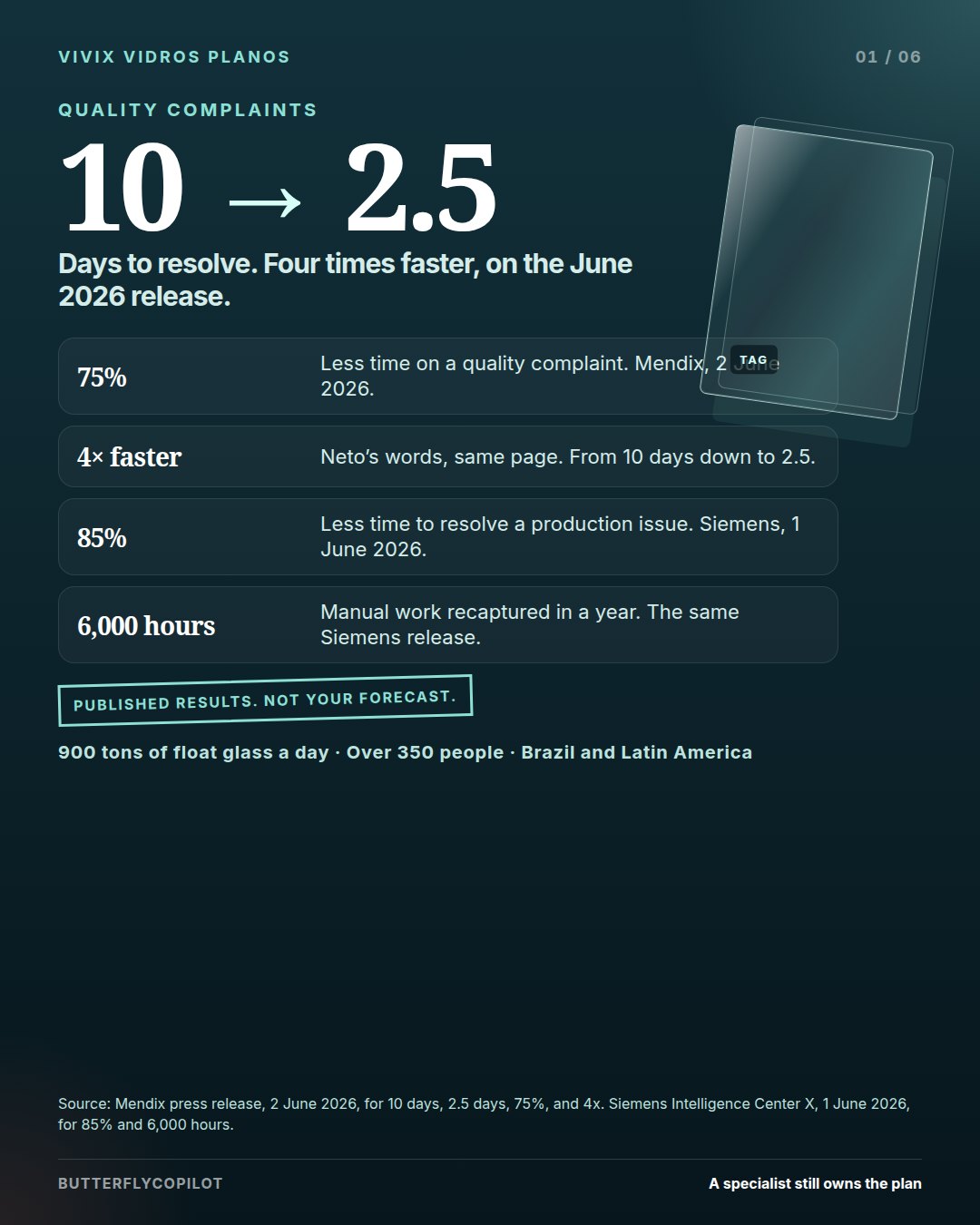
When a complaint arrives, the agent writes a report the quality specialist uses to validate the issue and develop the action plan. That is the AWS case’s description of the desk. The same release that states the 10 days also states what changed. Resolution went from 10 days to 2.5, which the page calls a 75% reduction, and which Neto calls 4x faster.
The Siemens release of 1 June 2026, the day Intelligence Center X was announced, reports two further results on this plant. Production issue resolution time down 85%. Manual work recaptured: 6,000 hours in a year. Those sentences belong to Vivix. A plant that does not pour 900 tons a day does not inherit them by putting a chatbot on a shared drive.
A draft is not a closed complaint
Speed is how a tidy agent “resolves” a complaint by touching the furnace.
The batch shows an edge that should not be there. A manual says hold the lot and look at the wheel. A past shift already logged the same note. If the agent closes the complaint because the story is coherent, the customer still has the sheet, and the specialist never owned the plan. If it writes a new setpoint because a model of the furnace looks confident, the plant has automated a change nobody signed. If it emails the customer a cause the retrieval never retrieved, the letter is the defect.
Vivix stated the counterweight in the same June release. Human-in-the-loop remains a core design principle, held in the Mendix governance layer, so senior engineers stay on the improvement and the agent carries the preparation. The specialist validates. The specialist owns the plan.
The release also describes the next step, and it is not this one. Sentinel watches the furnaces. Anomaly models in RapidMiner AI Studio train on the OT data in Snowflake. The plant is moving toward a setup where a furnace anomaly asks the Virtual Engineer to start workflows that adjust parameters and schedule maintenance. That workflow is ahead of them. The instruction file does not build it. Version 1 has no flag that writes a setpoint, closes a complaint, or schedules maintenance.
Faber-Castell’s line is a different hour. A camera took over a check that used to happen as the pen went by. Vivix’s agent starts later. The complaint has already arrived. The batch is already on a tag. The work is the investigation.
What a smaller manufacturer should steal
If complaints already land in one tracker, and a person still rebuilds the batch from exports and a folder of SOPs, the first thirty days are one specialist and one product family.
One specialist, one product family
        ↓
Ten days of exports, a corpus, and a stopwatch on the complaints they already close
        ↓
Ten days of drafts they may accept or reject, while they still close the complaint
        ↓
Ten days where an accepted action may become a checklist row
        ↓
The row is open. The specialist still closes. The setpoint stays put.
Time the month you already have. Days from the complaint to a report a person accepts. How many complaints a person still investigates from scratch. How the drafts split across accepted, rejected, and rewritten. How often a cited sentence points at a document the search actually returned. How often the tag is missing. How many checklist rows a person accepts, and how many they later undo. How often a closed complaint comes back. After the family is live, time the same things. Those pairs are your result.
The 10 days, the 2.5, the 4x, the 75%, the 85%, and the 6,000 hours are Vivix’s published story. They are not a line for a proposal.
What the instruction file will make an agent do
The file below is the brief. It is not Glass DNA, and it is not Vivix’s specs, scores, or timers. None of that wiring is public. The blanks are yours.
It will make the agent:
- Refuse to run while a
REPLACEline is empty, or while anEXAMPLErow is still in a live sheet. - Read the complaint, the batch stages, the parameters and their specs, the inspections, the checklist history, the people, and a folder of SOPs and closed cases. If a required file is missing or older than the plant allows, the run stops.
- Judge out-of-spec in code, in thousandths, bounds included. A blank measurement is not zero. A reading that exists only in the OT file is shown and never judged, and never written back.
- Search by overlap against the plant’s own documents, or against a retriever that returns the same chunk list. The product name is a filter, not a bag of query words. A cause sentence survives only when every citation was retrieved on that run.
- Propose a defect from the plant’s catalog and actions from a catalog whose flags forbid a setpoint, a customer email, and a close. Any other action is dropped.
- Escalate a safety word, a repeat of the same defect, an empty search, and a draft nobody has touched when the clock says so. The hours and the repeat count are the plant’s.
- Let a named specialist accept or reject the report on a form. The model cannot accept. A checklist file is written only after a second acceptance, only when the flag is on, only with an owner who is allowed to own it, and only with status
open. - Leave the complaint’s status where it was. Closing stays in the tracker the plant already trusts.
- Write a daily file from this plant’s own baseline. No comparison with the case study’s counts.
The tests are in the file. A cited report on a real edge chip. A sentence that cites a manual the search did not return. A setpoint smuggled into the plan. A model that tries to approve. A note that is too short. A checklist write while the flag is off, then a clean open row when the flag is on. An owner who is not allowed to own. A deadline of today, and a deadline past the limit. A closed status in the payload. An unknown tag. A complaint with no overlapping document. The wrong product family. Two tags in one cell. A complaint that is already closed. The word laceration. A third past case of the same defect. A stale export. An example row in the live folder. The same complaint twice. A draft left for 24 hours. A note that says to close the complaint and change the setpoint. A daily file that tries to borrow 4x. If the agent clears any of those by closing the complaint or by writing a parameter, the test fails.
The instruction file
The brief has the role, the file connector for whatever ERP or MES the plant already runs, the batch schema, the retrieval, the report, the approval, the checklist, the escalation, the thirty days, and the tests that decide when a specialist may let a row be written.
Replace every REPLACE line. Delete every EXAMPLE row. Let it sit beside the complaints a person still investigates, before anyone treats a draft as a plan the customer has already been told.
Sources
The complaint pair, 10 days to 2.5, is from Mendix’s release of 2 June 2026, including Aristóteles Terceiro Neto’s wording of 4x faster. The 85 percent and the 6,000 hours are from Siemens’ release of 1 June 2026. They are not an independent audit of a baseline, and they are not a forecast for another plant. The company description is from those pages and from the Mendix customer story. The AWS case is the source for the report a quality specialist validates, and for the retrieval over the plant’s own documents.
- Mendix, “Vivix Vidros Planos achieves 4x faster quality resolution by scaling agentic AI with Mendix and Snowflake,” 2 June 2026, San Francisco. Quality complaint resolution times reduced by 75%, from 10 days down to 2.5. More than 30 Mendix applications on Snowflake. Virtual Engineer embedded in Glass DNA, used to track and trace quality and production issues. Highbyte named as the partner that standardizes OT data into a unified namespace, persisted in Snowflake. Sentinel monitors furnaces. RapidMiner AI Studio for anomaly models. Snowflake Cortex AI as the conversational layer. Sentinel and Glass DNA described as moving toward a multi-agent setup in which a furnace anomaly can prompt the Virtual Engineer to start workflows that optimize production parameters and perform maintenance. Human-in-the-loop stated as a core design principle. Aristóteles Terceiro Neto, Industrial Transformation Manager: more than 30 applications in three years, and the Virtual Engineer resolves customer quality complaints 4x faster, from 10 days down to 2.5. About-blurb: float, laminated, and mirror glass, primarily Brazil and Latin America; over 350 employees; 900 tons of float glass a day; the only glass manufacturing plant funded by 100% Brazilian capital.
- Siemens, “Siemens powers the next phase of industrial AI with Intelligence Center X,” 1 June 2026, Detroit. Vivix Vidros Planos, Brazil’s leading flat glass manufacturer. Nearly 30 Mendix applications connecting OT and IT across SAP S/4HANA, Siemens Industrial Edge, and Snowflake. An 85 percent reduction in production issue resolution time. 6,000 hours of manual work recaptured in a single year. Virtual Engineer built with Amazon Bedrock and Claude from Anthropic.
- AWS, “Vivix Vidros Planos Transforms Glass Manufacturing with Mendix Low-code and Amazon Bedrock.” Glass DNA as the batch track-and-trace hub. The Virtual Engineer generates a detailed report so the quality specialist can validate the issue and develop an action plan. Retrieval-augmented generation over knowledge bases of the plant’s own data, for defect assessment, historical analysis, and document retrieval. Manual batch analysis from layering to cutting to finalizing. Excel and paper, consolidated into SAP. More than 18 solutions evaluated. Customers primarily in construction and furniture. Claude through Amazon Bedrock.
- Mendix, “Vivix Transforms Glass Manufacturing for a Clearer Future.” Own raw-material plant, the only glass company in Brazil with one. Three-year roadmap from 2021. Siemens software named: Opcenter APS, Industrial Edge, PCS7, WinCC Unified, WinCC Professional. Glass DNA tag number for layering, cutting, and finalizing, linked to the Checklist app. Checklist: a deadline, a delegated owner, a status. Neto on four or five hours a shift lost to manual checklist work. Virtual Engineer built with Deloitte Brazil, Claude 3 through Amazon Bedrock. Mendix SAP OData connector for SAP S/4HANA. Raissa Alencar, process and continuous improvement engineer, on the checklist and on Glass DNA.