
How AGC Chemicals Cut Sourcing Costs with AI Agents
The suppliers who could make the material were not in the catalog. The first project was worth roughly $75k to $80k a year, and a certificate that fails still does not become a lot.
ButterflyCopilot
0106
The supplier was not in the tool.
AGC Chemicals Americas manufactures and supplies high-performance fluoropolymers, fluoro compounds, and specialty chemical products for industrial markets. The company site puts the Americas business head office in Exton, Pennsylvania, at 55 E. Uwchlan Avenue, and a Thorndale plant on Bailey Road in Downingtown. Procurement buys specialized raw materials. The suppliers who can actually make them sit in technical markets, and a conventional sourcing catalog does not list them.
Three limits sat on the same desk. The team could not see the vendors. A provider with one specific technical capability was hard to find. There was no competitive price to set next to the incumbent, so a renegotiation had nothing to stand on. Certificates of analysis and receiving documents arrived on top of that pile, and people handled them by hand.
Donny Lombardi, director of supply chain, described the piece that came off one person's week. Half of the mundane, non-value-added load. That person could then do work that actually helps the company. The volume, he said, is not something you compare with a human.
What they stood up
Didero put agents on the desk in 2024. They are in production. Didero describes the company as a mid-sized chemicals manufacturer. Sourcing came first.
The agents read a specification. They search for suppliers and qualify the ones with the technical and operational capability the job needs. They filter on the application and on a price range. The request for quotation, and the follow-ups after it, leave through AGC's own email domain. The replies come back into one place. A structured commercial benchmark is what the buyer takes into the renegotiation with the incumbent. Several of those projects run at the same time.
Stefano Matozzo, senior procurement and inventory manager, put the shape of the work in two sentences. The team can get dozens of vendors through the agent. The AI sits alongside them. It does not replace them. Procurement enters at the vetting stage, after the search, not at the start of it.
Once that sourcing work was running, they mapped the certificates and the receiving papers. Agents watch the supplier inbox. They classify what came in. They extract the lot and the batch. They update Dynamics 365, attach the file to the right record, and route the exception to a person.
A specification names the material, the application, and the price range
        ↓
Vendors are searched, qualified, and filtered
        ↓
A person vets the list. The RFQ leaves from the company's own domain
        ↓
Replies become one benchmark. The incumbent's price is not edited here
        ↓
A certificate and a receiving document meet on lot and batch
        ↓
A pass can update the ERP. A failure is an exception, with the file attached
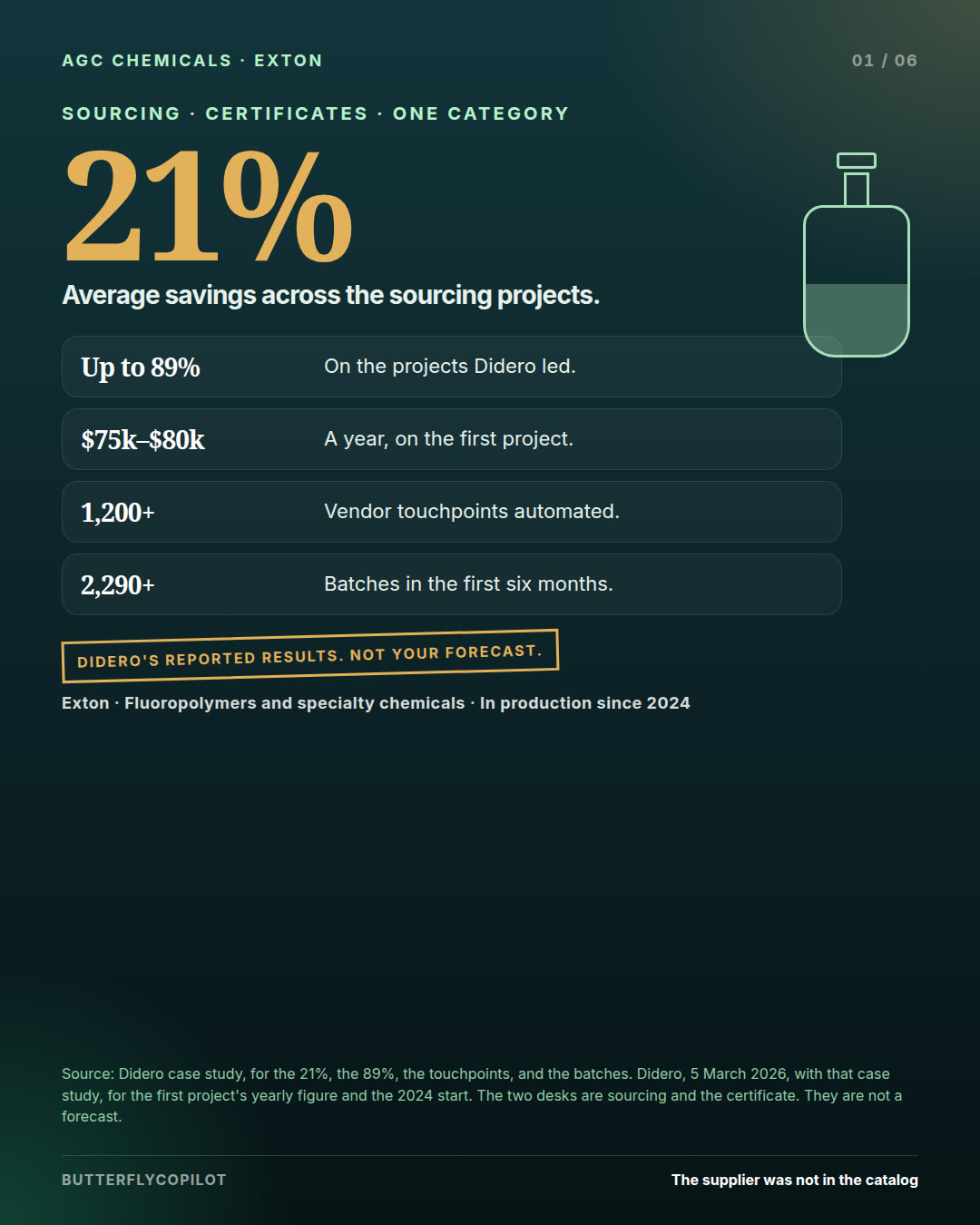
Across the sourcing projects, the average saving was 21%. On the projects Didero led, savings reached as high as 89%. The first project was worth roughly $75k to $80k a year. The same rollout automated 1,200+ vendor touchpoints, and it processed 2,290+ product batches in the first six months.
Those figures belong to this company and this deployment. A plant with a shorter vendor list does not inherit them by switching a tool on.
A gap is not a booked saving
Speed is how a tidy agent invents a vendor the sheet does not contain, sends the RFQ from a personal mailbox, writes the low quote onto the incumbent, and calls the difference a saving. Speed is also how a certificate that failed the spec becomes a lot, because someone described the ERP update as automatic.
The file for a smaller plant keeps the two jobs and drops the tenant. One category. The vendors a buyer can already name. A search hit counts only when it has a URL and the email is actually in the text. The model may copy the brief. It may not invent a company, an address, or a price. The band is the band on the project. On the fixture, 6.80 is inside a band that ends at 6.80, and 6.81 is not.
The benchmark is a median of the qualified quotes. An even count takes the lower of the two middle prices. It does not average them. Three fixture quotes, 4.80, 5.60, and 6.00 dollars a kilogram, against an incumbent at 6.40, resolve to 5.60. The gap is 80 cents a kilogram. At 12,000 kilograms that is 960,000 cents, and 1,250 basis points. A fourth quote at 5.20 moves the benchmark to 5.20, not to the average of the two middle prices. A single quote at 7.00, inside a wider band, leaves a gap of 60 cents the wrong way, 720,000 cents across the year, and the file keeps the minus sign. Those cents are fixture rows. They are not a fluoropolymer price, and they are not AGC's 21%.
The certificate uses the same kind of lock. Purity and moisture are integers, in hundredths of a percent. The fixture's 99.70% is 9,970, and 0.03% moisture is 3, against limits of 9,950 and 5. Both pass, and the quantity 500.00 kilograms is 50,000 hundredths. Purity of 99.40% is 9,940. It fails, and it does not post. A lot that exists only in a PDF the agent was not given as text is a missing lot. A blank is not stored as a lot id. A receiving quantity of 480.00 does not get averaged with 500.00, and it does not get clipped down to the purchase order.
The buyer vets the exact recipient list, and the send checks a hash of that list. The message leaves from the company's domain or it does not leave. The follow-up is the same fixed note. It asks for a price. It does not negotiate, and it stops after the number of chases the plant typed. The reviewer sees the exception. A failed spec, a duplicate lot, or a missing batch cannot be approved into a post. Dynamics 365 is the system AGC updates. The file writes one canonical record a person can load into Dynamics 365, SAP Business One, or Odoo. It does not ship three connectors, and it does not release a payment.
Footprint chases the acknowledgement on a purchase order that the material plan already named. FABco keys the bill of lading and matches the invoice. Different plants. Different work. This desk discovers the vendor and files the certificate. The award, and the money, stay with a person.
What a smaller plant should steal
If the incumbent has the price because nobody else was on the sheet, the first ninety days are one category and the suppliers you can already defend.
AGC is the useful size of example for that month. A chemicals manufacturer, specialized raw materials, a team that still has to vet. The lesson is not "buy a catalog." The lesson is that the search and the filing can move, and the decision stays in the room. Matozzo's line is the one to keep. The agent is alongside the team.
One category, one incumbent, the vendors you can name
        ↓
Thirty days of exports, and a stopwatch on the project you already run
        ↓
Thirty days of RFQs from your own domain, after a named buyer vets the list
        ↓
Thirty days where a clean certificate may write the lot, and a failure may not
        ↓
A second project waits. The award still waits for a person.
Time the stretch you already have. Hours from the brief in hand to a comparison you would take into a renegotiation. Vendors you add or strike when you vet the list. The gap, in your own cents, labeled as a gap. Follow-ups a person still sends. Hours from the certificate email to a lot in the ERP, or to an exception. Records you later reverse. Awards the agent made, prices it changed, messages it sent from the wrong domain, and failed specs it posted. Those last counts stay at zero.
The 21%, the 89%, the first project's roughly $75k to $80k a year, the 1,200+ touchpoints, and the 2,290+ batches are AGC's published story. They are not a line for a proposal. Do not paste them onto yours.
What the instruction file will make an agent do
The file below is the brief. It is not Didero. It is not AGC's Dynamics 365 tenant, their vendor index, or their spec limits. None of that wiring is public. The blanks are yours.
It will make the agent:
- Refuse to run while a
REPLACEline is empty, or while anEXAMPLErow is still in a live sheet. - Read a brief against a phrase table the company wrote.
about 12000does not become 12,000. Two applications on one brief stay a question. A phrase the table does not contain does not become a capability. - Qualify from the vendor sheet. A missing capability excludes. A known price outside the band excludes. A blank price does not. The incumbent stays the baseline and, until the plant says otherwise, stays off the mailing list.
- Accept a discovered supplier only with a URL and an email that appears in the hit. A model that types an address has not discovered anyone.
- Draft one fixed RFQ. Send it only after the buyer approves that exact list, only from the company's domain, and only once the send flag is on. A follow-up uses the same restraint and stops at the chase cap.
- Price the benchmark in code. The fixture's three quotes resolve to 560 cents, a gap of 960,000 cents a year, and 1,250 basis points. Two quotes resolve to the lower one, not the average. A worse quote keeps its minus sign. Nothing in the file awards the low bidder or writes the incumbent's price.
- Classify a certificate and a receiving document. Extract a lot, a batch, a purity, a moisture, and a quantity only when the email text contains them. The fixture's clean pair is purity 9,970, moisture 3, and quantity 50,000 hundredths. A 99.40% result fails and has no ERP payload. A lot hidden in an unread PDF stays missing, and the secret in those bytes never lands in the output.
- Hold a mismatch. Two quantities are not averaged. A receipt above the open purchase order is not clipped. A second batch on a lot that already posted is a duplicate. An invoice that is not a certificate is not a payment.
- Write a morning file from this plant's own hours, its own gap, and its own exception counts. No comparison with the case study.
The tests are in the file. A recipient list that hashes to the four fixture vendors. A send from gmail that does not leave. A fifth name added after approval that voids the send. A quote of 5.6 that is not read as 5.60. A comma in 99,70% that is not read as 99.70. A model that says the purity is 99.99% while the body says 99.70%. A card number that is not copied into the note. If the agent clears any of those by inventing a vendor, averaging two prices, emailing the incumbent a new price, or posting the failed certificate, the test fails.
The instruction file
The brief has the role, the sheets a spreadsheet or an ERP export can hold, the two paths, the prompts, the median and the spec check, the vetting hash, the chase, the exception routes, the mapping toward Dynamics 365, SAP Business One, or Odoo, the ninety days, and the tests that decide when a buyer may let a message leave.
Replace every REPLACE line. Delete every EXAMPLE row. Let it sit beside one category a person still sources by hand, before anyone treats a file as a quotation the supplier has already been sent, or as a lot the ERP has already accepted.
Sources
The savings, the touchpoints, the batches, the two jobs, and the sentences from Donny Lombardi and Stefano Matozzo are from Didero's AGC Chemicals case study. The 2024 start, the production status, the vetting stage, and the specification-and-filter account are from Didero's note of 5 March 2026. The first project is stated here as roughly $75k to $80k a year. The Exton office and the Thorndale plant are from AGC's own site. The figures are as those pages report them. They are not an independent audit, and they are not a forecast for another plant.
- Didero, "AGC Chemicals." AGC Chemicals Americas manufactures and supplies high-performance fluoropolymers, fluoro compounds, and specialty chemical products. Procurement manages specialized raw materials and suppliers in technical markets that do not show up in conventional sourcing tools. Limited vendor visibility, difficulty finding specific technical capabilities, and no competitive market data against incumbents. Sourcing agents qualify vendors, run RFQ outreach and follow-ups through AGC's own email domain, consolidate responses, and build commercial benchmarks. Multiple projects run in parallel. Document agents monitor supplier inboxes, classify certificates of analysis and receiving documents, extract lot and batch, update Dynamics 365, attach the files, and route exceptions. 21% average savings across sourcing projects. Up to 89% savings on Didero-led sourcing projects. $80k per year saved on the first project. 1,200+ vendor touchpoints automated. 2,290+ product batches in the first 6 months. Donny Lombardi, Director of Supply Chain, on half of one person's mundane load, and on volume. Stefano Matozzo, Senior Procurement and Inventory Manager, on dozens of vendors, and on AI alongside the team.
- Didero, "When Procurement Stops Being a Search Problem," 5 March 2026. The note says AGC Chemicals Americas was featured in Supply Chain World. Agents interpret specifications, search, and filter by application and price range. Procurement enters at the vetting stage. A single vendor change in the first weeks delivered $75,000 in annualized savings. Deployed in 2024, in production. Described there as a mid-sized chemicals manufacturer. This page does not describe the magazine article.
- AGC Chemicals Americas, agcchem.com. AGC Chemicals Americas, Inc., 55 E. Uwchlan Avenue, Suite 201, Exton, PA 19341. The site calls that office the Americas business head office. Thorndale plant, 255 S. Bailey Road, Downingtown, PA 19335. Fluoropolymers, fluoroelastomers, PFA and ETFE resins, compounds, and specialty materials. No headcount is printed. The address is not a result of the agents.