
How Covestro Cut Material Master Time with AI Agents
The packed material was still an email. Twelve hours became six minutes, and a plant the table does not have still does not get a number.
ButterflyCopilot
0106
The request was already a material. It was just still an email.
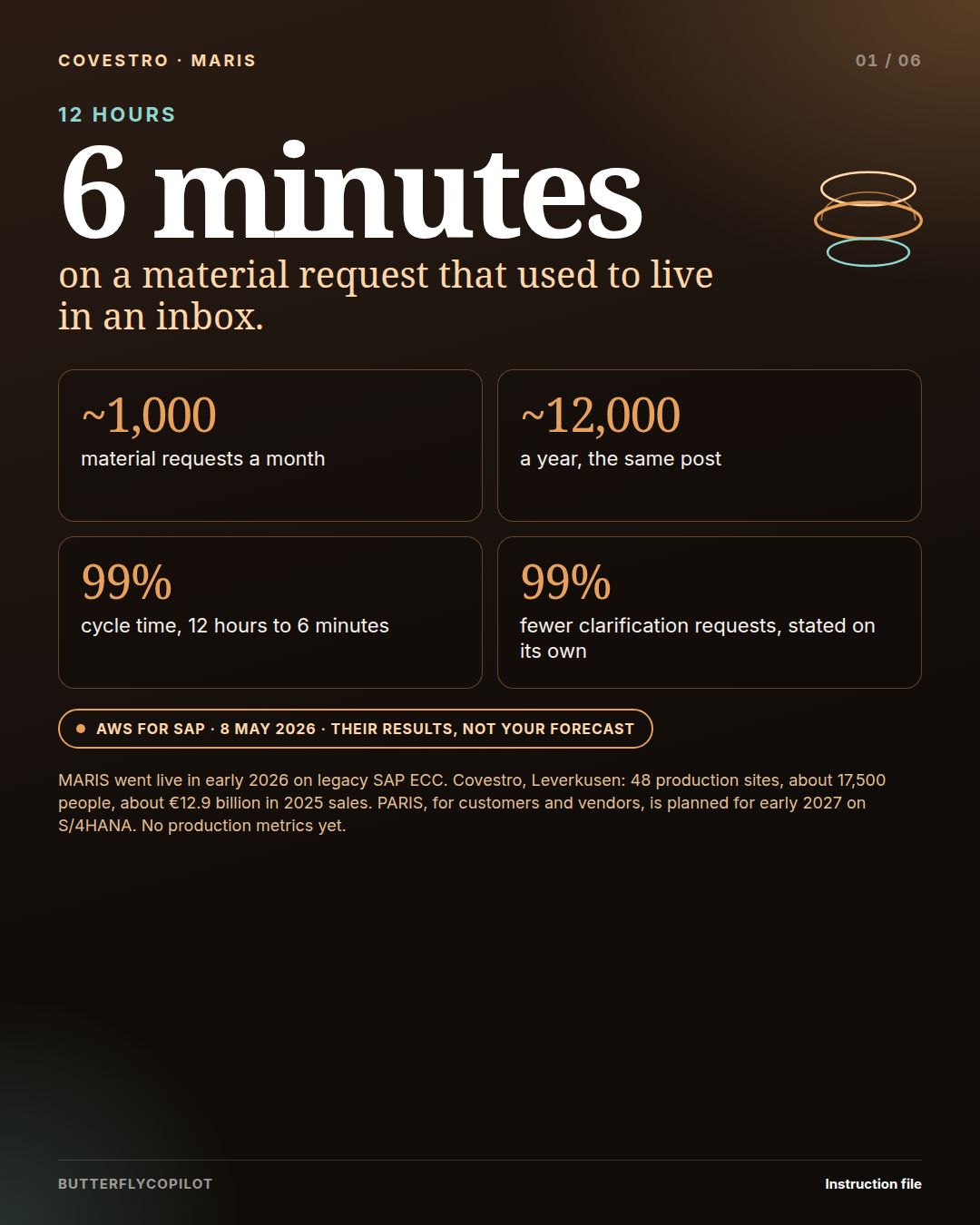
Covestro makes the polymers other industries build with. Polycarbonates, polyurethanes, coatings, adhesives, specialty elastomers. The AWS account of the company puts the headquarters in Leverkusen and the footprint at 48 production sites, approximately 17,500 people, and approximately €12.9 billion in 2025 sales. The materials go into cars, buildings, electronics, and medical devices. The SAP Innovation Awards 2026 entry is filed under Covestro Deutschland AG, and it describes this same cut in the time to create a material master.
Someone at a plant needed a packed material created. Or a plant view. Or a sales organization on a material that already existed. Sometimes a change. Sometimes a deletion. There was no door into SAP Master Data Governance for that person. The door was an inbox. An MDG expert read an unstructured email, asked for the attribute that was missing, checked for a duplicate by hand, and typed the record. A single request could take hours or days. The average that later moved was 12 hours.
About a thousand material requests arrive in a month. About twelve thousand in a year. Every one of them waited on the same small craft: interpret, clarify, search, type.
What they stood up
MARIS, the Material Artificial Realtime Intelligence Specialist, went live in early 2026 on the legacy SAP ERP, the ECC system. Covestro built it with Deloitte. The agents run on Amazon Bedrock AgentCore, built with the Strands Agents SDK, on Claude. The door the requester actually opens is CoVA, the Covestro Virtual Assistant, in a browser or in Microsoft Teams.
A supervisor reads the sentence and hands it to a task agent. The task agent walks the request down to a handful of fields, checks those fields against SAP data that AWS Glue has replicated into Amazon S3, and lets Amazon Athena answer the questions that used to be a phone call: is this material number real, is this plant real, is this material type real, is this sales organization real. It looks for a duplicate across the systems that extract covers. It fills what can be derived. It creates an SAP MDG change request through SAP BTP Integration Suite, and that change request goes into the approval workflow the company already ran.
The conversation no longer waits on an expert to retype the email. The approval still waits on a person.
The average went from 12 hours to 6 minutes. The post calls that a 99% reduction in cycle time, on those thousand requests a month. In the conclusion it states a second figure on its own: the clarification requests that used to fill inboxes fell by 99%. Sunny Liu, Global Process Owner for Material Master Data, described the desk the requesters now have.
Our AI agent MARIS has transformed our approach to material master data maintenance by providing instant, conversational access to complex processes. We are now available to our stakeholders 24/7, with no waiting times and no manual dependencies.
The first people to use it, the commercial operations requestors in APAC, said the validation caught the gaps on the first submission and asked for the complete record up front. The experts who used to live in the inbox moved toward the governance work. The post describes that shift, and it does not put a headcount on it. This article will not invent one.
PARIS, the twin that will handle customers, vendors, and prospects, is planned for early 2027, and only on SAP S/4HANA. The post says the numbers for PARIS come after that go-live. There is nothing to borrow. The S/4HANA program itself, ACT, is planned for January 2027, and MARIS moves onto it then. The year MARIS is live, as the post dates it, is a year on ECC.
A sentence in CoVA, in the browser or in Teams
        ↓
A supervisor picks one job and refuses to pick two
        ↓
The task agent asks for what is missing and checks the extract
        ↓
A duplicate stops. A derived field is copied from a table, not composed
        ↓
An MDG change request enters the approval workflow a person already runs
A plant the table does not have
Speed is how a tidy agent invents the plant code that was almost right, accepts a packed material with the net weight left blank, and writes the master because the chat felt finished. Speed is also how a material number gets built out of the description, and how a deletion lands on a material that still sits on an order.
The published path is the right shape, and it is the wrong shopping list for a plant that does not have Covestro's estate. The file below keeps the five jobs. Create a packed material. Change one field. Extend it to a plant. Extend it to a sales organization. Mark it for deletion. It drops the tenant. One plant. One material type. The sheets are an export the company already knows how to produce: plants, types, sales organizations, packaging, the material list, and a block of numbers a steward has already reserved.
A code that is not on the sheet is a stop. The sheet does not grow to make the request true. The create asks for seven things: the description, the type, the unit, the plant, the packaging, the gross weight, and the net weight. The net is not optional. If the net equals the gross, there is no pack, and there is no draft.
On the fixture, an amber jerrycan at 1,400 grams gross and 1,000 grams net matches a packaging tare of 400 grams. That card drafts. The same card with the net left blank does not. A plant id the extract does not contain is not added to the extract. A description that matches a drum already on the list, once the commas and the extra spaces are folded away, is a duplicate, not a second material. The steward approves the hash of that exact payload. Until that signature, nothing is submitted. After it, the file is a change request. The material row is still not inserted. The reserved number is still reserved.
Three of four made-up requests were complete the first time. That is 7,500 basis points. It is this file's arithmetic on four rows. It is not 99%, and it is not six minutes.
AGC Chemicals kept a person on the certificate that fails. Wolfspeed kept a person on the decision a report is not allowed to execute. This desk already has the material request. It will draft the change. It will not invent the plant, and it will not be the approver.
What a smaller plant should steal
If the request still arrives as an email, and someone still retypes it into the master, the first ninety days are one plant and the packed materials that plant can describe completely.
Covestro is the useful size of example for the volume, and for the decision to leave the yes inside the change-request workflow. The lesson is smaller than the estate. A smaller plant does not need Bedrock, Glue, Athena, and BTP to find out whether its own extract can refuse a bad plant. It needs the extract, a steward who is not the requester, and a clock that belongs to the plant.
The hard part, reading the post, was not the model. Users had no path into MDG, so the expert inbox had become the system. The company was in the middle of a transformation, so the agent had to be useful on ECC while S/4HANA was still a January 2027 date. And the approval could not leave with the email. A faster inbox that writes the master directly is a different system, and it is a worse one. They also did not fold customers and vendors into the same release. PARIS waits.
One plant, one packed material type
        ↓
Thirty days of exports, and a stopwatch on requests a person already finishes
        ↓
Thirty days where the steward can see the draft, and nothing is submitted
        ↓
Thirty days where an approved draft may become a change-request file
        ↓
The master is still written by the workflow you already trust. A second plant waits.
Time the stretch you already have. Hours from the request in hand to a change request a person would actually submit. The share that arrives complete the first time. The count of follow-up questions, as a count. The hours from a finished draft to a person's approval, with a span under an hour kept at zero rather than rounded into a victory. Plants the agent added, numbers it composed, locked fields it rewrote, files it submitted with no signature, rows it wrote straight into the master. Those last counts stay at zero.
Covestro's scoreboard is not your forecast. The 12 hours, the 6 minutes, the thousand a month, the twelve thousand a year, and both 99% figures are this company's published story. The award entry restates the hours. Measure your own hours, your own first-time-right, your own clarifications, and your own approval cycle. Do not paste their numbers onto a proposal.
What the instruction file will make an agent do
The file below is the brief. It is not CoVA, and it is not Covestro's ECC tenant. The blanks are yours. Covestro's agent creates the change request and the company's approval workflow takes it from there. This file is stricter on the way in: a named steward approves the payload before the change-request file exists. If you then load that file into MDG, or into whatever change-request object you already run, those approvers are a second gate. The agent is neither of them.
It will make the agent:
- Refuse to run while a
REPLACEline is empty, or while anEXAMPLErow is still in a live sheet. - Take one plant and one packed material type. A customer, a vendor, or a second job in the same sentence stops. Two intents do not get collapsed into a create.
- Check every plant, material type, sales organization, storage location, and packaging code against the export. An id the sheet does not have is not created. On the fixture,
EXAMPLE-PLANT-Zadds nothing. - Refuse a packed create that is missing its net weight, its gross weight, or its tare. A net equal to the gross is not a packed material. A weight written
1.400or1400gis not 1,400 grams. - Treat a matching description as a duplicate, including one that only differs by spaces, commas, and case. A retired material still counts. The agent does not merge the two rows.
- Refuse a change to the material number, the material type, the base unit, the packaging, or the plant. Those fields stay. A deletion of a material that is still in use does not draft.
- Accept a material number on a create only from a block a steward already reserved, and only at submit, and without marking the block consumed. A number the user typed is refused.
- Write a change-request file only after the steward approves that exact hash, and only once the submit flag is on. The material master is not updated.
master_writtenstays false. - Write a morning file from this plant's own hours, its own first-time-right, its own clarification count, and its own approval hours. No comparison with the published 12 hours or the published 6 minutes.
The tests are in the file. A plant that is not on the sheet and is not added. A jerrycan with no net weight that does not draft. A submit before the steward's note that does not leave a file. A model that says "approved" and is ignored. A card number that is not copied onto the draft. If the agent clears any of those by inventing a plant, completing the packed record on its own, or posting without the signature, the test fails.
The instruction file
The brief has the role, the sheets a spreadsheet or an ERP export can hold, the supervisor and the task agent in ordinary language, the path from the sentence to the draft, the hash, the steward's gate, the mapping sheet for whatever system the plant already runs, the ninety days, and the tests that decide when a file may exist.
Replace every REPLACE line. Delete every EXAMPLE row. Let it sit beside one plant and one packed cohort, with a person still approving by hand, before anyone treats a file as a change request the workflow has already accepted, or as a material the master has already stored.
Sources
The company footprint, the 12 hours and the 6 minutes, the thousand requests a month, the twelve thousand a year, the clarification figure, the MARIS and PARIS dates, the architecture, and the sentences from Sunny Liu and the APAC requestors are from the AWS for SAP guest post of 8 May 2026. The award page restates the 12 hours to 6 minutes for Covestro Deutschland AG and does not add a second set of counts. The figures are as those pages report them. They are not an independent audit, and they are not a forecast for another plant.
- AWS for SAP, Sachin Bhatt and Sourav Sadhu, with Christian Jantzen (Covestro), Neelesh Jain, Ahmad Shawabkeh, and Kristina Pietukhova (Deloitte Germany), "Covestro Transforms Master Data Governance with AI Agents on AWS," 8 May 2026. Covestro, Leverkusen, 48 production sites, approximately 17,500 employees, approximately €12.9 billion in 2025 sales. Polycarbonates, polyurethanes, coatings, adhesives, and specialty elastomers, for automotive, construction, electronics, and medical devices. The old path was unstructured email to MDG experts: interpret, clarify, correct, check duplicates by hand, and enter SAP MDG. A single request could take hours or days. MARIS (Material Artificial Realtime Intelligence Specialist) went live in early 2026 on legacy SAP ERP (ECC). It handles create, change, and deletion for material master data, including packed material creation, plant extensions, and sales organization extensions. Average cycle time from 12 hours to 6 minutes, a 99% reduction, for approximately 1,000 material requests a month, roughly 12,000 a year. MARIS sits in CoVA, the Covestro Virtual Assistant, in a browser or Microsoft Teams. A supervisor on Amazon Bedrock AgentCore, built with the Strands Agents SDK on Claude, routes to a task agent. Validation uses SAP data replicated by AWS Glue into Amazon S3 and queried with Amazon Athena: material numbers, plant codes, material types, and sales organizations. Duplicate checks, derived enrichment, and an SAP MDG change request created through SAP BTP Integration Suite into the standard approval workflow. DynamoDB for logs, AgentCore Memory for the conversation, CloudFormation for the infrastructure. The conclusion states that clarification requests that once filled inboxes have been reduced by 99%. Sunny Liu, Global Process Owner for Material Master Data. The Commercial Operations Requestor Group, APAC, on validation that caught gaps up front. PARIS (Partner Artificial Realtime Intelligence Specialist) is planned for early 2027, exclusively on SAP S/4HANA, and the post says its quantitative metrics come after go-live. SAP S/4HANA go-live under the ACT program is planned for January 2027, and MARIS transitions then. Deloitte Consulting GmbH is the integrator named on the program. Nicolas Roussel is quoted as a Deloitte partner. Andreas Henjes is named as Program Manager, SAP S/4HANA Transformation.
- SAP, "Covestro Deutschland AG — SAP Innovation Awards 2026," entry 26035. Covestro AG implemented an AI-powered agent to streamline material master data creation, reducing process time from 12 hours to 6 minutes, during the SAP S/4HANA transformation. The page describes better data quality and users who no longer depend on the old bottleneck. It does not publish a second set of volumes or a clarification percentage. "Eliminates errors" on that page is not treated here as a measured zero.