
How DESTACO Cut Customer Defects 53% with AI Agents
The build you last ran a year ago was in a veteran's head. The checklist proved a pen had moved.
ButterflyCopilot
0106
A gripper came up that nobody on the shift had built since last winter.
The sheet on the bench was laminated, and it was for a different job. The PowerPoint sat on a shared drive, three folders past the one people actually opened. The assembler who knew the build was on the other shift, or already gone. Asking that person was faster than finding the instruction. On a custom the plant had never built, there was nothing to find.
DESTACO makes the hardware that holds the work. Manual clamps, pneumatic clamps, hydraulic clamps. Grippers, indexers, conveyors, robotic end effectors, vacuum tooling. The customers are in automotive, health sciences, and industrial manufacturing. The flagship plant in this story is in Mt. Juliet, Tennessee. The company is headquartered in Auburn Hills. The mix is the difficulty: thousands of configurable products, many of them built only a handful of times a year, some of them a one-off. DESTACO was part of Dover. Stabilus closed the acquisition in 2024, and DESTACO is a Stabilus expert brand. At the signing, Stabilus described about 650 people across 13 locations, and about US$213 million of revenue in 2022.
The size is not the lesson. The lesson is a Tuesday when the job is rare and the person who has done it is not at the station.
The signature proved the pen
Safe-to-Start was a checklist. So was the quality inspection. So was the layered process audit. A signature and a check mark. Nothing in the record showed that anyone had looked at the station, taken the measurement, or put a wrench on the bolt. The technique lived with the veterans, and it was not written down. A retirement does not file a handover.
Rakuya Artis, Global VP of Operations and Supply Chain, put the cost on the customer.
Our customers can't afford a quality error because we're training a new operator.
Record it once
They put Squint on the problem. Squint is an industrial AI company in San Francisco.
The instructions that already existed were not thrown away. DESTACO connected the document hub it had, and several hundred work instructions came over intact.
The jobs that were new, or rare, or only in someone's hands, went the other way. An expert assembler runs the job once. Squint records it. A tribal-knowledge agent, tuned to DESTACO's preferences, turns the video into a written instruction: the steps in order, the quality checks called out. An engineer reviews it before anyone else builds from it. At the station the operator sees the step, the photo, the video, the measurement, and the torque spec.
Louis Bianco builds complex grippers.
On a job I haven't run in months, I can watch someone who knows it do it, one step at a time.
Before the build, Safe-to-Start is a walk down the station with a camera. Equipment, tooling, fixtures, the work area. The published Gripper Workbench card is seven steps, and one of them is a photograph of the whole workstation. A dry-erase mark is gone at the end of the shift. The photograph stays. A step on the floor now reads like a proof: confirm there is no damage, paint, or masking residue on the links in section A of the conveyor, and take the photo. The procedure does not close until that photo is in.
The same product is built at more than one site. Each site used to keep its own version of the instruction. A standardization and compliance agent holds the wording and the format to what DESTACO has approved, so one site writes it and every site uses it. The operator reads it in their own language. The process is the same one.
Blas Leon joined as an engineering co-op.
Before Destaco, training meant direct supervision and taking up someone else's time. With Squint, I was independent within my first few days.
The Squint blog records a separate fact from the same kind of work. An engineering co-op with no manufacturing background built nearly 100 work instructions in 60 days.
Jeff Clark, Director of Global Operational Excellence and Quality:
Squint became the standard. Everybody opens it before they start building.
The morning the complaint became the instruction
Each morning, Quality sits with what came back from customers and what came up inside the plant. They run the root cause. They update the instruction the issue touches, and they put the customer's photograph and the lesson on the step. Every assembler sees the change before the next build. A fix that used to take weeks is standard work in hours.
The procedure will not close until the critical steps are recorded. The evidence is the inspection. The signature is not a substitute for it.
Layered process audits left the paper. The auditor answers, uploads the photo, and records the correction before the audit can close. On the gripper line, participation and on-time closure of findings reached 100%.
An assembler who finds a hole in the instruction flags it and proposes the fix. Engineering reviews it before it is published. The person on the station is allowed to say the instruction is wrong. They are not the one who publishes the correction.
Clark's sentence is the design, not a slogan.
Standard work isn't just documentation, it's one of the most important quality systems in a manufacturing plant. Today, every engineering change, customer complaint, quality alert, and lesson learned is incorporated into our standard work almost immediately. That has fundamentally changed how we improve quality, train our employees, and preserve manufacturing knowledge.
Artis had expected to hire industrial engineers to capture the work, and they are harder to find every year. Now every operator can do it, which makes the associates, including her, technical experts.
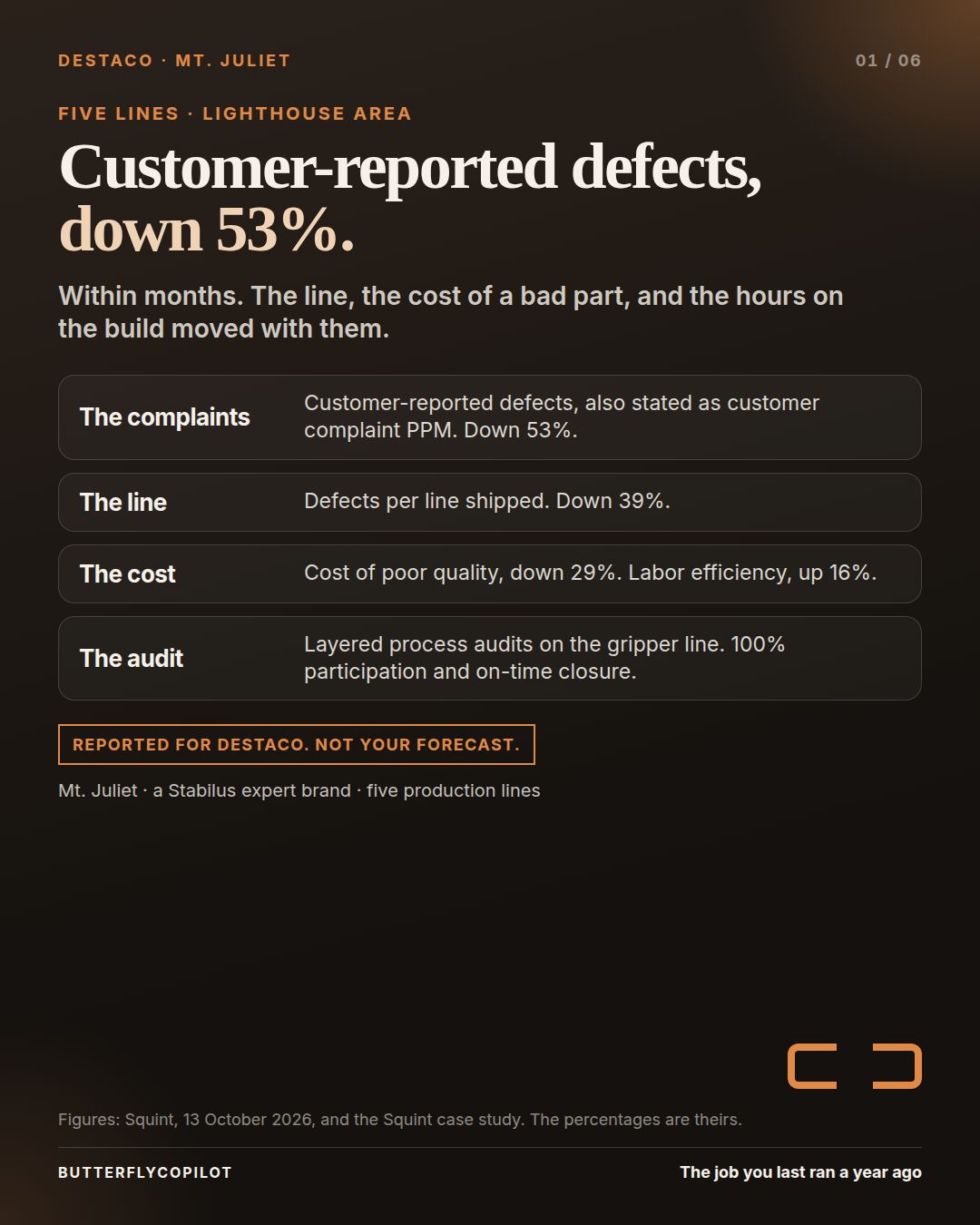
The figures are from the vendor's published case study. In the lighthouse area, five production lines, within months: customer-reported defects, which the case study also states as customer complaint PPM, fell 53%. Defects per line shipped fell 39%. Cost of poor quality fell 29%. Labor efficiency rose 16%. Squint has not published the models, the prompts, or the schema. The boxes below are ours.
An expert records one job, narrating while they build
        ↓
A draft, with steps in order. A spoken number is not a spec
        ↓
An engineer approves. A missing document stays blank
        ↓
One master. Every site. The operator's own language
        ↓
A morning complaint becomes a proposal. The next build shows it
        ↓
The critical step needs its evidence, or the job does not close
What a smaller plant should steal
Start with one area. Three to five lines. Not the company.
The instruction is the quality system. A binder nobody opens is a binder. A step the operator has to photograph before the job can close is a system. Clark said it plainly: without standard work you cannot improve, and you cannot sustain the improvement.
The agent drafts. An engineer approves. A torque, a measurement, or a tolerance comes from the engineering document, with the document id on the step, or the sentence stays blank for that engineer. The agent does not guess the number. A complaint becomes a proposal. It does not become the live instruction until a person publishes it.
Count the baseline before the first recording. Customer complaint PPM. Defects per line shipped. Cost of poor quality. Hours per unit. Whether the layered audits happened, and whether the findings closed on time. Hours from a complaint to the instruction that changed. Days until a new hire can run the job without a veteran standing there. Eight to twelve weeks of before, on the same lines you will change, and the same length after. The 53% is this plant's published result. It is not a number you type into a goal.
On the fixture, which is ours, a spoken 18 on a clamp bolt is not the spec. The engineering row says 12.0 N·m, document DOC-TORQUE-17, and the draft keeps both facts: the video said 18, the document says 12.0, and the sentence that can be approved cites the document. A proposal that changes 12.0 to 14.0 is refused. A paint thickness the document does not contain is a blank, with no digit in the sentence. An assembler who has not acknowledged the new version cannot start. A critical step with no photograph cannot close the job. None of those rows is a DESTACO order.
Vivix turns a complaint into a report a specialist still owns. The days on that page stay on that page. This desk turns the complaint into the instruction. BASS keeps the work instruction as it was. This file changes the instruction, and only after the engineer.
Two weeks of definitions, and eight to twelve weeks of your own exports
        ↓
Two weeks of the documents you already have. Conflicts stay unpublished
        ↓
One line. Drafts from video. Evidence required on the first live build
        ↓
The morning queue proposes. A person publishes. The other lines wait
        ↓
The case figures stay on the case
Count the stretch you already have. Drafts an engineer accepted, and the minutes they spent editing each one. Complaint PPM, defects per line shipped, and cost of poor quality, from your own exports, the before beside the after. Hours from a complaint to a published version. Layered-audit participation, and how many findings closed on time. Days to independence for a new hire. Instructions this agent published with no engineer. Torque values it invented. Those last two stay at zero.
What the instruction file will make an agent do
The file below is the brief. It is not their QMS, their torque table, or their approval screen. None of that schema is public. The blanks are yours.
It will make the agent:
- Refuse to run while a
REPLACEline is empty, or while anEXAMPLEid is in a live file. Refuse 53%, 39%, 29%, 16%, and 100% LPA as a setting. - Take one recording of one job. Pull keyframes and a 16 kHz wav. Drop a transcript segment whose timestamps do not hold. Refuse a second job in the same file.
- Ask a multimodal model for steps, then throw away any number that is not in the engineering table. Copy a torque only with the document id. Leave a TODO, and no digit, when the document is missing.
- Lint the sentence: one verb, one action, the approved word, the approved unit. A rewrite that fails the lint is not the step.
- Hold one master per product. Another site does not publish a local dialect. A translation of a safety step has to survive a glossary lock and a back-translation, or it stays blocked.
- Link a complaint by the product code and the words on the step. Leave it unmatched when the code is missing or two steps tie. Propose a change. Refuse a change to the torque. Publish only when the engineer approves on the form.
- On the station, require an acknowledgement of the new version, a photograph or a reading on every critical step, a Safe-to-Start photo, and a correction before an audit can close. An operator can flag a hole. The flag is a draft.
The tests are in the file. The spoken 18 that must not become the spec. The missing paint thickness that must not grow a number. The complaint that links, and the one that does not. The proposal that tries to write 14.0 and is refused. The build that cannot start, and the build that cannot close. The German sentence that drops the locked term. The second plant that does not get its own version. If the agent clears any of those by publishing itself, inventing a torque, or writing 53% into the config, the test fails.
The instruction file
The brief has the role, the tables, the schema, both pipelines, the lint, the translation check, the seven tools, the prompts, the station gates, the morning queue, the sixteen weeks, and the program that has to pass before a draft is treated as an instruction the plant has already published.
Replace every REPLACE line. Delete every EXAMPLE row. Let it sit beside one line, with an engineer still approving every draft by hand, before anyone treats a morning file as the standard the floor is already following.
Sources
The products, the Mt. Juliet plant, the laminated sheets, the paper checklists, the agents, the morning loop, the quotes, and the results are from Squint. The acquisition, the headcount, the 2022 revenue, Auburn Hills, and Dover are from Stabilus. The 53%, the 39%, the 29%, the 16%, and the 100% are the vendor's published case. None of this is a forecast for another plant.
- Squint, 13 October 2026, Nina Stepanov, "How DESTACO Cut Customer-Reported Defects 53% with AI-Driven Standard Work." Mt. Juliet, Tennessee. Thousands of highly configurable products: manual, pneumatic, and hydraulic clamps, robotic end effectors, grippers, and vacuum tooling. Many built only a handful of times a year. Some one-off customs. Laminated sheets, PowerPoint on shared drives, veteran knowledge. Asking a veteran was often faster than finding the instruction. Rakuya Artis, Global Vice President of Operations and Supply Chain: "Our customers can't afford a quality error because we're training a new operator." Squint connected the existing document hub. Several hundred instructions came over intact. A tribal-knowledge agent turns an expert's video into a draft for engineering to approve. A standardization agent holds DESTACO's standards at every site, in the operator's language. Each morning Quality reviews internal and external concerns, updates the instruction, and every assembler sees the change before the next build. Critical steps are recorded before the procedure can close. A corrective action becomes standard work in hours instead of weeks. Five production lines. Within months, customer-reported defects down 53%. On the most complex lines, defects per shipment down 39%, cost of poor quality down 29%, labor efficiency up 16%. An engineering co-op with no manufacturing background built nearly 100 work instructions in 60 days. Safe-to-Start uses photo evidence. Squint's address on the page is 101 2nd Street, Suite 1200, San Francisco.
- Squint, "How Destaco Transformed Standard Work with Squint." Destaco, a Stabilus expert brand. Workholding, grippers, indexers, conveyors, and robotic tooling for automotive, health sciences, and industrial manufacturing. Flagship facility in Mt. Juliet. High-mix, low-volume. Results in the lighthouse area, five production lines, within months: customer issues down 53%, defects per line shipped down 39%, cost of poor quality down 29%, labor efficiency up 16%. Layered process audits reached 100% participation and timely closure of findings. The later page states customer complaint PPM in the lighthouse area down 53%, and on the gripper line, participation and on-time closure of findings at 100%. Gripper Workbench Safe to Start, seven steps, including a photograph of the full workstation. Jeff Clark: "Squint became the standard. Everybody opens it before they start building." And: "Standard work isn't just documentation, it's one of the most important quality systems in a manufacturing plant. Today, every engineering change, customer complaint, quality alert, and lesson learned is incorporated into our standard work almost immediately. That has fundamentally changed how we improve quality, train our employees, and preserve manufacturing knowledge." Louis Bianco, Complex Gripper Assembler: "On a job I haven't run in months, I can watch someone who knows it do it, one step at a time." Blas Leon, Engineering Co-op: "Before Destaco, training meant direct supervision and taking up someone else's time. With Squint, I was independent within my first few days." Rakuya Artis: "We would have hired industrial engineers to capture this work, and they are harder to find every year. Now every operator can do it themselves, which makes all of our associates, including me, technical experts." The PDF does not name a model, a prompt, or a schema.
- Stabilus SE, 12 October 2023, "Stabilus SE signs agreement to acquire DESTACO." DESTACO, from Dover Corporation. Founded 1915. Headquarters in Auburn Hills, Michigan. Part of Dover since 1962. Clamping, gripping, conveyors, rotary positioners, and robotic end effectors. Revenue of US$213 million in 2022. About 650 employees across 13 locations in the USA, Europe, India, China, and Thailand. Closing expected in the first half of 2024.
- Stabilus SE, 1 April 2024, "Stabilus SE concludes acquisition of DESTACO." Closing of the October 2023 agreement, effective 31 March 2024.