
How J4S Lifted On-Time Commitments with AI Agents
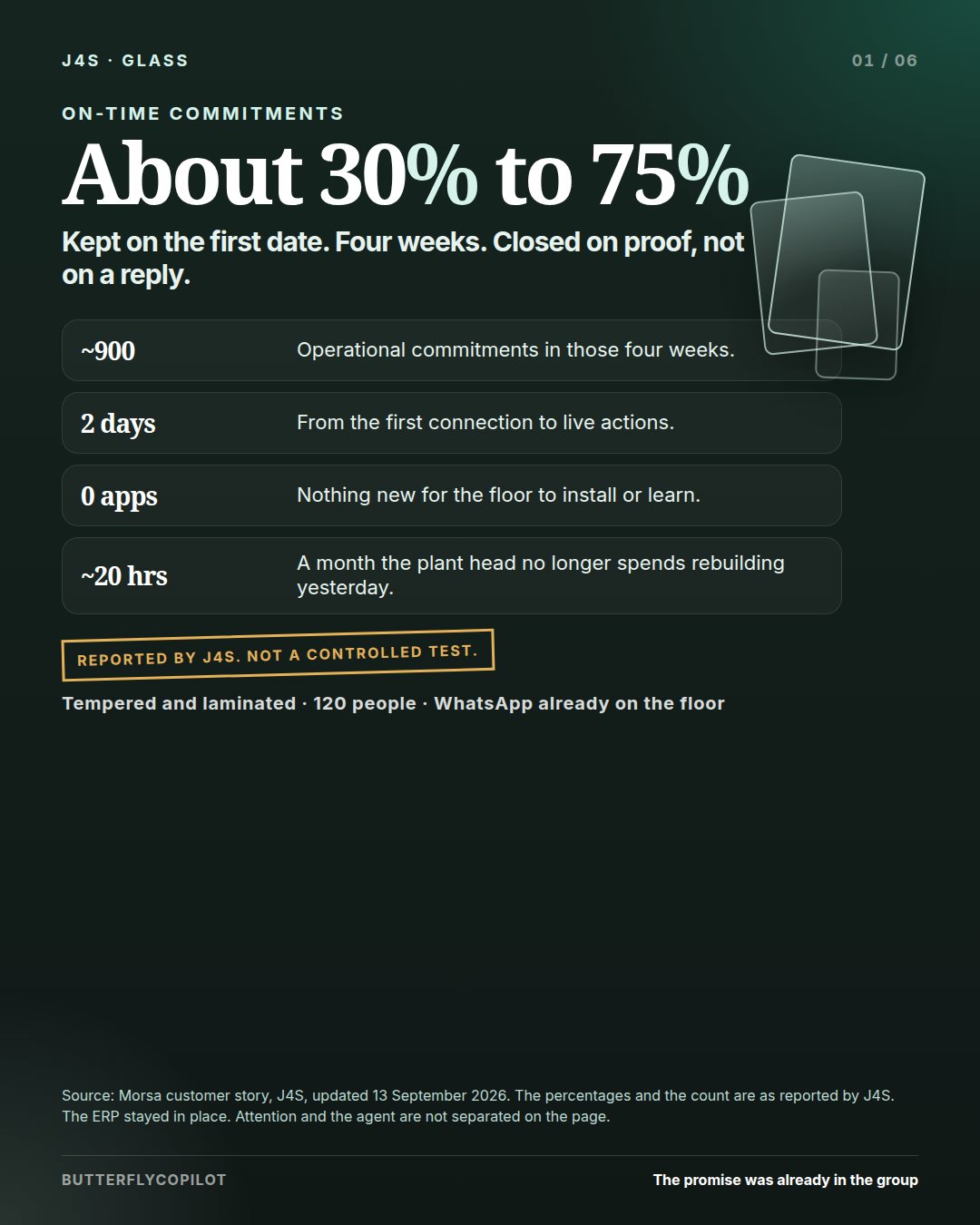
The promise was already in the WhatsApp group. Nobody owned it. On-time completion went from about 30% to about 75%, and a done message still does not close the work.
ButterflyCopilot
0106
The message was already in the group.
J4S runs a glass plant. 120 people. Tempered glass and laminated glass, for architectural customers and for industrial ones. Production, stores, quality, dispatch, maintenance. An ERP held the sales orders, the stock, the purchase orders, and the dispatch. The floor did not work in the ERP. It worked in WhatsApp, one group per department and one per line.
Anil Kohli, the production head, had a word for the first hour. Switchboard. A stores note that the clear stock would last until Wednesday. A question about whether Friday’s dispatch would go. Sales had already told the customer Friday. The notes sat near each other. Connecting them was a person: call stores, call purchasing, walk to the line, tell sales, then do it again for the next change. If nobody connected them, the consequence arrived on its own. A short dispatch. An idle line. A customer on the phone.
“Managers had to figure out what had changed in the plant, and who needed to take what action,” Anil says.
Sunil K Verma, the plant head, used the same hour from the other side of the desk. He reconstructed yesterday. What had been promised. What had moved. What had gone quiet. The review started once the picture was rebuilt from the groups.
They counted. Over one week, every commitment in the groups was checked against the date in the message. Material by Tuesday. Dispatch on Friday. Quality clearance today. Fewer than one in three were completed on that date. The rest were not a refusal. They were forgotten, reassigned in conversation, or finished late by whoever noticed first.
What they refused
The usual answer is a board. A ticket app. A shared sheet. J4S had tried versions. Each one lasted a few weeks. The supervisors’ language was the group, on a phone, at the line. A second place to look lost.
Anil set the condition for anything new. The floor would not be asked to change how it worked. No app for 120 people. No training session. No dashboard a supervisor had to open beside the furnace.
What they stood up
Morsa joined the groups the plant already ran, Production, Stores, Purchase, and Dispatch, and it read the ERP. The first workflow was material availability and dispatch, on one line. Two days, from the first connection to live actions. Day 1 was the connection. The configuration, who owns what, who an idle commitment escalates to, and what counts as proof, sat inside those two days. Day 2 was live. The four weeks of counting start there. The floor was not given a new step.
A change can start in a message or in the ERP. A stores line at night is one signal. A supplier delivery date moving on a purchase order is another, and nobody has to post it for the change to be visible. Both become the same object. An owner. A due time. The orders it touches. A way out if it goes quiet.
A promise in the group, or a date that moved in the ERP
        ↓
Work, with an owner and a due time, and the orders it affects
        ↓
It is posted to the person who can act, in the group they already use
        ↓
Quiet work is nudged, then escalated up the reporting line
        ↓
It closes on a goods receipt, a photo, or a dispatch note
The purchasing commitment does not stay in the stores group that happened to see it. It goes to the purchasing head, in the Purchase group, with the open orders and the dispatch dates on it. Anil’s sentence for the change is specific. If anything changes, in any department, that information goes to the department concerned.
The chase is the part the groups used to do by asking “any update on this?” Idle work is nudged before the due time. Work that stays idle is escalated to the person who can unblock it, not to the whole group, with the consequence written out. Which dispatch. Which customer, when the messages support it. How many pieces, when the ERP actually has the quantity.
It closes when the evidence shows up. A goods receipt in the ERP. A photo of the staged lot. A dispatch note. The story is plain about the alternative. A “done” message does not close it. Before, done meant someone said so.
The page walks one stores message end to end, and it labels the clocks and the order numbers illustrative. Stock enough until Wednesday becomes purchasing’s work, tied to three Line 2 orders that dispatch Thursday and Friday. A nudge. An escalation to the production head. A supplier date that moves, with a note of who moved it and why. A goods receipt. The closure posted back to the groups. Nobody on the floor opened anything but WhatsApp. Those order numbers are not a measurement. The mechanism is the part the page says runs.
In the second week, a purchase-order delivery date had moved twice in the ERP, and nobody in Stores or Production had been told. The lot was due on Line 1 that Thursday. It became a re-plan on Tuesday instead of a stoppage on Thursday. That class of change had always been in the ERP. It had not always been read in time.
A done message is not a receipt
Speed is how a tidy agent hears “done,” closes the row, and lets Friday take care of itself.
The first date stays the first date. The story’s own line for the result is the share closed on the first date given, on proof. A later date, agreed because a supplier slipped, is a real move, and it should carry the name and the reason. It does not rewrite the promise that was counted. A commitment due Tuesday and closed on Wednesday can still leave the Friday dispatch on Friday. It is late against Tuesday. Those are different sentences, and a plant that mixes them will congratulate itself for the wrong one.
“Soon” is not a due time. Neither is an urgent with no day on it. The question goes back to the sender. A photograph closes a quality hold when the quality owner posted it against that commitment. It does not close because a model looked at the glass and felt satisfied. A receipt closes a material commitment when the quantity covers the orders attached to it. A short receipt stays open.
The agent does not write the ERP. J4S did not migrate one, and nobody learned a new screen. It does not message the customer, and it does not message the supplier. Supplier follow-up is what the plant said is next. The week-four resequence, when the float-glass delivery slid three days and Friday still went, was the Line 2 supervisor’s. The agent’s job was that purchasing already owned the slip, and that the note Anil read said it had been handled.
Vivix’s glass work starts when a customer complaint lands on a batch. Different plant, different hour. Footprint’s buyers already have the purchase order and go looking for the acknowledgement. That is the neighbouring desk. It is not this file.
What a smaller plant should steal
If the commitments already live in a group, and a manager still spends the morning joining them up, the first pilot is one line and one workflow. Material and dispatch. Not the whole plant, and not a new app for the floor.
One line
        ↓
Day 1: export the groups and the ERP, and count last week by hand
        ↓
Day 2: owners, proof, and the tests. Replay the week. Post only after a person signs
        ↓
Four weeks: on-time against the first date, and commitments per day
        ↓
A second line later. Supplier chasing is a different file.
J4S was live on day 2, and the four-week count starts at that go-live. Two days is their clock. It is not a promise that an empty owner map finishes on a Thursday. If the tests are red, day 2 does not post.
Time the week you already have. The share of commitments closed on proof by the first date, with the numerator beside the percent. How many opened per day. How many closes arrived on the word done. How many due dates moved, and whether each one has a reason. How many purchase-order dates moved in the ERP before anyone said so in the group. How many messages this agent sent to a customer or a supplier. How many ERP rows it wrote. Those last two stay at zero. After the line is live, time the same things. Those pairs are your result.
The about 30%, the about 75%, the roughly 900, the roughly 400 the page reads off that gap, the about 20 hours a month, and the two days are J4S’s published story. The customer story puts Sunil’s old first hour at about 20 hours a month he no longer spends reconstructing yesterday. The page also says the gain was not a controlled test. Part of it is attention. Once a commitment has a name and a date, people keep more of them, and the two causes are not separated. They did not need them separated. The chasing no longer waits for a manager to notice.
“Our people don’t have to learn any new software. People just message the way they always have. Morsa coordinates all the messages in the background.”
That is Anil, on the part that did not change. It is also the constraint on the file below. The floor does not get a new screen.
What the instruction file will make an agent do
The file below is the brief. It is not Morsa. It is not J4S’s groups, clocks, or ERP. None of that wiring is public. The blanks are yours.
It will make the agent:
- Refuse to run while a
REPLACEline is empty, or while anEXAMPLErow is still in a live sheet. - Read WhatsApp or Teams messages, and ERP tables for sales orders, stock, purchase orders, goods receipts, and dispatch. A phone number on an export is not copied into the commitment.
- Extract a candidate from the message. The model may copy the item, the phrase, and the order text. It may not set the owner, the due instant, the affected orders, or the proof type. Those are code.
- Open work from a stock horizon, a dated promise, a quality hold, or a purchase-order delivery date that moved when nobody had posted it. “Soon” stays a question. A blank quantity is not zero.
- Route to the owner on the map, in that person’s group, with the orders on the pilot line and their dispatch times. Another line is out of the pilot. Two people with the same role do not get a guess.
- Nudge in the owner’s group. Escalate once, in a direct message, to the person they report to, with the orders and the quantities the file actually holds. The illustration’s 1,200 pieces is not a stand-in.
- Move a due time only when the owner, or the production head, states one new instant and a reason. The first date stays the first date. On-time is judged against it.
- Reassign only from the production head, the plant head, or the owner’s manager, with a reason. A model that types the new name has not reassigned anything.
- Close on a goods receipt that covers the demand, a photo hash linked to the commitment and posted by the role that owns the proof, or a dispatch note. A done-only message does not close. There is no tool that looks at the picture.
- Refuse a customer message, a supplier message, an ERP write, and a change to the plan. The supervisor still resequences. Purchasing still talks to the supplier.
- Write a morning file: open, late, quiet, this plant’s on-time percent, and commitments per day. A sentence that imports the case study’s scoreboard is dropped. A real zero, when the denominator is at least one, is allowed. An empty denominator is not stored as zero.
- Stay on one line for four weeks after a day of exports and a day of tests. Posts wait for a signature. The two days are the earliest, not a skip.
The tests are in the file. A horizon that becomes Tuesday at 17:00 under a 24-hour lead, not Tuesday at 12:00 because an illustration said so. A line on another line that is not attached. A late receipt that stays late. A done message that leaves the row open. A short receipt. A soon. A purchase-order move that links to work already open, and one that opens work when the chat never mentioned it. A stores photo that does not clear quality. A planned dispatch that is not a note. A model that tries to sign go-live, write the ERP, or promise the customer. If the agent clears any of those by inventing a date, closing on “done,” or sending a message it was told not to send, the test fails.
The instruction file
The brief has the role, the file connector for whatever ERP already holds the order and the receipt, the message schema, the owner map, the date rules, the nudge and the escalation, the close checks, the morning note, the two days, the four weeks, and the tests that decide when a group may be posted.
Replace every REPLACE line. Delete every EXAMPLE row. Let it sit beside one line’s groups for a week a person still counts by hand, before anyone treats a file as a commitment the floor has already accepted.
Sources
The plant, the quotes, the two days, and the percentages are from Morsa’s J4S customer story, updated 13 September 2026. The figures are as reported by J4S for four weeks. They are not an independent audit, and they are not a forecast for another plant. The story says it was not a controlled test. Two Morsa guides restate the same figures and the same week-four shape. They also describe other plants and other numbers. Those are not this rollout.
- Morsa, “How J4S took on-time completion from 30% to 75% in four weeks, with no new software,” updated 13 September 2026. J4S, a 120-person glass manufacturing plant. Tempered and laminated glass for architectural and industrial customers. People across production, stores, quality, dispatch, and maintenance. WhatsApp groups, one per department and one per line. An ERP for sales orders, stock, purchase orders, and dispatch. First workflow: material availability and dispatch commitments, on one line. On-time completion of operational commitments from about 30% to about 75% in the first four weeks, across roughly 900 commitments, as reported by J4S. The page’s own reading: roughly 400 commitments kept on the date given that the old rate would have slipped, and more than 30 a day. The plant head’s first hour put at about 20 hours a month. Two days from first connection to live actions. No new app, dashboard, or training for the floor. The ERP unchanged. Closed on a goods receipt, a photo, or a dispatch note, not on a done message. Measured against the first date given. Not a controlled test. Part of the improvement is attention. Anil Kohli, Production Head. Sunil K Verma, Plant Head. The walk-through’s order numbers and clocks are labeled illustrative. Supplier follow-up is named as next.
- Morsa, “AI for material shortages in manufacturing,” updated 25 September 2026. Restates the J4S percentages, the roughly 900, the two days, and the week-four shape: a float-glass delivery slid three days, the 21:10 stores message became purchasing’s work at 21:10, the new date was in the group by the next afternoon, and Friday’s dispatch went. The guide’s other plants, prices, and shortage counts are not this case.
- Morsa, “AI copilot for manufacturing,” updated 25 September 2026. Restates the same J4S result and the two sentences used here from Sunil K Verma and Anil Kohli. Describes a six-step loop, a three-tier approval boundary, and a deploy sequence that includes an optional shadow. J4S’s own table is connect, configure, and live, in two days. The guide’s night-shift example and its JRG Automotive figures are not identified as J4S, and this page does not use them.