
How Stölzle Lausitz Cut Glass Scrap 36.5% with AI Agents
One tipped glass on the curve does not stay one glass. Nobody can stand on every curve.
ButterflyCopilot
0106
A glass tipped on the curve at Weißwasser.
It did not stay one glass. Crystal on a moving line has no room for a piece that has fallen over. The next glass hits it. The one behind hits both. The jam is the pile, and the pile is scrap. A glass that only took the stress is scrap as well. It cannot be sold. The break does not have to finish the job. The doubt does.
Stölzle Lausitz has been making drinking glasses in Weißwasser, in Saxony, for more than 130 years. Premium crystal, for hotels and restaurants, for winemakers, for the table at home. About 435 people work at the Weißwasser company. Leopold Grupp is the chief executive. It is a Mittelstand plant: old enough to know the craft, small enough that a bad hour on one line is not a rounding error.
The size is not the lesson. The lesson is a curve, a stacker, and a loading point, all moving, and one pair of eyes.
The operator can stand in one place
The fragile stretch is not the furnace. It is the path the finished glass takes. Transfer curves. Stackers. Loading and unloading. A single piece tips, collides, or shatters. One fallen glass blocks the flow, and the glasses behind it break in turn. Anything stressed comes off the line.
Nobody can watch all of those points. The fault is often visible only after it has already arrived downstream, which is another way of saying the scrap has already been made.
Grupp described the same hour as blockages, fallen glasses, and jams: scrap, stops, and a risk to the people on the line. The goal he set was earlier, and faster. See the disruption while it is still one glass.
One line, then the speakers
They put Cerrion on the cameras the plant already had. Standard CCTV. Not a new vision rig. The agents watch the critical points in real time: a glass that has tipped, a glass that has fallen or been damaged, a jam.
The act is a voice at that station. The alert names the fault and the place, in the operator's own language. The person who can reach the curve is the person who hears it. Every incident is stored with the clip and with structured data, not with a note someone writes at the end of the shift if they remember. On the shop floor the same record is what the team uses for the root cause, the handover, and the improvement that is supposed to stop the next one. The streams the team reviews are anonymised.
They started on one line.
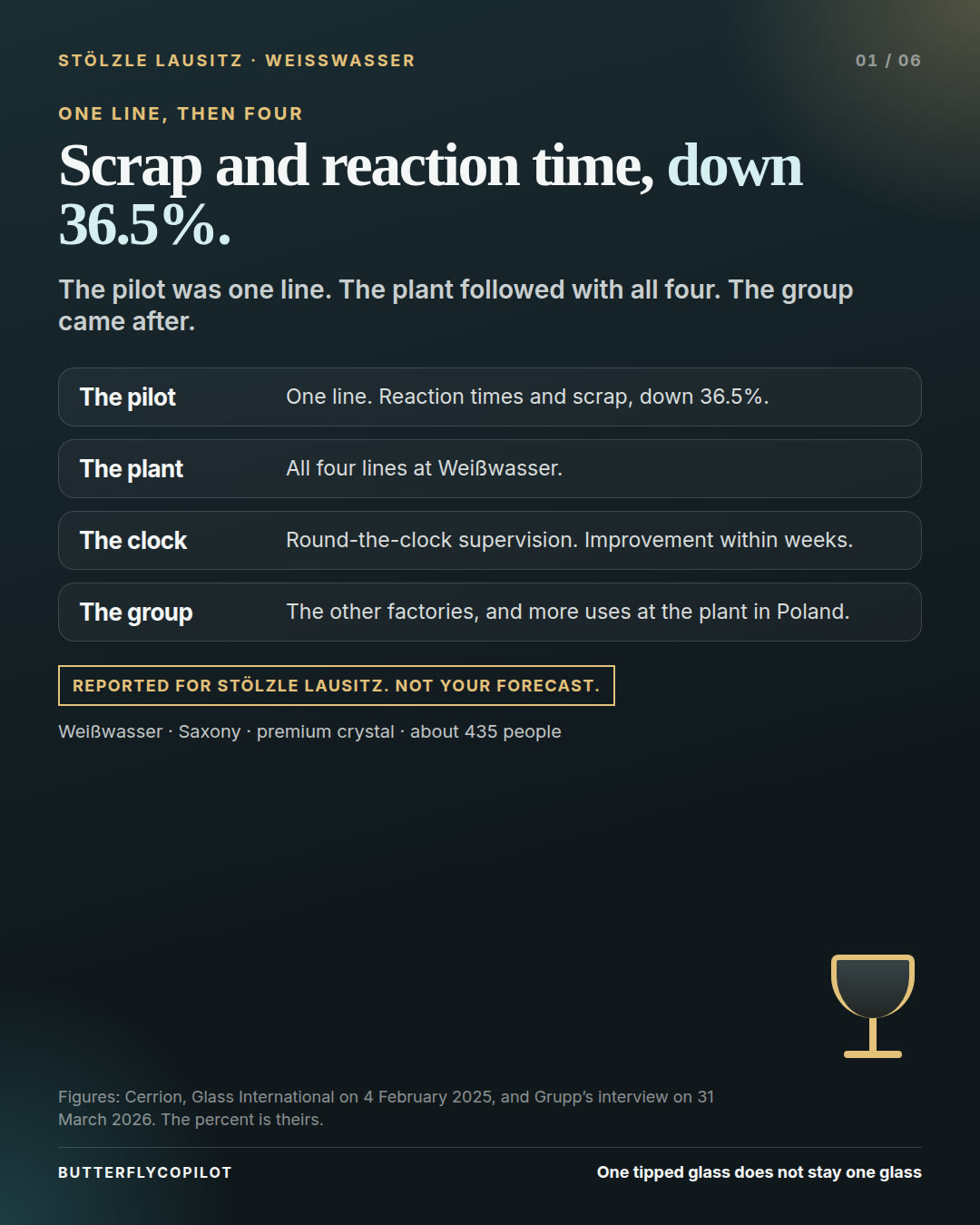
The pilot cut reaction times and scrap by 36.5%. Those figures are the company's and the vendor's. Cerrion's page states the scrap cut the same way, and adds round-the-clock supervision and an improvement that showed within weeks. On the strength of the one line they put the agents on all four lines at Weißwasser. The decision after that was to take the system across the group's factories, and to add further uses at the plant in Poland.
Cerrion has already enabled us to respond much faster to process disruptions, and we are only at the beginning of our work together.
That is Grupp. He also said they were glad to be pioneering this in crystal tableware, and that the work was early.
The part worth stealing is not the percent. It is how the percent got believed. He started on a single line and made the change measurable, which is what brought the teams with him. And he said, from the beginning, that the AI watches the process. It does not watch the people.
The cameras already on the curves, the stackers, the loading points
        ↓
A class the speaker can say: tipped, fallen, jammed
        ↓
The speaker at that station, in the operator's language
        ↓
The clip and the row. A person clears it
        ↓
The shift note and the weekly list. A person names the cause
What a smaller plant should steal
Start with one line. The highest-loss points on that line, not every camera in the building. Grupp's lesson is the whole rollout: measure that line, then earn the next one. Four lines was the result at Weißwasser. It is not the opening move.
Use the CCTV you have. The project that begins with a camera tender is a different project. The one that begins with the curve you already film can be checked against a week of your own scrap.
The speaker is the product. A dashboard in an office, ten minutes later, is the downstream view they were already late for. The sentence has to name the fault and the station, and it has to come from a template. A model that writes a fresh warning will eventually name a person, or invent a count. The operator's language is a setting. The fixture in the file speaks German because the test plant is typed as German. Yours speaks whatever your line actually speaks. Do not copy the German because Saxony speaks it.
A tip that becomes a fall is one incident. That is the cascade: the same glass, worse. A second alarm for the same station teaches the hall to ignore the first. A jam on a different station is a different incident, because a different person has to walk there.
The camera does not know scrap. A stressed glass can be pulled later, off camera, and it still cannot be sold. Scrap per line comes from the counter you already trust. Reaction time is the clock from the alert to the acknowledge. If nobody acknowledges, the time is missing. It is not zero. Incidents per shift are the count of faults the rule opened, not the count of frames.
Do not slow the line from the agent. The published system alarms. It does not, in anything those pages describe, close a contact on the PLC. A slowdown is a safety decision. The file keeps it off until a named safety owner has signed, and even then a timer cannot send it. The line leader cannot send it from this desk either.
Tell the team what the cameras are for before you aim them. Where a works council exists, that conversation is the gate. The file will not arm without a recorded yes. The yes is not a legal opinion. It is the promise Grupp made in plain language: the process, not the people. No score of who was standing nearest. No cause code that names an operator. The clip blurs a person, or it does not get stored.
Faber-Castell put the camera at the end, on a pen that is already a pen. This desk is earlier. The glass is still moving. BASS reads the signals a line already emits. This one reads the pictures a line already takes.
Two weeks to name the line, the stations, and the scrap you already count
        ↓
Two weeks of the cameras you have, and a few hundred labelled clips, speakers off
        ↓
Two weeks of one line speaking. A person clears every incident
        ↓
Two weeks of causes a person assigns. The next line waits for your numbers
        ↓
The case figures stay on the case
Count the stretch you already have. Scrap basis points from your counter, the weeks before beside the weeks after. Median milliseconds from the alert to the acknowledge. Incidents per shift. Stations that had no fresh frame. Automatic slowdowns. Scrap rows that came from the camera. Causes the model assigned. Those last three stay at zero.
The 36.5%, the four lines, the round-the-clock claim, and the "within weeks" are this plant's published story. They are not a line in a proposal. Do not paste them onto yours.
On the fixture, which is ours, a tipped glass on a curve becomes a fall on the same incident, and the speaker says so twice, at that station. A jam on the stacker is a second incident. Nobody clears it, so at 45 seconds the line leader's speaker gets the sentence, and the line does not slow. The loading camera sees a weak tip and stays quiet. Unloading has no picture, so the line is not "clear." Scrap on the fixture is 476 basis points, from 40 pieces out of 840, off a counter. Eighteen seconds is the acknowledge on the curve. None of those numbers is a Weißwasser result. 36.5% is theirs. 476 is our test.
What the instruction file will make an agent do
The file below is the brief. It is not their camera network, their detector, or their speaker wiring. None of that schema is public. The blanks are yours.
It will make the agent:
- Refuse to run while a
REPLACEline is empty, or while a live file still saysEXAMPLEorFIXTURE. Refuse 36.5%, 24/7, and "within weeks" as a setting. Refuse a second line. Refuse to arm until the works-council yes is recorded. - Read RTSP from the cameras you name, over TCP, two stills a second, with the camera's microphone off. A URL that contains a password is refused. A camera with no fresh frame marks that station unwatched, and the line is not clear.
- Take boxes from an object detector, or from an anomaly model that also names a class. An anomaly score with no class does not speak. Three agreeing frames open a tip, a fall, or a break. Five open a jam. A gap in the frames resets the count.
- Keep one open incident per station. A fall upgrades a tip. It does not open another alarm. The sentence is a template, in the operator's language, on that station's speaker.
- Escalate to the line leader's speaker when the plant's own timer runs out. Leave the PLC alone unless the safety owner, on the form, has a signed tag. A model cannot send it. The picture going back to normal does not clear the incident.
- Store the clip window and the row. Blur a person, or hold the clip. Never keep the raw stream. Write the shift note from the rows. Group the week by station. Accept a cause only from the closed list, and only from the line leader. A cause that names a person is refused.
The tests are in the file. The cascade that stays one incident. The jam that escalates and does not slow the line. The weak tip that stays a watch. The blind station that fails the go/no-go. The scrap export the camera is not allowed to replace. The German sentences, which are the fixture's, and the hash they lock. If the agent clears any of those by writing 36.5% into the config, counting scrap off the image, or slowing the line on its own, the test fails.
The instruction file
The brief has the role, the camera map, the RTSP plan, the labelling gate, the event rules, the templates, the escalation, the slowdown sign-off, the shift note, the eight weeks, and the program that has to pass before a speaker is treated as an incident the plant has already cleared.
Replace every REPLACE line. Delete every EXAMPLE row. Let it sit beside one line, speakers off, until the labelled clips and the shadow week agree with what the operators already know is a fault.
Sources
The plant, the line, the cameras, the alarms, the quotes, and the results are from Cerrion, from Glass International, and from Grupp's interview with Fink & Fuchs. The headcount and the street address are from the vocatium exhibitor page. The 36.5%, the four lines, the round-the-clock claim, and the "within weeks" are the company's and the vendor's published figures. None of this is a forecast for another plant.
- Cerrion, "Stölzle Lausitz cuts glassware waste by 36.5%." Premium drinking glasses for the hospitality and consumer markets. Over 130 years of history. Two production facilities. Customers: hotels, restaurants, winemakers, and consumers. The failure mode on the page: on transfer curves, stackers, and loading systems a glass can tip, collide, or shatter; one fallen or damaged glass can jam the flow and cause cascading breakage; any stressed or potentially compromised glass must be scrapped; operators cannot watch every critical point, and incidents are often handled only once they show up downstream. Deployment: Cerrion AI agents on standard CCTV, at stackers, transfer curves, and loading and unloading, on four production lines at Weißwasser, aimed at the highest-loss points. Real-time detection of tipped or damaged glasses and of blockages. Localized audio alerts naming the issue and the location in the operator's native language. Every incident recorded with video and structured anomaly data. Shop-floor applications for root-cause analysis, shift handovers, and continuous improvement. Results stated on the page: 36.5% reduction in waste, also stated as 36.5% reduction in scrap; 24/7 automated line supervision; improved line performance within weeks; two facilities rolling out. The page says a decision followed to roll Cerrion out across all factories in the group and to add use cases at the Polish facility. Leopold Grupp, CEO: "We are glad to be pioneering the world of AI together with Cerrion in the crystal glass tableware sector. Cerrion has already enabled us to respond much faster to process disruptions, and we are only at the beginning of our work together. We are looking forward to what is to come." The page does not name a model, a prompt, a camera count, a timer, or a PLC tag. Its wording of the rollout starts from the four lines. The one-line pilot is the next two sources.
- Glass International, 4 February 2025, Greg Morris, "Stölzle Lausitz expands Cerrion's video AI agents across glass plant." Weißwasser, Germany. The same Grupp quotation. Faults named: transport blockages, fallen and broken glass, and jams, with risks to operator safety, more scrap, and possible equipment damage or fires. The article does not say a fire occurred. Agents on all four production lines. A successful pilot on one production line delivered a 36.5% reduction in reaction times and scrap. The agents monitor through video cameras, detect jams or fallen glasses, and trigger automated responses, including sound alarms. Incident analytics and anonymised video streams for faster resolution and root-cause work.
- Fink & Fuchs, 31 March 2026, "Sichtbarkeit für Innovationen made in Germany: KI-Projekt von Stölzle Lausitz." Interview with Leopold Grupp, Geschäftsführer. The German account of the same project: a pilot on one line cut reaction times and scrap by 36.5 percent ("unsere Reaktionszeiten und den Ausschuss bereits um 36,5 Prozent reduzieren"), then the rollout to all four lines in Weißwasser. Cameras in real time, anomalies such as a glass jam or a fallen glass, immediate alarms, and incident analysis for causes. Grupp on adoption: "Ein entscheidender Erfolgsfaktor war, mit einer einzelnen Linie zu starten und die Verbesserungen messbar zu machen. So konnten wir Vertrauen und Akzeptanz bei den Teams gewinnen. Ebenso wichtig war die transparente Kommunikation: Wir haben von Anfang an klar gemacht, dass die KI die Prozesse überwacht, nicht die Mitarbeitenden." His advice to other Mittelstand firms was to start from a defined operational goal rather than from the technology, and to teach the production teams to use the data. The page describes the company as Mittelstand and the plant as being in Weißwasser, Saxony. It does not name a model or a schema.
- vocatium, "Stölzle Lausitz GmbH, Weißwasser." Exhibitor page. Stölzle Lausitz GmbH, Berliner Straße 22–32, 02943 Weißwasser. Website www.stoelzle-lausitz.com. Beschäftigte: 435. The page says the works has been making glass for 135 years ("seit 135 Jahren"). Cerrion's page says over 130 years. This essay uses "more than 130 years" in the narrative and records both wordings here. The 435 is the exhibitor page's headcount, not a figure from the Cerrion case.